ATHLETE RECOVERYATHLETE RECOVERY
Work hard + Recover Well =
BEST PERFORMANCE
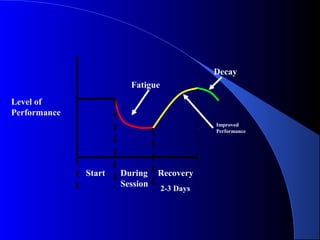
Decay
Fatigue
Level of
Performance
Start
2-3 Days
RecoveryDuring
Session
Improved
Performance
The Principle of RecoveryThe Principle of Recovery
 Athletes need time to adapt to training – this
occurs when the athlete is recovering
 The Overload principle – body is stressed,
fatigues, recovers, stressed etc
 The fresher you are the better the chance to
improve
 Recovery is maximised when fatigue is reduced as
athletes cope more effectively
 Negative adaptation can occur
MONITORING TRAININGMONITORING TRAINING
RESPONSESRESPONSES
Daily Log Book / Self Monitoring sheets
Sleep quality
Morning resting heart rate
Morning body weight
Daily energy rating levels
SIGNS OF NON-SIGNS OF NON-
ADAPTATIONADAPTATION
Sudden drop in body weight (more than
3%)
Sudden increase in morning heart rate
(more than 20%)
Inability to respond to relaxation techniques
Sleep disturbances (+/- 2 hours for 2 days)
Low sleep quality (more than 2 days)
Feeling constantly tired
RESTREST
 Passive rest
 Meditation
 Flotation
 Reading
 Listening to music
 SLEEP
 REST DAYS
 Active rest
 Light walking, jogging,
cycling
 Stretching
 Visualising
 Cross training
 Pool sessions
STRATEGIES FOR SLEEPSTRATEGIES FOR SLEEP
DIFFICULTIESDIFFICULTIES
Practice relaxation before bed – music,
muscle, breathing, visualisation
Lie down to sleep ONLY when you are
tired
If not sleeping within half hour try point 1
If you wake up and cant get back to sleep
try point 1
Get up at the same time each day
FLUID AND FUEL FORFLUID AND FUEL FOR
RECOVERYRECOVERY
It is essential to replace fluid – a loss of 2%
can effect anaerobic output
It is essential to replace fuel – first 20
minutes following exercise is best
FATIGUE FIGHTERSFATIGUE FIGHTERS
CHECKLISTCHECKLIST
Drink, eat, move, stretch and hot/cold
shower following exercise
At the end of the day
– Hot/cold, stretch & self massage, relaxation and
similar techniques
– Monitor how you feel each day
– High intensity trainings require more recovery
time
GUIDELINES FORGUIDELINES FOR
HYDROTHERAPYHYDROTHERAPY
HOW
– Re-hydrate before and after
– Clean skin with soap before and after
– Shower (alternate warm 1 – 2 mins, cold 30 –
60 seconds, repeat 3 times)
– Spa/bath (alternate warm 3 – 4 mins, cold 30 –
60 seconds, repeat 3 times) shower to finish
Showers can be used anytime, baths are best at
the end of the day – do not do if injured
OTHER RECOVERYOTHER RECOVERY
TECHNIQUESTECHNIQUES
 Hydrotherapy
 Sports Massage
 Acupuncture or pressure
 Hyperbaric Oxygenation
Therapy (HBO)
 Psycho-regulatory training
(PRT)
 Meditation
 Progressive muscle
relaxation
 Autogenic training
 Imagery and visualisation
 Breathing
 Restricted Environment
Stimulation Therapy
(REST) and flotation
 Music
 Emotional recovery
PUTTING IT ALL TOGETHERPUTTING IT ALL TOGETHER
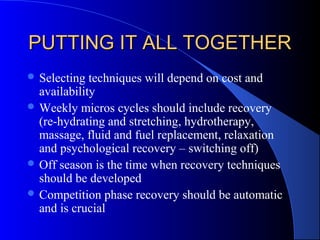
 Selecting techniques will depend on cost and
availability
 Weekly micros cycles should include recovery
(re-hydrating and stretching, hydrotherapy,
massage, fluid and fuel replacement, relaxation
and psychological recovery – switching off)
 Off season is the time when recovery techniques
should be developed
 Competition phase recovery should be automatic
and is crucial
YOU THE ATHLETE ANDYOU THE ATHLETE AND
THE COACH ARETHE COACH ARE
RESPONSIBLE FOR YOURRESPONSIBLE FOR YOUR
OWN RECOVERYOWN RECOVERY
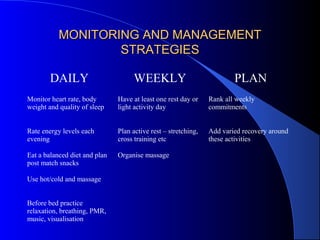
MONITORING AND MANAGEMENTMONITORING AND MANAGEMENT
STRATEGIESSTRATEGIES
DAILY WEEKLY PLAN
Monitor heart rate, body
weight and quality of sleep
Have at least one rest day or
light activity day
Rank all weekly
commitments
Rate energy levels each
evening
Plan active rest – stretching,
cross training etc
Add varied recovery around
these activities
Eat a balanced diet and plan
post match snacks
Organise massage
Use hot/cold and massage
Before bed practice
relaxation, breathing, PMR,
music, visualisation

Athlete recovery

  • 1.
    ATHLETE RECOVERYATHLETE RECOVERY Workhard + Recover Well = BEST PERFORMANCE
  • 2.
  • 3.
    The Principle ofRecoveryThe Principle of Recovery  Athletes need time to adapt to training – this occurs when the athlete is recovering  The Overload principle – body is stressed, fatigues, recovers, stressed etc  The fresher you are the better the chance to improve  Recovery is maximised when fatigue is reduced as athletes cope more effectively  Negative adaptation can occur
  • 4.
    MONITORING TRAININGMONITORING TRAINING RESPONSESRESPONSES DailyLog Book / Self Monitoring sheets Sleep quality Morning resting heart rate Morning body weight Daily energy rating levels
  • 5.
    SIGNS OF NON-SIGNSOF NON- ADAPTATIONADAPTATION Sudden drop in body weight (more than 3%) Sudden increase in morning heart rate (more than 20%) Inability to respond to relaxation techniques Sleep disturbances (+/- 2 hours for 2 days) Low sleep quality (more than 2 days) Feeling constantly tired
  • 6.
    RESTREST  Passive rest Meditation  Flotation  Reading  Listening to music  SLEEP  REST DAYS  Active rest  Light walking, jogging, cycling  Stretching  Visualising  Cross training  Pool sessions
  • 7.
    STRATEGIES FOR SLEEPSTRATEGIESFOR SLEEP DIFFICULTIESDIFFICULTIES Practice relaxation before bed – music, muscle, breathing, visualisation Lie down to sleep ONLY when you are tired If not sleeping within half hour try point 1 If you wake up and cant get back to sleep try point 1 Get up at the same time each day
  • 8.
    FLUID AND FUELFORFLUID AND FUEL FOR RECOVERYRECOVERY It is essential to replace fluid – a loss of 2% can effect anaerobic output It is essential to replace fuel – first 20 minutes following exercise is best
  • 9.
    FATIGUE FIGHTERSFATIGUE FIGHTERS CHECKLISTCHECKLIST Drink,eat, move, stretch and hot/cold shower following exercise At the end of the day – Hot/cold, stretch & self massage, relaxation and similar techniques – Monitor how you feel each day – High intensity trainings require more recovery time
  • 10.
    GUIDELINES FORGUIDELINES FOR HYDROTHERAPYHYDROTHERAPY HOW –Re-hydrate before and after – Clean skin with soap before and after – Shower (alternate warm 1 – 2 mins, cold 30 – 60 seconds, repeat 3 times) – Spa/bath (alternate warm 3 – 4 mins, cold 30 – 60 seconds, repeat 3 times) shower to finish Showers can be used anytime, baths are best at the end of the day – do not do if injured
  • 11.
    OTHER RECOVERYOTHER RECOVERY TECHNIQUESTECHNIQUES Hydrotherapy  Sports Massage  Acupuncture or pressure  Hyperbaric Oxygenation Therapy (HBO)  Psycho-regulatory training (PRT)  Meditation  Progressive muscle relaxation  Autogenic training  Imagery and visualisation  Breathing  Restricted Environment Stimulation Therapy (REST) and flotation  Music  Emotional recovery
  • 12.
    PUTTING IT ALLTOGETHERPUTTING IT ALL TOGETHER  Selecting techniques will depend on cost and availability  Weekly micros cycles should include recovery (re-hydrating and stretching, hydrotherapy, massage, fluid and fuel replacement, relaxation and psychological recovery – switching off)  Off season is the time when recovery techniques should be developed  Competition phase recovery should be automatic and is crucial
  • 13.
    YOU THE ATHLETEANDYOU THE ATHLETE AND THE COACH ARETHE COACH ARE RESPONSIBLE FOR YOURRESPONSIBLE FOR YOUR OWN RECOVERYOWN RECOVERY
  • 14.
    MONITORING AND MANAGEMENTMONITORINGAND MANAGEMENT STRATEGIESSTRATEGIES DAILY WEEKLY PLAN Monitor heart rate, body weight and quality of sleep Have at least one rest day or light activity day Rank all weekly commitments Rate energy levels each evening Plan active rest – stretching, cross training etc Add varied recovery around these activities Eat a balanced diet and plan post match snacks Organise massage Use hot/cold and massage Before bed practice relaxation, breathing, PMR, music, visualisation