EXERCISE PRESCRIPTION
BCKR-PHYSIOTHERAPIST
• Definition:- An exercise prescription is a basic plan or program of activity
designed by professionals to enhance the well-being of a patient.
Many doctors and physiotherapists believe exercise can benefit a host of
debilitating diseases and conditions including:
Asthma
Coronary heart disease
Depression
Diabetes mellitus
Hypertension (high blood pressure)
Decreased bone density
Decreased muscle mass
Osteoarthritis
Peripheral artery disease (PAD)
Obesity
• In addition to prescribing exercise, it is usually recommended that the
client stops smoking, eats a healthier diet featuring more fruits and
vegetables along with good fats, manages stress, and sets a target
body weight as a long-term goal.
• An exercise prescription can take numerous forms, but they all have
four things in common. They follow the FITT principles.
F- FREQUENCY
I-INTENSITY
T-TYPE OF EXERCISE
T-TIME(DURATION OF EXS).
• The gold standard for exercise prescriptions is considered to be
moderate-level aerobic exercise.
• Resistance training involving weights can also be utilized, along with
stretching.
• Exercise prescription should take into account the patient's medical
history, and a pre-examination of a patient's physical fitness to make
sure a person has the capacity to perform the exercises.
Pre-exercise Screening:-
recommend screening to identify cardiovascular risk factors.
Screenings help mitigate the risk for adverse responses to exercise, as
even moderate physical activity can trigger cardiac events in individuals
who are largely sedentary.
• The most commonly used questionnaire is-
1) the PAR-Q(PHYSICAL ACTIVITY READINESS QUESTIONAIRE)
2) Fitness Facility Pre-participation Screening Questionnaire.
Assessment of Exercise Capacity
• Multiple protocols for measuring baseline exercise capacity exist.
• For aerobic capacity, exercise testing falls into 2 categories:
maximal and sub-maximal testing.
• Maximal testing is reserved for assessing the capacity of individuals
who participate in vigorous exercise.
• Sub-maximal testing is adequate for individuals who will only
participate in moderate or low-intensity exercise.
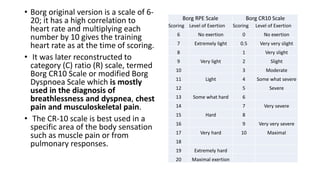
Borg RPE Scale Borg CR10 Scale
Scoring Level of Exertion Scoring Level of Exertion
6 No exertion 0 No exertion
7 Extremely light 0.5 Very very slight
8 1 Very slight
9 Very light 2 Slight
10 3 Moderate
11 Light 4 Some what severe
12 5 Severe
13 Some what hard 6
14 7 Very severe
15 Hard 8
16 9 Very very severe
17 Very hard 10 Maximal
18
19 Extremely hard
20 Maximal exertion
• Borg original version is a scale of 6-
20; it has a high correlation to
heart rate and multiplying each
number by 10 gives the training
heart rate as at the time of scoring.
• It was later reconstructed to
category (C) ratio (R) scale, termed
Borg CR10 Scale or modified Borg
Dyspnoea Scale which is mostly
used in the diagnosis of
breathlessness and dyspnea, chest
pain and musculoskeletal pain.
• The CR-10 scale is best used in a
specific area of the body sensation
such as muscle pain or from
pulmonary responses.
Exercise Prescription-FITT PRINCIPLE
Measure of aerobic intensity include the following:
• Borg Rating of Perceived Exertion Scale (RPE)(0-10scale)
• Target heart rate: Percent of maximum heart rate (HR max) or
Karvonen Formula/Heart Rate Reserve (HRR)
• Metabolic Equivalents (METS)
• Maximum oxygen consumption (VO2 max)
• Each measure has guidelines for what parameters denote vigorous,
moderate, and low intensity exercise.
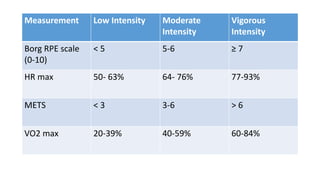
Measurement Low Intensity Moderate
Intensity
Vigorous
Intensity
Borg RPE scale
(0-10)
< 5 5-6 ≥ 7
HR max 50- 63% 64- 76% 77-93%
METS < 3 3-6 > 6
VO2 max 20-39% 40-59% 60-84%
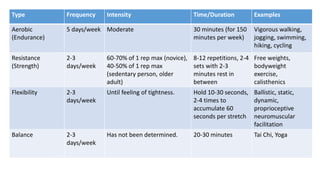
Type Frequency Intensity Time/Duration Examples
Aerobic
(Endurance)
5 days/week Moderate 30 minutes (for 150
minutes per week)
Vigorous walking,
jogging, swimming,
hiking, cycling
Resistance
(Strength)
2-3
days/week
60-70% of 1 rep max (novice),
40-50% of 1 rep max
(sedentary person, older
adult)
8-12 repetitions, 2-4
sets with 2-3
minutes rest in
between
Free weights,
bodyweight
exercise,
calisthenics
Flexibility 2-3
days/week
Until feeling of tightness. Hold 10-30 seconds,
2-4 times to
accumulate 60
seconds per stretch
Ballistic, static,
dynamic,
proprioceptive
neuromuscular
facilitation
Balance 2-3
days/week
Has not been determined. 20-30 minutes Tai Chi, Yoga
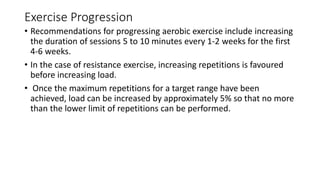
Exercise Progression
• Recommendations for progressing aerobic exercise include increasing
the duration of sessions 5 to 10 minutes every 1-2 weeks for the first
4-6 weeks.
• In the case of resistance exercise, increasing repetitions is favoured
before increasing load.
• Once the maximum repetitions for a target range have been
achieved, load can be increased by approximately 5% so that no more
than the lower limit of repetitions can be performed.
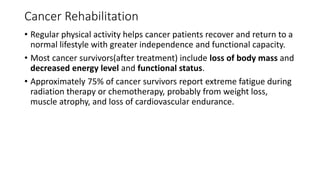
Cancer Rehabilitation
• Regular physical activity helps cancer patients recover and return to a
normal lifestyle with greater independence and functional capacity.
• Most cancer survivors(after treatment) include loss of body mass and
decreased energy level and functional status.
• Approximately 75% of cancer survivors report extreme fatigue during
radiation therapy or chemotherapy, probably from weight loss,
muscle atrophy, and loss of cardiovascular endurance.
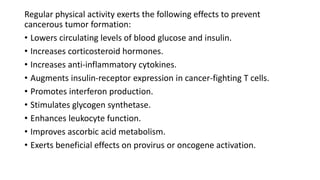
Regular physical activity exerts the following effects to prevent
cancerous tumor formation:
• Lowers circulating levels of blood glucose and insulin.
• Increases corticosteroid hormones.
• Increases anti-inflammatory cytokines.
• Augments insulin-receptor expression in cancer-fighting T cells.
• Promotes interferon production.
• Stimulates glycogen synthetase.
• Enhances leukocyte function.
• Improves ascorbic acid metabolism.
• Exerts beneficial effects on provirus or oncogene activation.
Exercise Prescription for Cancer
• Emphasis should focus on intervals of low-to-moderate aerobic
activity performed several times daily rather than one relatively
strenuous bout of continuous exercise.
• Cancer patients initially receive a symptom-limited, graded exercise
stress test (GXT) on a treadmill or cycle ergometer to form their
exercise prescription.
Aims of Exercise Prescription-
1. To produce ambulation
2. ROM
3. Improve muscle strength & FFM.
4. Improve overall mobility.
• Exercise progression and intensity are individualized, with initial
work–rest ratios of 1:1 increasing to 2:1.
• Eventually, continuous exercise for up to 15 minutes can replace
intermittent exercise bouts.
Aerobic exercise guidelines:-
• Frequency - At least 3–5 times per week; daily activity may be optimal
for deconditioned patients.
• Intensity - Depends on fitness status and GXT results; usually 50–70%
VO2peak; or 60%–80% HRmax; or RPE = 11 to 14.
• Type (mode) - Large muscle group activity, particularly walking and
cycling in some cases
• Time (duration) - 20 to 30 continuous minutes per session; this goal
may have to be achieved through multiple intermittent shorter
sessions with adequate rest intervals.
• Progression – This may not always be linear; rather it may be cyclical
with periods of regression, depending on treatments, etc.
Exercise Prescription Cardiovascular disease
• Prescribing physical activity involves successful integration of exercise science
with behavioral objectives to enhance patient compliance and goal attainment.
Improvements in CHD Patients:-
• A properly prescribed and monitored exercise program safely improves a cardiac
patient’s functional capacity.
• Clinical symptoms (e.g., ECG abnormalities) often improve or disappear.
• This occurs partly from structural and functional changes in the myocardium.
• Cardiac patients and healthy individuals respond to exercise training with
physiologic adjustments that reduce cardiac work at any given external exercise
load.
• For example, reduced exercise heart rate and blood pressure (two major
determinants of myocardial workload and oxygen consumption) reduce
myocardial effort.
• The reduced rate–pressure product (HR SBP) delays the onset of anginal pain and
allows exercise of greater intensity and duration.
• Prescribed exercises usually include rhythmic big-muscle movements
that stimulate cardiovascular improvement; examples include
walking, jogging, cycling, rope skipping, swimming, stair-climbing,
cross-country ski simulation, dynamic calisthenics, and higher-
intensity interval training, even among the elderly and patients with
congestive heart failure.
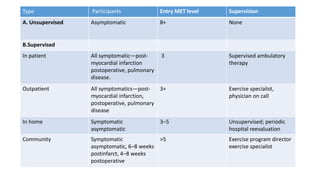
Type Participants Entry MET level Supervision
A. Unsupervised Asymptomatic 8+ None
B.Supervised
In patient All symptomatic—post-
myocardial infarction
postoperative, pulmonary
disease.
3 Supervised ambulatory
therapy
Outpatient All symptomatics—post-
myocardial infarction,
postoperative, pulmonary
disease
3+ Exercise specialist,
physician on call
In home Symptomatic
asymptomatic
3–5 Unsupervised; periodic
hospital reevaluation
Community Symptomatic
asymptomatic, 6–8 weeks
postinfarct, 4–8 weeks
postoperative
>5 Exercise program director
exercise specialist
• Resistance exercises added to a cardiac rehabilitation program
restore muscular strength, promote the preservation of FFM, improve
psychologic status and quality of life, and increase glucose tolerance
and insulin sensitivity.
• Combining resistance training and aerobic training yields more
pronounced physiologic adaptations (improved aerobic capacity,
muscle strength, and lean body mass) in patients with coronary artery
disease than aerobic training alone.
The following six conditions preclude(prevent/impossible) cardiac
patients from participating in resistance training:-
• Unstable angina
• Uncontrolled arrhythmias
• Left ventricular outflow obstruction (e.g., hypertrophic
cardiomyopathy with obstruction)
• Recent history of CHF without follow-up and treatment.
• Severe valvular disease, hypertension (systolic blood pressure 160
mm Hg and/or diastolic blood pressure 105 mm Hg).
• Poor left ventricular function and exercise capacity below 5 METs with
anginal symptoms or ischemic S–T segment depression.
Resistance Training Prescription:-
• Cardiac patients should exercise with light resistance (range of 30 to
50% of 1-RM) because of exaggerated blood pressure responses with
straining-type exercise.
• Do not initiate low-level resistance training until 2 to 3 weeks post-MI.
• Introduce barbells and/or weight machines after 4 to 6 weeks of
Recovery.
• Most cardiac patients begin range-of-motion exercises using relatively
light weights for the lower and upper extremities.
• In accordance with AHA recommendations, they should perform one
set of 10 to 15 repetitions to moderate fatigue, using 8 to 10 different
exercises (e.g., chest press, shoulder press, triceps extension, biceps
curl, lat pull-down, lower back extension, abdominal crunch/curl-up,
quadriceps extension or leg press, leg curl, calf raise).
• Exercises performed 2 to 3 days a week produce favorable
adaptations.
• The RPE should range from 11 to 14 on the Borg scale (“fairly light” to
“somewhat hard”).
• To minimize dramatic blood pressure fluctuations during lifting,
patients should be warned to avoid straining, performing the Valsalva
maneuver, and gripping weight handles or bars tightly.

EXERCISE PRESCRIPTION by PHYSIOTHERAPIST

  • 1.
  • 2.
    • Definition:- Anexercise prescription is a basic plan or program of activity designed by professionals to enhance the well-being of a patient. Many doctors and physiotherapists believe exercise can benefit a host of debilitating diseases and conditions including: Asthma Coronary heart disease Depression Diabetes mellitus Hypertension (high blood pressure) Decreased bone density Decreased muscle mass Osteoarthritis Peripheral artery disease (PAD) Obesity
  • 3.
    • In additionto prescribing exercise, it is usually recommended that the client stops smoking, eats a healthier diet featuring more fruits and vegetables along with good fats, manages stress, and sets a target body weight as a long-term goal. • An exercise prescription can take numerous forms, but they all have four things in common. They follow the FITT principles. F- FREQUENCY I-INTENSITY T-TYPE OF EXERCISE T-TIME(DURATION OF EXS). • The gold standard for exercise prescriptions is considered to be moderate-level aerobic exercise. • Resistance training involving weights can also be utilized, along with stretching.
  • 4.
    • Exercise prescriptionshould take into account the patient's medical history, and a pre-examination of a patient's physical fitness to make sure a person has the capacity to perform the exercises. Pre-exercise Screening:- recommend screening to identify cardiovascular risk factors. Screenings help mitigate the risk for adverse responses to exercise, as even moderate physical activity can trigger cardiac events in individuals who are largely sedentary. • The most commonly used questionnaire is- 1) the PAR-Q(PHYSICAL ACTIVITY READINESS QUESTIONAIRE) 2) Fitness Facility Pre-participation Screening Questionnaire.
  • 5.
    Assessment of ExerciseCapacity • Multiple protocols for measuring baseline exercise capacity exist. • For aerobic capacity, exercise testing falls into 2 categories: maximal and sub-maximal testing. • Maximal testing is reserved for assessing the capacity of individuals who participate in vigorous exercise. • Sub-maximal testing is adequate for individuals who will only participate in moderate or low-intensity exercise.
  • 6.
    Borg RPE ScaleBorg CR10 Scale Scoring Level of Exertion Scoring Level of Exertion 6 No exertion 0 No exertion 7 Extremely light 0.5 Very very slight 8 1 Very slight 9 Very light 2 Slight 10 3 Moderate 11 Light 4 Some what severe 12 5 Severe 13 Some what hard 6 14 7 Very severe 15 Hard 8 16 9 Very very severe 17 Very hard 10 Maximal 18 19 Extremely hard 20 Maximal exertion • Borg original version is a scale of 6- 20; it has a high correlation to heart rate and multiplying each number by 10 gives the training heart rate as at the time of scoring. • It was later reconstructed to category (C) ratio (R) scale, termed Borg CR10 Scale or modified Borg Dyspnoea Scale which is mostly used in the diagnosis of breathlessness and dyspnea, chest pain and musculoskeletal pain. • The CR-10 scale is best used in a specific area of the body sensation such as muscle pain or from pulmonary responses.
  • 7.
    Exercise Prescription-FITT PRINCIPLE Measureof aerobic intensity include the following: • Borg Rating of Perceived Exertion Scale (RPE)(0-10scale) • Target heart rate: Percent of maximum heart rate (HR max) or Karvonen Formula/Heart Rate Reserve (HRR) • Metabolic Equivalents (METS) • Maximum oxygen consumption (VO2 max) • Each measure has guidelines for what parameters denote vigorous, moderate, and low intensity exercise.
  • 8.
    Measurement Low IntensityModerate Intensity Vigorous Intensity Borg RPE scale (0-10) < 5 5-6 ≥ 7 HR max 50- 63% 64- 76% 77-93% METS < 3 3-6 > 6 VO2 max 20-39% 40-59% 60-84%
  • 9.
    Type Frequency IntensityTime/Duration Examples Aerobic (Endurance) 5 days/week Moderate 30 minutes (for 150 minutes per week) Vigorous walking, jogging, swimming, hiking, cycling Resistance (Strength) 2-3 days/week 60-70% of 1 rep max (novice), 40-50% of 1 rep max (sedentary person, older adult) 8-12 repetitions, 2-4 sets with 2-3 minutes rest in between Free weights, bodyweight exercise, calisthenics Flexibility 2-3 days/week Until feeling of tightness. Hold 10-30 seconds, 2-4 times to accumulate 60 seconds per stretch Ballistic, static, dynamic, proprioceptive neuromuscular facilitation Balance 2-3 days/week Has not been determined. 20-30 minutes Tai Chi, Yoga
  • 10.
    Exercise Progression • Recommendationsfor progressing aerobic exercise include increasing the duration of sessions 5 to 10 minutes every 1-2 weeks for the first 4-6 weeks. • In the case of resistance exercise, increasing repetitions is favoured before increasing load. • Once the maximum repetitions for a target range have been achieved, load can be increased by approximately 5% so that no more than the lower limit of repetitions can be performed.
  • 11.
    Cancer Rehabilitation • Regularphysical activity helps cancer patients recover and return to a normal lifestyle with greater independence and functional capacity. • Most cancer survivors(after treatment) include loss of body mass and decreased energy level and functional status. • Approximately 75% of cancer survivors report extreme fatigue during radiation therapy or chemotherapy, probably from weight loss, muscle atrophy, and loss of cardiovascular endurance.
  • 12.
    Regular physical activityexerts the following effects to prevent cancerous tumor formation: • Lowers circulating levels of blood glucose and insulin. • Increases corticosteroid hormones. • Increases anti-inflammatory cytokines. • Augments insulin-receptor expression in cancer-fighting T cells. • Promotes interferon production. • Stimulates glycogen synthetase. • Enhances leukocyte function. • Improves ascorbic acid metabolism. • Exerts beneficial effects on provirus or oncogene activation.
  • 13.
    Exercise Prescription forCancer • Emphasis should focus on intervals of low-to-moderate aerobic activity performed several times daily rather than one relatively strenuous bout of continuous exercise. • Cancer patients initially receive a symptom-limited, graded exercise stress test (GXT) on a treadmill or cycle ergometer to form their exercise prescription. Aims of Exercise Prescription- 1. To produce ambulation 2. ROM 3. Improve muscle strength & FFM. 4. Improve overall mobility.
  • 14.
    • Exercise progressionand intensity are individualized, with initial work–rest ratios of 1:1 increasing to 2:1. • Eventually, continuous exercise for up to 15 minutes can replace intermittent exercise bouts. Aerobic exercise guidelines:- • Frequency - At least 3–5 times per week; daily activity may be optimal for deconditioned patients. • Intensity - Depends on fitness status and GXT results; usually 50–70% VO2peak; or 60%–80% HRmax; or RPE = 11 to 14. • Type (mode) - Large muscle group activity, particularly walking and cycling in some cases
  • 15.
    • Time (duration)- 20 to 30 continuous minutes per session; this goal may have to be achieved through multiple intermittent shorter sessions with adequate rest intervals. • Progression – This may not always be linear; rather it may be cyclical with periods of regression, depending on treatments, etc.
  • 16.
    Exercise Prescription Cardiovasculardisease • Prescribing physical activity involves successful integration of exercise science with behavioral objectives to enhance patient compliance and goal attainment. Improvements in CHD Patients:- • A properly prescribed and monitored exercise program safely improves a cardiac patient’s functional capacity. • Clinical symptoms (e.g., ECG abnormalities) often improve or disappear. • This occurs partly from structural and functional changes in the myocardium. • Cardiac patients and healthy individuals respond to exercise training with physiologic adjustments that reduce cardiac work at any given external exercise load. • For example, reduced exercise heart rate and blood pressure (two major determinants of myocardial workload and oxygen consumption) reduce myocardial effort. • The reduced rate–pressure product (HR SBP) delays the onset of anginal pain and allows exercise of greater intensity and duration.
  • 17.
    • Prescribed exercisesusually include rhythmic big-muscle movements that stimulate cardiovascular improvement; examples include walking, jogging, cycling, rope skipping, swimming, stair-climbing, cross-country ski simulation, dynamic calisthenics, and higher- intensity interval training, even among the elderly and patients with congestive heart failure.
  • 18.
    Type Participants EntryMET level Supervision A. Unsupervised Asymptomatic 8+ None B.Supervised In patient All symptomatic—post- myocardial infarction postoperative, pulmonary disease. 3 Supervised ambulatory therapy Outpatient All symptomatics—post- myocardial infarction, postoperative, pulmonary disease 3+ Exercise specialist, physician on call In home Symptomatic asymptomatic 3–5 Unsupervised; periodic hospital reevaluation Community Symptomatic asymptomatic, 6–8 weeks postinfarct, 4–8 weeks postoperative >5 Exercise program director exercise specialist
  • 19.
    • Resistance exercisesadded to a cardiac rehabilitation program restore muscular strength, promote the preservation of FFM, improve psychologic status and quality of life, and increase glucose tolerance and insulin sensitivity. • Combining resistance training and aerobic training yields more pronounced physiologic adaptations (improved aerobic capacity, muscle strength, and lean body mass) in patients with coronary artery disease than aerobic training alone. The following six conditions preclude(prevent/impossible) cardiac patients from participating in resistance training:- • Unstable angina • Uncontrolled arrhythmias • Left ventricular outflow obstruction (e.g., hypertrophic cardiomyopathy with obstruction)
  • 20.
    • Recent historyof CHF without follow-up and treatment. • Severe valvular disease, hypertension (systolic blood pressure 160 mm Hg and/or diastolic blood pressure 105 mm Hg). • Poor left ventricular function and exercise capacity below 5 METs with anginal symptoms or ischemic S–T segment depression. Resistance Training Prescription:- • Cardiac patients should exercise with light resistance (range of 30 to 50% of 1-RM) because of exaggerated blood pressure responses with straining-type exercise. • Do not initiate low-level resistance training until 2 to 3 weeks post-MI. • Introduce barbells and/or weight machines after 4 to 6 weeks of Recovery.
  • 21.
    • Most cardiacpatients begin range-of-motion exercises using relatively light weights for the lower and upper extremities. • In accordance with AHA recommendations, they should perform one set of 10 to 15 repetitions to moderate fatigue, using 8 to 10 different exercises (e.g., chest press, shoulder press, triceps extension, biceps curl, lat pull-down, lower back extension, abdominal crunch/curl-up, quadriceps extension or leg press, leg curl, calf raise). • Exercises performed 2 to 3 days a week produce favorable adaptations. • The RPE should range from 11 to 14 on the Borg scale (“fairly light” to “somewhat hard”). • To minimize dramatic blood pressure fluctuations during lifting, patients should be warned to avoid straining, performing the Valsalva maneuver, and gripping weight handles or bars tightly.