Neurological
System
Examination
What and When?
Presented by-
Dr. Md. Sanaullah Khan
Honorary Medical Officer,
Dept. of Medicine, MU-VII
Dhaka Medical College Hospital, Dhaka
E-mail: sani17k65@gmail.com
What are the points of NSE ?
• Higher Psychic Function
• Cranial nerve examinations including
fundoscopy
• Examinations of motor system
• Cerebellar functions tests
• Examinations of sensory system
• Signs of meningeal irritation
• Examination of Gait
Higher Psychic Function
• Appearance
- attire, facial expression
• Behaviour
- co-operation, rapport, eye contact
- over-activity, under-activity
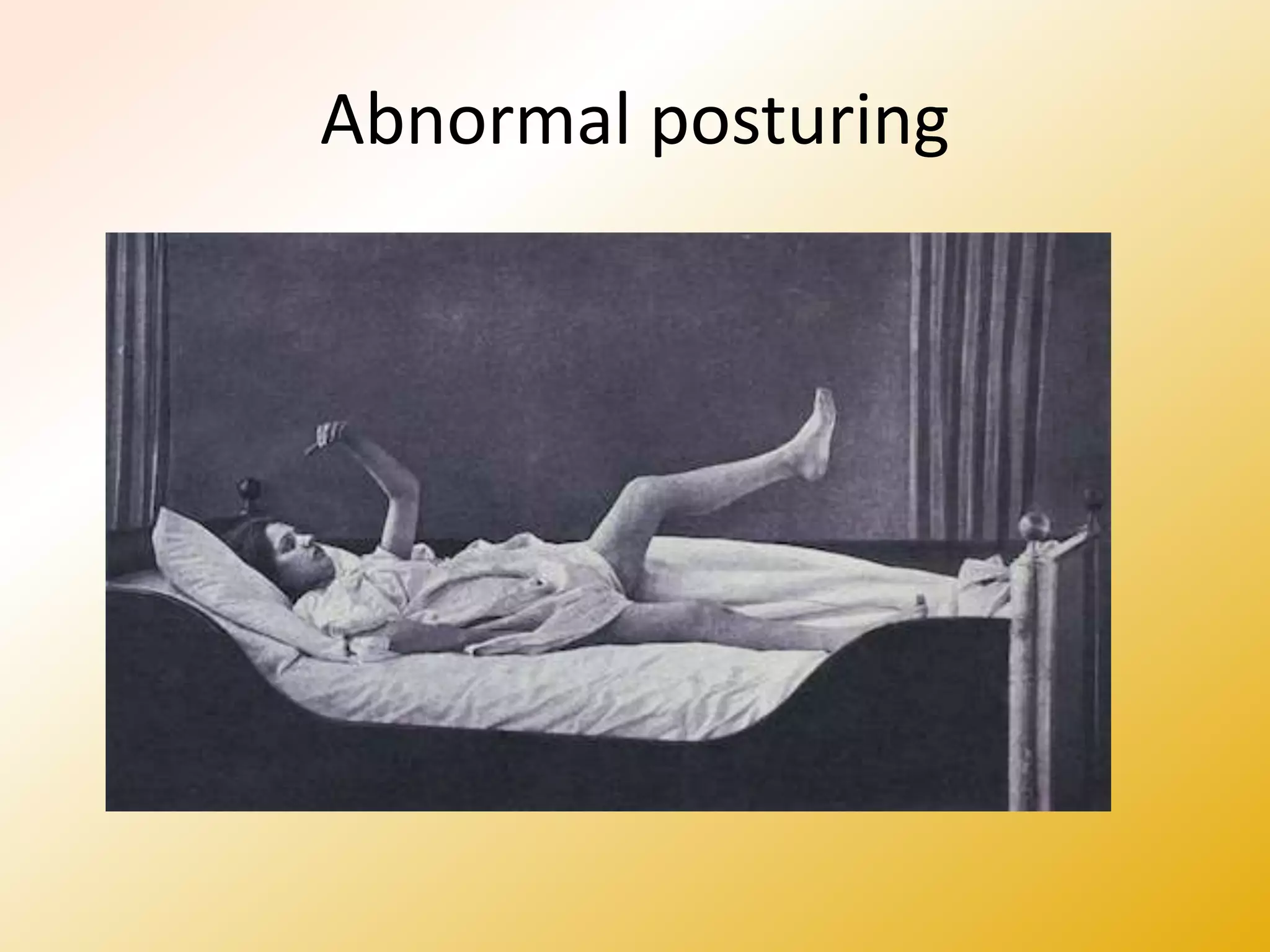
- abnormal posturing
Abnormal posturing
Abnormal posturing
Higher Psychic Function
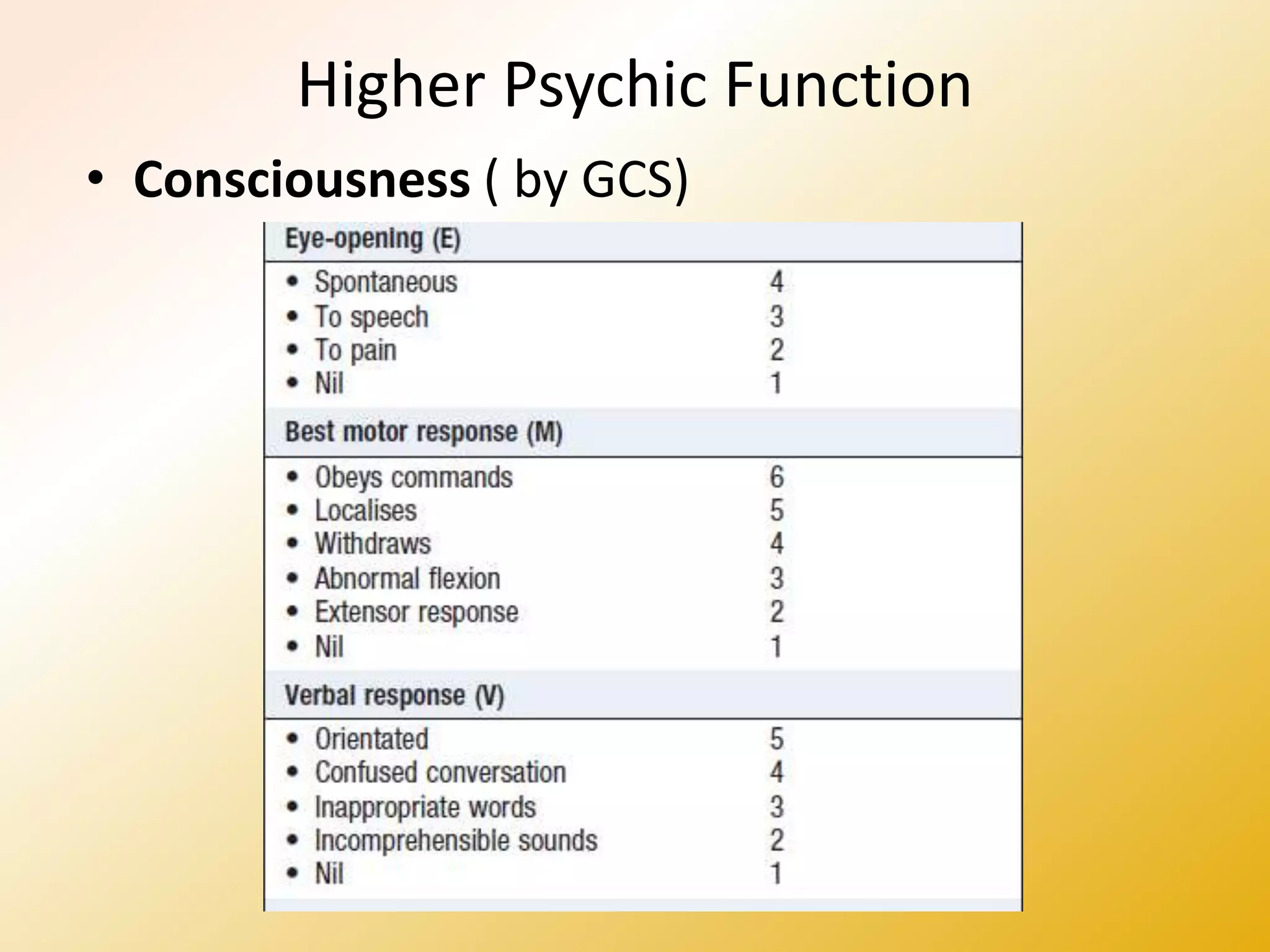
• Consciousness ( by GCS)
Higher Psychic Function
• Mental state examination
- Mood/ affect :
? depressed, elated, anxious, fearful,
angry, suspicious, irritable, perplexed
? Congruous/ incongruous
A. I’m depressed B. I’m so happy
Higher Psychic Function
• Mental state examination
- Thought form:
? Pressure of thought, flight of ideas, loosening
of association, perseveration, concrete thinking
- Thought content:
? Phobia, Obsession, Hypocondriasis, Delusion,
Passivity phenomenon (thought broadcasting/
insertion/withdrawl)
???
???
Higher Psychic Function
• Mental state examination
- Cognitive function:
? Orientation
? Memory:
* working memory : objects or number
* short term memory: retention of naming
of objects after 5 min
* Long term memory: personal history
Higher Psychic Function
• Mental state examination
- Cognitive function:
? Intelligence :
* educational attainment
* occupation
* abstract thinking and understanding
? Insight
? Psychiatric rating scale ( abbreviated mental
test or MMSE)
Abbreviated mental test
M
M
S
E
Higher Psychic Function
• Speech:
- Problem in content (mutism, neologism,
pressure of speech, echolalia etc.)
- Difficulty in speech:
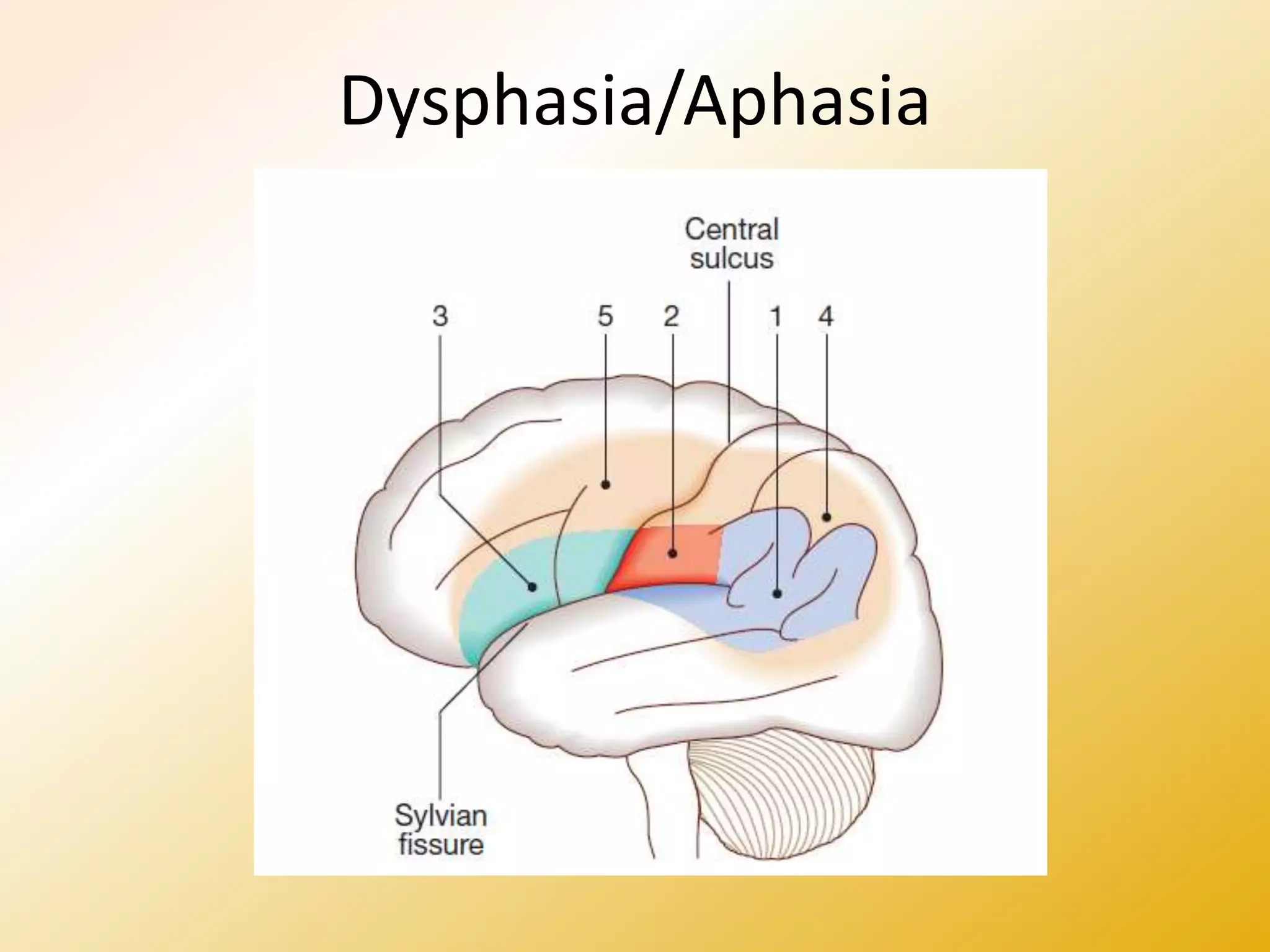
* Dysphasia
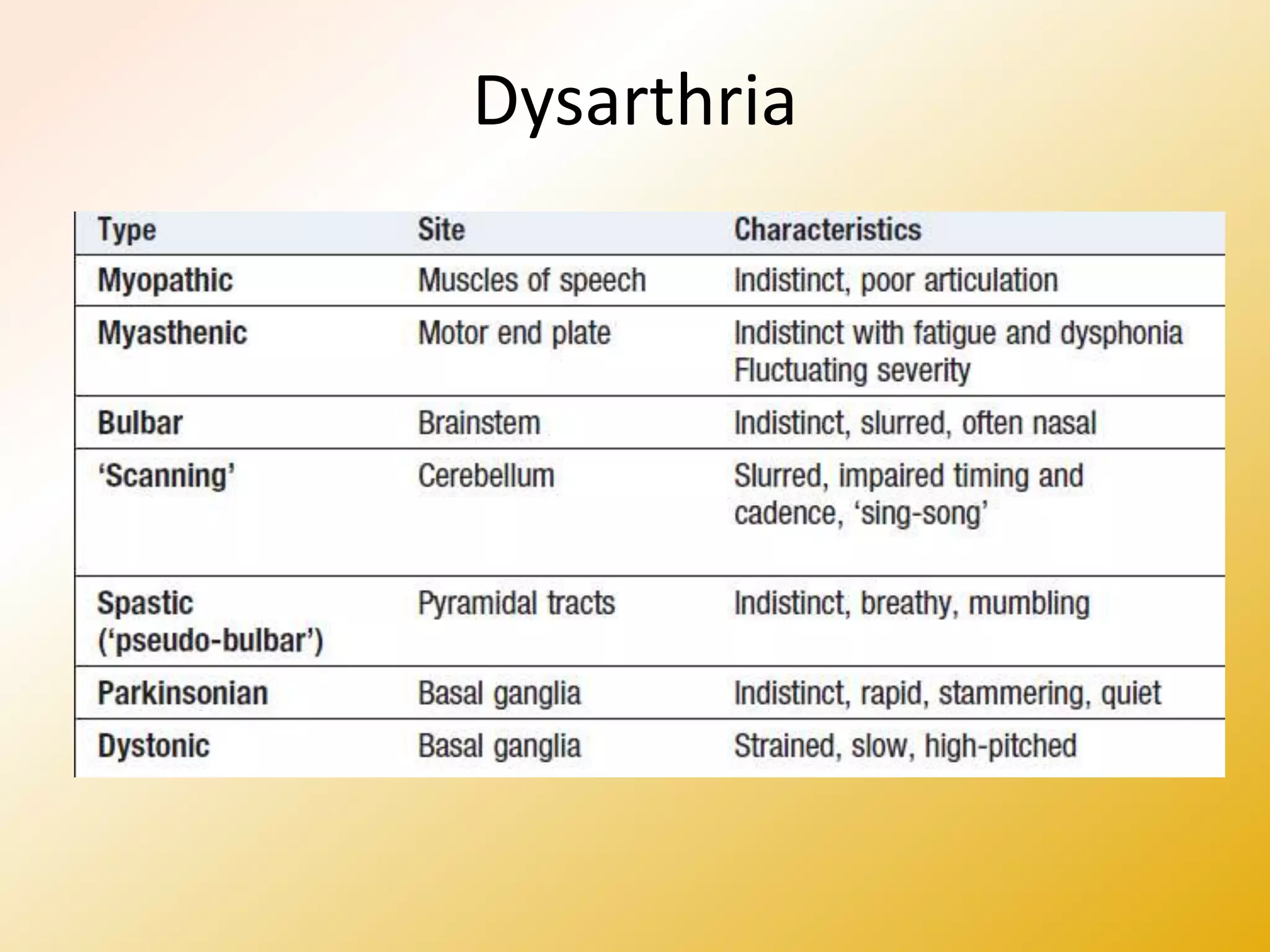
* Dysarthria
* Dysphonia
Dysarthria
Dysphasia/Aphasia
Cranial nerve examination
• Cranial nerve-I:
Sense of smell
- coffee, chocolate, soap or orange peel
• Cranial nerve-II:
Visual acuity
- For distant vision: Snellen chart ( 6 m
distance, each eye separate)
- finger counting, hand movement, perception
of light, projection of rays
- For near vision: test card held at comfortable
reading distance
Cranial nerve examination
• Cranial nerve-II:
Visual acuity
- For macular
function:
Amsler grid
Cranial nerve examination
• Cranial nerve-II:
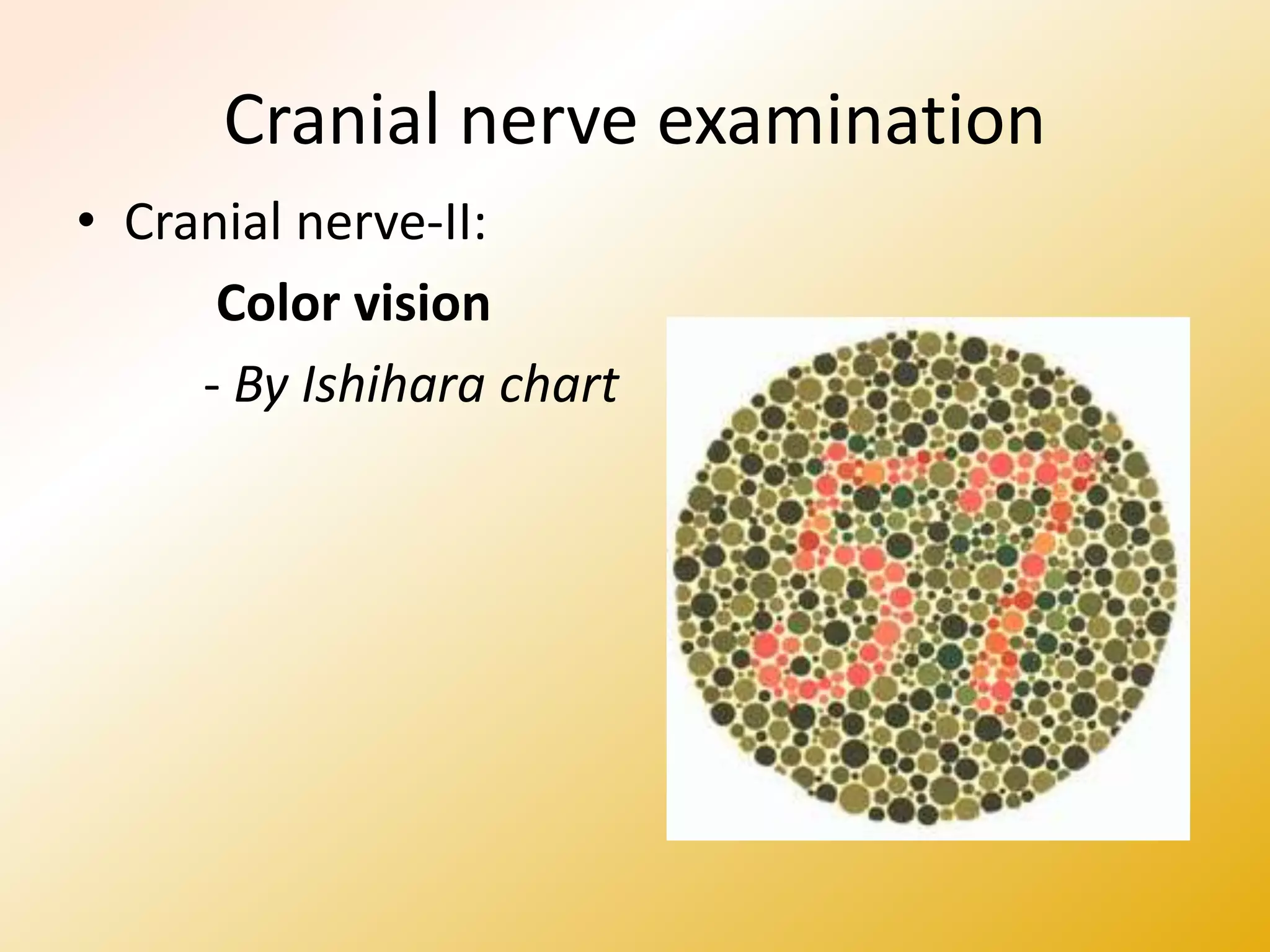
Color vision
- By Ishihara chart
Cranial nerve examination
• Cranial nerve-II: Field of vision
CN-II : optic nerve examination
• Test of central scotoma
• Light reflex (Direct or consensual)
• Opthalmoscopy
Cranial nerve examination
• Cranial nerve-III, IV & VI:
? Any ptosis or squint
- Occular movements
* H pattern
* Any nystagmus or diplopia at
extreme gaze ?
- Light reflex
- Accomodation reflex
??? Dx
Cranial nerve examination
• Cranial nerve-V:
- Motor:
* ? Wasting of masseter or temporalis
* Clenching of teeth
* Opening of jaw against resistance
* Jaw jerk
- Sensory:
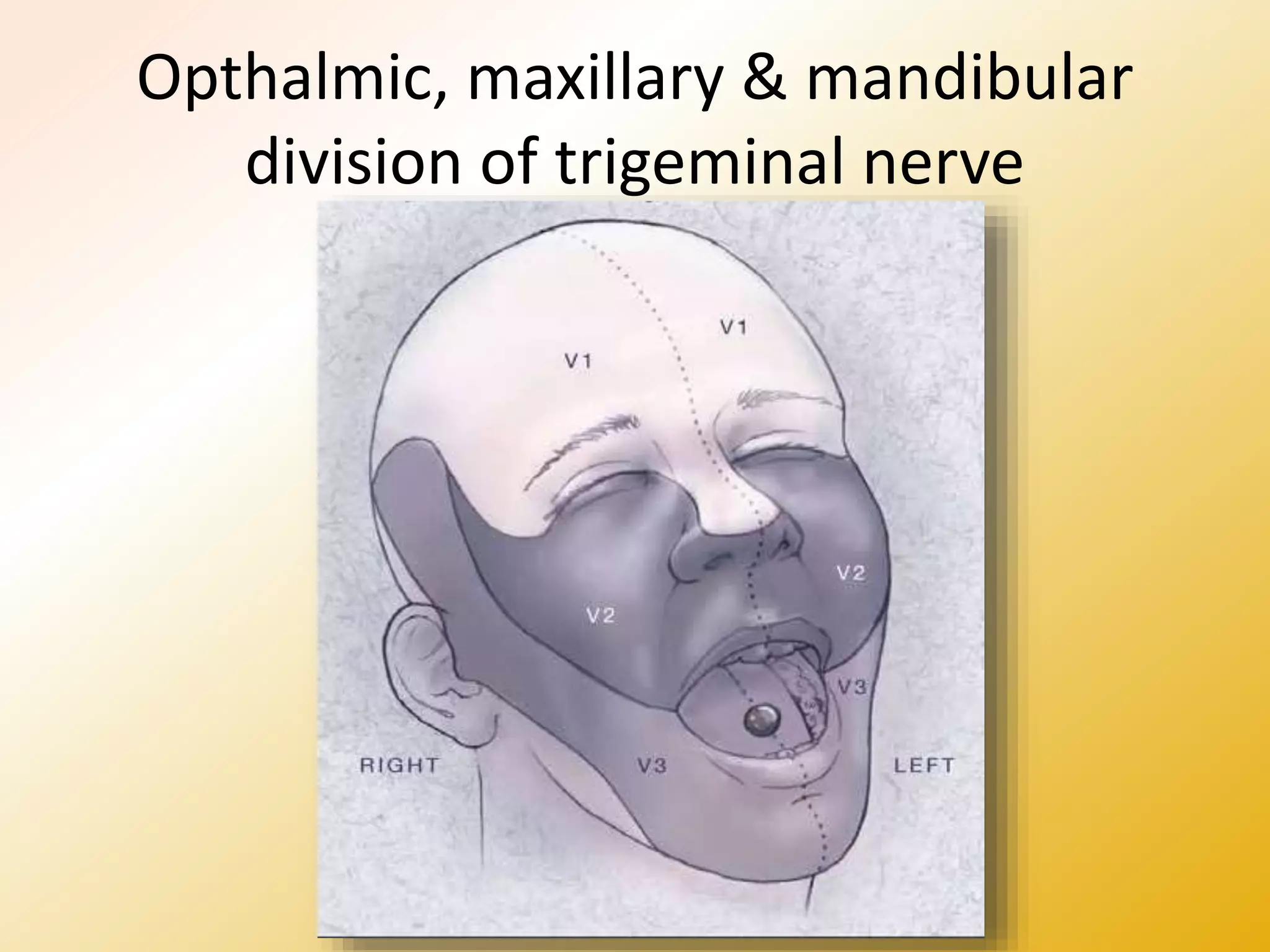
* Test along the 3 divisions
* Corneal reflex
Jaw jerk and Corneal reflex
Opthalmic, maxillary & mandibular
division of trigeminal nerve
Cranial nerve examination
• Cranial nerve-VII:
- Motor: Look
Cranial nerve examination
• Cranial nerve-VII:
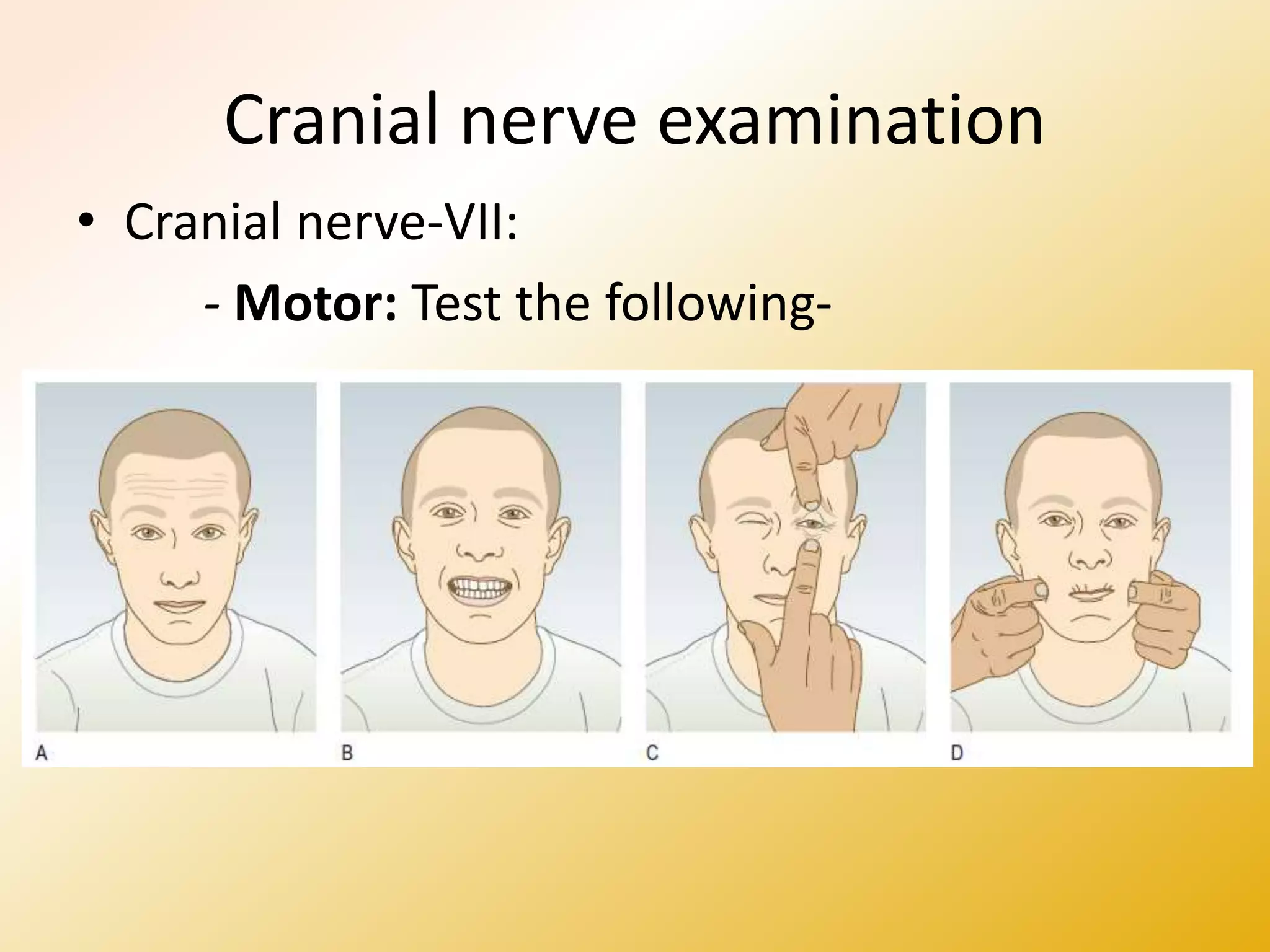
- Motor: Test the following-
Cranial nerve examination
• Cranial nerve-VII:
- Taste sensation: anterior 2/3 of the
tongue
- Look at external auditory meatus and
palate
- Test for hyperacusis ( nerve to stapedius
muscle)
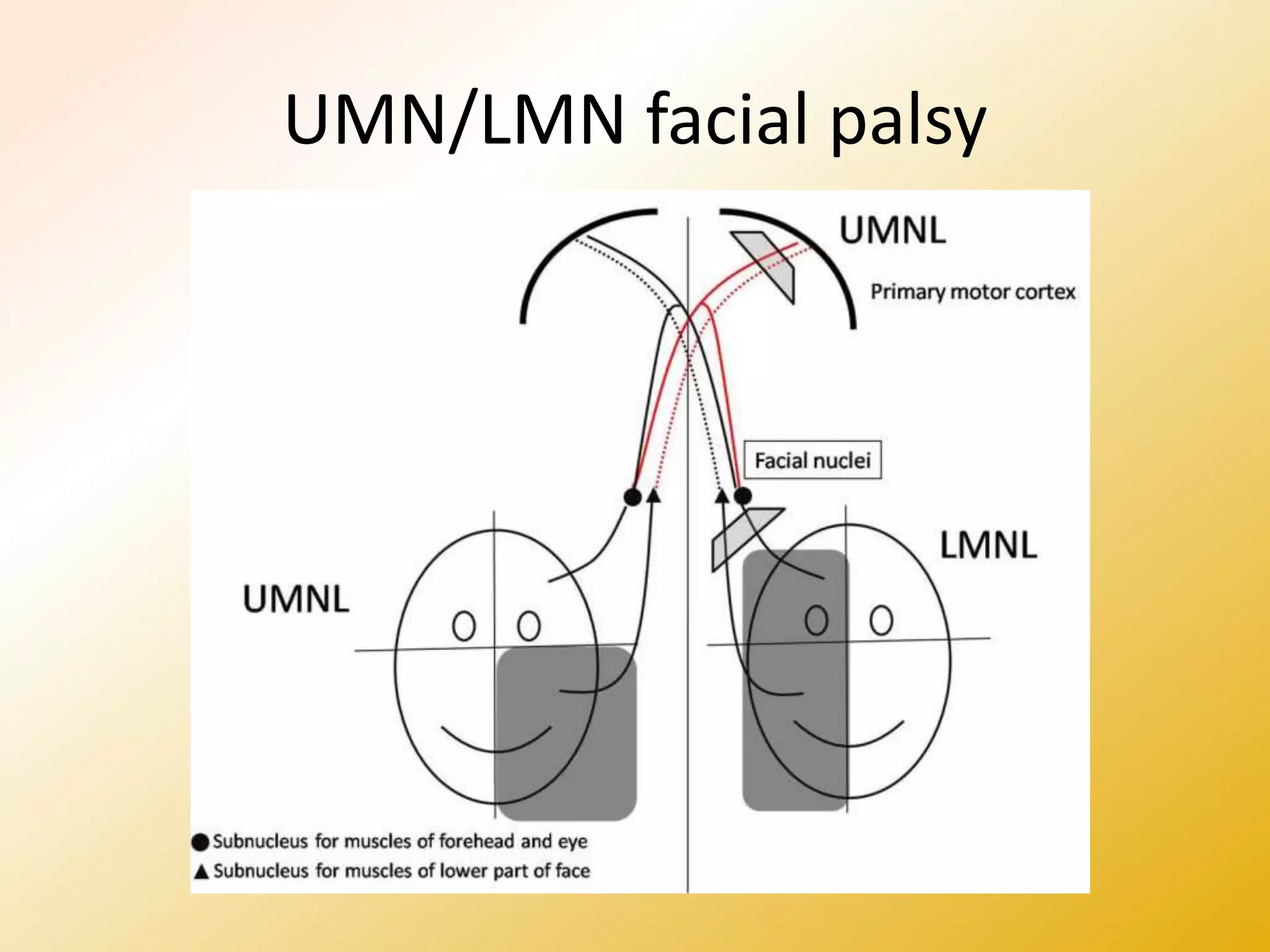
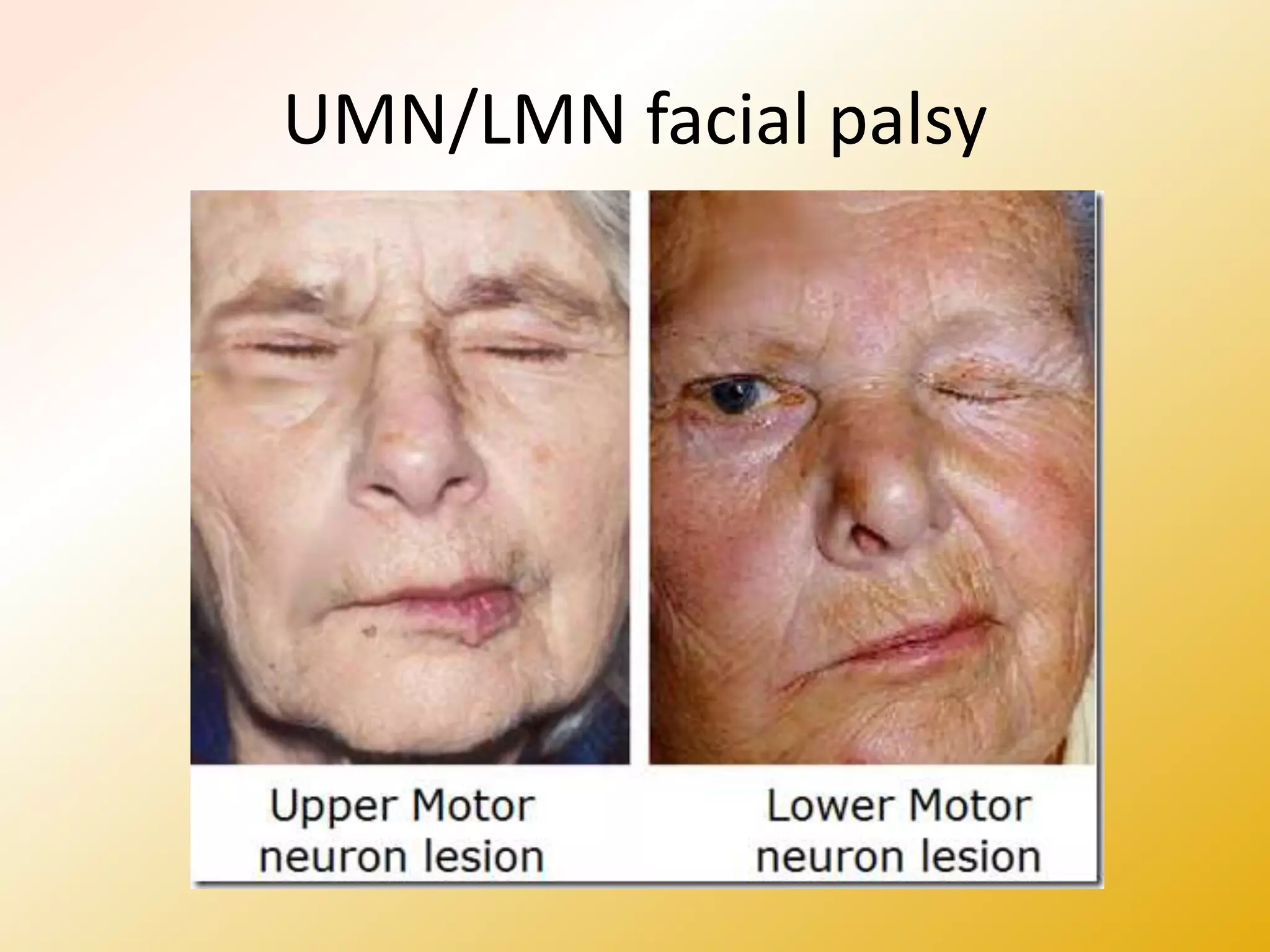
UMN/LMN facial palsy
???
Cranial nerve examination
• Cranial nerve-VIII: Test for hearing
- Whispered voice test
- Weber test & Rinne’s test (512/256 Hz)
Weber test:
Condition Interpertation
Lateralizes Ipsilateral conductive deafness
Contralateral sensory deafness
Not lateralizes No hearing abnormality
Bilateral hearing abnormality
Rinne’s test:
Condition Interpertation
Positive
(AC>BC)
Normal
Negative
(BC>AC)
Ipsilateral conductive deafness
Cranial nerve examination
• Cranial nerve-VIII: Test for vestibular function
- Testing for nystagmus
? Horizontal/ vertical/ rotatory
? Jerky or pendular
? Direction of fast phase
? Unidirectional/ bidirectional
? Disconjugate/ Ataxic nystagmus
- Dix- Hallpike positional test
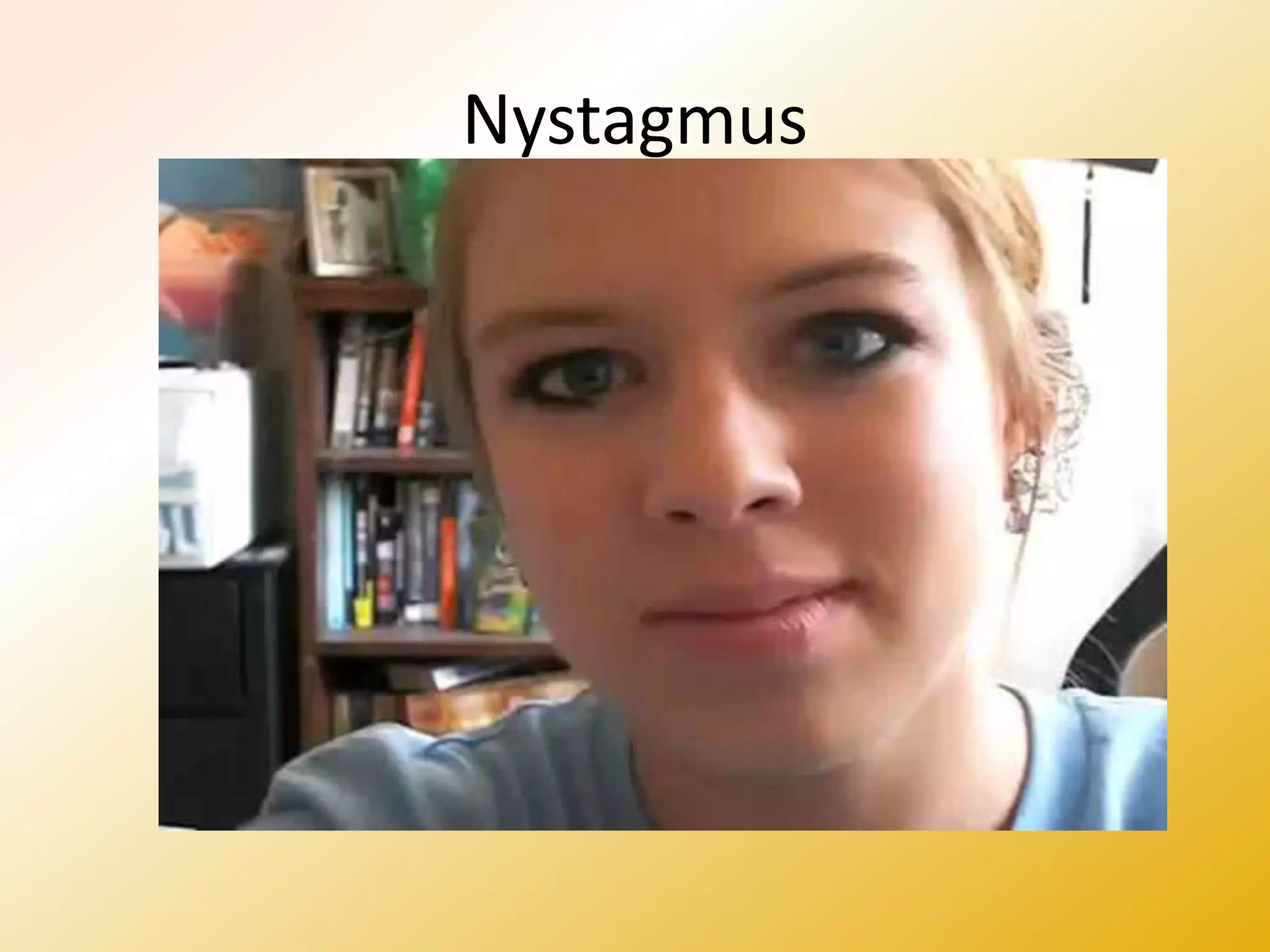
Nystagmus
Nystagmus
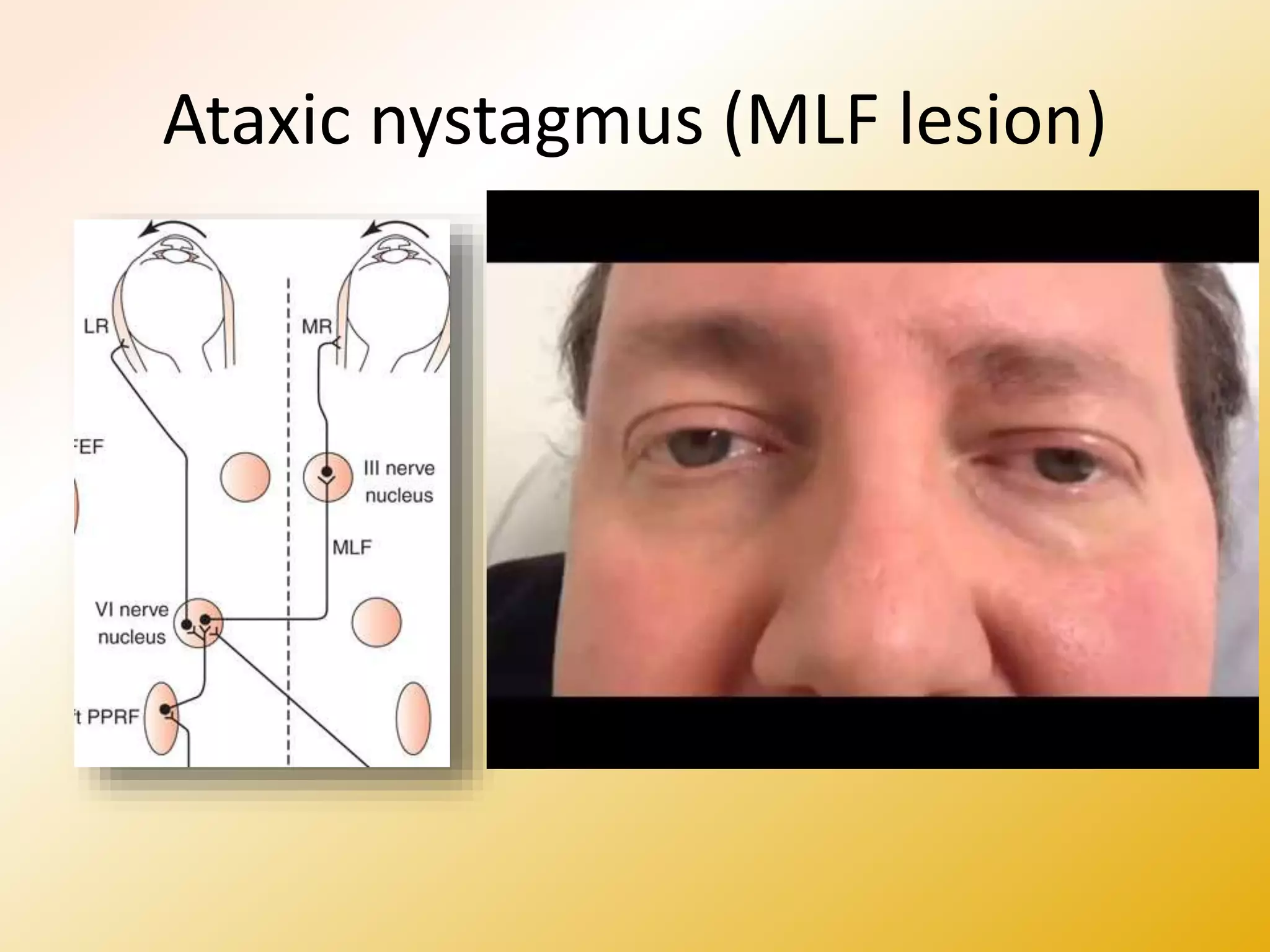
Ataxic nystagmus (MLF lesion)
Dix-Hallpike test
Cranial nerve examination
• Cranial nerve-IX & X:
? Any nasal voice/hoarseness/ nasal regurgitation
- Movement of palate
? Open the mouth and say ‘ahh’
- Cough test
- Gag reflex
- Water swallow test
- Taste sensation: ( post. 1/3 of tongue )
Cranial nerve examination
• Cranial nerve- XI:
- Inspection and palpation of sternocleidomastoid
and trapezius
- Shrugging of shoulder
- Test for sternocleidomastoid (fig-B)
Cranial nerve examination
• Cranial nerve- XII:
- Open the mouth and Inspect the tongue
? any wasting, fasciculation, small, spastic
tongue
- Ask the patient to put out of the tongue
? Any deviation or unable to put out
- Side to side movement of the tongue
Cranial nerve examination
• Cranial nerve- XII:
- Test power:
ask the patient to press the tongue against
the inside of each cheek while the
examiner press from outside with fingers
- Speech:
ask to say ‘yellow lorry’
- Assess swallowing:
water swallow test
Examinations of motor system
- Inspection: Any wasting, fasciculation or
involuntary movements
- Bulk of the muscle
- Tone of the muscle:
* Passive movement of joints/ rolling of
limbs/ falling of limbs against gravity
? Flaccid, spastic, rigid
* Knee and ankle clonus (Fig B & C below)
Clonus
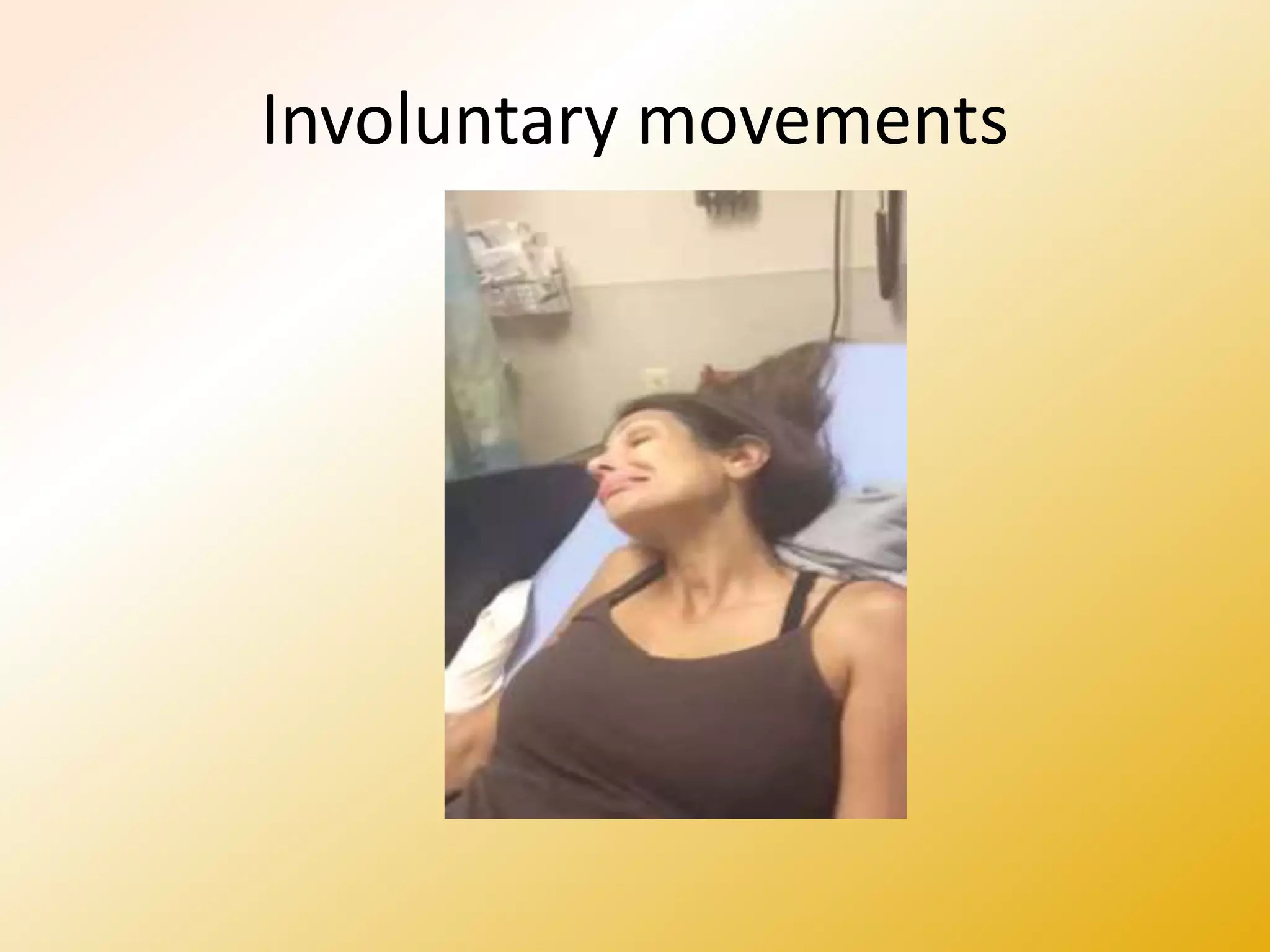
Involuntary movements
Examinations of motor system
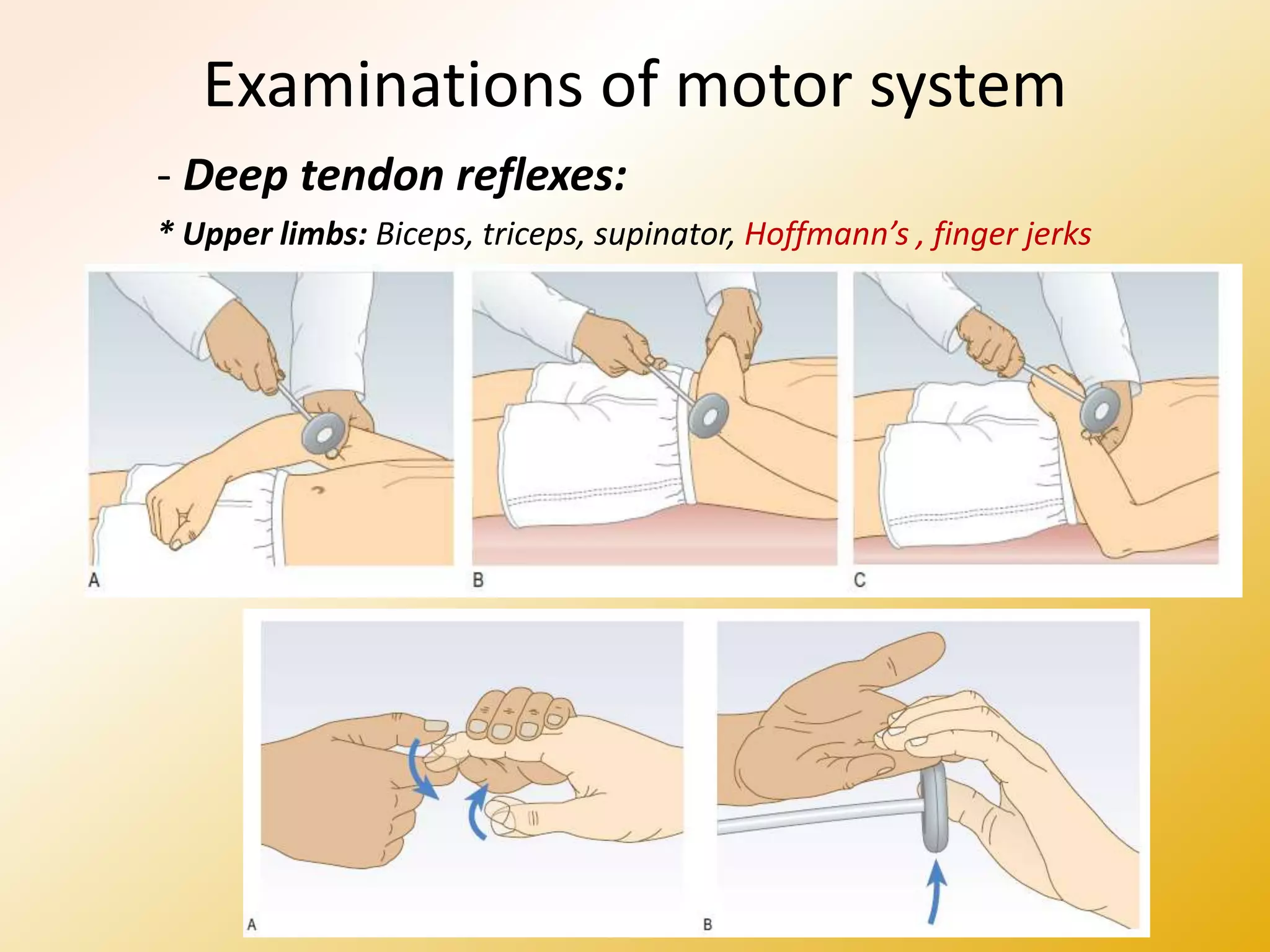
- Deep tendon reflexes:
* Upper limbs: Biceps, triceps, supinator, Hoffmann’s , finger jerks
Examinations of motor system
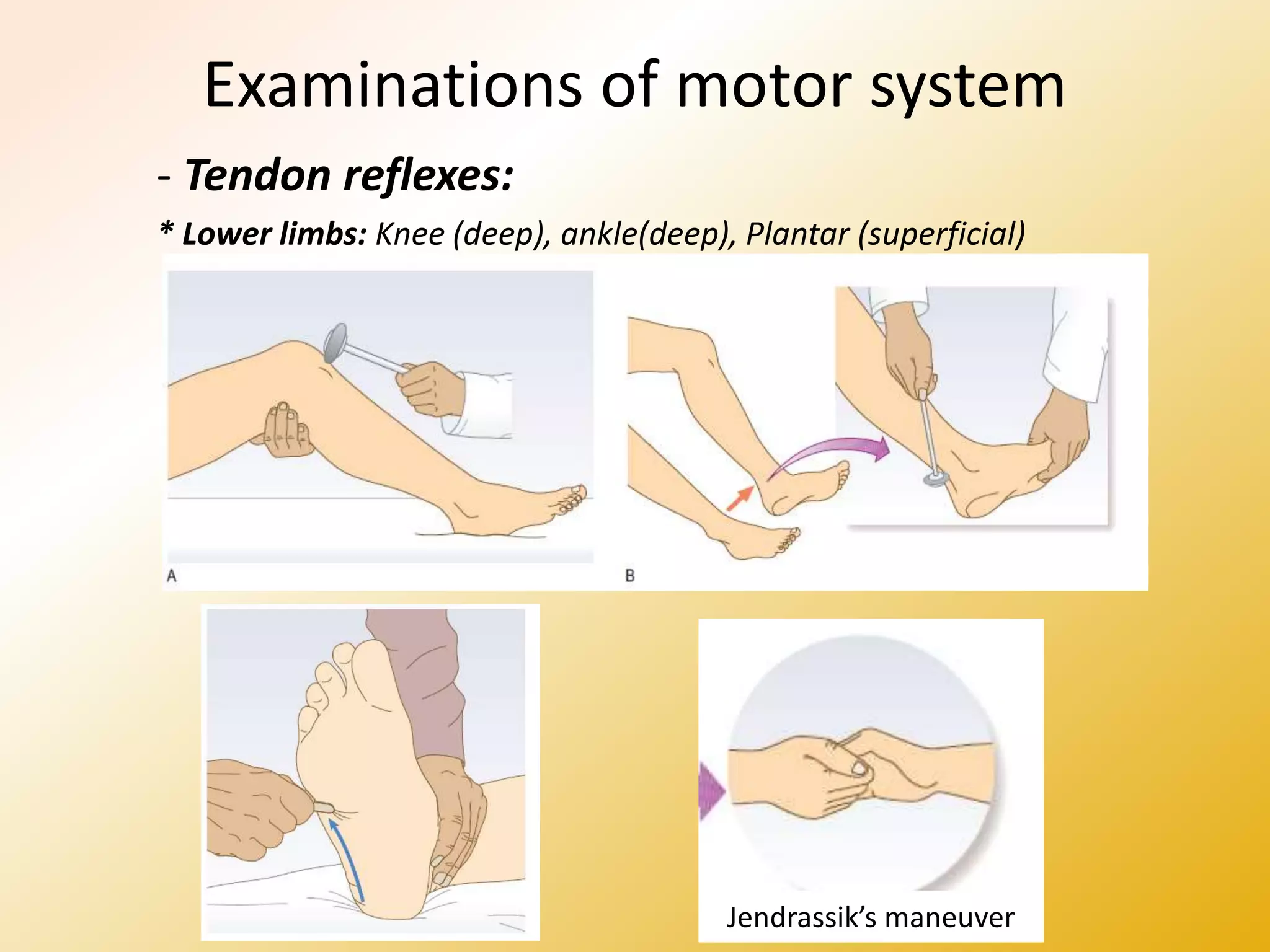
- Tendon reflexes:
* Lower limbs: Knee (deep), ankle(deep), Plantar (superficial)
Jendrassik’s maneuver
Examinations of motor system
? Gordon’s sign
? Oppenheim’s sign
- Deep tendon reflexes:
Record the responses as-
Response How to write
Increased +++
Normal ++
Diminished +
Absent -
Only present after
reinforcement
±
Examinations of motor system
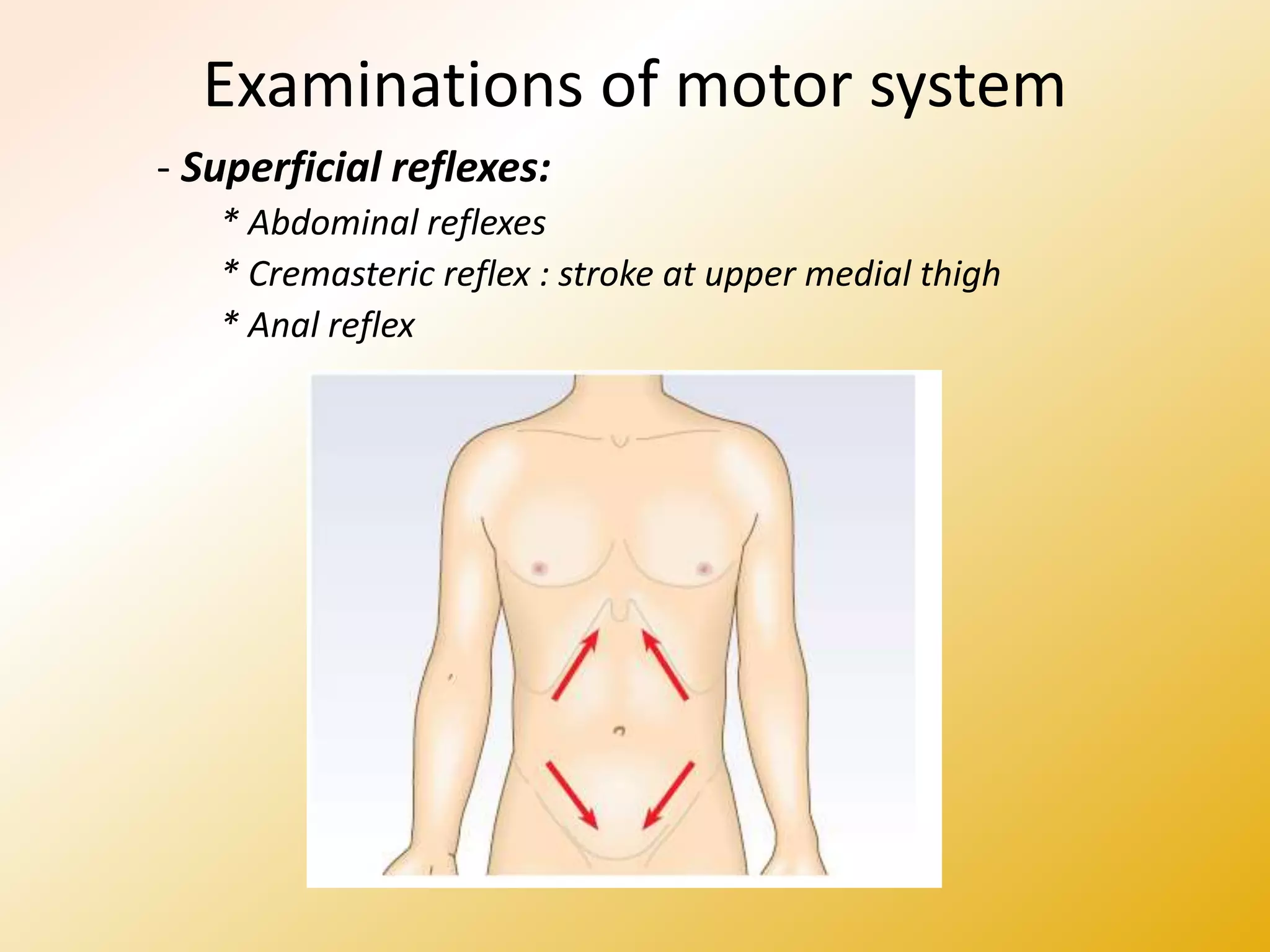
- Superficial reflexes:
* Abdominal reflexes
* Cremasteric reflex : stroke at upper medial thigh
* Anal reflex
Examinations of motor system
- Muscle power:
Medical Research Council (MRC) scale
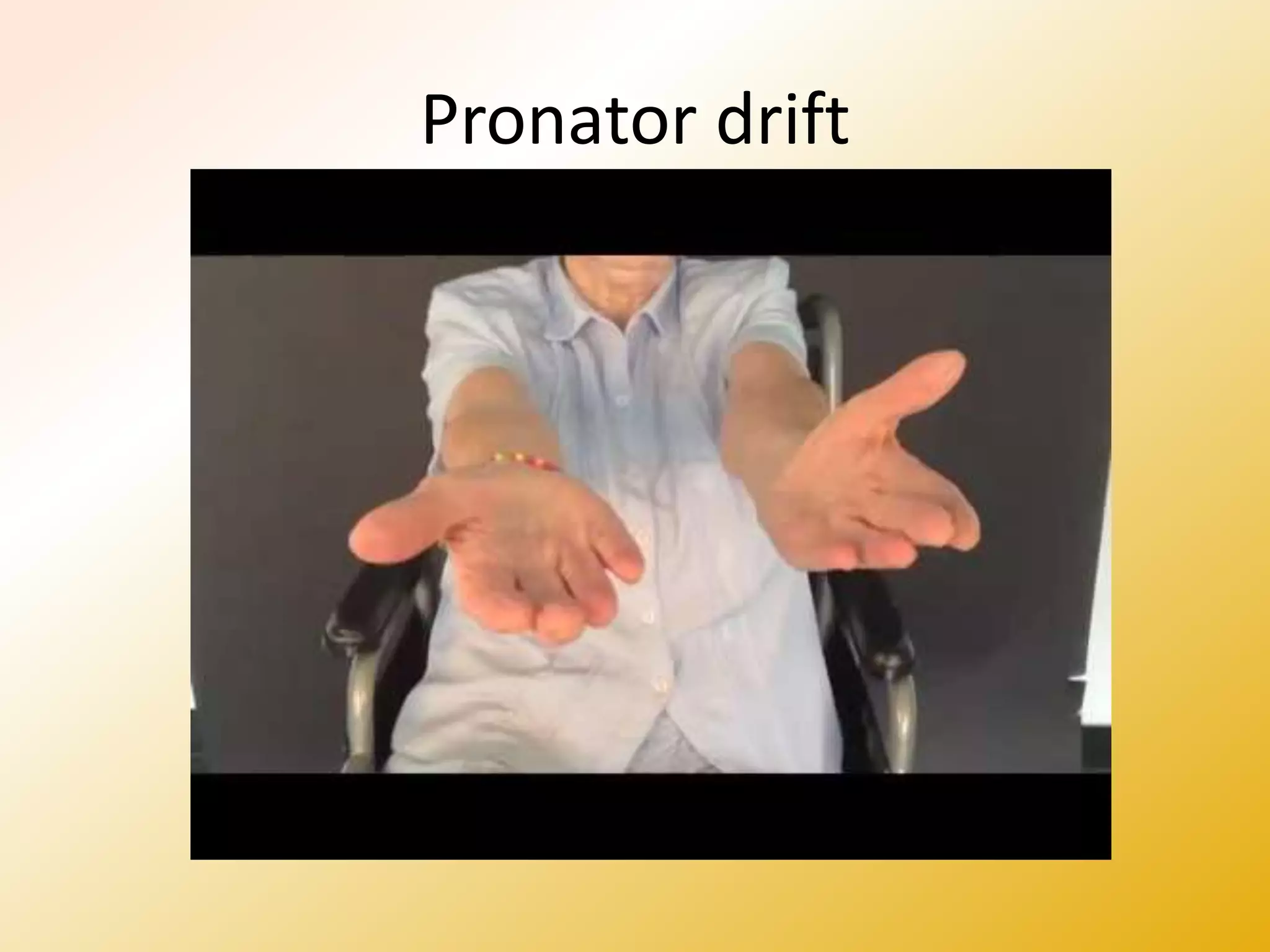
Pronator drift
Cerebellar function tests
- ? Eye ( test for Nystagmus, occular dysmetria )
- ? Speech
- Tone of muscle (hypotonia)
- Finger- nose test
- Rapid alternating movements
- Rebound phenomenon
- Heel-shin test
- Tendon reflex (pendular)
- Gait
Special test for cortical motor function
Apraxias:
* Constructional
* Dressing
* Ideamotor
- can’t obey a command of movement
* Ideational
- can’t carry out a sequence of movement
* Gait
Examinations of sensory system
• Light touch (cotton)
• Pressure
(squeeze muscle/ apply pressure to fingernail or toenail)
• Pain (neurological pin)
• Temperature (cold metallic object)
• Vibration ( 128 Hz tuning fork)
- Points to be touched
( lower limbs- tip of great toe, interphalangeal joint, medial
malleolus, tibial tuberosity, anterior-superior iliac spine;
upper limbs- distal interphalangeal joint, radial styloid,
olecrenon process, acromion process)
Examinations of sensory system
• Joint position (great toes or middle fingers)
• Two point discrimination
- Open out paper clip or blunt tipped school compass
- Test both fingers and thumbs
• Point localization
- Light touching of various parts of the body
? Which part and which side
- Touching of individual fingers
? Which finger
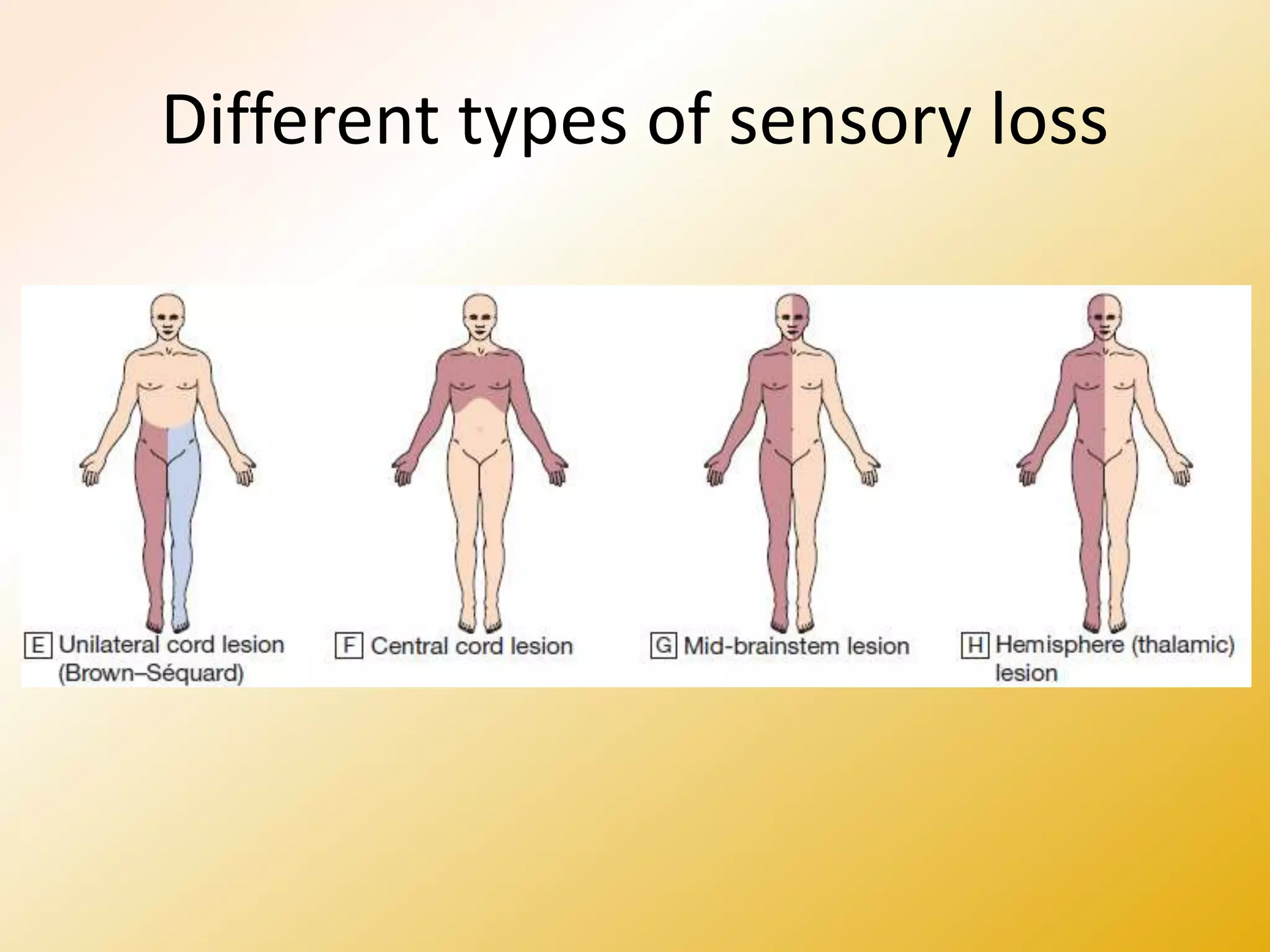
Different types of sensory loss
Special tests for cortical sensory system
• Stereognosis
- Place an object in patient’s hand
? Size, shape, texture of the object
• Graphaesthesia
- Using blunt end of a pencil and draw letter/digit
? Ask to identify
• Sensory inattention
- Touch each hand in turn and ask which one
- Touch both hands simultaneously and ask whether
rt/lt/both
N.B.
For all sensory exam, patient’s eyes should remain closed.
Visual Neglect
Signs of meningeal irritation
• Neck rigidity (fig- A)
• Kernig’s sign (fig- B)
• Brudzinski’s sign
- Passive flexion of neck causes flexion of hips and knees
Examination of gait
• Inspection of the lower limb and spine
• Romberg’s test
• Walking test
- Normal walking
- Heel to toe walking
- Heel walking
- Toe walking
Some gait disorder
Type Cause
Pyramidal or spastic
gait
UMNL
High stepping gait LMNL, foot drop
Waddling or
Tendrelenberg gait or
myopathic gait
Myopathy
Ataxic or broad based
or drunken gait
Lesion in cerebellum/ vestibular
apparatus/ phenytoin toxicity
Some gait disorder
Type Cause
Stamping gait Proprioceptive defect
Apraxic gait
[difficulty in walking
initiation]
Diffuse bilateral hemispheric disease
(normal pressure hydrocephalus),
diffuse frontal lobe disease
Festinant or
Extrapyramidal gait
PD
Marche a petits pas
[Like festinant gait but
arm swinging is normal ]
Small vessel cerebrovascular disease
Finding helpful for localization
Pattern Location
Abnormal mental status/ cognitive
impairment
Seizure or movement disorder
Unilateral sensory-motor signs
Visual field abnormality
Cerebrum
Isolated cranial nerve palsies
( single or multiple)
Crossed sensory-motor signs
Brainstem
Back-pain or tenderness
Sensory-motor signs sparing the head
Mixed upper & lower motor neuron finding
Sensory level
Sphincter dysfunction
Spinal cord
Finding helpful for localization
Pattern Location
Radiating limb pain
Weakness or sensory abnormalities following
root distribution
Spinal roots
Mid or distal limb pain
Sensory-motor signs following nerve
distribution
Stoking or glove distribution sensory loss
Loss of reflexes
Peripheral nerve
Bilateral weakness including face (ptosis,
diplopia, dysphagia) and proximal limbs
Increasing weakness with exertion
Sparing of sensation
Neuromuscular
junction
References
1. Macleod’s Clinacal Examination. Graham Douglas, Fiona
Nicol, Colin Robertson, 12th edd
2. Hutchison’s Clinical Methods. Michael Glynn, William
Drake, 23th edd
3. Long cases in Clinical Medicine. Dr. ABM Abdullah, 5th
edd
4. Short cases in Clinical Medicine. Dr. ABM Abdullah, 4th
edd
5. Neurology and neurosurgery illustrated. Kenneth
Wilndsat, Ian Bone, Geraint Fuller, 5th edd
6. Harrison’s principles of internal medicine. Longo, Fauci,
Casper, Hauser, Jameson, Loscalzo, 18th edd
Limitations
1. Time constraints
2. Examinations of individual disease like Perkinson’s
disease, Myotonic dystrophy etc. and Autonomic
Nervous System - not covered.
3. Tests of neurological emergencies - not covered
4. More audio-visual aids should be added for better
understanding.
Any ?
Neurological System Examination. Khan MS

Neurological System Examination. Khan MS

  • 1.
  • 2.
    Presented by- Dr. Md.Sanaullah Khan Honorary Medical Officer, Dept. of Medicine, MU-VII Dhaka Medical College Hospital, Dhaka E-mail: sani17k65@gmail.com
  • 3.
    What are thepoints of NSE ? • Higher Psychic Function • Cranial nerve examinations including fundoscopy • Examinations of motor system • Cerebellar functions tests • Examinations of sensory system • Signs of meningeal irritation • Examination of Gait
  • 4.
    Higher Psychic Function •Appearance - attire, facial expression • Behaviour - co-operation, rapport, eye contact - over-activity, under-activity - abnormal posturing
  • 5.
  • 6.
  • 7.
    Higher Psychic Function •Consciousness ( by GCS)
  • 8.
    Higher Psychic Function •Mental state examination - Mood/ affect : ? depressed, elated, anxious, fearful, angry, suspicious, irritable, perplexed ? Congruous/ incongruous
  • 9.
    A. I’m depressedB. I’m so happy
  • 10.
    Higher Psychic Function •Mental state examination - Thought form: ? Pressure of thought, flight of ideas, loosening of association, perseveration, concrete thinking - Thought content: ? Phobia, Obsession, Hypocondriasis, Delusion, Passivity phenomenon (thought broadcasting/ insertion/withdrawl)
  • 11.
  • 12.
  • 13.
    Higher Psychic Function •Mental state examination - Cognitive function: ? Orientation ? Memory: * working memory : objects or number * short term memory: retention of naming of objects after 5 min * Long term memory: personal history
  • 14.
    Higher Psychic Function •Mental state examination - Cognitive function: ? Intelligence : * educational attainment * occupation * abstract thinking and understanding ? Insight ? Psychiatric rating scale ( abbreviated mental test or MMSE)
  • 15.
  • 16.
  • 17.
    Higher Psychic Function •Speech: - Problem in content (mutism, neologism, pressure of speech, echolalia etc.) - Difficulty in speech: * Dysphasia * Dysarthria * Dysphonia
  • 18.
  • 19.
  • 20.
    Cranial nerve examination •Cranial nerve-I: Sense of smell - coffee, chocolate, soap or orange peel • Cranial nerve-II: Visual acuity - For distant vision: Snellen chart ( 6 m distance, each eye separate) - finger counting, hand movement, perception of light, projection of rays - For near vision: test card held at comfortable reading distance
  • 21.
    Cranial nerve examination •Cranial nerve-II: Visual acuity - For macular function: Amsler grid
  • 22.
    Cranial nerve examination •Cranial nerve-II: Color vision - By Ishihara chart
  • 23.
    Cranial nerve examination •Cranial nerve-II: Field of vision
  • 24.
    CN-II : opticnerve examination • Test of central scotoma • Light reflex (Direct or consensual) • Opthalmoscopy
  • 25.
    Cranial nerve examination •Cranial nerve-III, IV & VI: ? Any ptosis or squint - Occular movements * H pattern * Any nystagmus or diplopia at extreme gaze ? - Light reflex - Accomodation reflex
  • 26.
  • 27.
    Cranial nerve examination •Cranial nerve-V: - Motor: * ? Wasting of masseter or temporalis * Clenching of teeth * Opening of jaw against resistance * Jaw jerk - Sensory: * Test along the 3 divisions * Corneal reflex
  • 28.
    Jaw jerk andCorneal reflex
  • 29.
    Opthalmic, maxillary &mandibular division of trigeminal nerve
  • 30.
    Cranial nerve examination •Cranial nerve-VII: - Motor: Look
  • 31.
    Cranial nerve examination •Cranial nerve-VII: - Motor: Test the following-
  • 32.
    Cranial nerve examination •Cranial nerve-VII: - Taste sensation: anterior 2/3 of the tongue - Look at external auditory meatus and palate - Test for hyperacusis ( nerve to stapedius muscle)
  • 33.
  • 34.
  • 35.
  • 36.
    Cranial nerve examination •Cranial nerve-VIII: Test for hearing - Whispered voice test - Weber test & Rinne’s test (512/256 Hz)
  • 37.
    Weber test: Condition Interpertation LateralizesIpsilateral conductive deafness Contralateral sensory deafness Not lateralizes No hearing abnormality Bilateral hearing abnormality Rinne’s test: Condition Interpertation Positive (AC>BC) Normal Negative (BC>AC) Ipsilateral conductive deafness
  • 38.
    Cranial nerve examination •Cranial nerve-VIII: Test for vestibular function - Testing for nystagmus ? Horizontal/ vertical/ rotatory ? Jerky or pendular ? Direction of fast phase ? Unidirectional/ bidirectional ? Disconjugate/ Ataxic nystagmus - Dix- Hallpike positional test
  • 39.
  • 40.
  • 41.
  • 42.
  • 43.
    Cranial nerve examination •Cranial nerve-IX & X: ? Any nasal voice/hoarseness/ nasal regurgitation - Movement of palate ? Open the mouth and say ‘ahh’ - Cough test - Gag reflex - Water swallow test - Taste sensation: ( post. 1/3 of tongue )
  • 44.
    Cranial nerve examination •Cranial nerve- XI: - Inspection and palpation of sternocleidomastoid and trapezius - Shrugging of shoulder - Test for sternocleidomastoid (fig-B)
  • 45.
    Cranial nerve examination •Cranial nerve- XII: - Open the mouth and Inspect the tongue ? any wasting, fasciculation, small, spastic tongue - Ask the patient to put out of the tongue ? Any deviation or unable to put out - Side to side movement of the tongue
  • 46.
    Cranial nerve examination •Cranial nerve- XII: - Test power: ask the patient to press the tongue against the inside of each cheek while the examiner press from outside with fingers - Speech: ask to say ‘yellow lorry’ - Assess swallowing: water swallow test
  • 47.
  • 48.
    Examinations of motorsystem - Inspection: Any wasting, fasciculation or involuntary movements - Bulk of the muscle - Tone of the muscle: * Passive movement of joints/ rolling of limbs/ falling of limbs against gravity ? Flaccid, spastic, rigid * Knee and ankle clonus (Fig B & C below)
  • 49.
  • 50.
  • 51.
  • 52.
  • 53.
    Examinations of motorsystem - Deep tendon reflexes: * Upper limbs: Biceps, triceps, supinator, Hoffmann’s , finger jerks
  • 54.
    Examinations of motorsystem - Tendon reflexes: * Lower limbs: Knee (deep), ankle(deep), Plantar (superficial) Jendrassik’s maneuver
  • 55.
    Examinations of motorsystem ? Gordon’s sign ? Oppenheim’s sign - Deep tendon reflexes: Record the responses as- Response How to write Increased +++ Normal ++ Diminished + Absent - Only present after reinforcement ±
  • 56.
    Examinations of motorsystem - Superficial reflexes: * Abdominal reflexes * Cremasteric reflex : stroke at upper medial thigh * Anal reflex
  • 57.
    Examinations of motorsystem - Muscle power: Medical Research Council (MRC) scale
  • 58.
  • 59.
    Cerebellar function tests -? Eye ( test for Nystagmus, occular dysmetria ) - ? Speech - Tone of muscle (hypotonia) - Finger- nose test - Rapid alternating movements - Rebound phenomenon - Heel-shin test - Tendon reflex (pendular) - Gait
  • 60.
    Special test forcortical motor function Apraxias: * Constructional * Dressing * Ideamotor - can’t obey a command of movement * Ideational - can’t carry out a sequence of movement * Gait
  • 61.
  • 62.
    Examinations of sensorysystem • Light touch (cotton) • Pressure (squeeze muscle/ apply pressure to fingernail or toenail) • Pain (neurological pin) • Temperature (cold metallic object) • Vibration ( 128 Hz tuning fork) - Points to be touched ( lower limbs- tip of great toe, interphalangeal joint, medial malleolus, tibial tuberosity, anterior-superior iliac spine; upper limbs- distal interphalangeal joint, radial styloid, olecrenon process, acromion process)
  • 63.
    Examinations of sensorysystem • Joint position (great toes or middle fingers) • Two point discrimination - Open out paper clip or blunt tipped school compass - Test both fingers and thumbs • Point localization - Light touching of various parts of the body ? Which part and which side - Touching of individual fingers ? Which finger
  • 64.
    Different types ofsensory loss
  • 65.
    Different types ofsensory loss
  • 66.
    Special tests forcortical sensory system • Stereognosis - Place an object in patient’s hand ? Size, shape, texture of the object • Graphaesthesia - Using blunt end of a pencil and draw letter/digit ? Ask to identify • Sensory inattention - Touch each hand in turn and ask which one - Touch both hands simultaneously and ask whether rt/lt/both N.B. For all sensory exam, patient’s eyes should remain closed.
  • 67.
  • 68.
    Signs of meningealirritation • Neck rigidity (fig- A) • Kernig’s sign (fig- B) • Brudzinski’s sign - Passive flexion of neck causes flexion of hips and knees
  • 69.
    Examination of gait •Inspection of the lower limb and spine • Romberg’s test • Walking test - Normal walking - Heel to toe walking - Heel walking - Toe walking
  • 70.
    Some gait disorder TypeCause Pyramidal or spastic gait UMNL High stepping gait LMNL, foot drop Waddling or Tendrelenberg gait or myopathic gait Myopathy Ataxic or broad based or drunken gait Lesion in cerebellum/ vestibular apparatus/ phenytoin toxicity
  • 71.
    Some gait disorder TypeCause Stamping gait Proprioceptive defect Apraxic gait [difficulty in walking initiation] Diffuse bilateral hemispheric disease (normal pressure hydrocephalus), diffuse frontal lobe disease Festinant or Extrapyramidal gait PD Marche a petits pas [Like festinant gait but arm swinging is normal ] Small vessel cerebrovascular disease
  • 72.
    Finding helpful forlocalization Pattern Location Abnormal mental status/ cognitive impairment Seizure or movement disorder Unilateral sensory-motor signs Visual field abnormality Cerebrum Isolated cranial nerve palsies ( single or multiple) Crossed sensory-motor signs Brainstem Back-pain or tenderness Sensory-motor signs sparing the head Mixed upper & lower motor neuron finding Sensory level Sphincter dysfunction Spinal cord
  • 73.
    Finding helpful forlocalization Pattern Location Radiating limb pain Weakness or sensory abnormalities following root distribution Spinal roots Mid or distal limb pain Sensory-motor signs following nerve distribution Stoking or glove distribution sensory loss Loss of reflexes Peripheral nerve Bilateral weakness including face (ptosis, diplopia, dysphagia) and proximal limbs Increasing weakness with exertion Sparing of sensation Neuromuscular junction
  • 74.
    References 1. Macleod’s ClinacalExamination. Graham Douglas, Fiona Nicol, Colin Robertson, 12th edd 2. Hutchison’s Clinical Methods. Michael Glynn, William Drake, 23th edd 3. Long cases in Clinical Medicine. Dr. ABM Abdullah, 5th edd 4. Short cases in Clinical Medicine. Dr. ABM Abdullah, 4th edd 5. Neurology and neurosurgery illustrated. Kenneth Wilndsat, Ian Bone, Geraint Fuller, 5th edd 6. Harrison’s principles of internal medicine. Longo, Fauci, Casper, Hauser, Jameson, Loscalzo, 18th edd
  • 75.
    Limitations 1. Time constraints 2.Examinations of individual disease like Perkinson’s disease, Myotonic dystrophy etc. and Autonomic Nervous System - not covered. 3. Tests of neurological emergencies - not covered 4. More audio-visual aids should be added for better understanding.
  • 76.