Musculoskeletal System Nursing 330 Governors State University Shirley Comer
Relevant History Joint pain, swelling, stiffness, heat, ROM Muscles pain, cramps weakness Bone pain, deformity, trauma Functional assessment Self care habits, lifting repetitive motions Exercise program Recent weight gain or loss
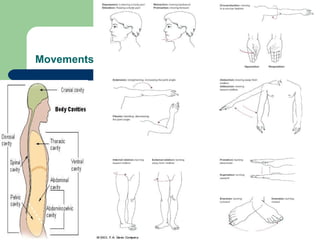
Movements
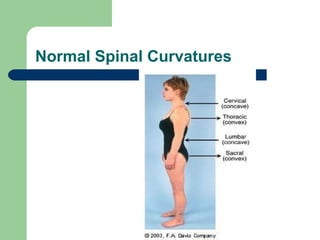
Inspection/Palpation Observe posture and spinal alignment Kyphosis Normal convex curvature of cervical spine Lordosis Normal concave curvature of the lumbar spine Scoliosis Abnormal side to side curvature of the spine Assess spinal alignment Bend at waist and touch toes Hips, scapulas and  shoulders should be symmetrical in height Stand against wall to assess Lordosis Observe Gait
Cervical Spine Inspect – heal alignment and spine straightness  Palpate – spinous processes and stenomastoid, trapezious and paravertebral muscles Ask pt touch chin to chest, lift chin to ceiling, touch chin to opposite shoulders (do not attempt is neck trauma suspected)
Inspection/palpation cont Compare joints on both limbs Length Symmetry Function-ROM Size and contour Skin for color, edema, masses or deformity Palpate Note temperature Swelling masses Crepitus Tone
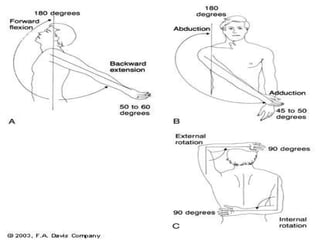
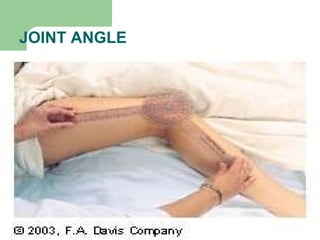
Range of Motion Active – Ask Pt to move each joint through it’s appropriate range of motion Passive – done by assessor.  Do not force a joint to move beyond it’s capability If pt is contractured, gently try to extend the joint but do not force Estimate the angle of the extension of impaired joint
Pix ROM shoulder
JOINT ANGLE
Muscle Testing Test each muscle group Ask pt to flex and hold Attempt to extend the joint Pt should resist your attempts to extend joint If pt’s resistance is easily overcome then muscle strength is weakened
Rating Muscle Strength 5 - Normal- Active motion against full resistance 4  – Sl Weakness – active motion against some resistance 3  – Average weakness – Active motion against gravity 2  – Poor ROM – Passive ROM 1  – Severe Weakness - Slight flicker of contraction 0  – paralysis – no muscular contraction
Normal Spinal Curvatures
Upper Extremities Inspect and palpate – shoulders and arms Ask pt to rotate arms internally and externally, lift above head and move arm in circle Test shoulder strength by asking pt to shrug against your hands (CN XII) Bend elbow and have pt try to flex against your resistance Inspect and Palpate wrist joint and hands Perform active and passive ROM of fingers and hand
Lower Extremities Inspect and palpate Hip  –raise leg then bend to chest, swing leg outward and inward, and front to back Crepitation Pain Decreased ROM  Knee –  Bend and extend Crepitation Moveable patella Foot  – point toes up and then to floor, rotate foot, move laterally- flex and extend toes Deformities Swelling, inflammation Decreased ROM
Tests for Common Joints Abnormalities Pronator Drift- Used to detect weakness in arms Extend supinated arms and close eyes. Should be able to hold position for 20-30 sec Straight Leg Raising- Used to assess for herniated disk when pt c/o LBP with radiation down leg Raise affected leg to the point of pain and dorsiflex the foot. Pain is positive for herniated disk
Tests for Common Joints Abnormalities cont Thomas Test – Assess hip flexure contractures hidden by increased lordosis Flex knee to chest- other knee should stay on table Trendelenburg test – Assess dislocated hip and gluteus medius muscle strength Shifting weight from 1 foot to another should not result in movement of iliac crest
Test for Knee complaints Bulge Test – Small amt of fluid Stroke upward medial side of knee then press lateral side and look for bulge on medial side Patellar Ballottement – Large amount of fluid Press firmly on each side of patella then tap patella. If fluid present, will bounce back Lachmean test – instability Flex knee to 30 degrees. Try to move the lower leg from side to side
Test for Knee complaints Drawer test- ACL and PCL  Flex knee to 90 degrees and apply pressure to anterior and posterior to tibia. Movement = tear McMurray’s test – tears in meniscus Positive if clicking with internal and external rotation Apley’s Test – Damage to meniscus Knee in 90 degrees, put pressure on knee and heel and rotate foot. Clicks = damage
Age Specific Consideration Infants  lift to observe back, passive ROM, observe spontaneous movements Children shoulders and scapula should be level 1 to 2 yrs old have broad gait and use arms for balance and place weight on inside of foot Weight shifts to outside of foot through childhood /c arms closer to body
Age Specific Continued Adolescents Screen for scoliosis beginning at age 10 to 12 Have child bend over and look for hump on one side of spine Differentiate from poor adolescent posture Pregnant Female Waddling gait  pronounced Lordosis
Age Specific Continued Aging Adult Decreased height Shortened trunk makes arms look longer Kyphosis common /c backward head tilt to compensate- makes shape of ā€œ3ā€ Decreased fat to limbs and increased to trunk Bony prominences more pronounced Shuffling gait Decreased sense of balance
Practice Exam Question Mr. Jones is 70 years old and just suffered a mild CVA. He appears to be functionally safe but you want to be sure before you let him ambulate alone.  While assisting him to ambulate he begins to sway. What piece of equipment should you have placed on Mr. Jones before ambulation? A. Walker B. Gait belt C. Wheel chair D. heart Monitor
Rationale B is the correct answer.  A gait belt will assist you in preventing the pt from falling.  It lets you maneuver him at his center of gravity no matter your respective sizes.

Musculoskeletal System

  • 1.
    Musculoskeletal System Nursing330 Governors State University Shirley Comer
  • 2.
    Relevant History Jointpain, swelling, stiffness, heat, ROM Muscles pain, cramps weakness Bone pain, deformity, trauma Functional assessment Self care habits, lifting repetitive motions Exercise program Recent weight gain or loss
  • 3.
  • 4.
    Inspection/Palpation Observe postureand spinal alignment Kyphosis Normal convex curvature of cervical spine Lordosis Normal concave curvature of the lumbar spine Scoliosis Abnormal side to side curvature of the spine Assess spinal alignment Bend at waist and touch toes Hips, scapulas and shoulders should be symmetrical in height Stand against wall to assess Lordosis Observe Gait
  • 5.
    Cervical Spine Inspect– heal alignment and spine straightness Palpate – spinous processes and stenomastoid, trapezious and paravertebral muscles Ask pt touch chin to chest, lift chin to ceiling, touch chin to opposite shoulders (do not attempt is neck trauma suspected)
  • 6.
    Inspection/palpation cont Comparejoints on both limbs Length Symmetry Function-ROM Size and contour Skin for color, edema, masses or deformity Palpate Note temperature Swelling masses Crepitus Tone
  • 7.
    Range of MotionActive – Ask Pt to move each joint through it’s appropriate range of motion Passive – done by assessor. Do not force a joint to move beyond it’s capability If pt is contractured, gently try to extend the joint but do not force Estimate the angle of the extension of impaired joint
  • 8.
  • 9.
  • 10.
    Muscle Testing Testeach muscle group Ask pt to flex and hold Attempt to extend the joint Pt should resist your attempts to extend joint If pt’s resistance is easily overcome then muscle strength is weakened
  • 11.
    Rating Muscle Strength5 - Normal- Active motion against full resistance 4 – Sl Weakness – active motion against some resistance 3 – Average weakness – Active motion against gravity 2 – Poor ROM – Passive ROM 1 – Severe Weakness - Slight flicker of contraction 0 – paralysis – no muscular contraction
  • 12.
  • 13.
    Upper Extremities Inspectand palpate – shoulders and arms Ask pt to rotate arms internally and externally, lift above head and move arm in circle Test shoulder strength by asking pt to shrug against your hands (CN XII) Bend elbow and have pt try to flex against your resistance Inspect and Palpate wrist joint and hands Perform active and passive ROM of fingers and hand
  • 14.
    Lower Extremities Inspectand palpate Hip –raise leg then bend to chest, swing leg outward and inward, and front to back Crepitation Pain Decreased ROM Knee – Bend and extend Crepitation Moveable patella Foot – point toes up and then to floor, rotate foot, move laterally- flex and extend toes Deformities Swelling, inflammation Decreased ROM
  • 15.
    Tests for CommonJoints Abnormalities Pronator Drift- Used to detect weakness in arms Extend supinated arms and close eyes. Should be able to hold position for 20-30 sec Straight Leg Raising- Used to assess for herniated disk when pt c/o LBP with radiation down leg Raise affected leg to the point of pain and dorsiflex the foot. Pain is positive for herniated disk
  • 16.
    Tests for CommonJoints Abnormalities cont Thomas Test – Assess hip flexure contractures hidden by increased lordosis Flex knee to chest- other knee should stay on table Trendelenburg test – Assess dislocated hip and gluteus medius muscle strength Shifting weight from 1 foot to another should not result in movement of iliac crest
  • 17.
    Test for Kneecomplaints Bulge Test – Small amt of fluid Stroke upward medial side of knee then press lateral side and look for bulge on medial side Patellar Ballottement – Large amount of fluid Press firmly on each side of patella then tap patella. If fluid present, will bounce back Lachmean test – instability Flex knee to 30 degrees. Try to move the lower leg from side to side
  • 18.
    Test for Kneecomplaints Drawer test- ACL and PCL Flex knee to 90 degrees and apply pressure to anterior and posterior to tibia. Movement = tear McMurray’s test – tears in meniscus Positive if clicking with internal and external rotation Apley’s Test – Damage to meniscus Knee in 90 degrees, put pressure on knee and heel and rotate foot. Clicks = damage
  • 19.
    Age Specific ConsiderationInfants lift to observe back, passive ROM, observe spontaneous movements Children shoulders and scapula should be level 1 to 2 yrs old have broad gait and use arms for balance and place weight on inside of foot Weight shifts to outside of foot through childhood /c arms closer to body
  • 20.
    Age Specific ContinuedAdolescents Screen for scoliosis beginning at age 10 to 12 Have child bend over and look for hump on one side of spine Differentiate from poor adolescent posture Pregnant Female Waddling gait pronounced Lordosis
  • 21.
    Age Specific ContinuedAging Adult Decreased height Shortened trunk makes arms look longer Kyphosis common /c backward head tilt to compensate- makes shape of ā€œ3ā€ Decreased fat to limbs and increased to trunk Bony prominences more pronounced Shuffling gait Decreased sense of balance
  • 22.
    Practice Exam QuestionMr. Jones is 70 years old and just suffered a mild CVA. He appears to be functionally safe but you want to be sure before you let him ambulate alone. While assisting him to ambulate he begins to sway. What piece of equipment should you have placed on Mr. Jones before ambulation? A. Walker B. Gait belt C. Wheel chair D. heart Monitor
  • 23.
    Rationale B isthe correct answer. A gait belt will assist you in preventing the pt from falling. It lets you maneuver him at his center of gravity no matter your respective sizes.