MOTOR CONTROL
SHIVANI OZA
MPT – II (NEUROSCIENCE)
CONTENTS
INTRODUCTION
NATURE OF MOVEMENT
THEORIES OF MOTOR
CONTROL
THEORIES OF MOTOR
LEARNING
REFERENCES
DEFINITION
MOTOR CONTROL IS DEFINED AS THE ABILITY
TO REGULATE OR DIRECT THE MECHANISMS
ESSENTIAL TO MOVEMENT.
It is the process of initiating, directing, and
grading purposeful voluntary movement.
MOTOR CONTROL – SHUMWAY COOK 3
WHY SHOULD PHYSIOTHERAPISTS STUDY MOTOR
CONTROL?
• Because therapist spend considerable amount of time retraining patients who have
motor control problems producing functional movement disorders.
• Therapeutic intervention is often directed at changing movement or increasing the
capacity to move.
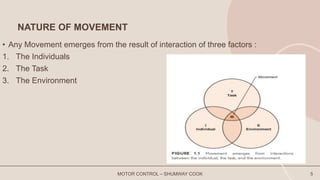
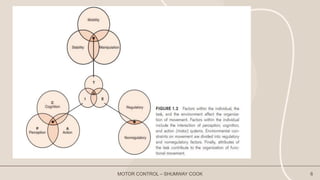
NATURE OF MOVEMENT
• Any Movement emerges from the result of interaction of three factors :
1. The Individuals
2. The Task
3. The Environment
MOTOR CONTROL – SHUMWAY COOK 5
MOTOR CONTROL – SHUMWAY COOK 6
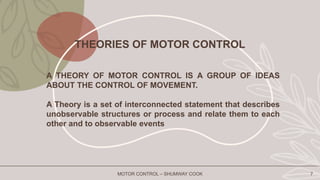
THEORIES OF MOTOR CONTROL
A THEORY OF MOTOR CONTROL IS A GROUP OF IDEAS
ABOUT THE CONTROL OF MOVEMENT.
A Theory is a set of interconnected statement that describes
unobservable structures or process and relate them to each
other and to observable events
MOTOR CONTROL – SHUMWAY COOK 7
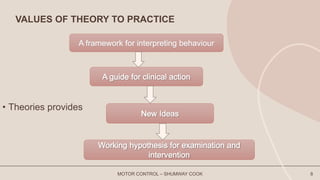
VALUES OF THEORY TO PRACTICE
• Theories provides
MOTOR CONTROL – SHUMWAY COOK 8
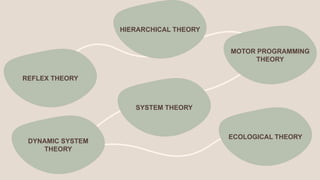
REFLEX THEORY
HIERARCHICAL THEORY
MOTOR PROGRAMMING
THEORY
SYSTEM THEORY
DYNAMIC SYSTEM
THEORY
ECOLOGICAL THEORY
1. REFLEX THEORY
• The Reflex Theory was given by Sir Charles Sherrington, a Neurophysiologist in
1906 in his written book named The Integrative Action of the Nervous System.
• For Sherrington, reflexes were the building blocks of complex behaviour.
• He believed that complex behaviour could be explained through the combined
action of individual reflexes that were chained together.
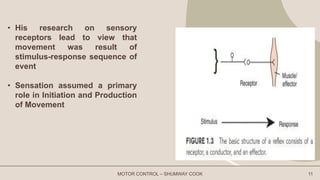
• In his research, he has formed the basic structure of reflex which consists of a
receptor, a conductor and an effector.
MOTOR CONTROL – SHUMWAY COOK 10
• His research on sensory
receptors lead to view that
movement was result of
stimulus-response sequence of
event
• Sensation assumed a primary
role in Initiation and Production
of Movement
MOTOR CONTROL – SHUMWAY COOK 11
MOTOR CONTROL – SHUMWAY COOK 12
LIMITATION
• The reflex can not be considered the basic unit of behaviour if both spontaneous and
voluntary movements are recognised as acceptable classes of behaviour as it is must
be activated by an outside agent.
• Does not adequately explain and predict movement that occurs in the absence of a
sensory stimulus.
• Does not explain fast movements, that is, sequences of movements that occur too
rapidly to allow for sensory feedback from the preceding movement to trigger the next.
• Theory fails to explain the fact that a single stimulus can result in varying responses
depending on context and descending commands.
• Does not explain the ability to produce novel and innovative movement.
CLINICAL IMPLICATIONS
MOTOR CONTROL – SHUMWAY COOK 13
• Clinical strategies designed to test reflexes, should allow therapists to predict function.
• A patient’s movement behaviour would be interpreted in terms of the presence or
absence of controlling reflexes.
• Retraining motor control for functional skills would focus on enhancing or reducing the
effect of various reflexes during motor tasks.
2. HIERARCHICAL THEORY
• Many researchers have contributed to the view that the nervous system is organized as
a hierarchy.
• The English Physician Hughlings Jackson, argued that the brain has higher, middle
and lower levels of control, equated with higher association areas, the motor cortex,
and spinal levels of motor function.
• Hierarchical control in general has been defined as organizational control
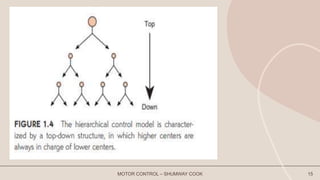
• The hierarchical control model is characterized by ​a top-down structure, in which
higher centers are always in charge of lower centers.
MOTOR CONTROL – SHUMWAY COOK 14
MOTOR CONTROL – SHUMWAY COOK 15
CURRENT CONCEPTS OF HIERARCHICAL CONTROL
• Modern neuroscientists have confirmed the importance of hierarchical organization in
motor control for which the concept of a strict hierarchy, in which higher centres are
always in control, has been modified.
• Current concept – hierarchical control within the nervous system recognise the fact that
each level of the nervous system can act on other levels (higher and lower), depending
on the task.
• The role of reflexes in movement has been modified
• Reflexes are not considered the sole determinants of motor control, but only as one of
many processes important to the generation and control of movement.
MOTOR CONTROL – SHUMWAY COOK 16
LIMITATIONS
• Can not explain the dominance of reflex behaviour in certain situations in normal
adults.
• Does not explain how down-up control operates
• Thus it assumes that all low-level behaviours are primitive, immature and non-adaptive
while all higher level behaviours are mature, adaptive and appropriate.
MOTOR CONTROL – SHUMWAY COOK 17
CLINICAL IMPLICATION
• Signe Brunnstrom, used a reflex hierarchical theory to describe disordered movement
following a motor cortex lesion.
• She stated that, “when the influence of higher centers is temporarily or permanently
interfered with, normal reflexes become exaggerated and so-called pathological
reflexes appear”
• Berta Bobath has stated that, “the release of motor responses integrated at lower
levels from restraining influences of higher centers, especially that of the cortex, leads
to abnormal postural reflex activity”
MOTOR CONTROL – SHUMWAY COOK 18
3. MOTOR PROGRAMMING THEORIES
• Reflex theories have been useful in explaining certain stereotyped patterns of
movement. However, an alternative way to view reflexes is to consider that one can
remove the stimulus, or the afferent input, and still have a patterned motor response.
• If we remove the motor response from its stimulus, we are left with the concept of a
central motor pattern.
• This concept of a central motor pattern, or motor program, is more flexible than the
concept of a reflex because it can be activated either by sensory stimuli or by central
processes.
MOTOR CONTROL – SHUMWAY COOK 19
MOTOR CONTROL – SHUMWAY COOK 20
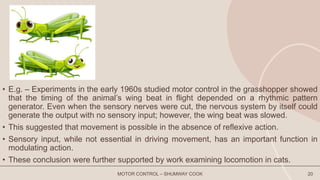
• E.g. – Experiments in the early 1960s studied motor control in the grasshopper showed
that the timing of the animal’s wing beat in flight depended on a rhythmic pattern
generator. Even when the sensory nerves were cut, the nervous system by itself could
generate the output with no sensory input; however, the wing beat was slowed.
• This suggested that movement is possible in the absence of reflexive action.
• Sensory input, while not essential in driving movement, has an important function in
modulating action.
• These conclusion were further supported by work examining locomotion in cats.
• The result of experiments showed that in the cat, spinal neural networks could produce
a locomotor rhythm with neither sensory inputs nor descending patterns from brain.
• By changing the intensity of stimulation to the spinal cord, the animal could be made to
walk, trot, or gallop.
• Thus, it was shown that reflexes do not drive action, but that central pattern generators
by themselves can generate such complex movements.
• These experiments led to the motor program theory of motor control.
• The term motor program used to identify CPG and to describe the higher-level motor
programs that represent actions in more abstract terms.
MOTOR CONTROL – SHUMWAY COOK 21
LIMITATIONS
• Central motor program can not be considered to be the sole determinant of action.
• The motor program concept does not take into account that the nervous system must
deal with both musculoskeletal and environmental variables in achieving movement
control.
• E.g. : Two identical commands to elbow flexors will produce different movements
depending on whether your arm is resting at your side or you are holding your arm out
in front of you.
• The forces of gravity will act differently on the limb in the two conditions, and thus
modify the movement.
• If your muscles are fatigued, similar nervous system commands will produce different
results.
MOTOR CONTROL - SHUMWAY
COOK
22
CLINICAL IMPLICATIONS
• Explanations for abnormal movement have been expanded to include problems
resulting from abnormalities in CPGs or in higher-level motor programs.
• In patients whose higher-levels of motor programming are affected, the motor program
theory suggests the importance of helping patients relearn the correct rules of action.
• Intervention should focus on retraining movements important to a functional task, not
just on re-educating specific muscle in isolation.
MOTOR CONTROL – SHUMWAY COOK 23
4. SYSTEM THEORY
• System theory was given by a Russian scientist Nicolai Bernstein who has recognized
that one can not understand the neural control of movement without an understanding
of the characteristics of the system you are moving and the external and internal forces
acting on the body.
• Bernstein looked at the whole body as a mechanical system, with mass and subject to
both external forces such as gravity and internal forces such as both Inertial and
movement-dependent forces.
• He thus showed that the same central command could result in quite different
movements because of the interplay between external forces and variations in the
initial conditions.
• For the same reasons, different commands could result in same movement.
• He also suggested that control of integrated movement was probably distributed
throughout many interacting systems working co-operatively to achieve movement.
• He noted that we have many degrees of freedom that need to be controlled.
MOTOR CONTROL – SHUMWAY COOK 24
• As a solution of degrees of freedom problem, he hypothesized hierarchical control
exists to simplify the control of the body’s multiple degrees of freedom.
• In this way, higher levels of the nervous system activate lower levels. The lower level
activates synergies, or group of muscles that are constrained to act together as a unit.
• Thus, he believed that synergies play an important role in solving the degree of
freedom problem.
MOTOR CONTROL – SHUMWAY COOK 25
LIMITATIONS
• System theory does not focus on interaction of organism with environment.
• The broadest and most complex theories among all. Because it takes into account not
only the contributions of the nervous system to action but also the contributions of the
muscle and skeletal systems, as well as the forces of gravity and inertia.
MOTOR CONTROL – SHUMWAY COOK 26
CLINICAL IMPLICATION
• Examine the contribution of impairments in the musculoskeletal system, as well as the
neural system.
• Examination and intervention must focus not only on the impairments within individual
systems, but among the multiple systems.
MOTOR CONTROL – SHUMWAY COOK 27
5. DYNAMIC SYSTEM THEORY
• The dynamic system theory comes from the broader study of dynamics or synergetics.
• The fundamental dynamic system principle is a “Self-organization”
• This principle states that when a system of individual parts comes together, its
elements behave collectively in an ordered way.
• There is no need for a “Higher” centre issuing instructions or commands in order to
achieve co-ordinated action.
• This principle predicts that movement could emerge as a result of interacting elements,
without need for specific commands within the nervous system.
• The theory suggests that the new movement emerges because of a critical change in
one of the systems, called a “control parameter.”
• Control parameter is a variable that regulates change in the behaviour of the entire
system.
• E.g. : change in a velocity will convert walking into running
MOTOR CONTROL – SHUMWAY COOK 28
LIMITATIONS
• The presumption that the nervous system has an unimportant role and that the
relationship between the physical system of the animal and the environment in which it
operates primarily determines the animal’s behaviour.
MOTOR CONTROL – SHUMWAY COOK 29
CLINICAL IMPLICATIONS
• Velocity can be an important contributor to the dynamic system theory
• The interaction between speed and physical properties of the body, which produce
momentum, and therefore can help a weak patient move with ease.
MOTOR CONTROL - SHUMWAY
COOK
30
6. ECOLOGICAL THEORY
• In 1960, James Gibson explored the way in which our motor system allow us to interact
most effectively with our surroundings in order to develop goal-oriented behavior.
• He focused on how we detect information in our environment that is relevant to our
actions and how we use this information to control our movements.
• He noted that actions require perceptual information that is specific to a desired goal-
directed action performed within a specific environment.
• He stated that perception focuses on detecting information in the environment that will
support the action necessary to achieve the goal.
• The Ecological theory has broadened our understanding of nervous system function
from that of a sensory/motor system, reacting to environmental variables, to that of a
perception/action system that actively explores the environment to satisfy its own goal.
MOTOR CONTROL – SHUMWAY COOK 31
LIMITATIONS
• It has tended to give less emphasis to the organization and function of the nervous
system that led to this interaction.
• Thus, the research emphasis has shifted from the nervous system to the environmental
interface.
MOTOR CONTROL – SHUMWAY COOK 32
CLINICAL IMPLICATION
• An important part of intervention is helping the patient explore the possibilities for
achieving the goal of a functional task in multiple ways.
• The ability to develop multiple adaptive solutions to accomplish the task.
MOTOR CONTROL – SHUMWAY COOK 33
MOTOR LEARNING
DEFINITION
• Motor learning is the study of acquisition or modification of movement
• It is a set of processes associated with practice or experience leading to relatively
permanent changes in the capability for producing movement.
MOTOR CONTROL – SHUMWAY COOK
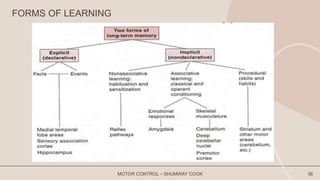
FORMS OF LEARNING
MOTOR CONTROL – SHUMWAY COOK 36
NONDECLARATIVE FORMS OF LEARNING
Non-associative Forms of Learning :-
• Non-associative learning occurs when a single stimulus is repeatedly given.
• As a result, the nervous system learns about the characteristics of that stimulus.
• Habituation and Sensitization are two very simple forms of non-associative learning.
HABITUATION :-
• It is decrease in responsiveness that occurs as a result of repeated exposure to a non-
painful stimulus.
• E.g.- habituation exercises are used to treat dizziness in patients. Patients are asked to
repeatedly move in ways that provoke their dizziness. This repetition results in
habituation of the dizziness response.
MOTOR CONTROL – SHUMWAY COOK 37
SENSITIZATION :-
• It is increase response to the stimulus.
• E.g. - If I receive painful stimulus on skin ,and then a light touch , I will react more
strongly than I normally would to the light touch.
• A person has habituated to one stimulus, a painful stimulus can dishabituate the
response to the first
MOTOR CONTROL – SHUMWAY COOK 38
ASSOCIATIVE LEARNING :-
• Learn to predict relationship between two stimuli.
• E.g. – when a patient recovering from stroke, through repeated practice he begins to
learn to redefine their stability limits so that they do not put so much weight on their
involved limb that they fall, that they are undergoing associative learning.
• There are two types of associative learning
1. Classical conditioning
2. Operant conditioning
MOTOR CONTROL – SHUMWAY COOK 39
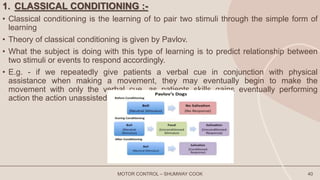
1. CLASSICAL CONDITIONING :-
• Classical conditioning is the learning of to pair two stimuli through the simple form of
learning
• Theory of classical conditioning is given by Pavlov.
• What the subject is doing with this type of learning is to predict relationship between
two stimuli or events to respond accordingly.
• E.g. - if we repeatedly give patients a verbal cue in conjunction with physical
assistance when making a movement, they may eventually begin to make the
movement with only the verbal cue, as patients skills gains eventually performing
action the action unassisted.
MOTOR CONTROL – SHUMWAY COOK 40
MOTOR CONTROL – SHUMWAY COOK 41
2. OPERANT CONDITIONING :-
• The principle of Operant Conditioning could be stated – “ Behaviours that are rewarded
tend to be repeated at the cost of other behaviours.
• E.g. – The classic experiment in this area were done with the animals that were given
food rewards whenever they randomly pressed a lever inside the cages. They soon
learned to associate the lever press with the presentation of food, and the frequency of
lever pressing became very high.
PROCEDURAL LEARNING : -
• Does not require attention , awareness or conscious thought , like a habit.
• Procedural learning develops slowly through repetition of an over many trials, and it is
expressed through improved performance of the task that was practiced.
• E.g. - From supported sit to stand to sit to stand unsupported
MOTOR CONTROL – SHUMWAY COOK 42
DECLARATIVE FORM OF LEARNING
• Require attention, awareness, and reflection
• Practice can transform declarative into procedural or nondeclarative
• E.g. - Patient first learns to stand up may verbally repeat the instruction(nose over toes)
by therapist , then after repeated practice , the patient may be able to stand up without
instruction.
• Then it will turn into procedural/nondeclarative.
MOTOR CONTROL – SHUMWAY COOK 43
MOTOR CONTROL – SHUMWAY COOK 44
THERORIES OF MOTOR LEARNING IS A GROUP
OF IDEAS ABOUT THE NATURE AND CONTROL
OF THE ACQUISITION OR MODIFICATION OF
MOVEMENT.
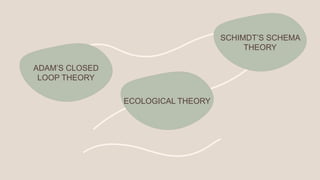
THEORIES OF MOTOR LEARNING
SCHIMDT’S SCHEMA
THEORY
ADAM’S CLOSED
LOOP THEORY
ECOLOGICAL THEORY
ADAM’S CLOSED LOOP THEORY
• Theory was given by Jack Adam in 1971.
• Sensory feedback from ongoing movement compared with stored memory of the
intended movement.
• Memory trace - use to produce appropriate action and to evaluate outcomes.
• Perceptual trace- use to provide the CNS with reference of correctness and error
detection.
• He proposed that after movement is initiated by memory trace, Perceptual trace takes
over to carry out the movement and detect error.
MOTOR CONTROL – SHUMWAY COOK
CLINICAL IMPLICATIONS
• Practice same movement repeatedly without error for correct perceptual trace.
• The more practices of the specific movement by the individual, the stronger the
perceptual trace and the less incorrect movements would become.
• E.g. - Practices picking up a glass more and more, the perceptual trace for movement
is developed and thus guides later movements to be more accurate.
MOTOR CONTROL – SHUMWAY COOK 47
LIMITATION
• Novel movement in absence of sensory feedbacks
MOTOR CONTROL – SHUMWAY COOK 48
SCHIMDT’S SCHEMA THEORY
• In 1970s, Richard Schmidt, a researcher proposed a new motor learning theory, which
he called the “Schema theory”.
• He predicted that when learning a new motor program, the individual learns a
generalised set of rules that can be applied to a variety of contexts.
• Schema is referred to an abstract representation of things stored in memory.
• Schmidt proposed that, after an individual makes a movement, four things are available
for brief storage in short-term memory.
a) The initial movement condition such as weight and position of the body
b) Parameters that used in generalised motor program
c) Outcome of movement in terms of knowledge of result
d) Sensory consequences of movement – like how it felt, look and sound
MOTOR CONTROL – SHUMWAY COOK 49
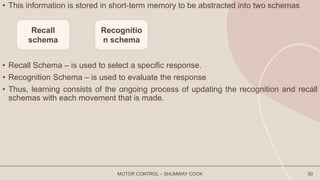
• This information is stored in short-term memory to be abstracted into two schemas
• Recall Schema – is used to select a specific response.
• Recognition Schema – is used to evaluate the response
• Thus, learning consists of the ongoing process of updating the recognition and recall
schemas with each movement that is made.
MOTOR CONTROL – SHUMWAY COOK 50
Recall
schema
Recognitio
n schema
CLINICAL IMPLICATIONS
• Practicing variety of movement tasks and outcomes would improve learning through
the development of expanded rules of schema.
• E.g. - To improve persons eating habit, trained the person with different kind of spoon
(size/shape)
MOTOR CONTROL – SHUMWAY COOK 51
LIMITATIONS
• Theory lacks the specificity that how a person makes his or her first movement before
any schema exists.
MOTOR CONTROL – SHUMWAY COOK 52
3. ECOLOGICAL THEORY
• Ecological theory is proposed by Karl Newell in 1991
• Based upon the system theory and ecological theory of motor control.
• Motor learning is occurred by the coordination of perception and action under the task
and environmental constraints.
• This optimal strategy consists not only finding the appropriate motor response for the
task but also the most appropriate perceptual cues for the optimal task solution.
MOTOR CONTROL - SHUMWAY COOK 53
CLINICAL IMPLICATION
• E.g. - practicing reaching and lifting different glass that contain variety of substances
facilitates learning with relevant perceptual cues for reaching and lifting different size,
slippery surface and fullness of the glass.
MOTOR CONTROL – SHUMWAY COOK 54
LIMITATIONS
• Limitation is that it has yet to be applied to specific examples of motor skill acquisition
in any systematic way.
MOTOR CONTROL – SHUMWAY COOK 55
STAGES OF MOTOR LEARNING
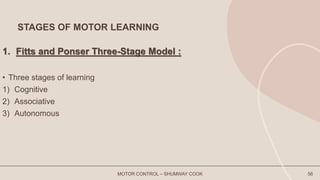
1. Fitts and Ponser Three-Stage Model :
• Three stages of learning
1) Cognitive
2) Associative
3) Autonomous
MOTOR CONTROL – SHUMWAY COOK 56
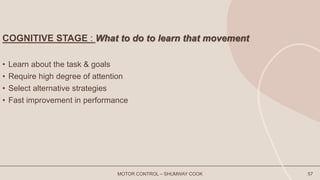
COGNITIVE STAGE : What to do to learn that movement
• Learn about the task & goals
• Require high degree of attention
• Select alternative strategies
• Fast improvement in performance
MOTOR CONTROL – SHUMWAY COOK 57
ASSOCIATIVE STAGE : How to do that movement
• Refine the skills
• Refine a particular movement strategy
• Performance is less variable and more consistent
MOTOR CONTROL – SHUMWAY COOK 58
AUTONOMOUS STAGE : To do it without attention
• Attention demands are greatly reduced
• Ability to detect own errors
MOTOR CONTROL - SHUMWAY
COOK
59
2. System Theory Stage Model
• Three stages of system theory stage model
1. Novice stage - learner simplifies the movement in order to reduce the degrees of
freedom
2. Advanced stage – learner start releasing additional degrees of freedom by allowing
movements at more joints
3. Expert stage - learner has released all the degrees of freedom necessary to perform
a task in a co-ordinated and efficient way.
MOTOR CONTROL – SHUMWAY COOK 60
3. Gentile’s Two Stage Model :
• Two stage model
1. First stage - goal is to understand the task dynamics and develop strategies
appropriate to achieving goal.
2. Second stage – goal of the learner is to refine the movement ( Consistent, Efficient
performance)
MOTOR CONTROL – SHUMWAY COOK 61
PRACTICAL APPLICATION OF MOTOR LEARNING
THEORIES
PRACTICE LEVELS:
The most important factor is retraining motor skills is the amount of practice.
FEEDBACK :
• Feedback is all the sensory information that is available as a results of movement
• Types of mode delivery :
1. INTRINSIC (e.g. visual, vestibular)
2. EXTRINSIC (e.g. instruction from PT, verbal cues, manual cues, biofeedback
device)
MOTOR CONTROL – SHUMWAY COOK 62
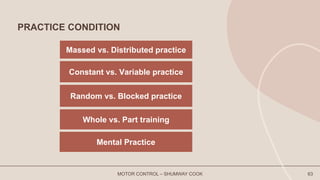
PRACTICE CONDITION
MOTOR CONTROL – SHUMWAY COOK 63
Massed vs. Distributed practice
Constant vs. Variable practice
Random vs. Blocked practice
Whole vs. Part training
Mental Practice
MASSED vs. DISTRIBUTED PRACTICE :
• Distributed in early stage (e.g. 20 min X 3 days) to avoid fatigue and massed in later
stage (e.g. 60 min in one day )
CONSTANT vs. VARIABLE PRACTICE :
• Variable practice (walk at different speeds) results better in learning outcomes than
constant (walk at same speed)
RANDOM vs. BLOCKED PRACTICE :
• Practice multiple tasks is 15 min results better than blocked practice (practice one task
in 15 min) in healthy adults not necessarily patients
MOTOR CONTROL – SHUMWAY COOK 64
WHOLE vs. PART TASK PRACTICE :
• Break the task down in to steps/part, helping the patient to master each step prior to
learning entire task (example : supine to standing, part this in to supine to sitting and
then sitting to standing)
MENTAL PRACTICE :
• Is a method in which performance on the task is imagined or visualized without
physical practice
• mental practice is an effective way to enhance learning during times when physical
practice is not possible and for patients who fatigue easily.
• Neural circuits(CPG) underlying the motor programs for the movements are actually
triggered during mental practice.
MOTOR CONTROL – SHUMWAY COOK 65
REFERENCES
• Motor Control translating research into clinical practice, Anne Shumway-cook &
Marjorie Woollacott
• Physical Rehabilitation , Susan B. O’Sullivan
66
THANK YOU

Motor Control and Learning Theories.pptx

  • 1.
    MOTOR CONTROL SHIVANI OZA MPT– II (NEUROSCIENCE)
  • 2.
    CONTENTS INTRODUCTION NATURE OF MOVEMENT THEORIESOF MOTOR CONTROL THEORIES OF MOTOR LEARNING REFERENCES
  • 3.
    DEFINITION MOTOR CONTROL ISDEFINED AS THE ABILITY TO REGULATE OR DIRECT THE MECHANISMS ESSENTIAL TO MOVEMENT. It is the process of initiating, directing, and grading purposeful voluntary movement. MOTOR CONTROL – SHUMWAY COOK 3
  • 4.
    WHY SHOULD PHYSIOTHERAPISTSSTUDY MOTOR CONTROL? • Because therapist spend considerable amount of time retraining patients who have motor control problems producing functional movement disorders. • Therapeutic intervention is often directed at changing movement or increasing the capacity to move.
  • 5.
    NATURE OF MOVEMENT •Any Movement emerges from the result of interaction of three factors : 1. The Individuals 2. The Task 3. The Environment MOTOR CONTROL – SHUMWAY COOK 5
  • 6.
    MOTOR CONTROL –SHUMWAY COOK 6
  • 7.
    THEORIES OF MOTORCONTROL A THEORY OF MOTOR CONTROL IS A GROUP OF IDEAS ABOUT THE CONTROL OF MOVEMENT. A Theory is a set of interconnected statement that describes unobservable structures or process and relate them to each other and to observable events MOTOR CONTROL – SHUMWAY COOK 7
  • 8.
    VALUES OF THEORYTO PRACTICE • Theories provides MOTOR CONTROL – SHUMWAY COOK 8
  • 9.
    REFLEX THEORY HIERARCHICAL THEORY MOTORPROGRAMMING THEORY SYSTEM THEORY DYNAMIC SYSTEM THEORY ECOLOGICAL THEORY
  • 10.
    1. REFLEX THEORY •The Reflex Theory was given by Sir Charles Sherrington, a Neurophysiologist in 1906 in his written book named The Integrative Action of the Nervous System. • For Sherrington, reflexes were the building blocks of complex behaviour. • He believed that complex behaviour could be explained through the combined action of individual reflexes that were chained together. • In his research, he has formed the basic structure of reflex which consists of a receptor, a conductor and an effector. MOTOR CONTROL – SHUMWAY COOK 10
  • 11.
    • His researchon sensory receptors lead to view that movement was result of stimulus-response sequence of event • Sensation assumed a primary role in Initiation and Production of Movement MOTOR CONTROL – SHUMWAY COOK 11
  • 12.
    MOTOR CONTROL –SHUMWAY COOK 12 LIMITATION • The reflex can not be considered the basic unit of behaviour if both spontaneous and voluntary movements are recognised as acceptable classes of behaviour as it is must be activated by an outside agent. • Does not adequately explain and predict movement that occurs in the absence of a sensory stimulus. • Does not explain fast movements, that is, sequences of movements that occur too rapidly to allow for sensory feedback from the preceding movement to trigger the next. • Theory fails to explain the fact that a single stimulus can result in varying responses depending on context and descending commands. • Does not explain the ability to produce novel and innovative movement.
  • 13.
    CLINICAL IMPLICATIONS MOTOR CONTROL– SHUMWAY COOK 13 • Clinical strategies designed to test reflexes, should allow therapists to predict function. • A patient’s movement behaviour would be interpreted in terms of the presence or absence of controlling reflexes. • Retraining motor control for functional skills would focus on enhancing or reducing the effect of various reflexes during motor tasks.
  • 14.
    2. HIERARCHICAL THEORY •Many researchers have contributed to the view that the nervous system is organized as a hierarchy. • The English Physician Hughlings Jackson, argued that the brain has higher, middle and lower levels of control, equated with higher association areas, the motor cortex, and spinal levels of motor function. • Hierarchical control in general has been defined as organizational control • The hierarchical control model is characterized by ​a top-down structure, in which higher centers are always in charge of lower centers. MOTOR CONTROL – SHUMWAY COOK 14
  • 15.
    MOTOR CONTROL –SHUMWAY COOK 15
  • 16.
    CURRENT CONCEPTS OFHIERARCHICAL CONTROL • Modern neuroscientists have confirmed the importance of hierarchical organization in motor control for which the concept of a strict hierarchy, in which higher centres are always in control, has been modified. • Current concept – hierarchical control within the nervous system recognise the fact that each level of the nervous system can act on other levels (higher and lower), depending on the task. • The role of reflexes in movement has been modified • Reflexes are not considered the sole determinants of motor control, but only as one of many processes important to the generation and control of movement. MOTOR CONTROL – SHUMWAY COOK 16
  • 17.
    LIMITATIONS • Can notexplain the dominance of reflex behaviour in certain situations in normal adults. • Does not explain how down-up control operates • Thus it assumes that all low-level behaviours are primitive, immature and non-adaptive while all higher level behaviours are mature, adaptive and appropriate. MOTOR CONTROL – SHUMWAY COOK 17
  • 18.
    CLINICAL IMPLICATION • SigneBrunnstrom, used a reflex hierarchical theory to describe disordered movement following a motor cortex lesion. • She stated that, “when the influence of higher centers is temporarily or permanently interfered with, normal reflexes become exaggerated and so-called pathological reflexes appear” • Berta Bobath has stated that, “the release of motor responses integrated at lower levels from restraining influences of higher centers, especially that of the cortex, leads to abnormal postural reflex activity” MOTOR CONTROL – SHUMWAY COOK 18
  • 19.
    3. MOTOR PROGRAMMINGTHEORIES • Reflex theories have been useful in explaining certain stereotyped patterns of movement. However, an alternative way to view reflexes is to consider that one can remove the stimulus, or the afferent input, and still have a patterned motor response. • If we remove the motor response from its stimulus, we are left with the concept of a central motor pattern. • This concept of a central motor pattern, or motor program, is more flexible than the concept of a reflex because it can be activated either by sensory stimuli or by central processes. MOTOR CONTROL – SHUMWAY COOK 19
  • 20.
    MOTOR CONTROL –SHUMWAY COOK 20 • E.g. – Experiments in the early 1960s studied motor control in the grasshopper showed that the timing of the animal’s wing beat in flight depended on a rhythmic pattern generator. Even when the sensory nerves were cut, the nervous system by itself could generate the output with no sensory input; however, the wing beat was slowed. • This suggested that movement is possible in the absence of reflexive action. • Sensory input, while not essential in driving movement, has an important function in modulating action. • These conclusion were further supported by work examining locomotion in cats.
  • 21.
    • The resultof experiments showed that in the cat, spinal neural networks could produce a locomotor rhythm with neither sensory inputs nor descending patterns from brain. • By changing the intensity of stimulation to the spinal cord, the animal could be made to walk, trot, or gallop. • Thus, it was shown that reflexes do not drive action, but that central pattern generators by themselves can generate such complex movements. • These experiments led to the motor program theory of motor control. • The term motor program used to identify CPG and to describe the higher-level motor programs that represent actions in more abstract terms. MOTOR CONTROL – SHUMWAY COOK 21
  • 22.
    LIMITATIONS • Central motorprogram can not be considered to be the sole determinant of action. • The motor program concept does not take into account that the nervous system must deal with both musculoskeletal and environmental variables in achieving movement control. • E.g. : Two identical commands to elbow flexors will produce different movements depending on whether your arm is resting at your side or you are holding your arm out in front of you. • The forces of gravity will act differently on the limb in the two conditions, and thus modify the movement. • If your muscles are fatigued, similar nervous system commands will produce different results. MOTOR CONTROL - SHUMWAY COOK 22
  • 23.
    CLINICAL IMPLICATIONS • Explanationsfor abnormal movement have been expanded to include problems resulting from abnormalities in CPGs or in higher-level motor programs. • In patients whose higher-levels of motor programming are affected, the motor program theory suggests the importance of helping patients relearn the correct rules of action. • Intervention should focus on retraining movements important to a functional task, not just on re-educating specific muscle in isolation. MOTOR CONTROL – SHUMWAY COOK 23
  • 24.
    4. SYSTEM THEORY •System theory was given by a Russian scientist Nicolai Bernstein who has recognized that one can not understand the neural control of movement without an understanding of the characteristics of the system you are moving and the external and internal forces acting on the body. • Bernstein looked at the whole body as a mechanical system, with mass and subject to both external forces such as gravity and internal forces such as both Inertial and movement-dependent forces. • He thus showed that the same central command could result in quite different movements because of the interplay between external forces and variations in the initial conditions. • For the same reasons, different commands could result in same movement. • He also suggested that control of integrated movement was probably distributed throughout many interacting systems working co-operatively to achieve movement. • He noted that we have many degrees of freedom that need to be controlled. MOTOR CONTROL – SHUMWAY COOK 24
  • 25.
    • As asolution of degrees of freedom problem, he hypothesized hierarchical control exists to simplify the control of the body’s multiple degrees of freedom. • In this way, higher levels of the nervous system activate lower levels. The lower level activates synergies, or group of muscles that are constrained to act together as a unit. • Thus, he believed that synergies play an important role in solving the degree of freedom problem. MOTOR CONTROL – SHUMWAY COOK 25
  • 26.
    LIMITATIONS • System theorydoes not focus on interaction of organism with environment. • The broadest and most complex theories among all. Because it takes into account not only the contributions of the nervous system to action but also the contributions of the muscle and skeletal systems, as well as the forces of gravity and inertia. MOTOR CONTROL – SHUMWAY COOK 26
  • 27.
    CLINICAL IMPLICATION • Examinethe contribution of impairments in the musculoskeletal system, as well as the neural system. • Examination and intervention must focus not only on the impairments within individual systems, but among the multiple systems. MOTOR CONTROL – SHUMWAY COOK 27
  • 28.
    5. DYNAMIC SYSTEMTHEORY • The dynamic system theory comes from the broader study of dynamics or synergetics. • The fundamental dynamic system principle is a “Self-organization” • This principle states that when a system of individual parts comes together, its elements behave collectively in an ordered way. • There is no need for a “Higher” centre issuing instructions or commands in order to achieve co-ordinated action. • This principle predicts that movement could emerge as a result of interacting elements, without need for specific commands within the nervous system. • The theory suggests that the new movement emerges because of a critical change in one of the systems, called a “control parameter.” • Control parameter is a variable that regulates change in the behaviour of the entire system. • E.g. : change in a velocity will convert walking into running MOTOR CONTROL – SHUMWAY COOK 28
  • 29.
    LIMITATIONS • The presumptionthat the nervous system has an unimportant role and that the relationship between the physical system of the animal and the environment in which it operates primarily determines the animal’s behaviour. MOTOR CONTROL – SHUMWAY COOK 29
  • 30.
    CLINICAL IMPLICATIONS • Velocitycan be an important contributor to the dynamic system theory • The interaction between speed and physical properties of the body, which produce momentum, and therefore can help a weak patient move with ease. MOTOR CONTROL - SHUMWAY COOK 30
  • 31.
    6. ECOLOGICAL THEORY •In 1960, James Gibson explored the way in which our motor system allow us to interact most effectively with our surroundings in order to develop goal-oriented behavior. • He focused on how we detect information in our environment that is relevant to our actions and how we use this information to control our movements. • He noted that actions require perceptual information that is specific to a desired goal- directed action performed within a specific environment. • He stated that perception focuses on detecting information in the environment that will support the action necessary to achieve the goal. • The Ecological theory has broadened our understanding of nervous system function from that of a sensory/motor system, reacting to environmental variables, to that of a perception/action system that actively explores the environment to satisfy its own goal. MOTOR CONTROL – SHUMWAY COOK 31
  • 32.
    LIMITATIONS • It hastended to give less emphasis to the organization and function of the nervous system that led to this interaction. • Thus, the research emphasis has shifted from the nervous system to the environmental interface. MOTOR CONTROL – SHUMWAY COOK 32
  • 33.
    CLINICAL IMPLICATION • Animportant part of intervention is helping the patient explore the possibilities for achieving the goal of a functional task in multiple ways. • The ability to develop multiple adaptive solutions to accomplish the task. MOTOR CONTROL – SHUMWAY COOK 33
  • 34.
  • 35.
    DEFINITION • Motor learningis the study of acquisition or modification of movement • It is a set of processes associated with practice or experience leading to relatively permanent changes in the capability for producing movement. MOTOR CONTROL – SHUMWAY COOK
  • 36.
    FORMS OF LEARNING MOTORCONTROL – SHUMWAY COOK 36
  • 37.
    NONDECLARATIVE FORMS OFLEARNING Non-associative Forms of Learning :- • Non-associative learning occurs when a single stimulus is repeatedly given. • As a result, the nervous system learns about the characteristics of that stimulus. • Habituation and Sensitization are two very simple forms of non-associative learning. HABITUATION :- • It is decrease in responsiveness that occurs as a result of repeated exposure to a non- painful stimulus. • E.g.- habituation exercises are used to treat dizziness in patients. Patients are asked to repeatedly move in ways that provoke their dizziness. This repetition results in habituation of the dizziness response. MOTOR CONTROL – SHUMWAY COOK 37
  • 38.
    SENSITIZATION :- • Itis increase response to the stimulus. • E.g. - If I receive painful stimulus on skin ,and then a light touch , I will react more strongly than I normally would to the light touch. • A person has habituated to one stimulus, a painful stimulus can dishabituate the response to the first MOTOR CONTROL – SHUMWAY COOK 38
  • 39.
    ASSOCIATIVE LEARNING :- •Learn to predict relationship between two stimuli. • E.g. – when a patient recovering from stroke, through repeated practice he begins to learn to redefine their stability limits so that they do not put so much weight on their involved limb that they fall, that they are undergoing associative learning. • There are two types of associative learning 1. Classical conditioning 2. Operant conditioning MOTOR CONTROL – SHUMWAY COOK 39
  • 40.
    1. CLASSICAL CONDITIONING:- • Classical conditioning is the learning of to pair two stimuli through the simple form of learning • Theory of classical conditioning is given by Pavlov. • What the subject is doing with this type of learning is to predict relationship between two stimuli or events to respond accordingly. • E.g. - if we repeatedly give patients a verbal cue in conjunction with physical assistance when making a movement, they may eventually begin to make the movement with only the verbal cue, as patients skills gains eventually performing action the action unassisted. MOTOR CONTROL – SHUMWAY COOK 40
  • 41.
    MOTOR CONTROL –SHUMWAY COOK 41 2. OPERANT CONDITIONING :- • The principle of Operant Conditioning could be stated – “ Behaviours that are rewarded tend to be repeated at the cost of other behaviours. • E.g. – The classic experiment in this area were done with the animals that were given food rewards whenever they randomly pressed a lever inside the cages. They soon learned to associate the lever press with the presentation of food, and the frequency of lever pressing became very high.
  • 42.
    PROCEDURAL LEARNING :- • Does not require attention , awareness or conscious thought , like a habit. • Procedural learning develops slowly through repetition of an over many trials, and it is expressed through improved performance of the task that was practiced. • E.g. - From supported sit to stand to sit to stand unsupported MOTOR CONTROL – SHUMWAY COOK 42
  • 43.
    DECLARATIVE FORM OFLEARNING • Require attention, awareness, and reflection • Practice can transform declarative into procedural or nondeclarative • E.g. - Patient first learns to stand up may verbally repeat the instruction(nose over toes) by therapist , then after repeated practice , the patient may be able to stand up without instruction. • Then it will turn into procedural/nondeclarative. MOTOR CONTROL – SHUMWAY COOK 43
  • 44.
    MOTOR CONTROL –SHUMWAY COOK 44 THERORIES OF MOTOR LEARNING IS A GROUP OF IDEAS ABOUT THE NATURE AND CONTROL OF THE ACQUISITION OR MODIFICATION OF MOVEMENT. THEORIES OF MOTOR LEARNING
  • 45.
  • 46.
    ADAM’S CLOSED LOOPTHEORY • Theory was given by Jack Adam in 1971. • Sensory feedback from ongoing movement compared with stored memory of the intended movement. • Memory trace - use to produce appropriate action and to evaluate outcomes. • Perceptual trace- use to provide the CNS with reference of correctness and error detection. • He proposed that after movement is initiated by memory trace, Perceptual trace takes over to carry out the movement and detect error. MOTOR CONTROL – SHUMWAY COOK
  • 47.
    CLINICAL IMPLICATIONS • Practicesame movement repeatedly without error for correct perceptual trace. • The more practices of the specific movement by the individual, the stronger the perceptual trace and the less incorrect movements would become. • E.g. - Practices picking up a glass more and more, the perceptual trace for movement is developed and thus guides later movements to be more accurate. MOTOR CONTROL – SHUMWAY COOK 47
  • 48.
    LIMITATION • Novel movementin absence of sensory feedbacks MOTOR CONTROL – SHUMWAY COOK 48
  • 49.
    SCHIMDT’S SCHEMA THEORY •In 1970s, Richard Schmidt, a researcher proposed a new motor learning theory, which he called the “Schema theory”. • He predicted that when learning a new motor program, the individual learns a generalised set of rules that can be applied to a variety of contexts. • Schema is referred to an abstract representation of things stored in memory. • Schmidt proposed that, after an individual makes a movement, four things are available for brief storage in short-term memory. a) The initial movement condition such as weight and position of the body b) Parameters that used in generalised motor program c) Outcome of movement in terms of knowledge of result d) Sensory consequences of movement – like how it felt, look and sound MOTOR CONTROL – SHUMWAY COOK 49
  • 50.
    • This informationis stored in short-term memory to be abstracted into two schemas • Recall Schema – is used to select a specific response. • Recognition Schema – is used to evaluate the response • Thus, learning consists of the ongoing process of updating the recognition and recall schemas with each movement that is made. MOTOR CONTROL – SHUMWAY COOK 50 Recall schema Recognitio n schema
  • 51.
    CLINICAL IMPLICATIONS • Practicingvariety of movement tasks and outcomes would improve learning through the development of expanded rules of schema. • E.g. - To improve persons eating habit, trained the person with different kind of spoon (size/shape) MOTOR CONTROL – SHUMWAY COOK 51
  • 52.
    LIMITATIONS • Theory lacksthe specificity that how a person makes his or her first movement before any schema exists. MOTOR CONTROL – SHUMWAY COOK 52
  • 53.
    3. ECOLOGICAL THEORY •Ecological theory is proposed by Karl Newell in 1991 • Based upon the system theory and ecological theory of motor control. • Motor learning is occurred by the coordination of perception and action under the task and environmental constraints. • This optimal strategy consists not only finding the appropriate motor response for the task but also the most appropriate perceptual cues for the optimal task solution. MOTOR CONTROL - SHUMWAY COOK 53
  • 54.
    CLINICAL IMPLICATION • E.g.- practicing reaching and lifting different glass that contain variety of substances facilitates learning with relevant perceptual cues for reaching and lifting different size, slippery surface and fullness of the glass. MOTOR CONTROL – SHUMWAY COOK 54
  • 55.
    LIMITATIONS • Limitation isthat it has yet to be applied to specific examples of motor skill acquisition in any systematic way. MOTOR CONTROL – SHUMWAY COOK 55
  • 56.
    STAGES OF MOTORLEARNING 1. Fitts and Ponser Three-Stage Model : • Three stages of learning 1) Cognitive 2) Associative 3) Autonomous MOTOR CONTROL – SHUMWAY COOK 56
  • 57.
    COGNITIVE STAGE :What to do to learn that movement • Learn about the task & goals • Require high degree of attention • Select alternative strategies • Fast improvement in performance MOTOR CONTROL – SHUMWAY COOK 57
  • 58.
    ASSOCIATIVE STAGE :How to do that movement • Refine the skills • Refine a particular movement strategy • Performance is less variable and more consistent MOTOR CONTROL – SHUMWAY COOK 58
  • 59.
    AUTONOMOUS STAGE :To do it without attention • Attention demands are greatly reduced • Ability to detect own errors MOTOR CONTROL - SHUMWAY COOK 59
  • 60.
    2. System TheoryStage Model • Three stages of system theory stage model 1. Novice stage - learner simplifies the movement in order to reduce the degrees of freedom 2. Advanced stage – learner start releasing additional degrees of freedom by allowing movements at more joints 3. Expert stage - learner has released all the degrees of freedom necessary to perform a task in a co-ordinated and efficient way. MOTOR CONTROL – SHUMWAY COOK 60
  • 61.
    3. Gentile’s TwoStage Model : • Two stage model 1. First stage - goal is to understand the task dynamics and develop strategies appropriate to achieving goal. 2. Second stage – goal of the learner is to refine the movement ( Consistent, Efficient performance) MOTOR CONTROL – SHUMWAY COOK 61
  • 62.
    PRACTICAL APPLICATION OFMOTOR LEARNING THEORIES PRACTICE LEVELS: The most important factor is retraining motor skills is the amount of practice. FEEDBACK : • Feedback is all the sensory information that is available as a results of movement • Types of mode delivery : 1. INTRINSIC (e.g. visual, vestibular) 2. EXTRINSIC (e.g. instruction from PT, verbal cues, manual cues, biofeedback device) MOTOR CONTROL – SHUMWAY COOK 62
  • 63.
    PRACTICE CONDITION MOTOR CONTROL– SHUMWAY COOK 63 Massed vs. Distributed practice Constant vs. Variable practice Random vs. Blocked practice Whole vs. Part training Mental Practice
  • 64.
    MASSED vs. DISTRIBUTEDPRACTICE : • Distributed in early stage (e.g. 20 min X 3 days) to avoid fatigue and massed in later stage (e.g. 60 min in one day ) CONSTANT vs. VARIABLE PRACTICE : • Variable practice (walk at different speeds) results better in learning outcomes than constant (walk at same speed) RANDOM vs. BLOCKED PRACTICE : • Practice multiple tasks is 15 min results better than blocked practice (practice one task in 15 min) in healthy adults not necessarily patients MOTOR CONTROL – SHUMWAY COOK 64
  • 65.
    WHOLE vs. PARTTASK PRACTICE : • Break the task down in to steps/part, helping the patient to master each step prior to learning entire task (example : supine to standing, part this in to supine to sitting and then sitting to standing) MENTAL PRACTICE : • Is a method in which performance on the task is imagined or visualized without physical practice • mental practice is an effective way to enhance learning during times when physical practice is not possible and for patients who fatigue easily. • Neural circuits(CPG) underlying the motor programs for the movements are actually triggered during mental practice. MOTOR CONTROL – SHUMWAY COOK 65
  • 66.
    REFERENCES • Motor Controltranslating research into clinical practice, Anne Shumway-cook & Marjorie Woollacott • Physical Rehabilitation , Susan B. O’Sullivan 66
  • 67.