Networked
The New Social Operating System in Civic Life
October 22, 2015
Lee Rainie - @lrainie and lrainie@pewinternet.org
Director, Internet, Science and Technology Research
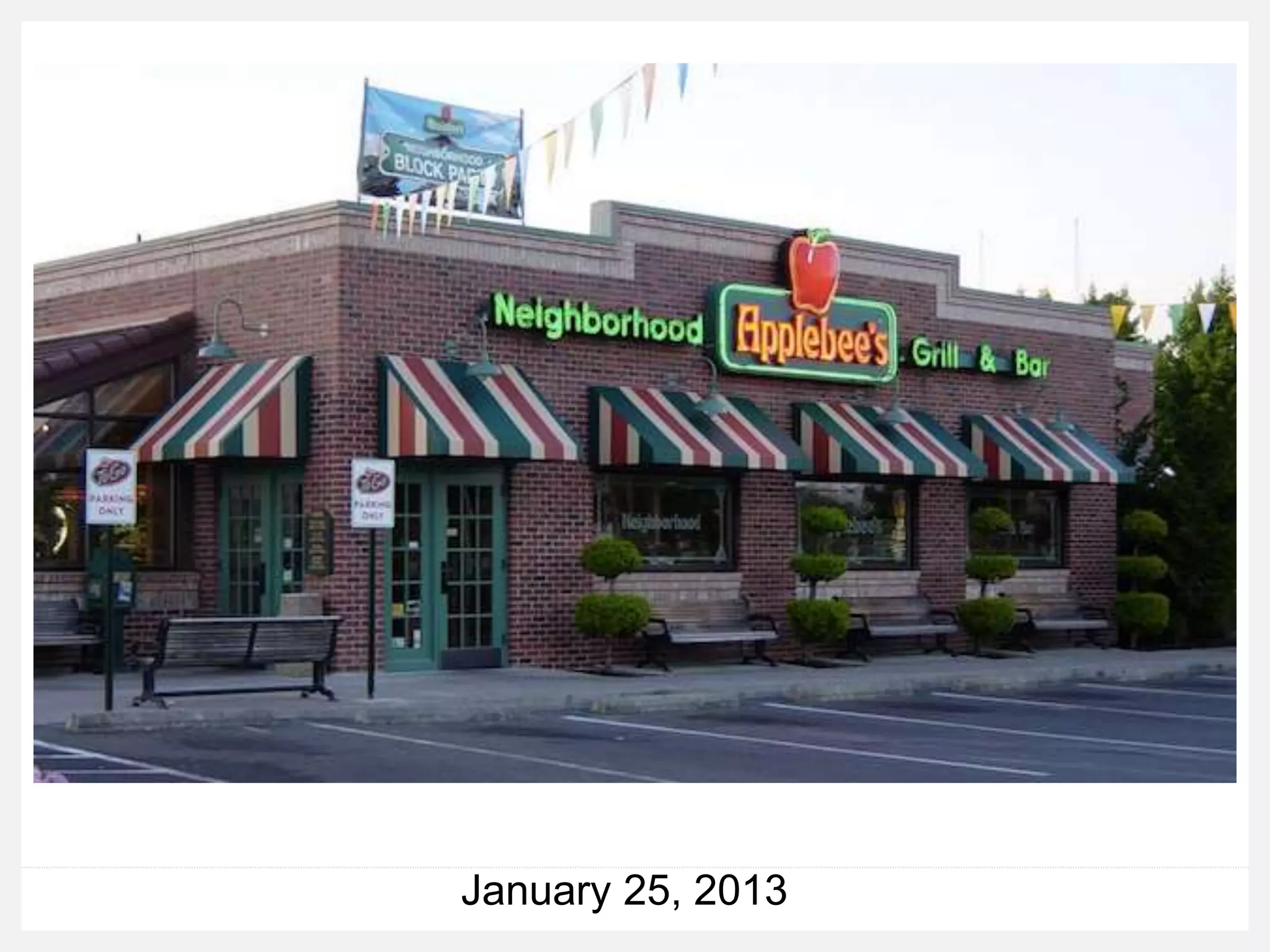
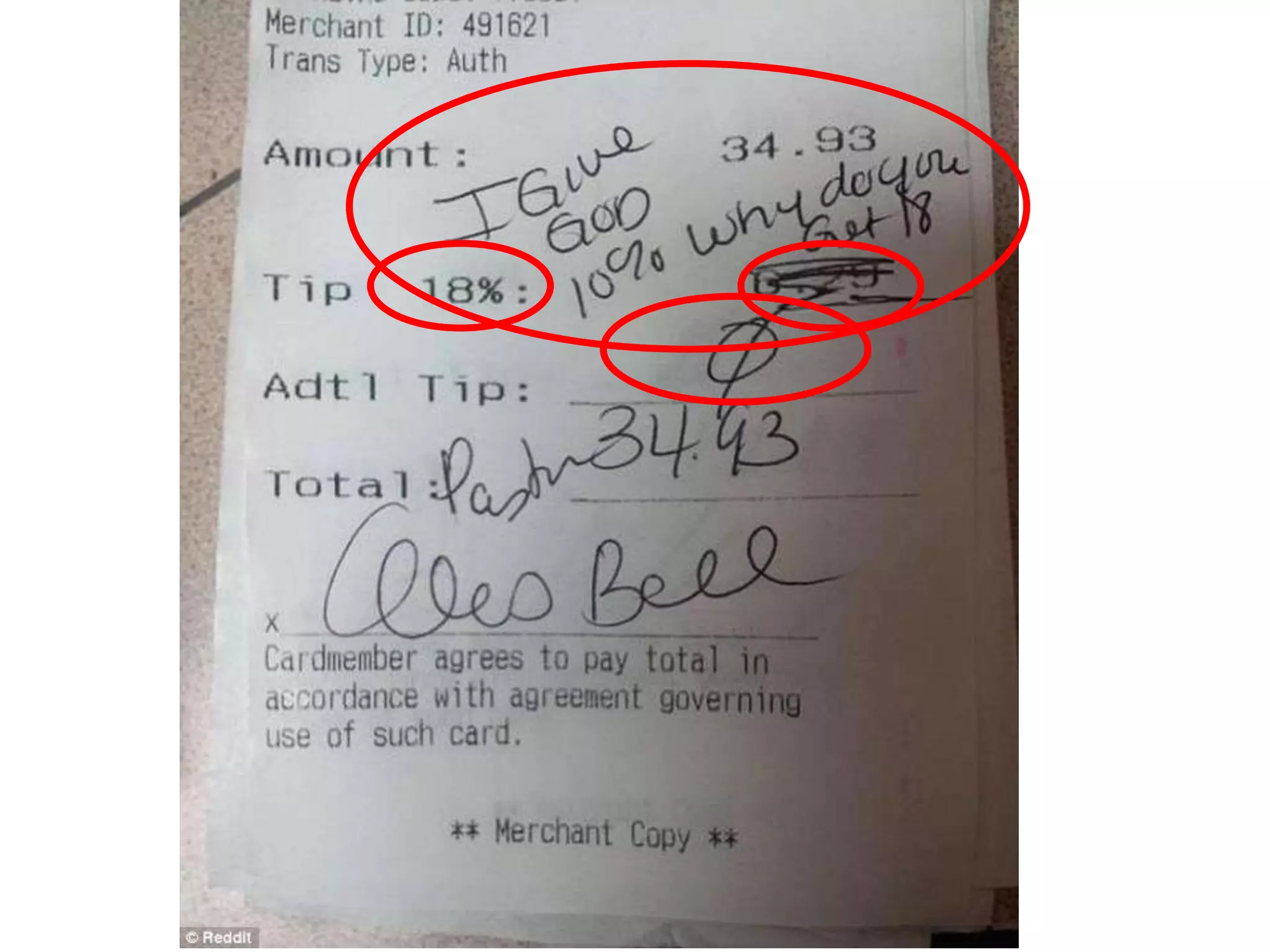
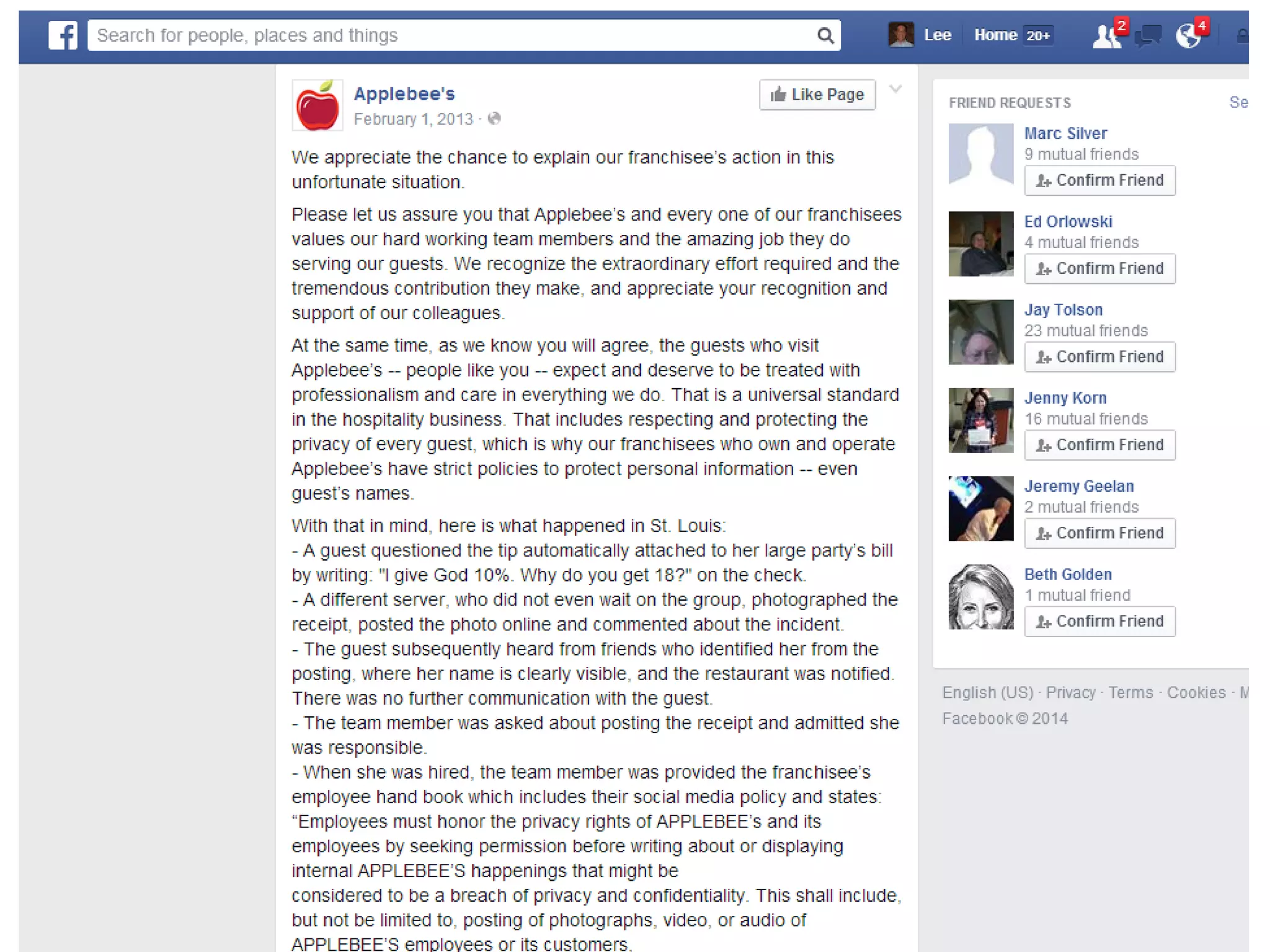
January 25, 2013
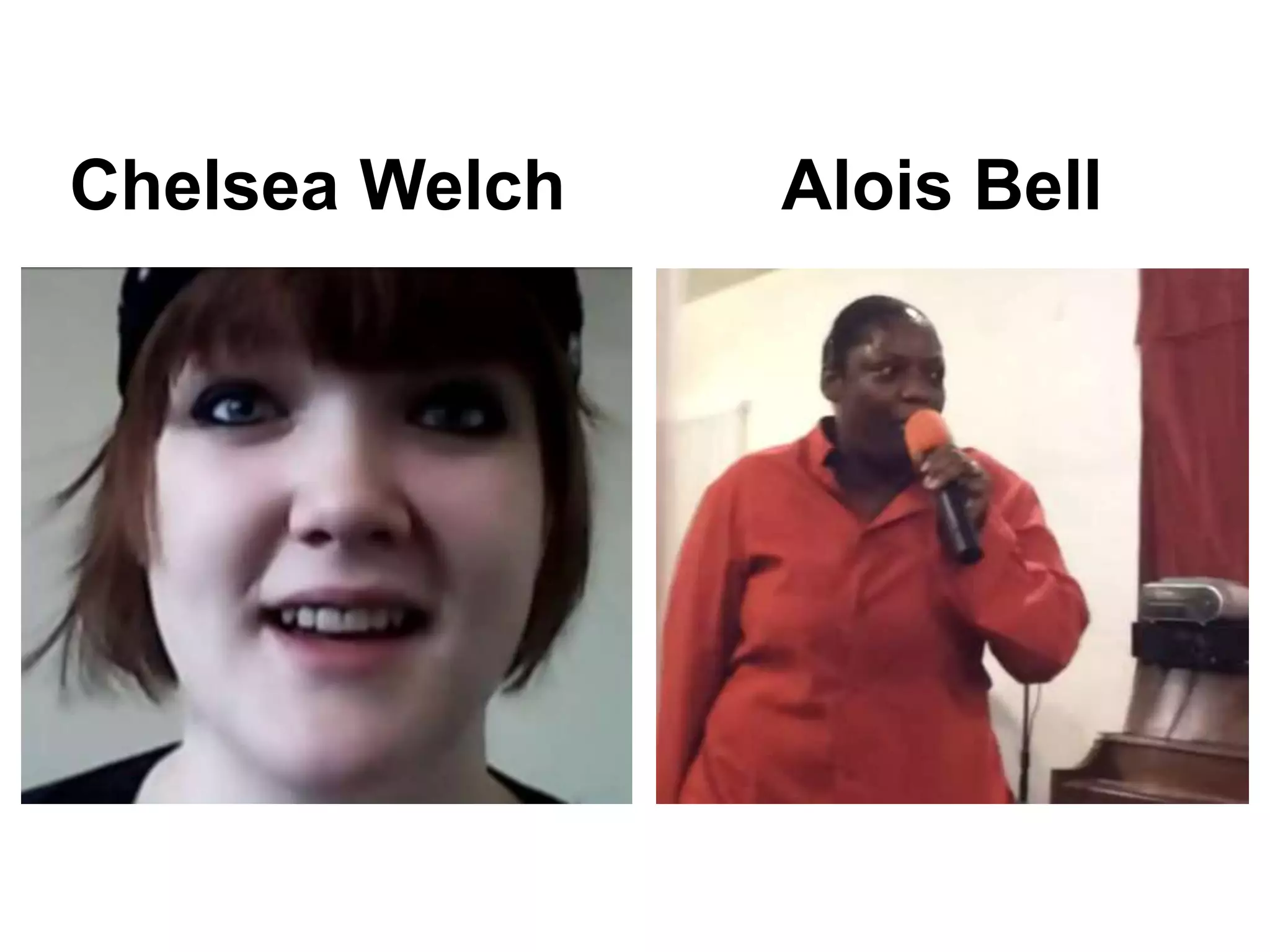
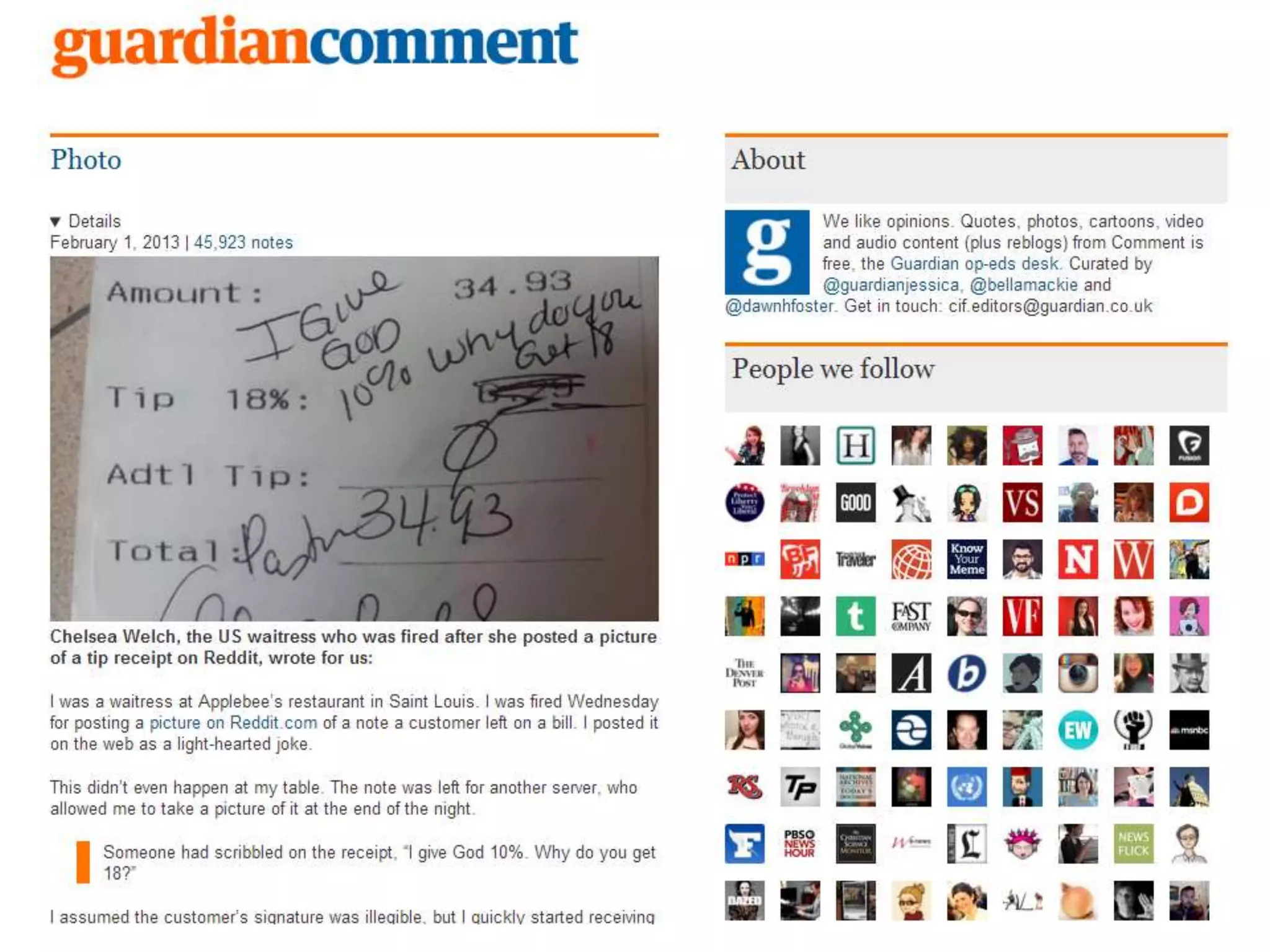
Chelsea Welch Alois Bell
r/atheism
“My mistake sir, I’m sure Jesus will
pay for my rent and groceries”
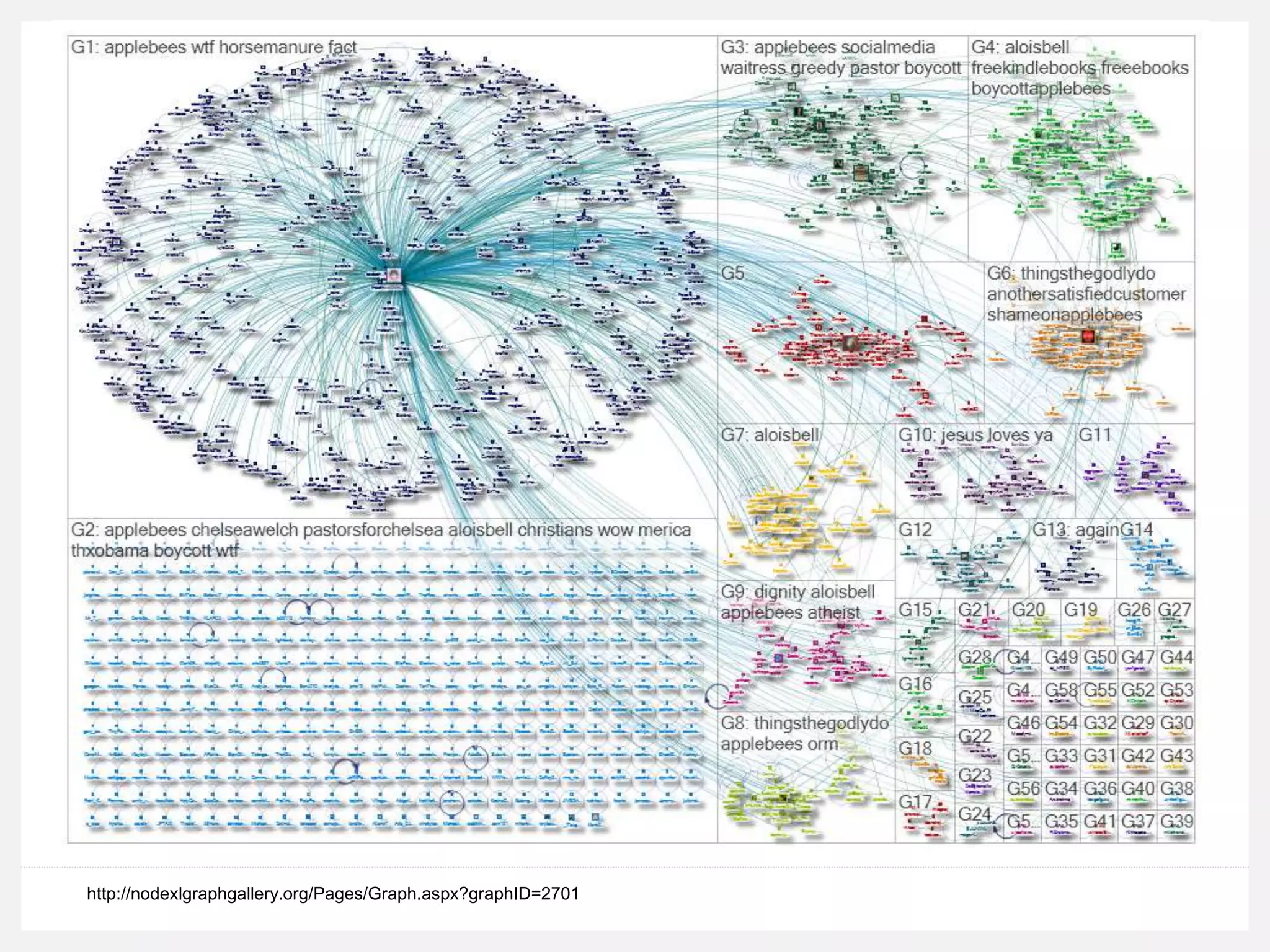
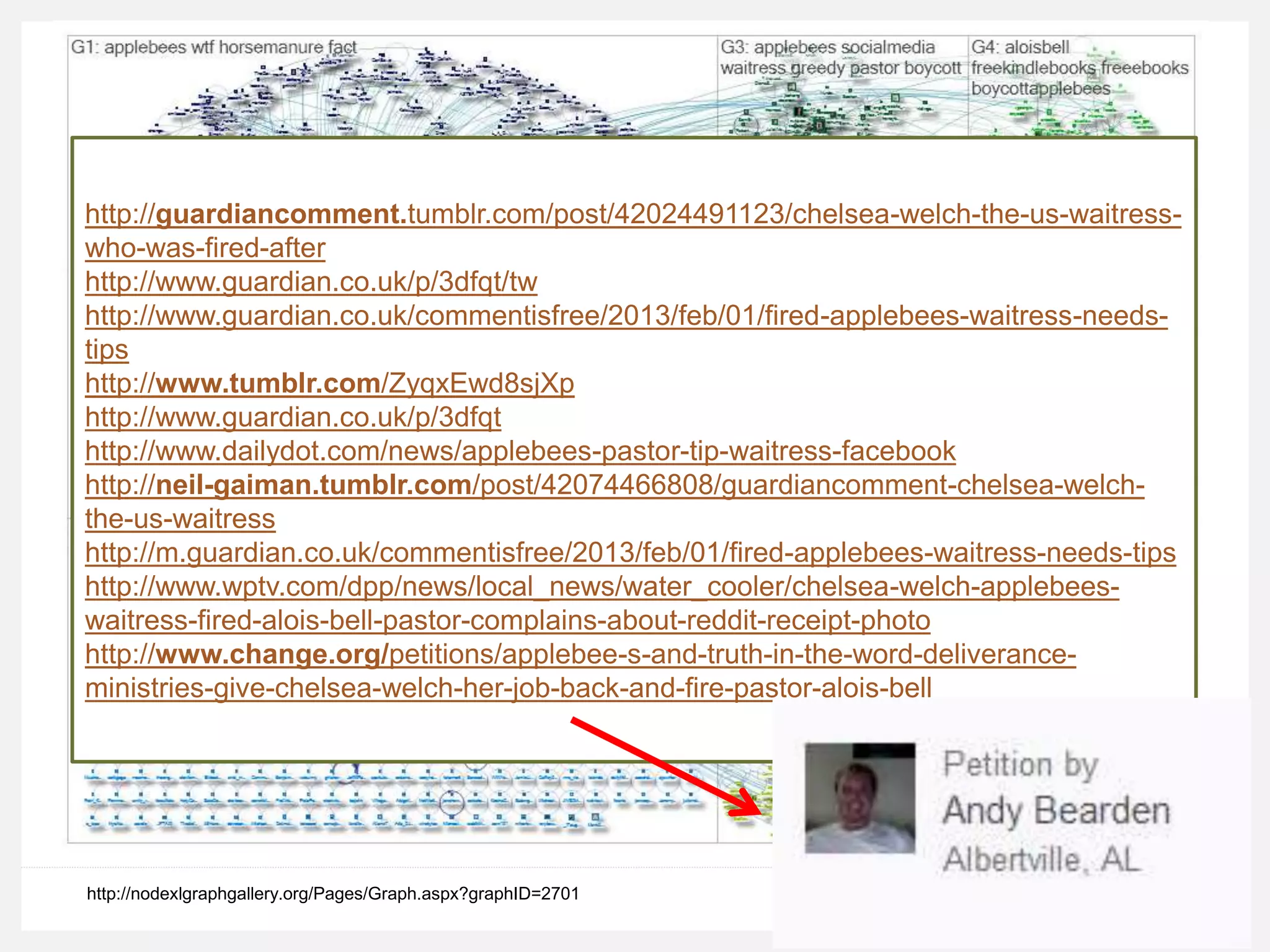
http://nodexlgraphgallery.org/Pages/Graph.aspx?graphID=2701
Top URLs in Tweet in Entire Graph:
http://guardiancomment.tumblr.com/post/42024491123/chelsea-welch-the-us-waitress-
who-was-fired-after
http://www.guardian.co.uk/p/3dfqt/tw
http://www.guardian.co.uk/commentisfree/2013/feb/01/fired-applebees-waitress-needs-
tips
http://www.tumblr.com/ZyqxEwd8sjXp
http://www.guardian.co.uk/p/3dfqt
http://www.dailydot.com/news/applebees-pastor-tip-waitress-facebook/
http://neil-gaiman.tumblr.com/post/42074466808/guardiancomment-chelsea-welch-
the-us-waitress
http://m.guardian.co.uk/commentisfree/2013/feb/01/fired-applebees-waitress-needs-tips
http://www.wptv.com/dpp/news/local_news/water_cooler/chelsea-welch-applebees-
waitress-fired-alois-bell-pastor-complains-about-reddit-receipt-photo
http://www.change.org/petitions/applebee-s-and-truth-in-the-word-deliverance-
ministries-give-chelsea-welch-her-job-back-and-fire-pastor-alois-bell
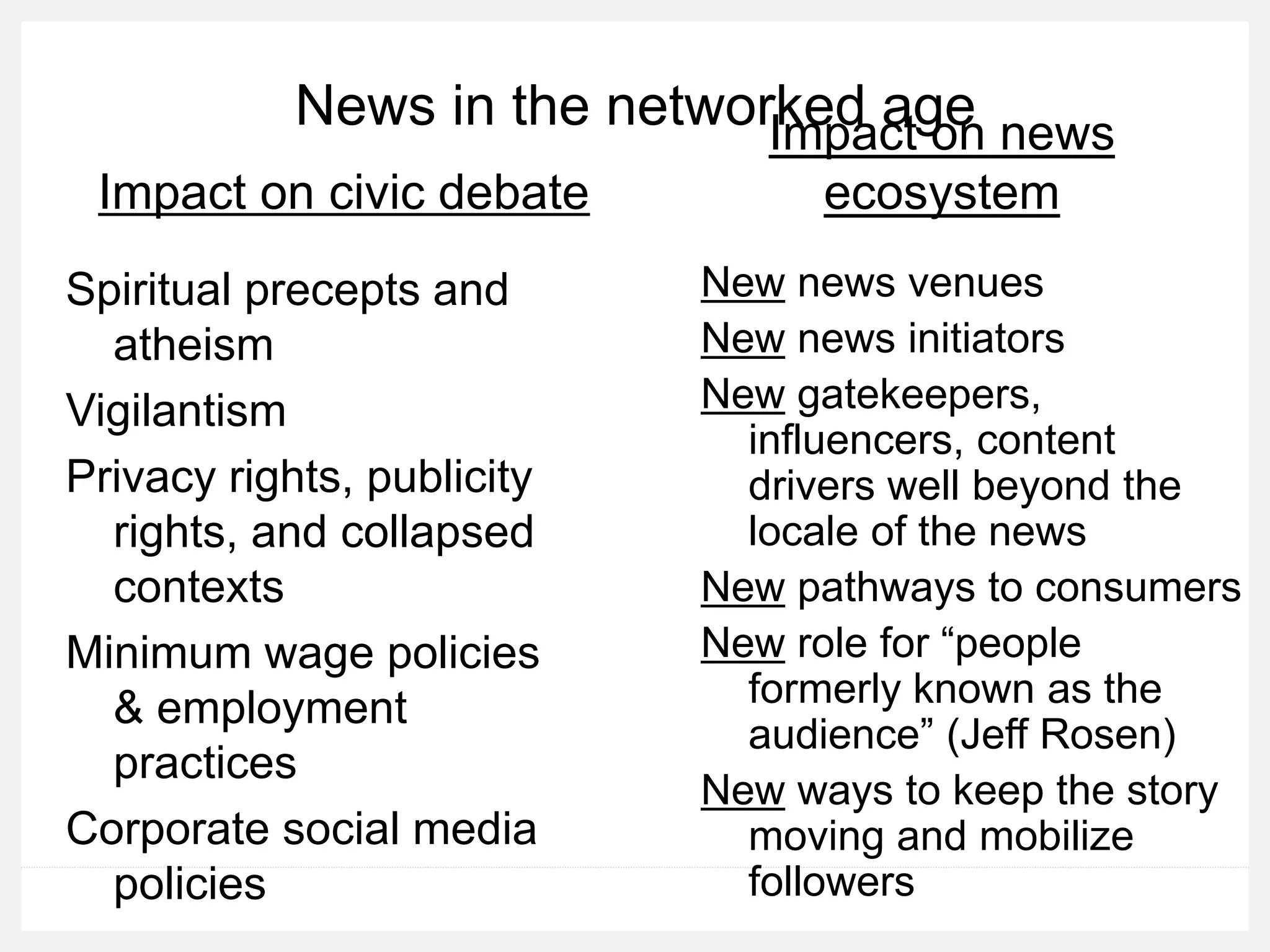
News in the networked age
Impact on civic debate
Spiritual precepts and
atheism
Vigilantism
Privacy rights, publicity
rights, and collapsed
contexts
Minimum wage policies
& employment
practices
Corporate social media
policies
Impact on news
ecosystem
New news venues
New news initiators
New gatekeepers,
influencers, content
drivers well beyond the
locale of the news
New pathways to consumers
New role for “people
formerly known as the
audience” (Jeff Rosen)
New ways to keep the story
moving and mobilize
followers
Civic life is networked life with
network information created and
shared by networked
organizations
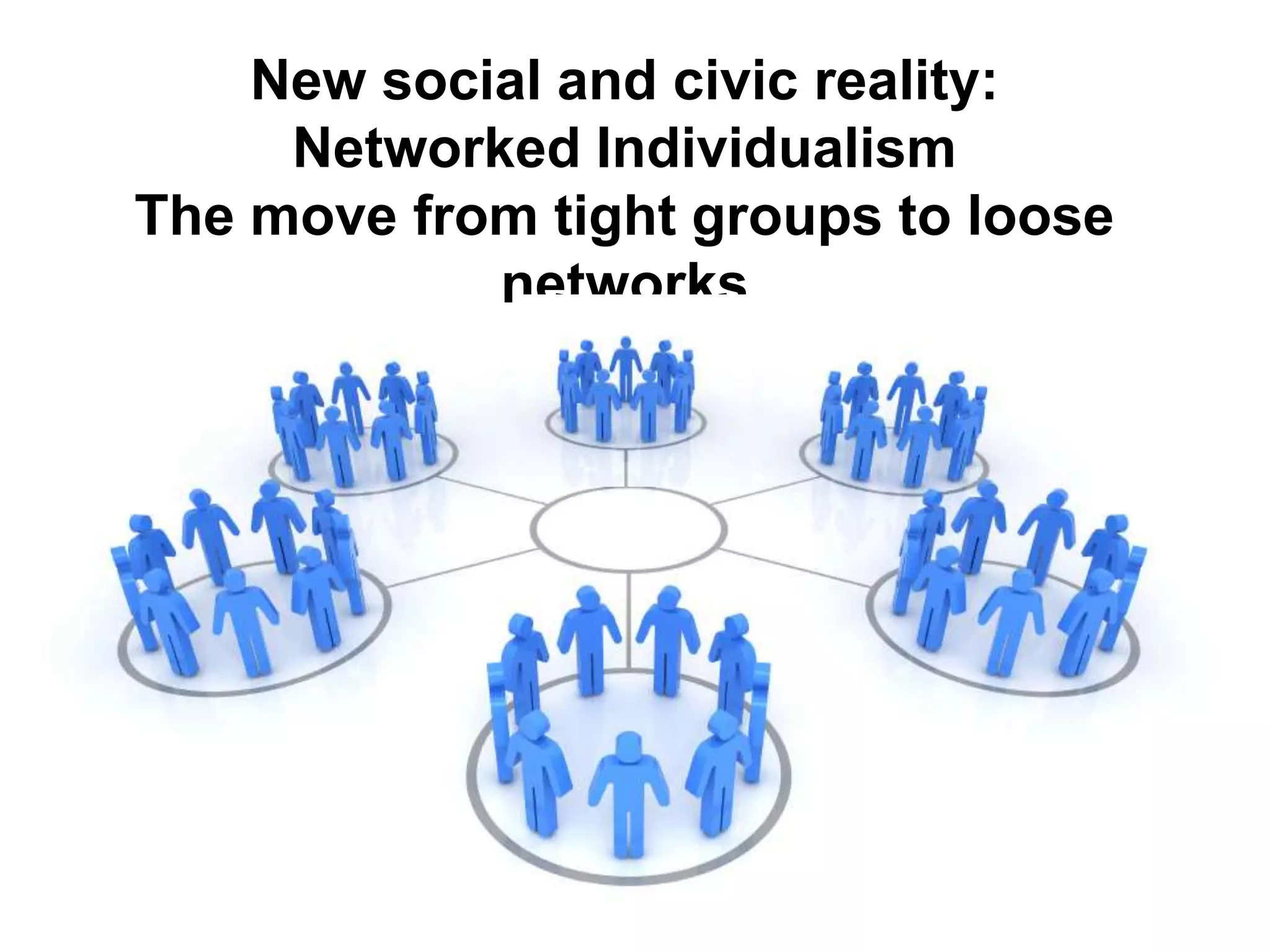
New social and civic reality:
Networked Individualism
The move from tight groups to loose
networks
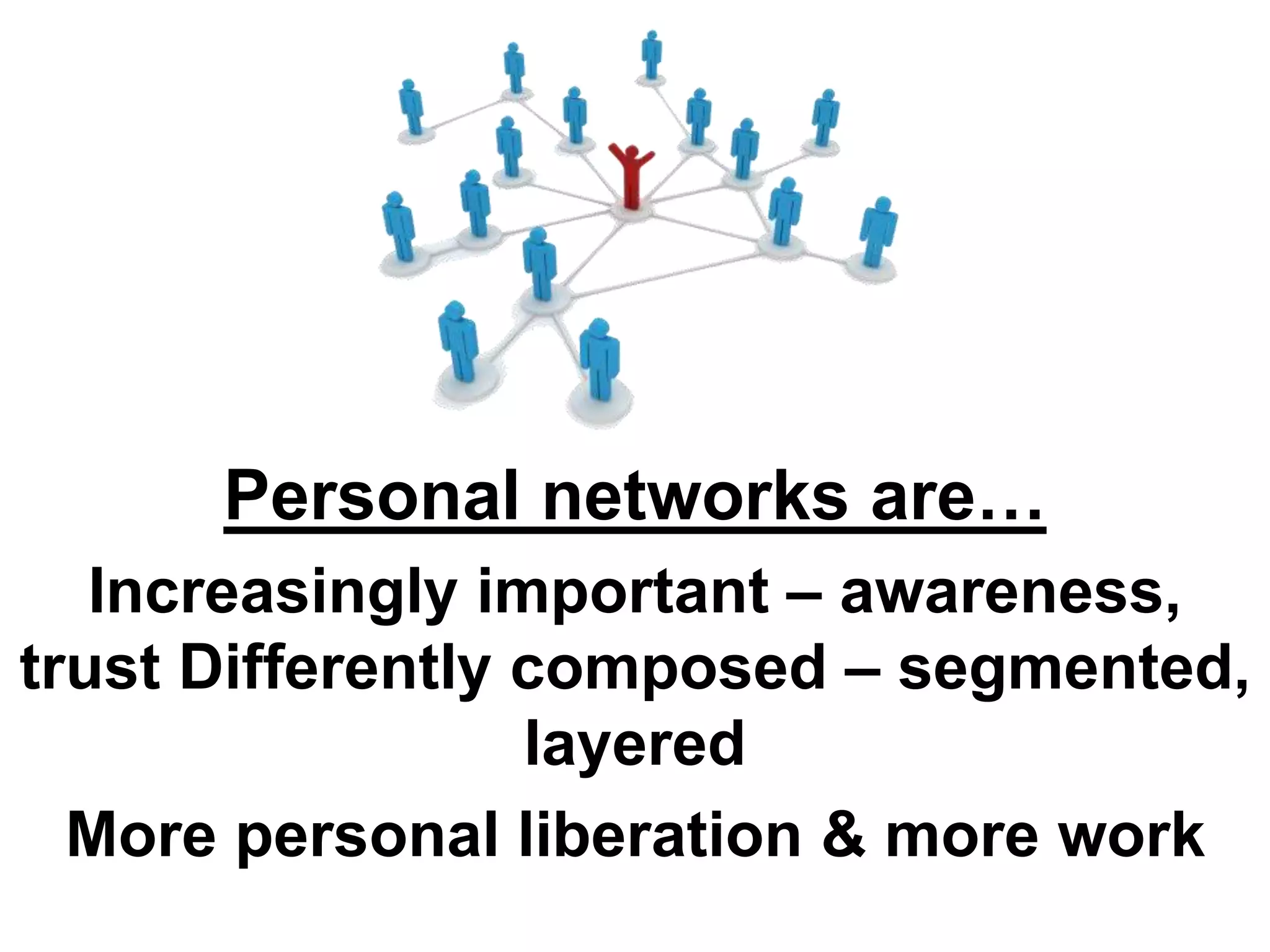
Personal networks are…
Increasingly important – awareness,
trust Differently composed – segmented,
layered
More personal liberation & more work
TECHNOLOGY PUSHES THE
MOVE TO NETWORKED
INDIVIDUALISM
INTO OVERDRIVE
14
36
44
52
55
59 61 63
67
71
74 74 76 76
79
83 84 84
87
0
20
40
60
80
100
1996 2000 2003 2006 2009 2012 2015
Revolution 1 - Internet Users
%
Revolution 1 – Home Broadband Users
3%
70
%
18
25
31
45
59
66
73
75
77
82 81
83 84 85
87
91
89
91 92
11
19
27
37
43 44
50
53
55
68
0
20
40
60
80
100
Dec-00 Dec-03 Apr-06 Apr-09 Apr-12 May-13 Jun-15
Cell
Smart phone
Revolution 2 – Mobile
Connectivity
10%
76
7
65
2005 2007 2009 2011 2013 2015
Among internet
Among all
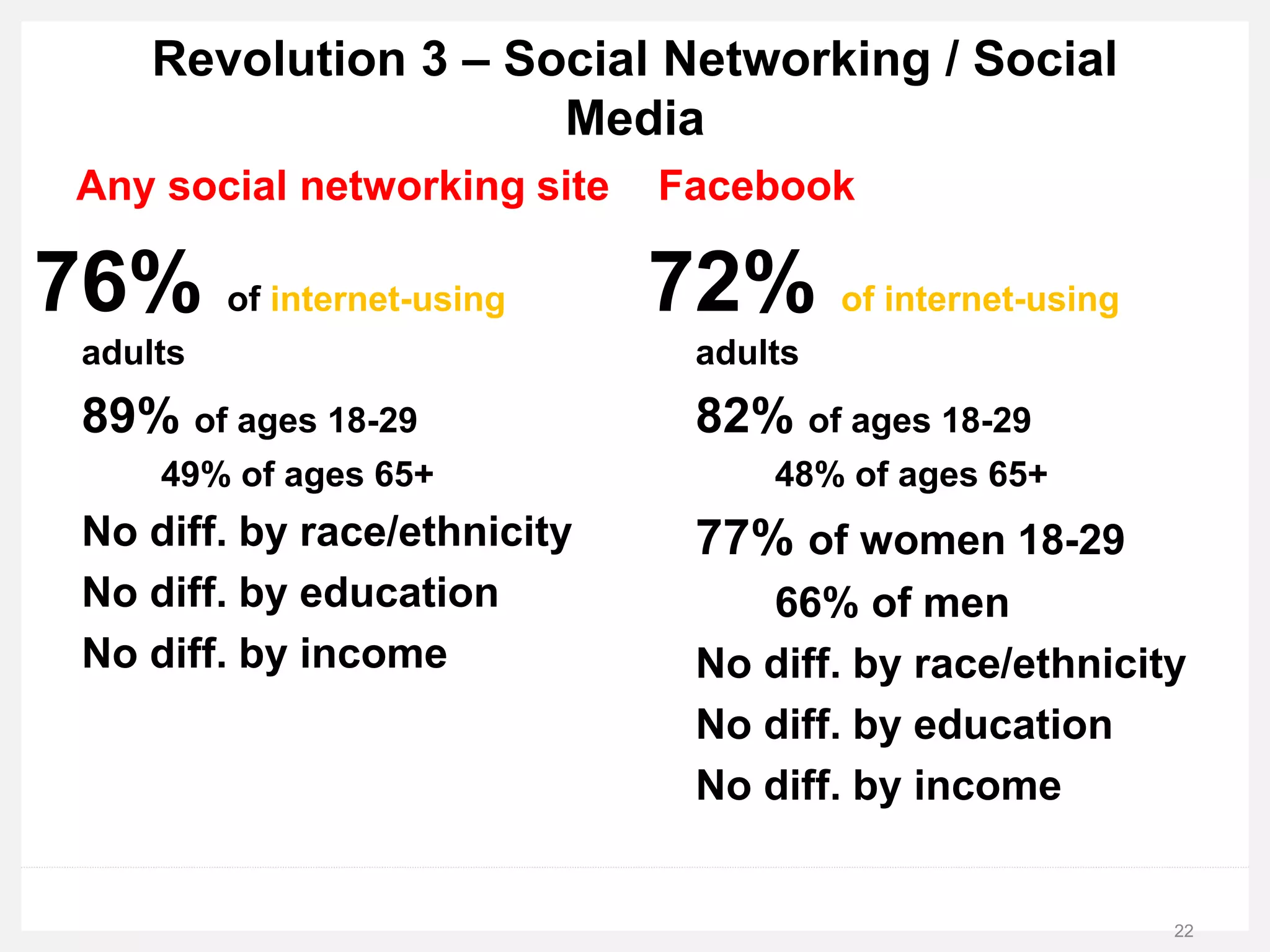
Revolution 3 – Social Networking / Social
Media
Any social networking site
76% of internet-using
adults
89% of ages 18-29
49% of ages 65+
No diff. by race/ethnicity
No diff. by education
No diff. by income
Facebook
22
72% of internet-using
adults
82% of ages 18-29
48% of ages 65+
77% of women 18-29
66% of men
No diff. by race/ethnicity
No diff. by education
No diff. by income
Revolution 3 – Social Networking / Social
Media
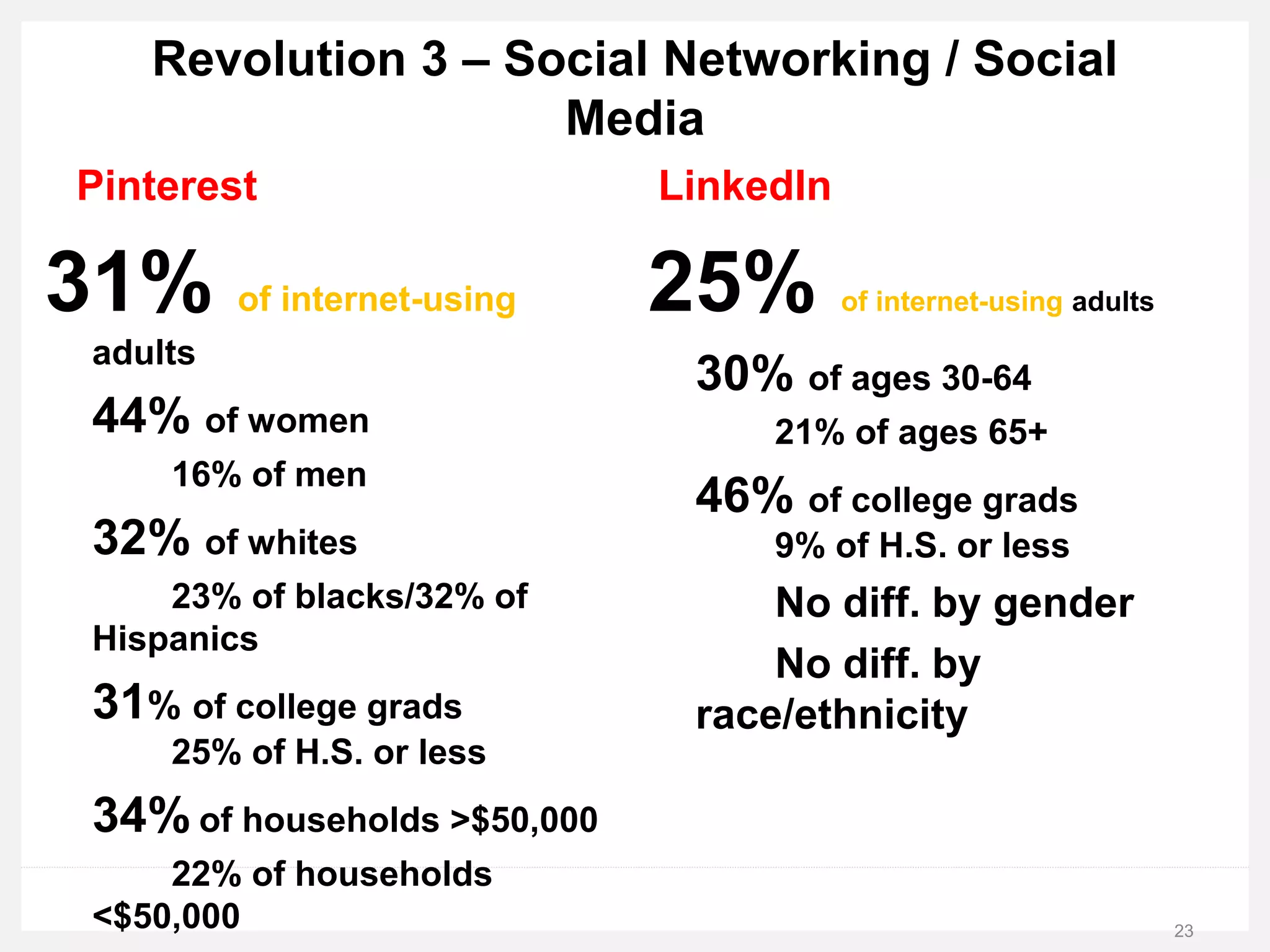
Pinterest
31% of internet-using
adults
44% of women
16% of men
32% of whites
23% of blacks/32% of
Hispanics
31% of college grads
25% of H.S. or less
34% of households >$50,000
22% of households
<$50,000
LinkedIn
23
25% of internet-using adults
30% of ages 30-64
21% of ages 65+
46% of college grads
9% of H.S. or less
No diff. by gender
No diff. by
race/ethnicity
Revolution 3 – Social Networking / Social
Media
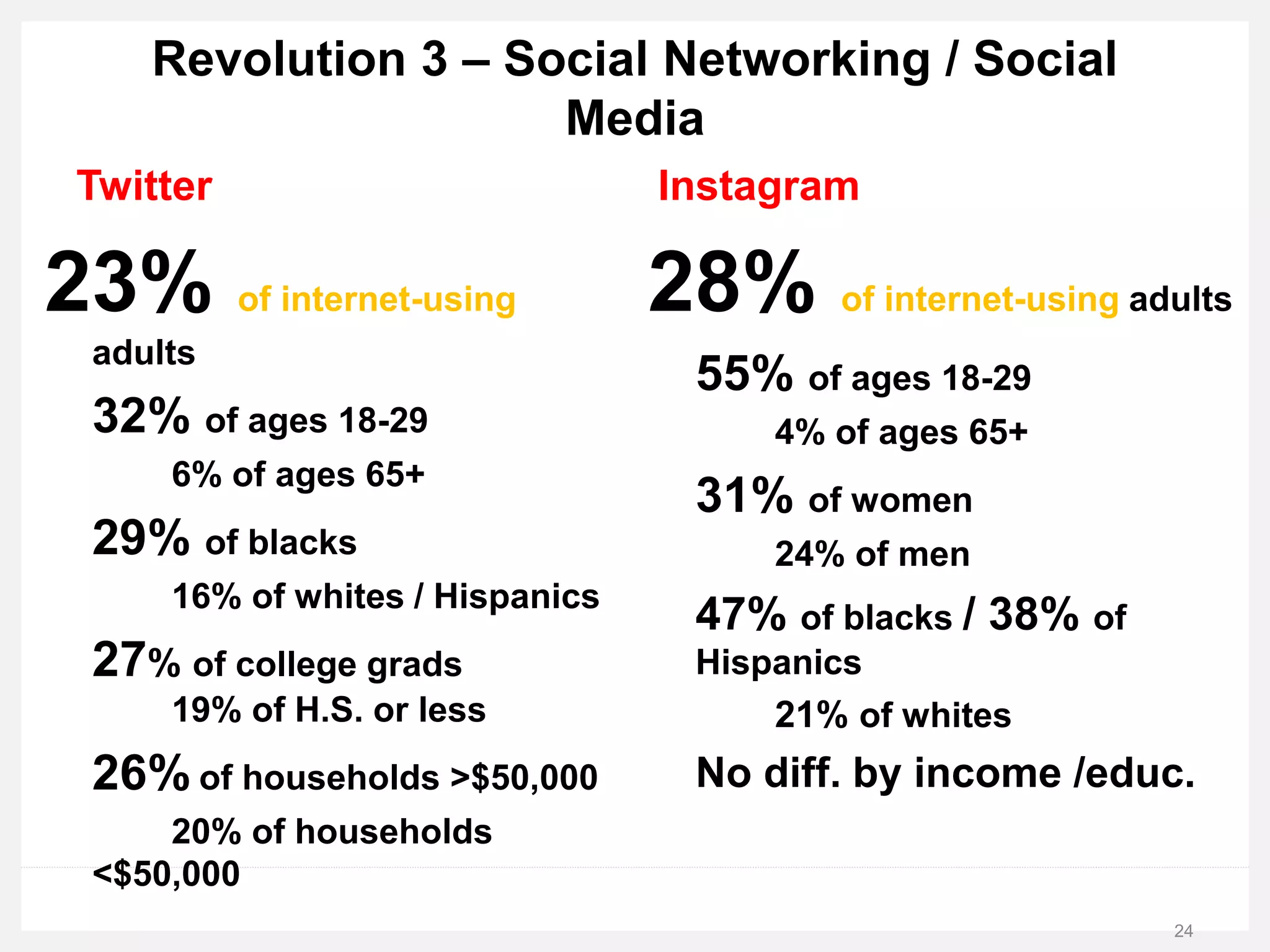
Twitter
23% of internet-using
adults
32% of ages 18-29
6% of ages 65+
29% of blacks
16% of whites / Hispanics
27% of college grads
19% of H.S. or less
26% of households >$50,000
20% of households
<$50,000
Instagram
24
28% of internet-using adults
55% of ages 18-29
4% of ages 65+
31% of women
24% of men
47% of blacks / 38% of
Hispanics
21% of whites
No diff. by income /educ.
Revolution 3 – Social Networking / Social
Media
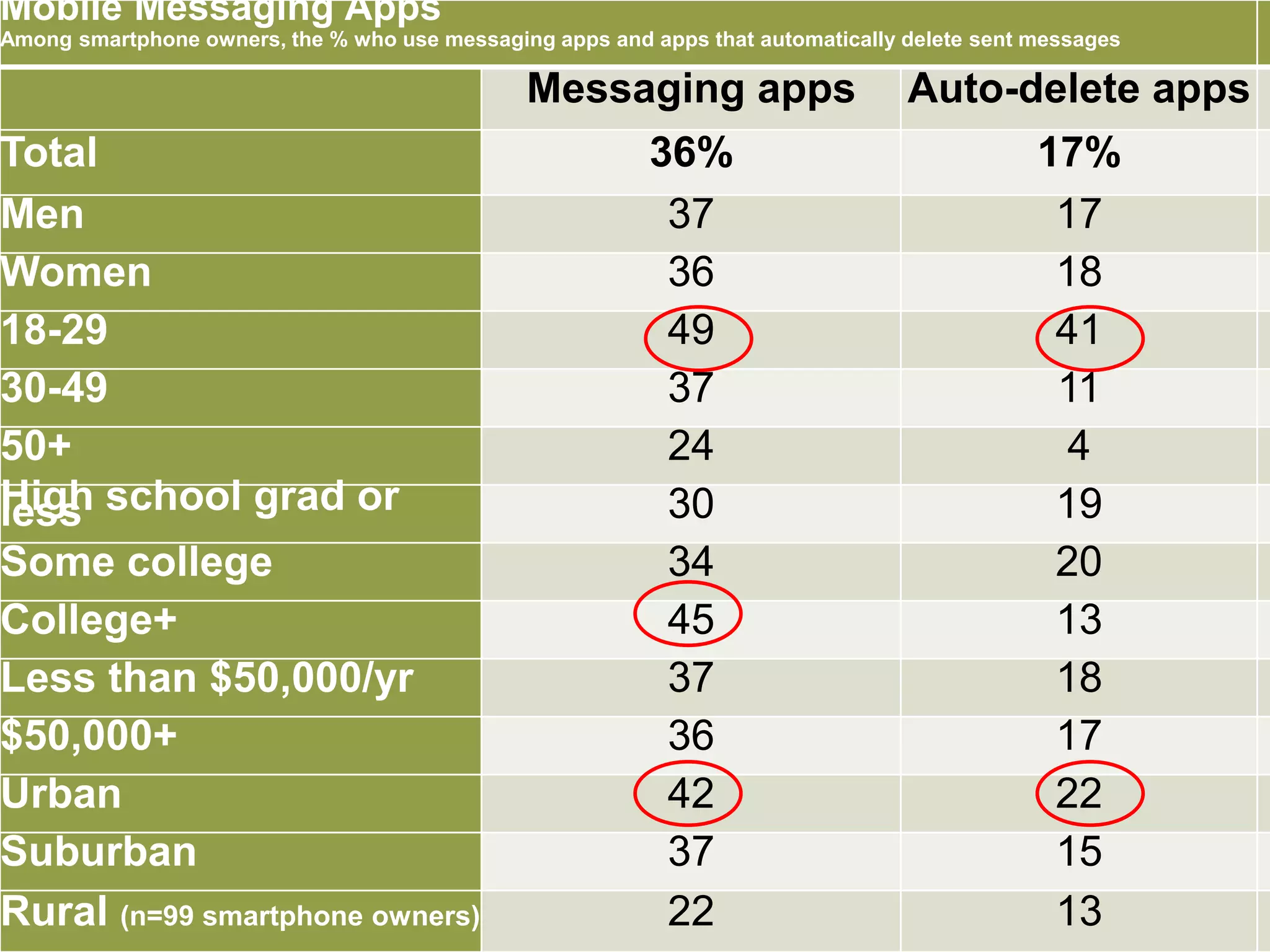
Mobile Messaging Apps
Among smartphone owners, the % who use messaging apps and apps that automatically delete sent messages
Messaging apps Auto-delete apps
Total 36% 17%
Men 37 17
Women 36 18
18-29 49 41
30-49 37 11
50+ 24 4
High school grad orless 30 19
Some college 34 20
College+ 45 13
Less than $50,000/yr 37 18
$50,000+ 36 17
Urban 42 22
Suburban 37 15
Rural (n=99 smartphone owners) 22 13
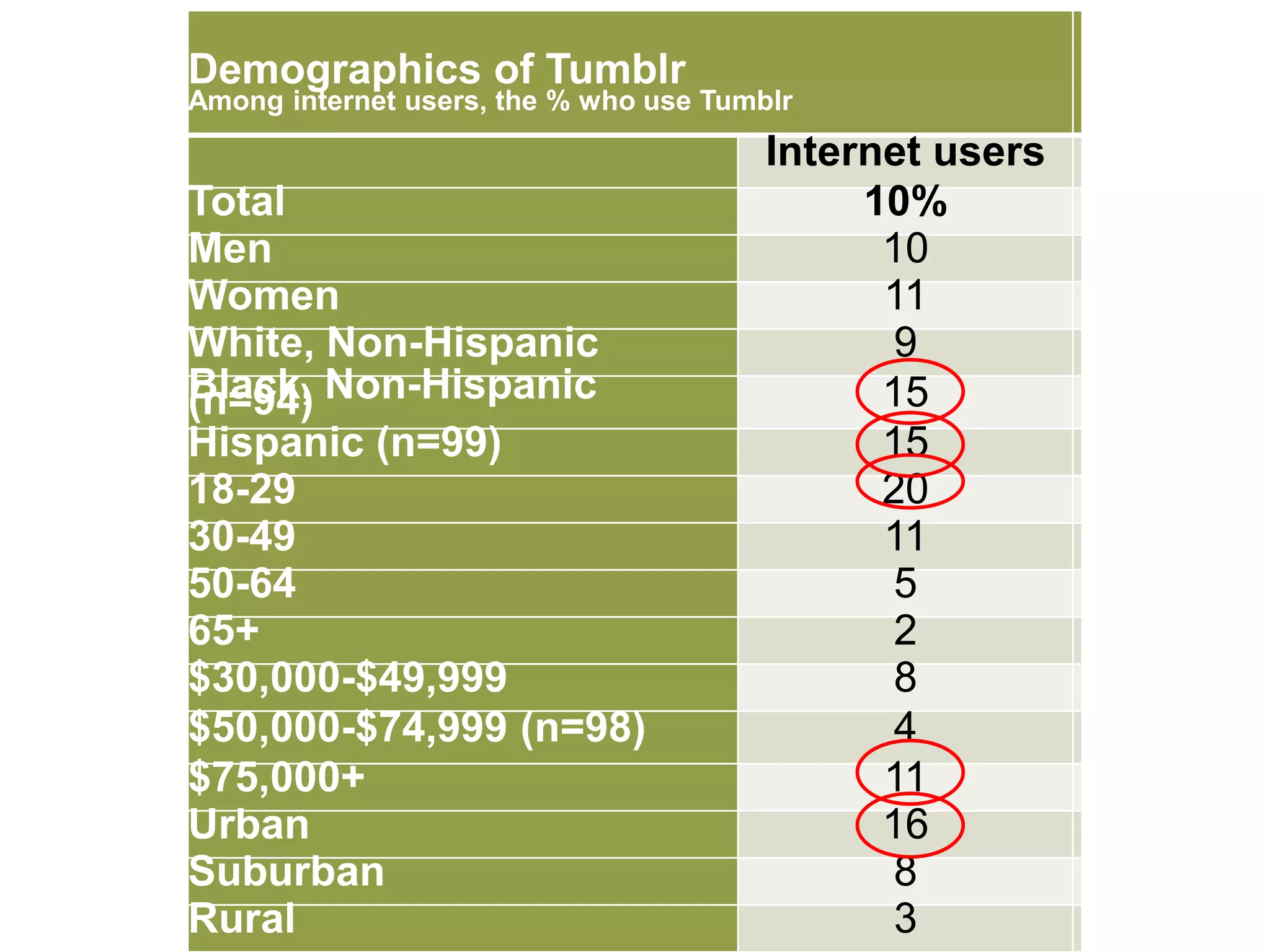
Demographics of Tumblr
Among internet users, the % who use Tumblr
Internet users
Total 10%
Men 10
Women 11
White, Non-Hispanic 9
Black, Non-Hispanic(n=94) 15
Hispanic (n=99) 15
18-29 20
30-49 11
50-64 5
65+ 2
$30,000-$49,999 8
$50,000-$74,999 (n=98) 4
$75,000+ 11
Urban 16
Suburban 8
Rural 3
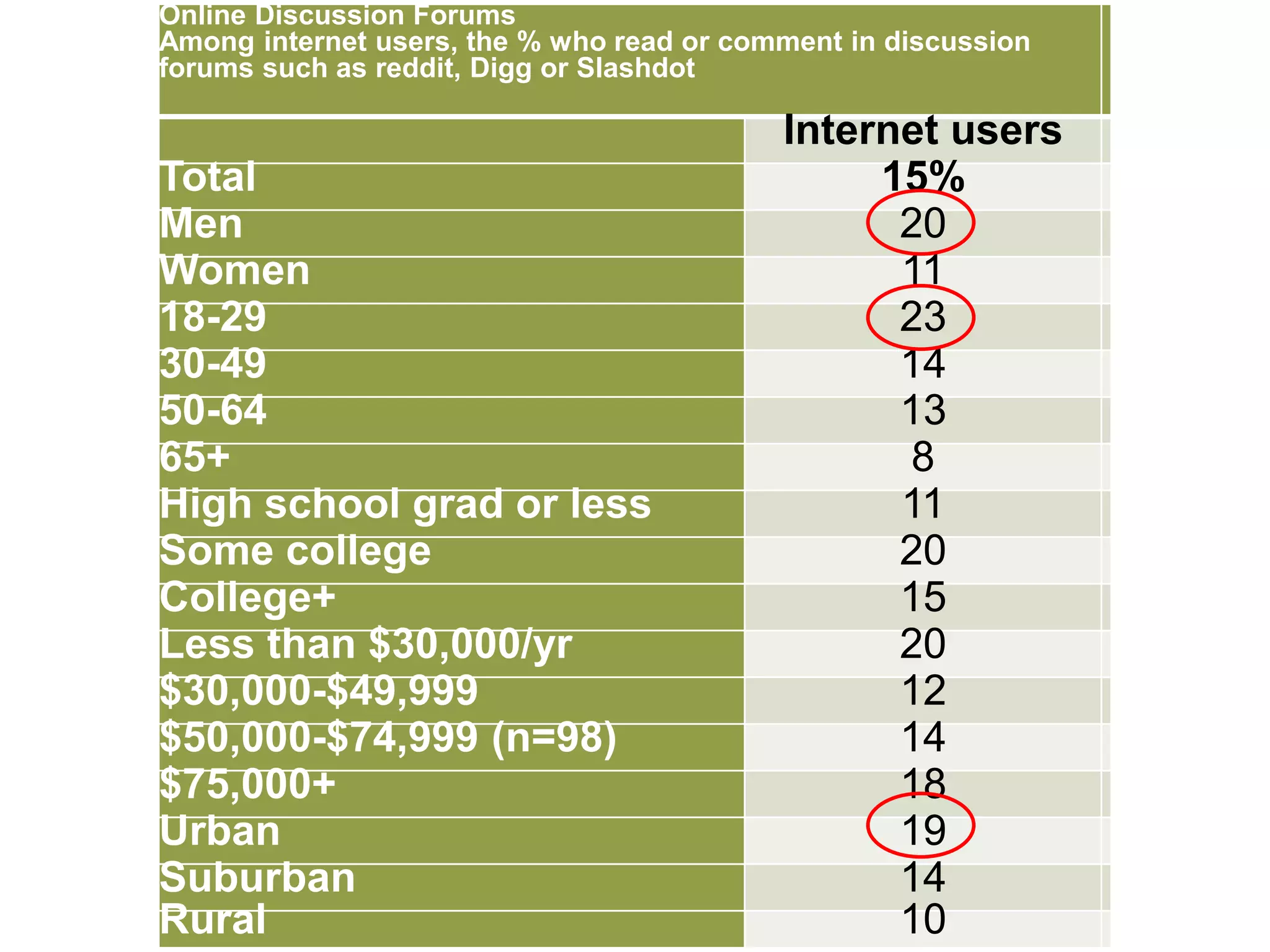
Online Discussion Forums
Among internet users, the % who read or comment in discussion
forums such as reddit, Digg or Slashdot
Internet users
Total 15%
Men 20
Women 11
18-29 23
30-49 14
50-64 13
65+ 8
High school grad or less 11
Some college 20
College+ 15
Less than $30,000/yr 20
$30,000-$49,999 12
$50,000-$74,999 (n=98) 14
$75,000+ 18
Urban 19
Suburban 14
Rural 10
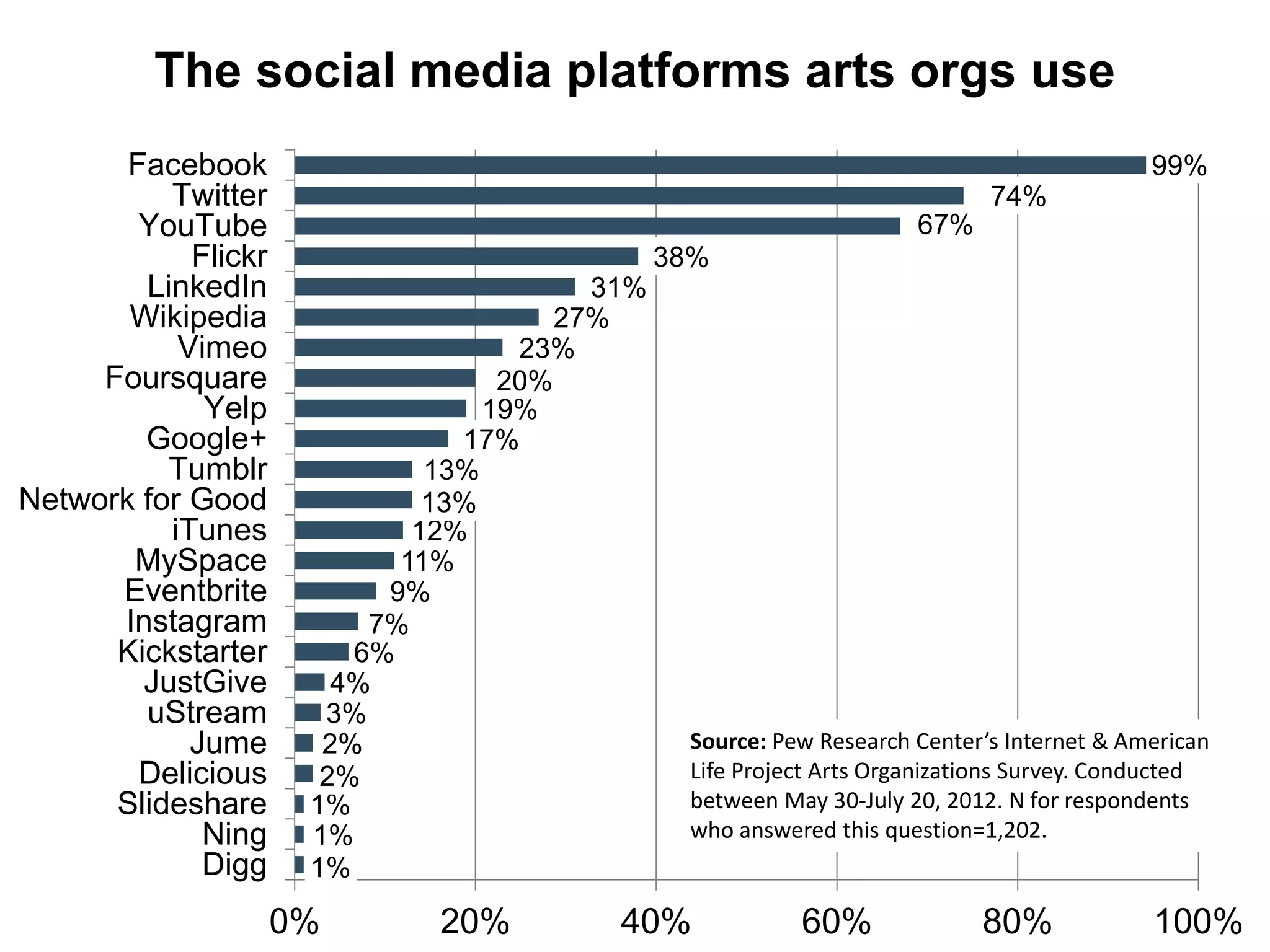
The social media platforms arts orgs use
1%
1%
1%
2%
2%
3%
4%
6%
7%
9%
11%
12%
13%
13%
17%
19%
20%
23%
27%
31%
38%
67%
74%
99%
0% 20% 40% 60% 80% 100%
Digg
Ning
Slideshare
Delicious
Jume
uStream
JustGive
Kickstarter
Instagram
Eventbrite
MySpace
iTunes
Network for Good
Tumblr
Google+
Yelp
Foursquare
Vimeo
Wikipedia
LinkedIn
Flickr
YouTube
Twitter
Facebook
Source: Pew Research Center’s Internet & American
Life Project Arts Organizations Survey. Conducted
between May 30-July 20, 2012. N for respondents
who answered this question=1,202.
102
138
148
153
141
132
95
70
48
36
31
16
9
10
3
2
1
1 platform
2 platforms
3 platforms
4 platforms
5 platforms
6 platforms
7 platforms
8 platforms
9 platforms
10 platforms
11 platforms
12 platforms
13 platforms
14 platforms
15 platforms
16 platforms
17 platforms
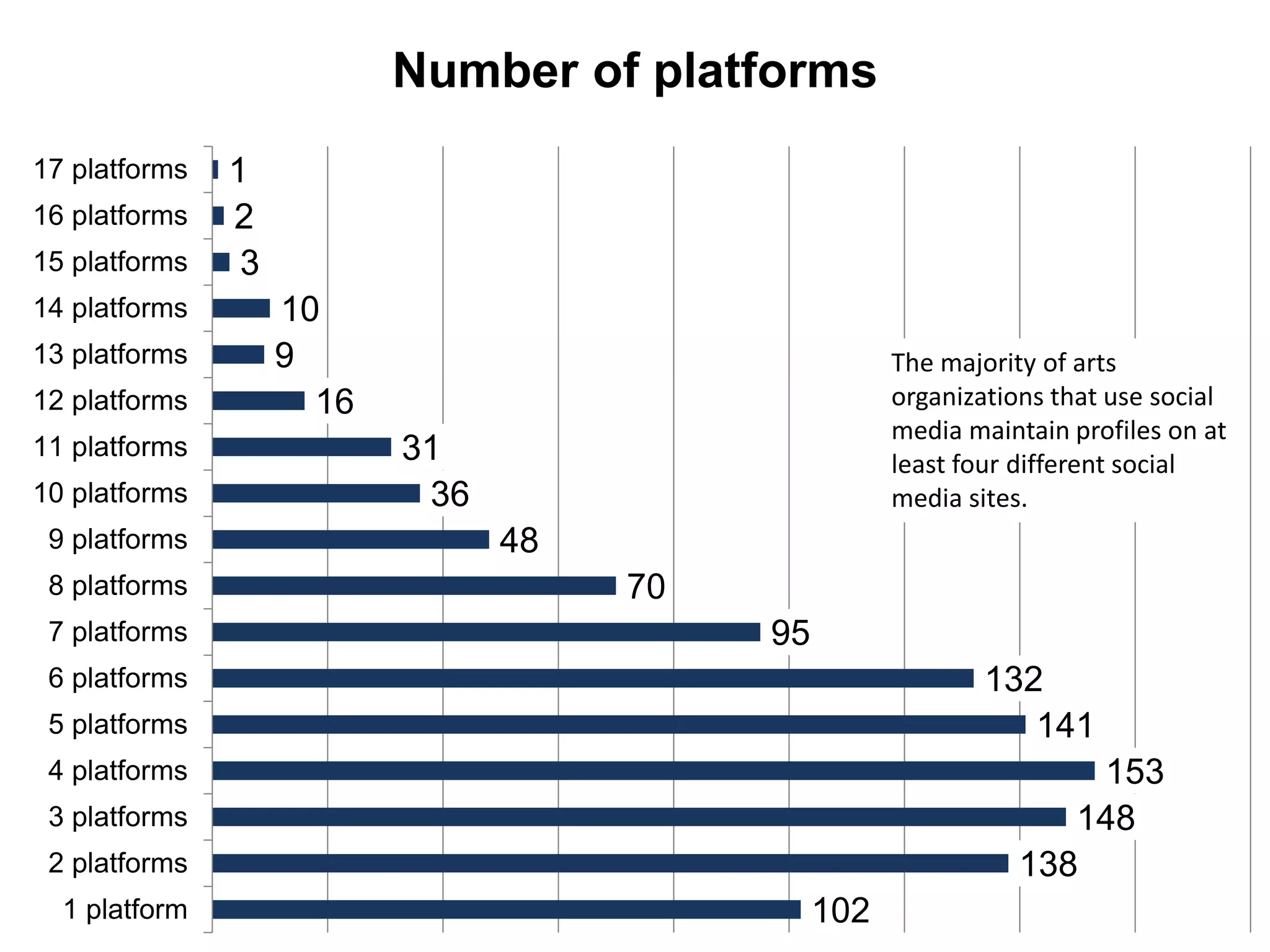
Number of platforms
The majority of arts
organizations that use social
media maintain profiles on at
least four different social
media sites.
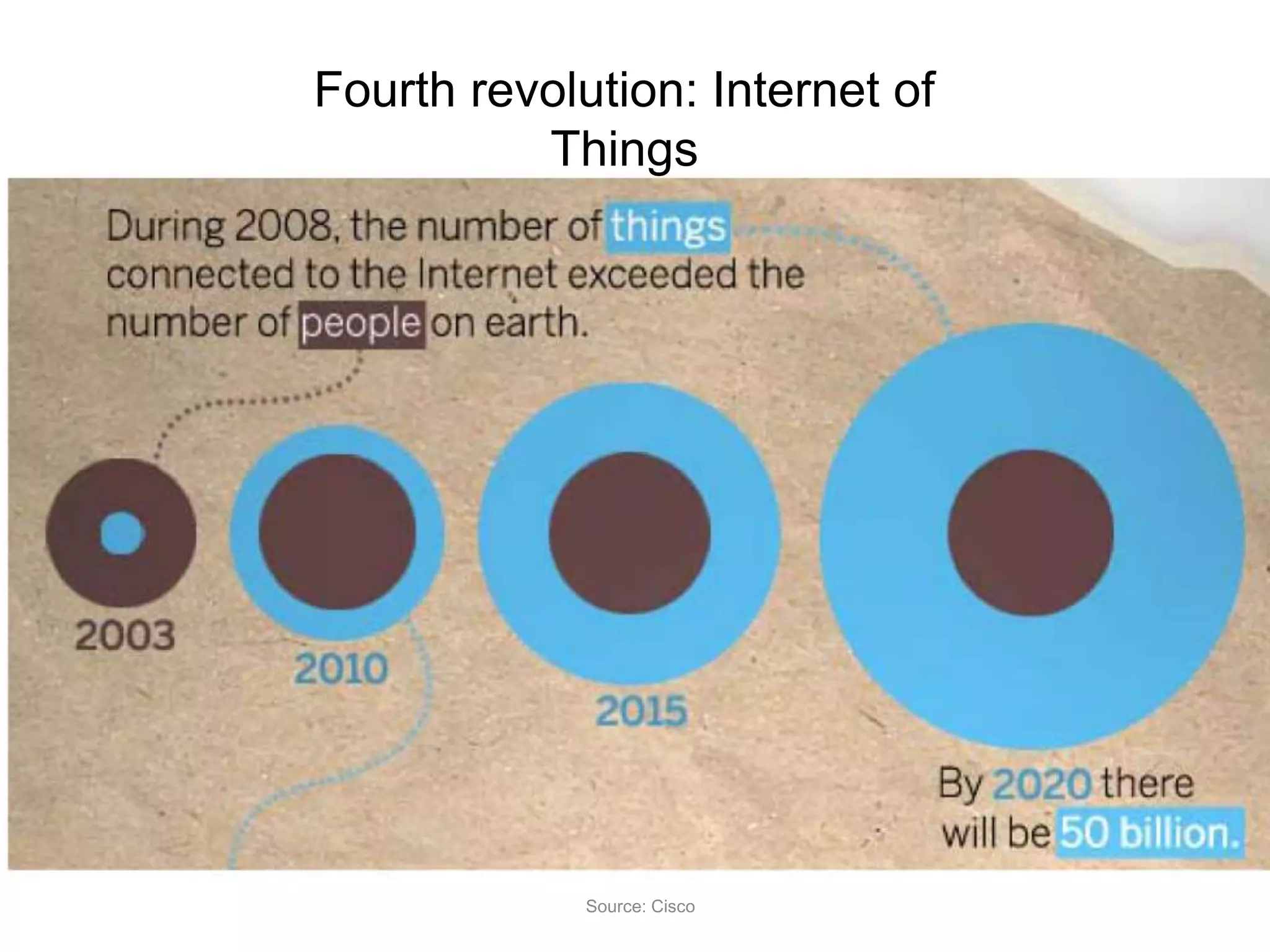
Source: Cisco
Fourth revolution: Internet of
Things
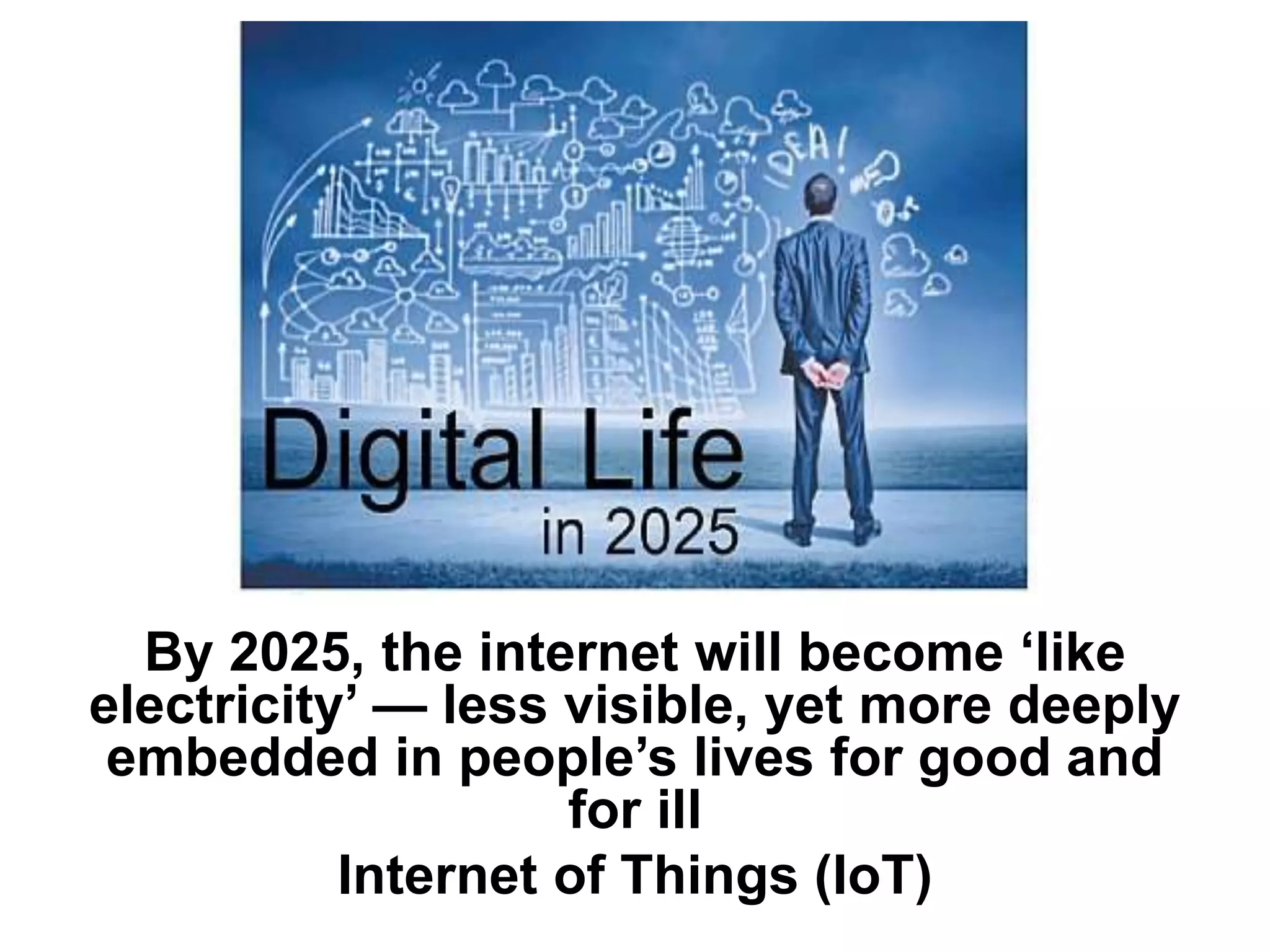
By 2025, the internet will become ‘like
electricity’ — less visible, yet more deeply
embedded in people’s lives for good and
for ill
Internet of Things (IoT)
Implications for civic actors - 1
Complexity is the new normal
You need to work harder to:
1) Be mobile friendly
2) Know who your audience is
3) Know how to reach them AND know
how to be found by them
4) Know how to create ‘spreadable
messages’
5) Know how to listen and have dialogue
Implications for civic actors - 2
In a polarized media
environment, your goals will
affect your communications
strategy
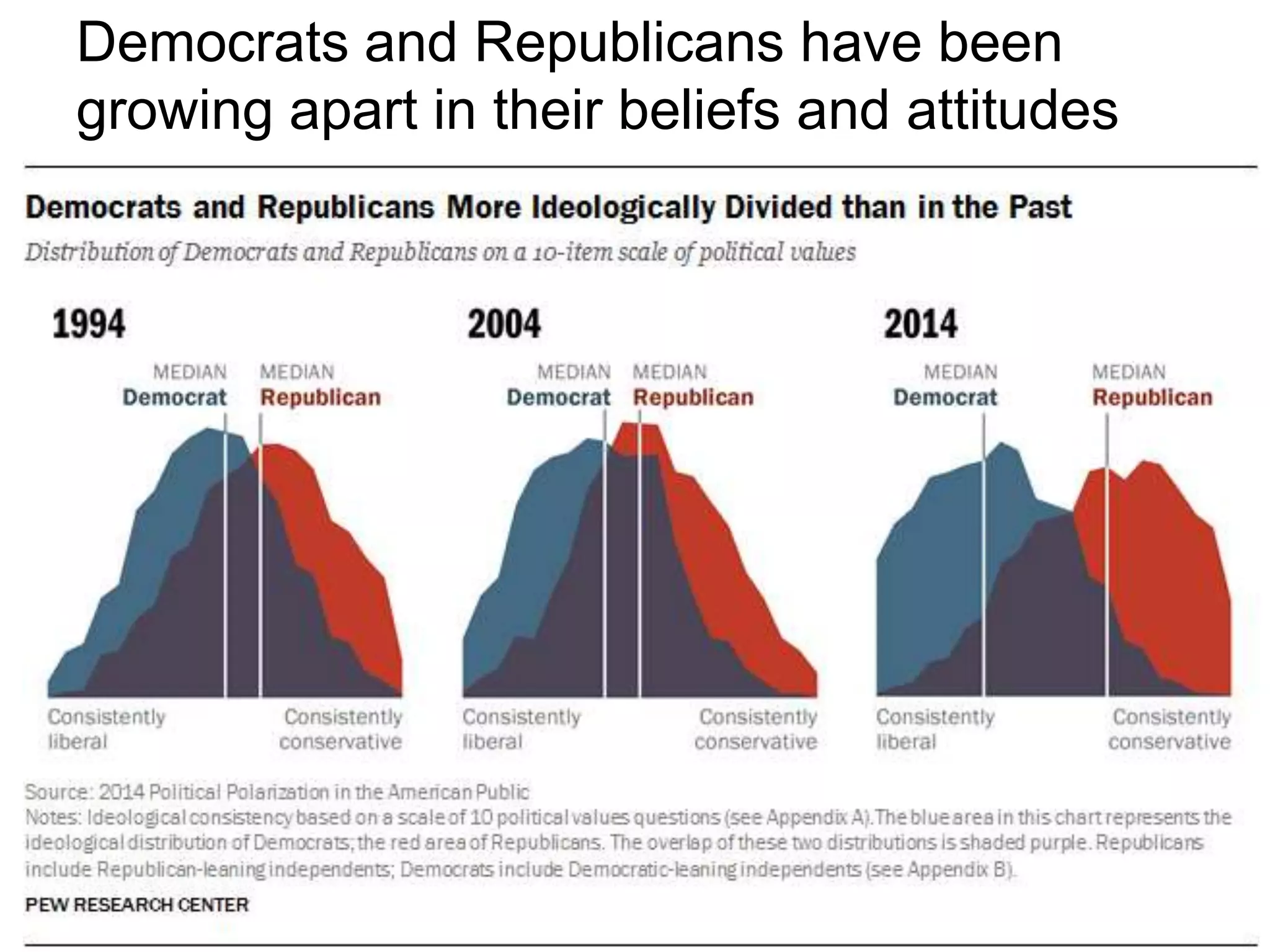
Democrats and Republicans have been
growing apart in their beliefs and attitudes
And also growing apart in their personal
opinions and preferences
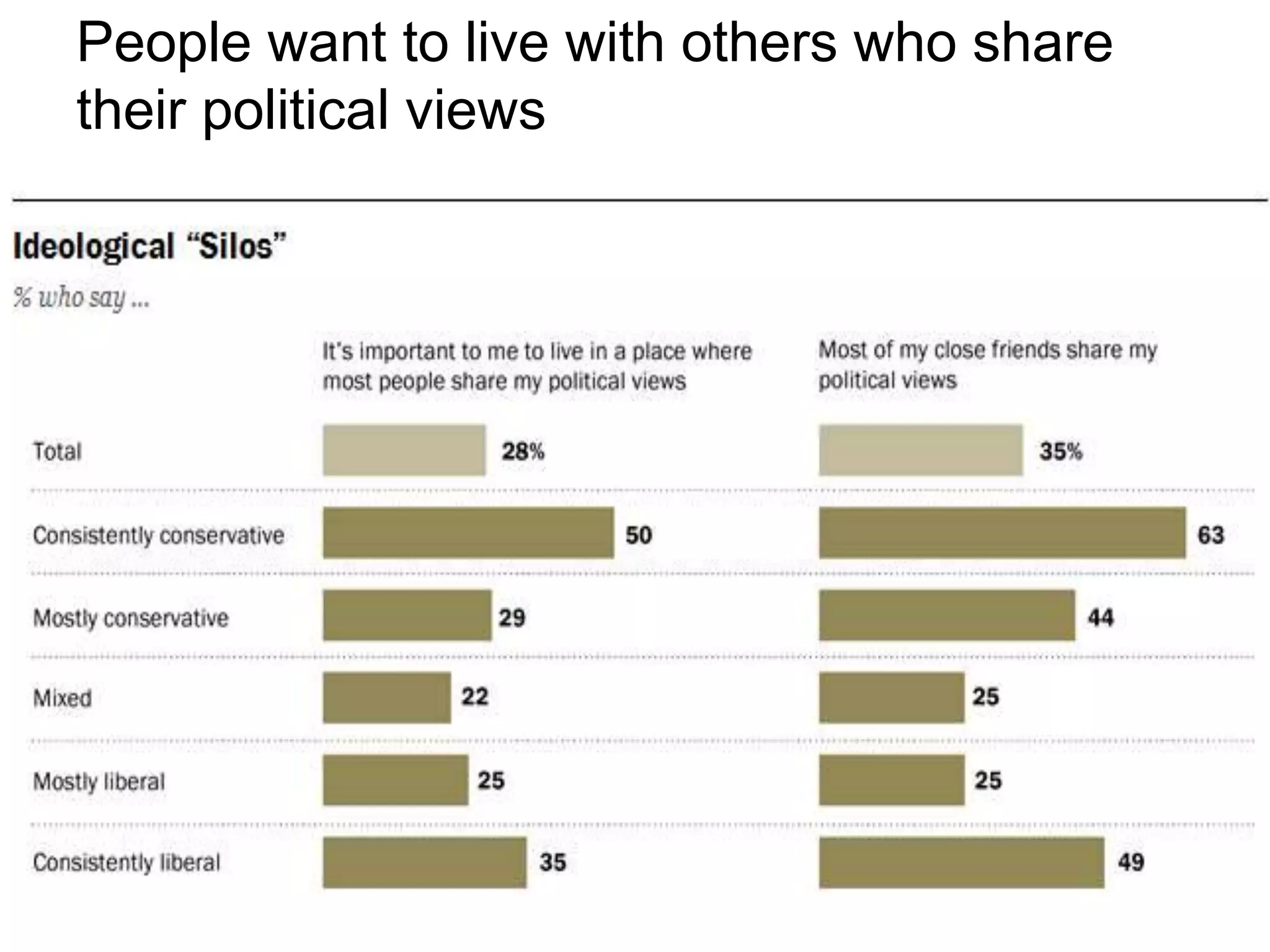
People want to live with others who share
their political views
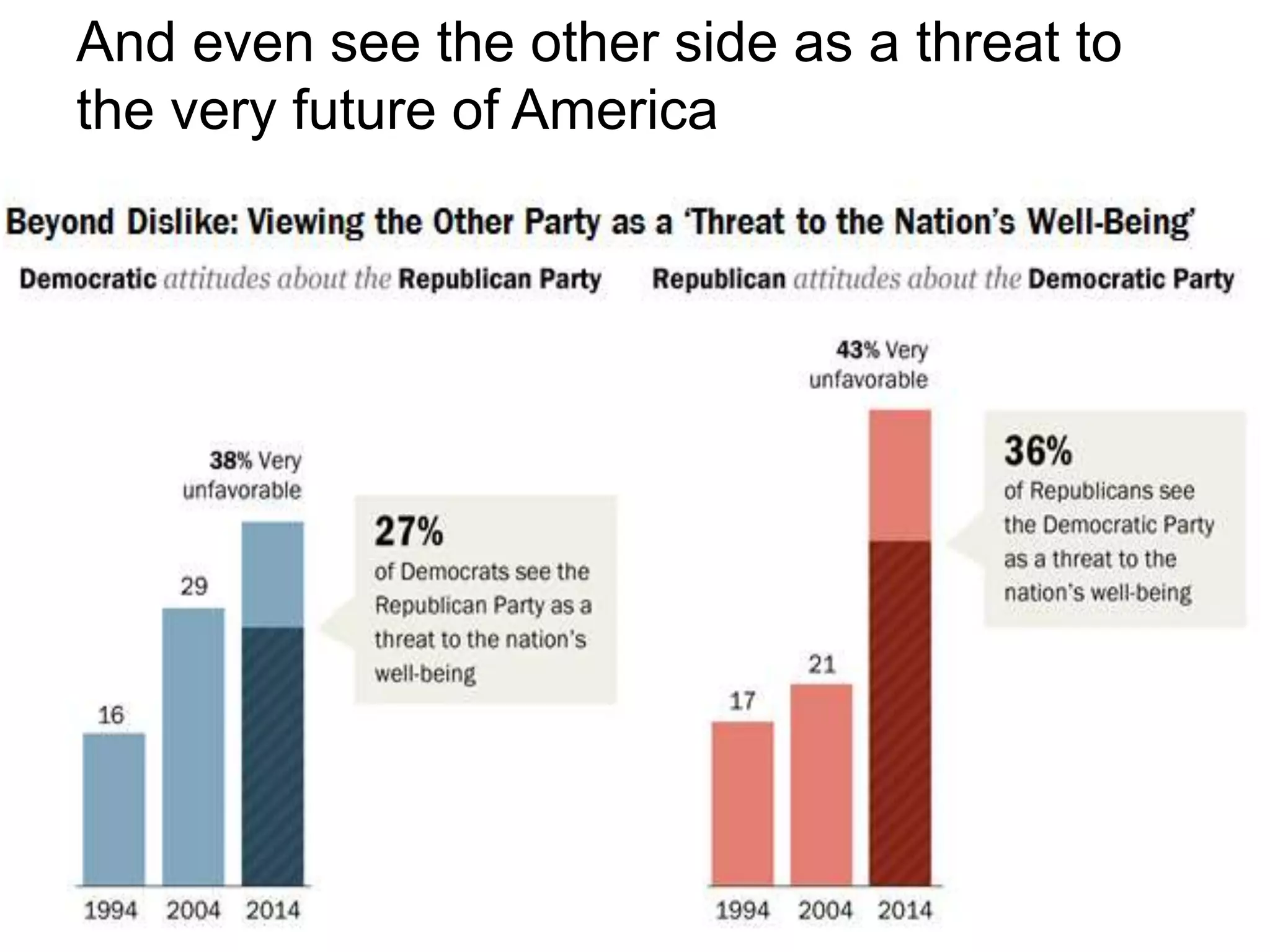
And even see the other side as a threat to
the very future of America
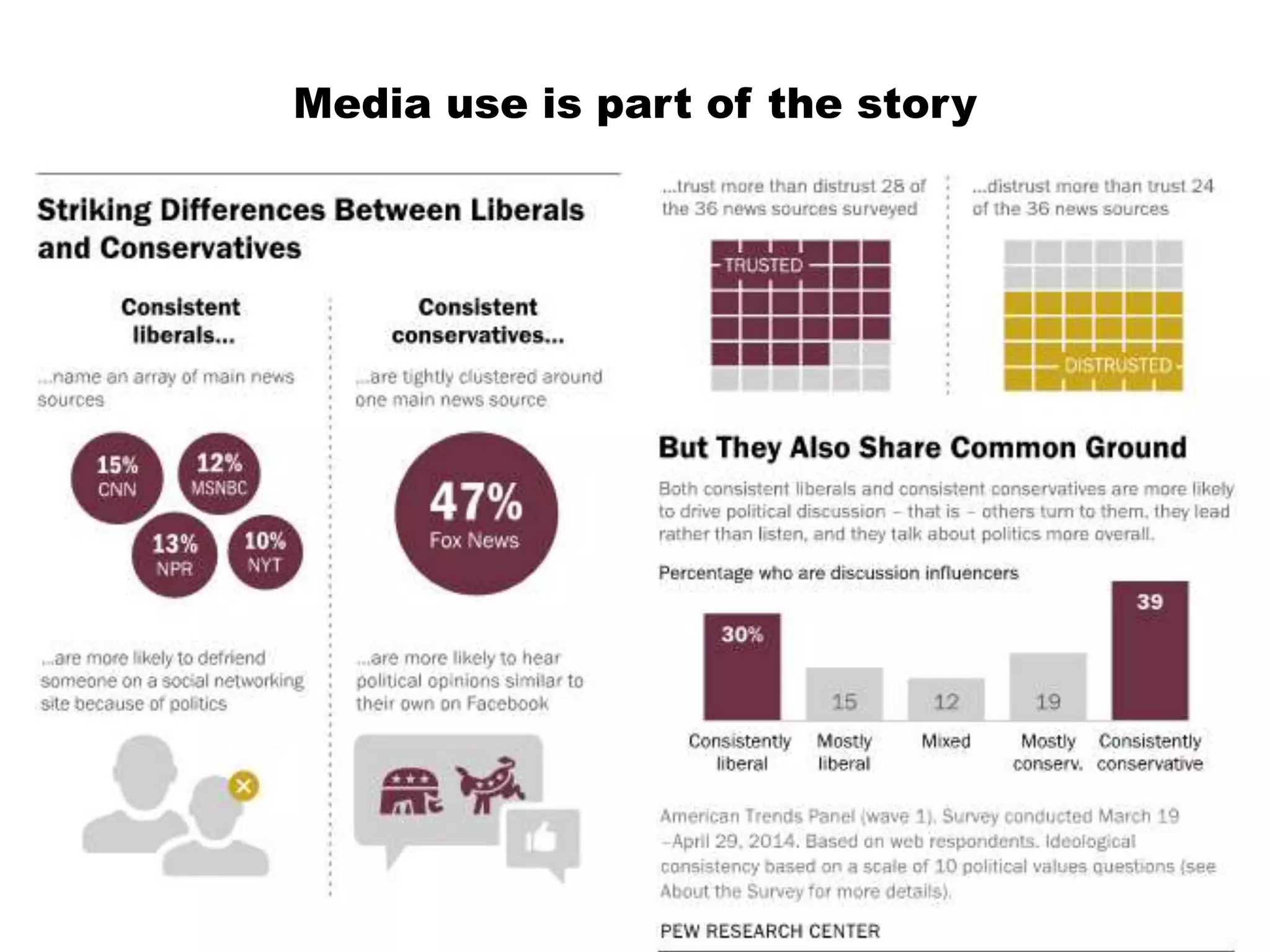
Media use is part of the story
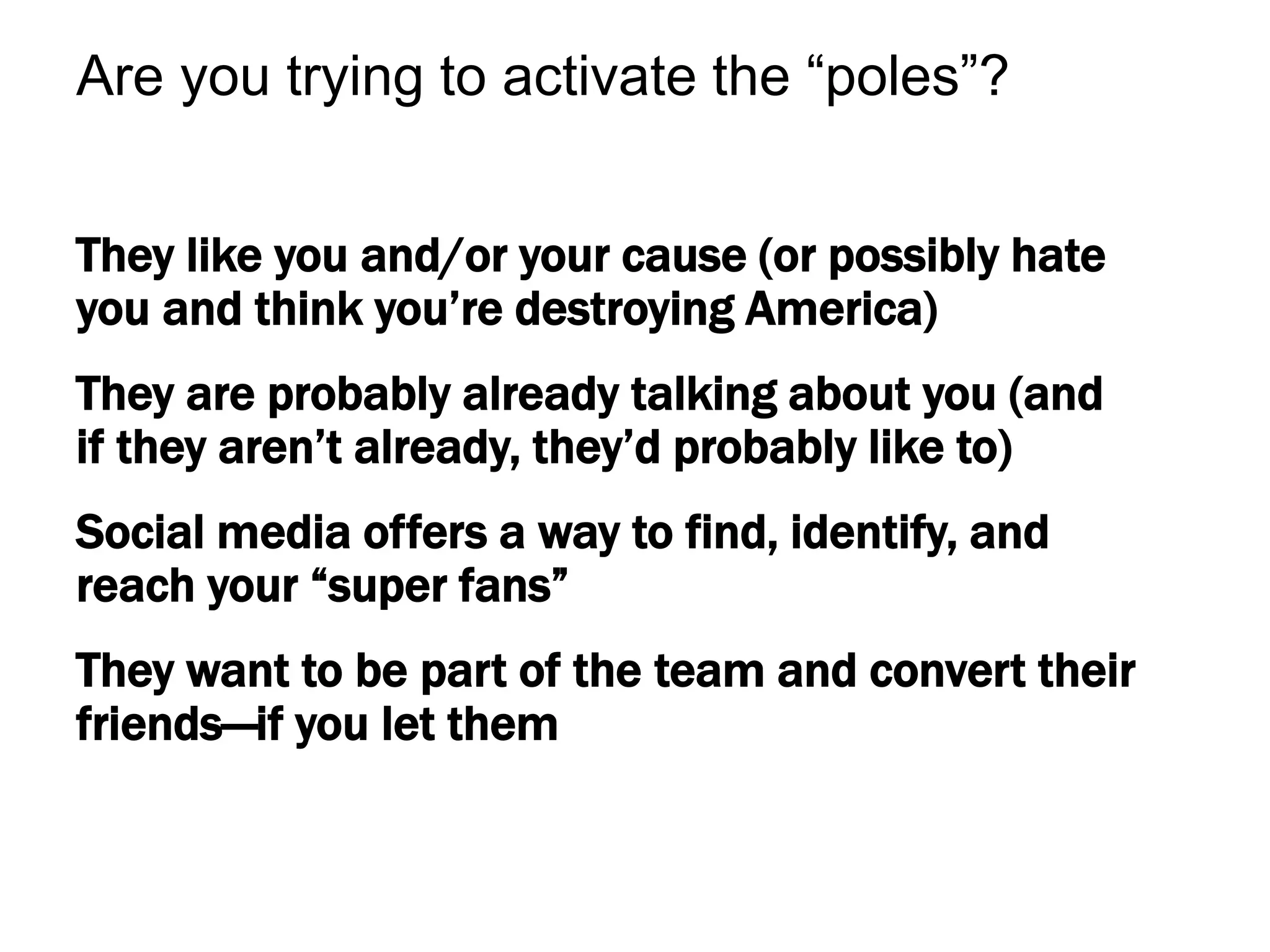
They like you and/or your cause (or possibly hate
you and think you’re destroying America)
They are probably already talking about you (and
if they aren’t already, they’d probably like to)
Social media offers a way to find, identify, and
reach your “super fans”
They want to be part of the team and convert their
friends—if you let them
Are you trying to activate the “poles”?
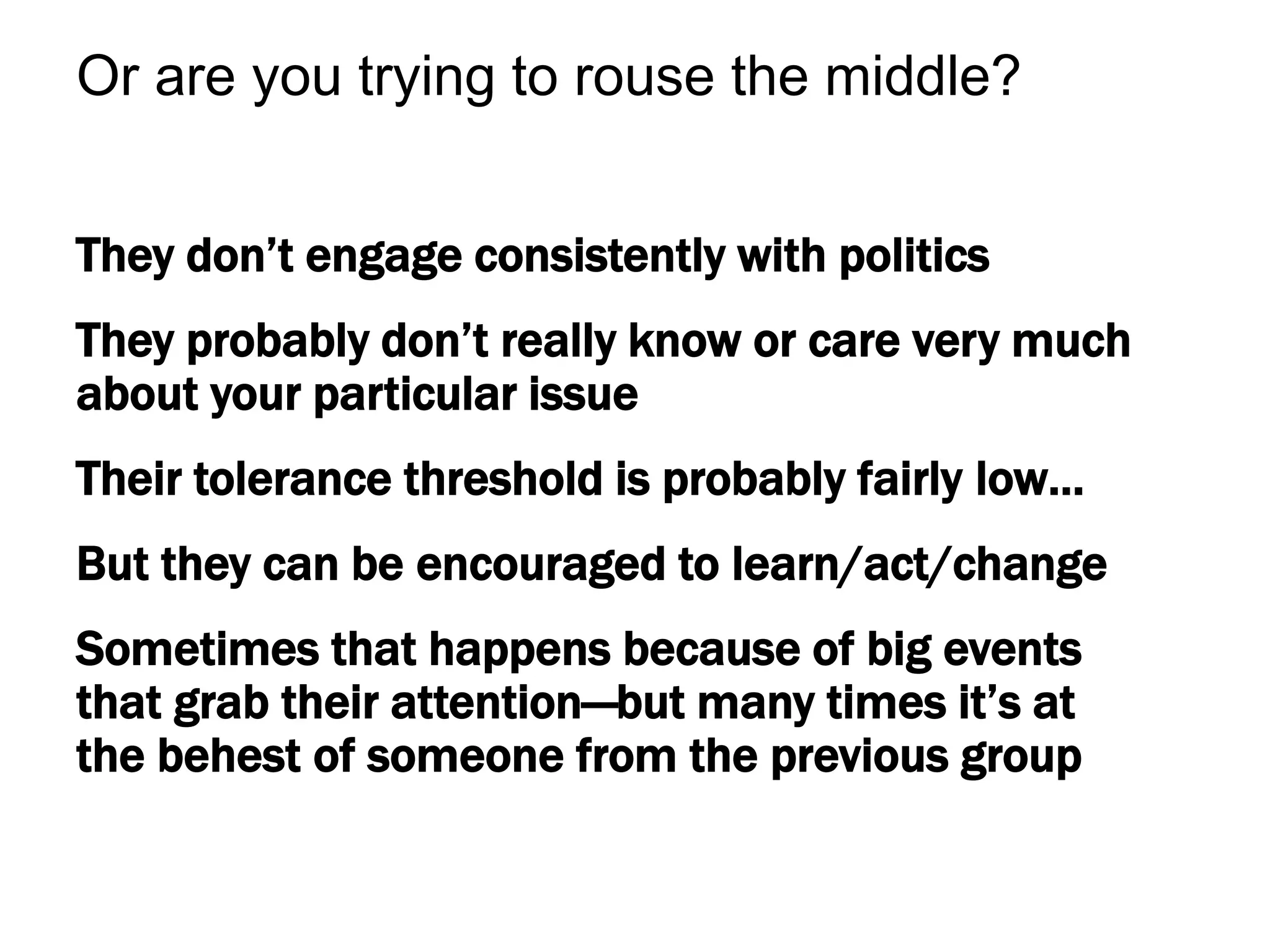
They don’t engage consistently with politics
They probably don’t really know or care very much
about your particular issue
Their tolerance threshold is probably fairly low…
But they can be encouraged to learn/act/change
Sometimes that happens because of big events
that grab their attention—but many times it’s at
the behest of someone from the previous group
Or are you trying to rouse the middle?
Your optimum moments for
teaching and engagement
• When you can “manufacture” a campaign
• When you/your issues are especially
timely, relevant at the personal AND
cultural level (e.g. when news breaks)
• When your “close up” unexpectedly
comes
• When your evangelists work their
networks
• When you can recruit unexpected allies
Implications for civic actors - 3
You have new ways to generate and
collect data to assess your impact
Be not
afraid
Thank you!

Networked: The New Social Operating System in Civic Life

  • 1.
    Networked The New SocialOperating System in Civic Life October 22, 2015 Lee Rainie - @lrainie and lrainie@pewinternet.org Director, Internet, Science and Technology Research
  • 3.
  • 4.
  • 6.
    r/atheism “My mistake sir,I’m sure Jesus will pay for my rent and groceries”
  • 9.
  • 10.
    http://nodexlgraphgallery.org/Pages/Graph.aspx?graphID=2701 Top URLs inTweet in Entire Graph: http://guardiancomment.tumblr.com/post/42024491123/chelsea-welch-the-us-waitress- who-was-fired-after http://www.guardian.co.uk/p/3dfqt/tw http://www.guardian.co.uk/commentisfree/2013/feb/01/fired-applebees-waitress-needs- tips http://www.tumblr.com/ZyqxEwd8sjXp http://www.guardian.co.uk/p/3dfqt http://www.dailydot.com/news/applebees-pastor-tip-waitress-facebook/ http://neil-gaiman.tumblr.com/post/42074466808/guardiancomment-chelsea-welch- the-us-waitress http://m.guardian.co.uk/commentisfree/2013/feb/01/fired-applebees-waitress-needs-tips http://www.wptv.com/dpp/news/local_news/water_cooler/chelsea-welch-applebees- waitress-fired-alois-bell-pastor-complains-about-reddit-receipt-photo http://www.change.org/petitions/applebee-s-and-truth-in-the-word-deliverance- ministries-give-chelsea-welch-her-job-back-and-fire-pastor-alois-bell
  • 13.
    News in thenetworked age Impact on civic debate Spiritual precepts and atheism Vigilantism Privacy rights, publicity rights, and collapsed contexts Minimum wage policies & employment practices Corporate social media policies Impact on news ecosystem New news venues New news initiators New gatekeepers, influencers, content drivers well beyond the locale of the news New pathways to consumers New role for “people formerly known as the audience” (Jeff Rosen) New ways to keep the story moving and mobilize followers
  • 14.
    Civic life isnetworked life with network information created and shared by networked organizations
  • 15.
    New social andcivic reality: Networked Individualism The move from tight groups to loose networks
  • 16.
    Personal networks are… Increasinglyimportant – awareness, trust Differently composed – segmented, layered More personal liberation & more work
  • 17.
    TECHNOLOGY PUSHES THE MOVETO NETWORKED INDIVIDUALISM INTO OVERDRIVE
  • 18.
    14 36 44 52 55 59 61 63 67 71 7474 76 76 79 83 84 84 87 0 20 40 60 80 100 1996 2000 2003 2006 2009 2012 2015 Revolution 1 - Internet Users %
  • 19.
    Revolution 1 –Home Broadband Users 3% 70 %
  • 20.
    18 25 31 45 59 66 73 75 77 82 81 83 8485 87 91 89 91 92 11 19 27 37 43 44 50 53 55 68 0 20 40 60 80 100 Dec-00 Dec-03 Apr-06 Apr-09 Apr-12 May-13 Jun-15 Cell Smart phone Revolution 2 – Mobile Connectivity
  • 21.
    10% 76 7 65 2005 2007 20092011 2013 2015 Among internet Among all Revolution 3 – Social Networking / Social Media
  • 22.
    Any social networkingsite 76% of internet-using adults 89% of ages 18-29 49% of ages 65+ No diff. by race/ethnicity No diff. by education No diff. by income Facebook 22 72% of internet-using adults 82% of ages 18-29 48% of ages 65+ 77% of women 18-29 66% of men No diff. by race/ethnicity No diff. by education No diff. by income Revolution 3 – Social Networking / Social Media
  • 23.
    Pinterest 31% of internet-using adults 44%of women 16% of men 32% of whites 23% of blacks/32% of Hispanics 31% of college grads 25% of H.S. or less 34% of households >$50,000 22% of households <$50,000 LinkedIn 23 25% of internet-using adults 30% of ages 30-64 21% of ages 65+ 46% of college grads 9% of H.S. or less No diff. by gender No diff. by race/ethnicity Revolution 3 – Social Networking / Social Media
  • 24.
    Twitter 23% of internet-using adults 32%of ages 18-29 6% of ages 65+ 29% of blacks 16% of whites / Hispanics 27% of college grads 19% of H.S. or less 26% of households >$50,000 20% of households <$50,000 Instagram 24 28% of internet-using adults 55% of ages 18-29 4% of ages 65+ 31% of women 24% of men 47% of blacks / 38% of Hispanics 21% of whites No diff. by income /educ. Revolution 3 – Social Networking / Social Media
  • 25.
    Mobile Messaging Apps Amongsmartphone owners, the % who use messaging apps and apps that automatically delete sent messages Messaging apps Auto-delete apps Total 36% 17% Men 37 17 Women 36 18 18-29 49 41 30-49 37 11 50+ 24 4 High school grad orless 30 19 Some college 34 20 College+ 45 13 Less than $50,000/yr 37 18 $50,000+ 36 17 Urban 42 22 Suburban 37 15 Rural (n=99 smartphone owners) 22 13
  • 26.
    Demographics of Tumblr Amonginternet users, the % who use Tumblr Internet users Total 10% Men 10 Women 11 White, Non-Hispanic 9 Black, Non-Hispanic(n=94) 15 Hispanic (n=99) 15 18-29 20 30-49 11 50-64 5 65+ 2 $30,000-$49,999 8 $50,000-$74,999 (n=98) 4 $75,000+ 11 Urban 16 Suburban 8 Rural 3
  • 27.
    Online Discussion Forums Amonginternet users, the % who read or comment in discussion forums such as reddit, Digg or Slashdot Internet users Total 15% Men 20 Women 11 18-29 23 30-49 14 50-64 13 65+ 8 High school grad or less 11 Some college 20 College+ 15 Less than $30,000/yr 20 $30,000-$49,999 12 $50,000-$74,999 (n=98) 14 $75,000+ 18 Urban 19 Suburban 14 Rural 10
  • 28.
    The social mediaplatforms arts orgs use 1% 1% 1% 2% 2% 3% 4% 6% 7% 9% 11% 12% 13% 13% 17% 19% 20% 23% 27% 31% 38% 67% 74% 99% 0% 20% 40% 60% 80% 100% Digg Ning Slideshare Delicious Jume uStream JustGive Kickstarter Instagram Eventbrite MySpace iTunes Network for Good Tumblr Google+ Yelp Foursquare Vimeo Wikipedia LinkedIn Flickr YouTube Twitter Facebook Source: Pew Research Center’s Internet & American Life Project Arts Organizations Survey. Conducted between May 30-July 20, 2012. N for respondents who answered this question=1,202.
  • 29.
    102 138 148 153 141 132 95 70 48 36 31 16 9 10 3 2 1 1 platform 2 platforms 3platforms 4 platforms 5 platforms 6 platforms 7 platforms 8 platforms 9 platforms 10 platforms 11 platforms 12 platforms 13 platforms 14 platforms 15 platforms 16 platforms 17 platforms Number of platforms The majority of arts organizations that use social media maintain profiles on at least four different social media sites.
  • 30.
  • 31.
    By 2025, theinternet will become ‘like electricity’ — less visible, yet more deeply embedded in people’s lives for good and for ill Internet of Things (IoT)
  • 32.
    Implications for civicactors - 1 Complexity is the new normal You need to work harder to: 1) Be mobile friendly 2) Know who your audience is 3) Know how to reach them AND know how to be found by them 4) Know how to create ‘spreadable messages’ 5) Know how to listen and have dialogue
  • 33.
    Implications for civicactors - 2 In a polarized media environment, your goals will affect your communications strategy
  • 34.
    Democrats and Republicanshave been growing apart in their beliefs and attitudes
  • 36.
    And also growingapart in their personal opinions and preferences
  • 37.
    People want tolive with others who share their political views
  • 38.
    And even seethe other side as a threat to the very future of America
  • 39.
    Media use ispart of the story
  • 40.
    They like youand/or your cause (or possibly hate you and think you’re destroying America) They are probably already talking about you (and if they aren’t already, they’d probably like to) Social media offers a way to find, identify, and reach your “super fans” They want to be part of the team and convert their friends—if you let them Are you trying to activate the “poles”?
  • 41.
    They don’t engageconsistently with politics They probably don’t really know or care very much about your particular issue Their tolerance threshold is probably fairly low… But they can be encouraged to learn/act/change Sometimes that happens because of big events that grab their attention—but many times it’s at the behest of someone from the previous group Or are you trying to rouse the middle?
  • 42.
    Your optimum momentsfor teaching and engagement • When you can “manufacture” a campaign • When you/your issues are especially timely, relevant at the personal AND cultural level (e.g. when news breaks) • When your “close up” unexpectedly comes • When your evangelists work their networks • When you can recruit unexpected allies
  • 43.
    Implications for civicactors - 3 You have new ways to generate and collect data to assess your impact
  • 44.
  • 45.

Editor's Notes

  • #5 http://news.yahoo.com/applebee-responds-fired-waitress-chelsea-welch-viral-god-184500260.html
  • #9 http://guardiancomment.tumblr.com/post/42024491123/chelsea-welch-the-us-waitress-who-was-fired-after
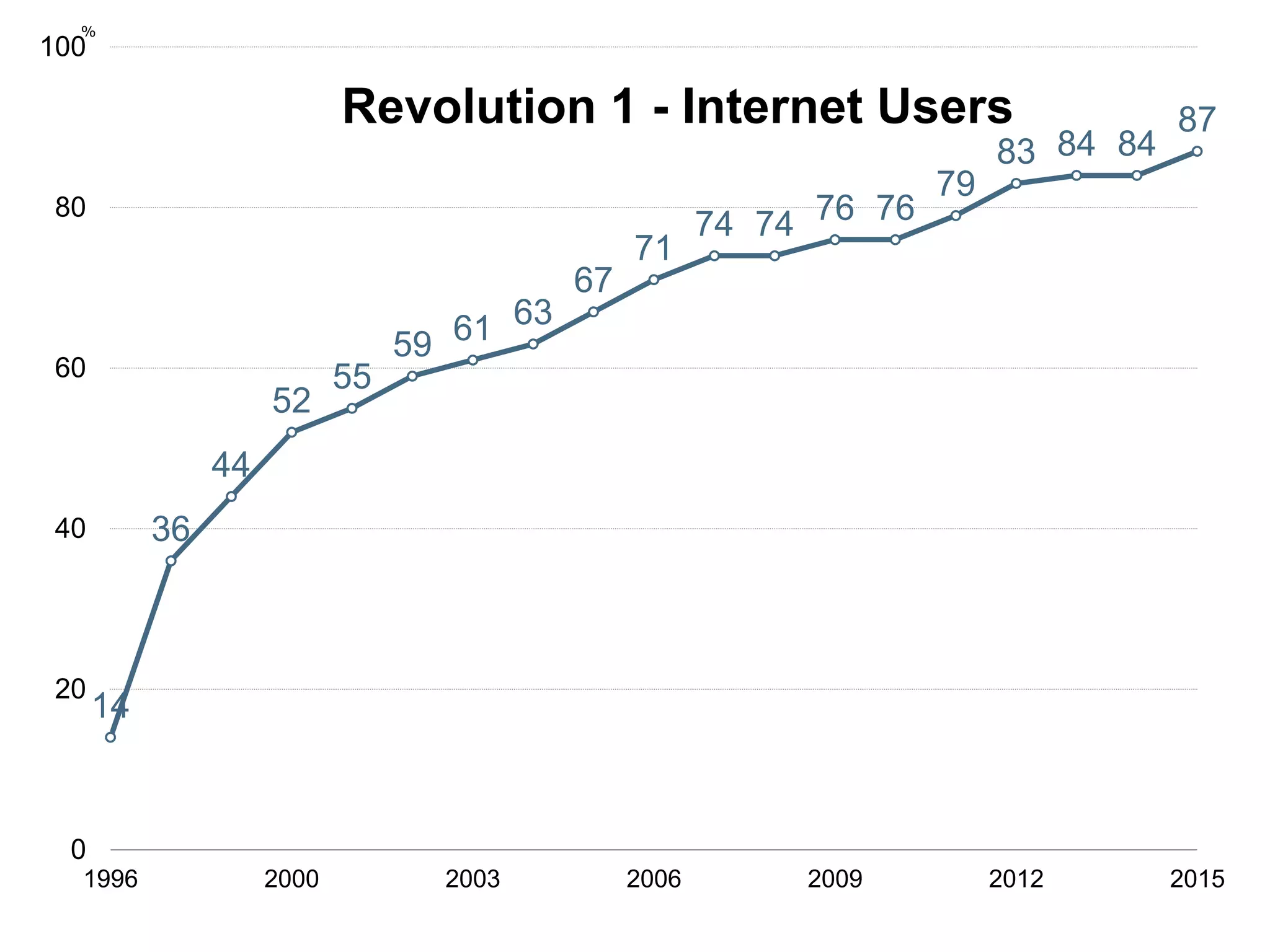
  • #19 The first revolution that we at Pew Research documented involves the rise of the internet and high-speed broadband connections to the internet. You can see in this chart that in America, about one tenth of adults used the internet in the year 1996. Now 87% of adults use the internet. Most of them have online wired connections at home or they use a smartphone with an internet connection at home. The rise of the internet and the world wide web had a profound impact because they allowed so many people and organizations to make contributions to news and information through websites. This exploded the number of opportunities that people had to find the information that interested them. As the web became a part of people’s daily lives, they found ways to get to the news and information that mattered most to them and it meant that the power of traditional, industrial-era news organizations to shape news stories and the culture was diminished a bit because people had other ways to discover the information they cared about. As the amount of information kept increasing and increasing it also meant that new information intermediaries like search engines became important ways that people found the material they needed.
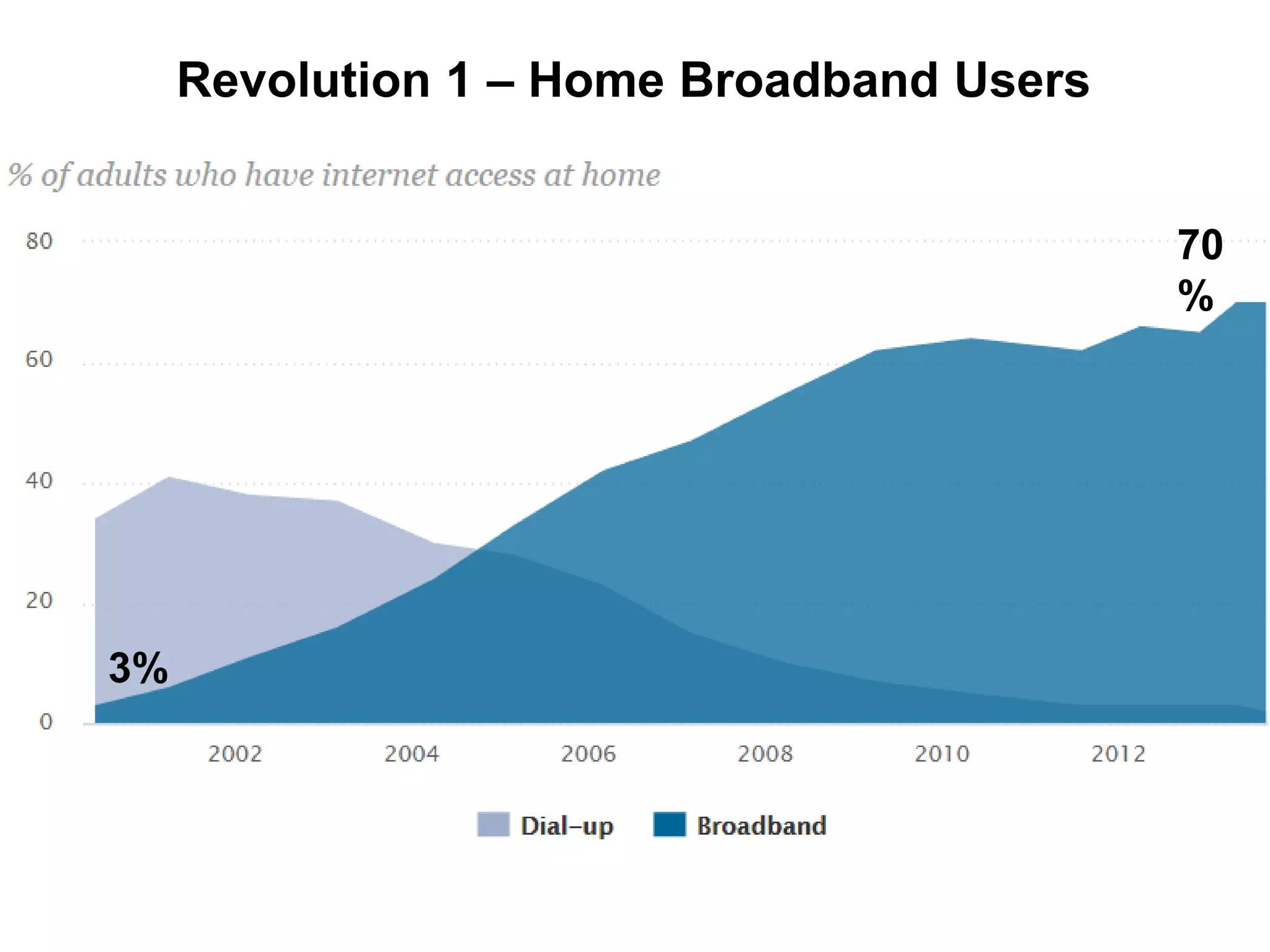
  • #20 These are the American data we have gathered that show how high-speed broadband connections spread through America since the year 2000. This is important because as broadband spread, people began to use the internet as an important “utility” in their lives. They stopped treating the internet as a “fun play thing” and started treated it as an essential factor that was woven into the rhythms of their lives. They started showing preference for digital content rather than paper content – they did not buy newspapers as much because they could get important news online. They stopped watching traditional television as much, and started to get their favorite programs online. They started using websites to learn how to cook food, or learn how to do algebra, or play games with each other, or even find people to date. It produced broad, big change throughout the culture.
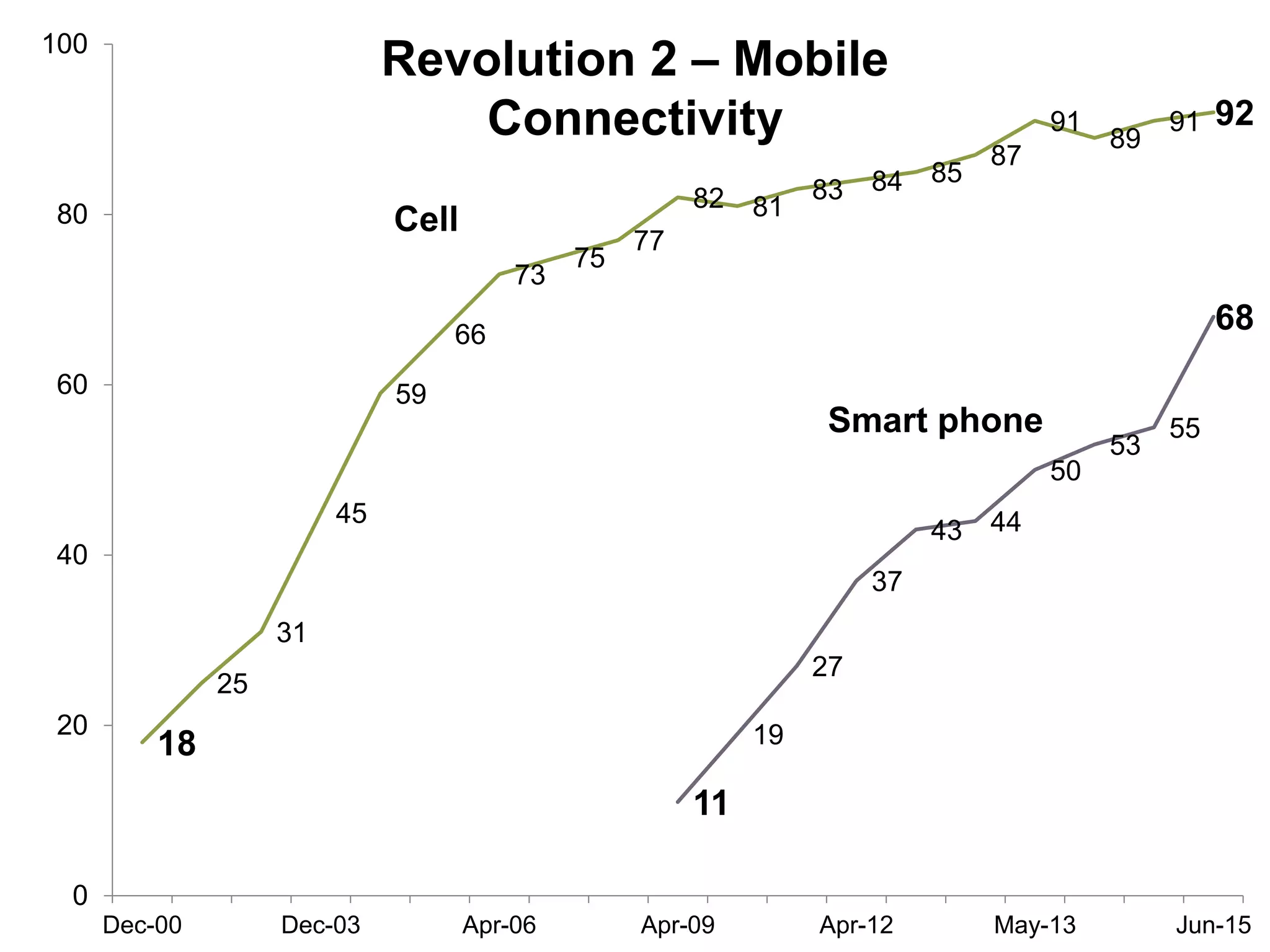
  • #21 The second revolution involved mobile connectivity as people began to enjoy cell phones and then smartphones after the Apple iPhone was introduced in 2007. You see in this chart now that 92% of American adults have cell phones and 68% -- two thirds – have smartphones. The mobile revolution has been really important because it means people can contact others anytime and anywhere. They can get information any time they want as long as they have their phone. I like to say that phones have allowed data to become our “third skin” – our first skin is our real skin; our second skin is our clothes; and now our third skin is all the data, information, and news that is in the air around us and easily captured by the apps in our mobile devices. Indeed, phones have become so important to people that they treat them like another body part – as important to them as their arms and their legs!
  • #32 We have seen lots of change already, but a fourth revolution is at our door. The internet of things (IoT) will be major force in the coming years. The internet of things means that lots of devices become networked – smart appliances, smart rooms, smart cars, smart buildings – and there is more “intelligence” built into artifacts of daily life. When we asked experts about what would happen in the next 10 years, they predicted by By 2025, the internet will become ‘like electricity’ — less visible, yet more deeply embedded in people’s lives for good and for ill. They thought the good benefits would include more convenience, more intelligence, and more connectivity. They worried about the impact of the IoT on privacy, about class divisions, and about whether government institutions could “keep up” and make wise policies about how these tools can be used. It will be a very challenging and exciting time.
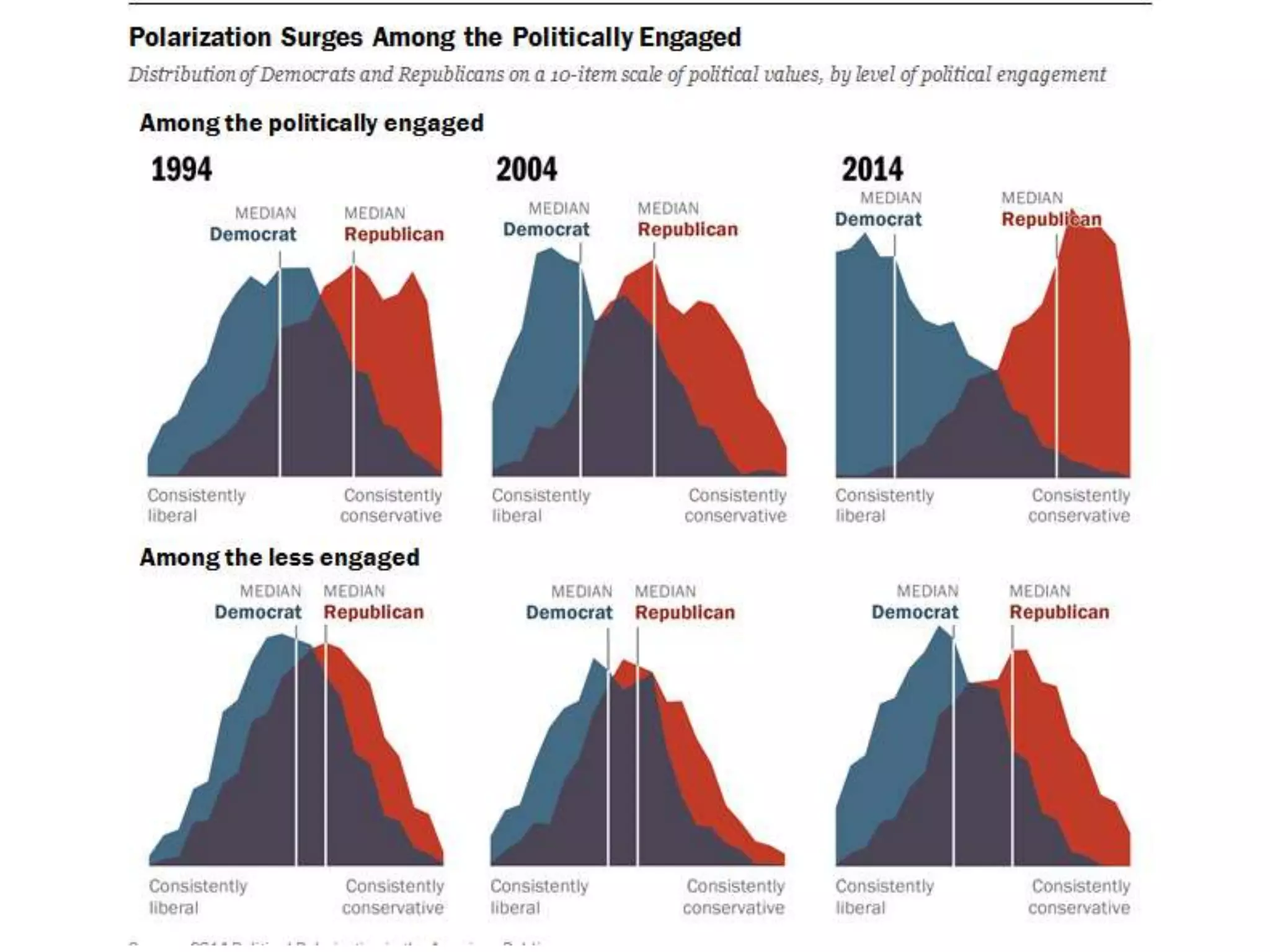
  • #36 But what’s very interesting is that this polarization is most pronounced among the people who are most engaged in the political process. If you look at people who are engaged politics, they’ve grown incredibly far apart. For people who are less actively engaged, they’ve grown apart somewhat but not nearly as much.