Performance is the new normal. Are you normal?
Dan Walter, CEP, is the founder of Performensation Consulting. Dan has more than 18 years of
experience in with equity compensation programs. He has designed and administrated both
management and broad-based programs, for both public and private companies.
Dan has worked extensively with companies in U.S. and abroad. His experience with young
entrepreneurial companies and established Fortune 100 companies provides his clients with a unique
perspective on compensation issues. He creates effective, and when needed, innovative company-
specific solutions. His clients appreciate the post-consultation support he provides to help ensure
programs are working as designed.
Dan’s expertise includes equity compensation, executive programs and talent management issues.
He has experience with all aspects of these programs including:
diagnosis, design, communication, administration and reporting. His equity compensation expertise
includes stock options, restricted share and units, stock purchase and performance-based programs.
Executive compensation experience includes benchmarking, short and long-term incentive program
design, proxy disclosure reporting and total-reward evaluations. Dan also has significant experience
in administrative and technological best practices for these programs.
Dan is co-author of two publications: “Equity Alternatives” and “The Decision Makers Guide to Equity
Compensation”, available at www.nceo.org. He is also a featured writer at the
www.CompensationCafe.com blog.
He accepts LinkedIn invitations from all compensation professionals at
www.linkedin.com/in/danwalter.
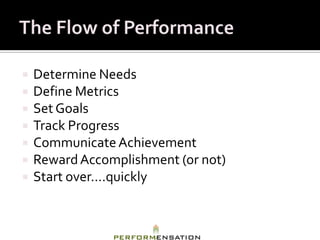
   Determine Needs
   Define Metrics
   Set Goals
   Track Progress
   Communicate Achievement
   Reward Accomplishment (or not)
   Start over….quickly
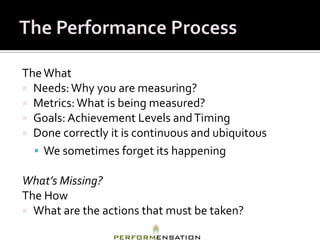
The What
 Needs: Why you are measuring?
 Metrics: What is being measured?
 Goals: Achievement Levels and Timing
 Done correctly it is continuous and ubiquitous
   We sometimes forget its happening

What’s Missing?
The How
 What are the actions that must be taken?
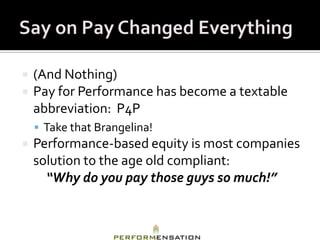
   (And Nothing)
   Pay for Performance has become a textable
    abbreviation: P4P
     Take that Brangelina!
   Performance-based equity is most companies
    solution to the age old compliant:
      “Why do you pay those guys so much!”
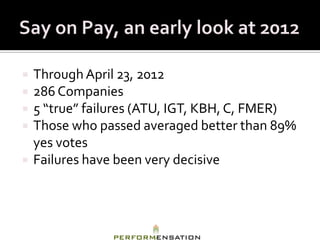
   Through April 23, 2012
   286 Companies
   5 “true” failures (ATU, IGT, KBH, C, FMER)
   Those who passed averaged better than 89%
    yes votes
   Failures have been very decisive
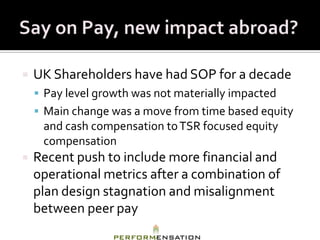
   UK Shareholders have had SOP for a decade
     Pay level growth was not materially impacted
     Main change was a move from time based equity
     and cash compensation to TSR focused equity
     compensation
   Recent push to include more financial and
    operational metrics after a combination of
    plan design stagnation and misalignment
    between peer pay
   Shareholders
   Media
   Politicians
   Compensation Consultants
   Executives (when they pay out)
   Companies (when they get SOP approval)

Only administrators don’t really love them
 And the providers who support admin
1.   Links equity comp to business strategy
2.   Provides a easy argument for better
     communication (and a budget)
3.   Done right it can be leveraged like Stock
     Options and safe like RSUs
4.   More interesting than time-based awards
5.   Like or not, it is the future of equity
     compensation
Stock Options     Restricted   Performance


  40%      37%         43%         41%       49%        48%

  16%      22%         17%         20%
                                             17%        20%

  44%      41%         39%         39%       34%        31%


2008 CEO            2009 CEO               2010 CEO
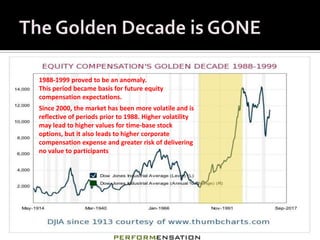
1988-1999 proved to be an anomaly.
This period became basis for future equity
compensation expectations.
Since 2000, the market has been more volatile and is
reflective of periods prior to 1988. Higher volatility
may lead to higher values for time-base stock
options, but it also leads to higher corporate
compensation expense and greater risk of delivering
no value to participants
   Relative Goals can reduce the impact of
    market volatility
     Relative TSR
   Absolute Goals can increase the focus on key
    achievements
   In a volatile Market Stock Options are too
    unpredictable
   In almost any market Restricted Stock Units
    provide limited motivation
   Properly designed, performance equity can offer
    MORE STABILITY than time-based equity
     Not completely dependent upon stock price
     Can factor in influence of the market volatility on
      peers and self
     Can provide upside leverage and downside protection
     Time to achievement based on corporate success
      cycles rather than the orbit of the earth around the
      sun
   Even if properly designed, performance equity
    can offer MORE RISK than time-based equity
     Improper goal setting can occur when source data or
      future projections are incorrect
     Payout based on excellent past performance, but
      delivered during poor current performance
     Grants at historically low prices it can result in
      tremendous value delivery
     Goals always seem ambitious until, and unless, they
      are achieved too soon
   Long-term Performance Compensation is
    Like a Marathon
     You run slowest in the dark
     A bit faster when there are occasional lights
     Even faster when there are mile markers
     Faster still when you know where the competition
      is
     A bit faster when you are in a strong group
     Fastest when you have all of the above AND a
      cheering section motivating you along the way
   Performance goals are in themselves a form
    of communication
     They must be talked about, consistently in
      patterns than mean something to participants
     Progress must be available when it is wanted, not
      only when its convenient
     Messages must include both the good and the
      bad, or the patterns will be inconsistent and
      unbelievable
1. Incorrect Metrics
 Metrics are the “things” that are being measured.
   These are the foundation of your plan and must
   represent the measurements of success
 Common issue: Misunderstanding of business
   strategy Vs employee engagement/alignment
 Common issue: Motivating one action without
   balance of counter-action
2. Poorly Set Goals
 Goals are the levels that define the success of each
   metric
 These are the drivers of your plan and must
   represent your destination
 Common issue: Insufficient modeling of Best
   Case, Worst Case and Expected Case scenarios
 Common issue: Goal achievement becomes
   obviously impossible (or far too possible) very early
   in the life of the program
3. Underwhelming Communication
 Performance compensation is often confusing
 Clean, clear, frequent, communications are essential
   to engaging and motivating your staff
 Common issue: No time or money to communicate
   after initial roll out of program
 Common issue: Disconnect between what HR/Comp
   believe is the purpose of the plan versus
   managements actual purpose
 Common issue: Communication, Who has time for
   communication?
4. Human Nature
 Human nature is the one thing that you cannot build
  into your compensation programs, yet it is the
  single biggest risk to pay for performance
 The problem isn’t that P4P programs don’t work
  well enough, it’s that they work TOO well
 For programs that demand high-performance, you
  must also provide strong management and
  oversight
 Many companies assume their compensation plans
  will manage people (only people manage people)
Dan Walter, CEP, President
            Performensation
        514 Precita Ave, Suite 100
         San Francisco, CA 94110
     877-803-9255 (toll free) ext. 700
           415-625-3406 (office)
          917-734-4649 (mobile)
     dwalter@performensation.com
       www.performensation.com

Twitter: www.twitter.com/performensation
 LinkedIn: www.linkedin.com/in/danwalter
    Blog: www.compensationcafe.com
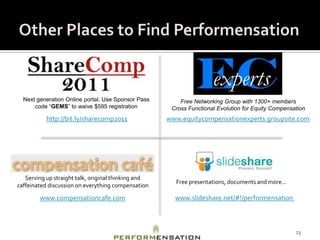
Next generation Online portal. Use Sponsor Pass        Free Networking Group with 1300+ members
      code “GEMS” to waive $595 registration          Cross Functional Evolution for Equity Compensation
           http://bit.ly/sharecomp2011               www.equitycompensationexperts.groupsite.com


   Serving up straight talk, original thinking and
                                                       Free presentations, documents and more…
caffeinated discussion on everything compensation

        www.compensationcafe.com                       www.slideshare.net/#!/performensation


                                                                                                    23

Performance is the new normal 20120426-preso

  • 1.
    Performance is thenew normal. Are you normal?
  • 2.
    Dan Walter, CEP,is the founder of Performensation Consulting. Dan has more than 18 years of experience in with equity compensation programs. He has designed and administrated both management and broad-based programs, for both public and private companies. Dan has worked extensively with companies in U.S. and abroad. His experience with young entrepreneurial companies and established Fortune 100 companies provides his clients with a unique perspective on compensation issues. He creates effective, and when needed, innovative company- specific solutions. His clients appreciate the post-consultation support he provides to help ensure programs are working as designed. Dan’s expertise includes equity compensation, executive programs and talent management issues. He has experience with all aspects of these programs including: diagnosis, design, communication, administration and reporting. His equity compensation expertise includes stock options, restricted share and units, stock purchase and performance-based programs. Executive compensation experience includes benchmarking, short and long-term incentive program design, proxy disclosure reporting and total-reward evaluations. Dan also has significant experience in administrative and technological best practices for these programs. Dan is co-author of two publications: “Equity Alternatives” and “The Decision Makers Guide to Equity Compensation”, available at www.nceo.org. He is also a featured writer at the www.CompensationCafe.com blog. He accepts LinkedIn invitations from all compensation professionals at www.linkedin.com/in/danwalter.
  • 4.
    Determine Needs  Define Metrics  Set Goals  Track Progress  Communicate Achievement  Reward Accomplishment (or not)  Start over….quickly
  • 5.
    The What  Needs:Why you are measuring?  Metrics: What is being measured?  Goals: Achievement Levels and Timing  Done correctly it is continuous and ubiquitous  We sometimes forget its happening What’s Missing? The How  What are the actions that must be taken?
  • 6.
    (And Nothing)  Pay for Performance has become a textable abbreviation: P4P  Take that Brangelina!  Performance-based equity is most companies solution to the age old compliant: “Why do you pay those guys so much!”
  • 7.
    Through April 23, 2012  286 Companies  5 “true” failures (ATU, IGT, KBH, C, FMER)  Those who passed averaged better than 89% yes votes  Failures have been very decisive
  • 8.
    UK Shareholders have had SOP for a decade  Pay level growth was not materially impacted  Main change was a move from time based equity and cash compensation to TSR focused equity compensation  Recent push to include more financial and operational metrics after a combination of plan design stagnation and misalignment between peer pay
  • 9.
    Shareholders  Media  Politicians  Compensation Consultants  Executives (when they pay out)  Companies (when they get SOP approval) Only administrators don’t really love them  And the providers who support admin
  • 10.
    1. Links equity comp to business strategy 2. Provides a easy argument for better communication (and a budget) 3. Done right it can be leveraged like Stock Options and safe like RSUs 4. More interesting than time-based awards 5. Like or not, it is the future of equity compensation
  • 11.
    Stock Options Restricted Performance 40% 37% 43% 41% 49% 48% 16% 22% 17% 20% 17% 20% 44% 41% 39% 39% 34% 31% 2008 CEO 2009 CEO 2010 CEO
  • 12.
    1988-1999 proved tobe an anomaly. This period became basis for future equity compensation expectations. Since 2000, the market has been more volatile and is reflective of periods prior to 1988. Higher volatility may lead to higher values for time-base stock options, but it also leads to higher corporate compensation expense and greater risk of delivering no value to participants
  • 13.
    Relative Goals can reduce the impact of market volatility  Relative TSR  Absolute Goals can increase the focus on key achievements  In a volatile Market Stock Options are too unpredictable  In almost any market Restricted Stock Units provide limited motivation
  • 14.
    Properly designed, performance equity can offer MORE STABILITY than time-based equity  Not completely dependent upon stock price  Can factor in influence of the market volatility on peers and self  Can provide upside leverage and downside protection  Time to achievement based on corporate success cycles rather than the orbit of the earth around the sun
  • 15.
    Even if properly designed, performance equity can offer MORE RISK than time-based equity  Improper goal setting can occur when source data or future projections are incorrect  Payout based on excellent past performance, but delivered during poor current performance  Grants at historically low prices it can result in tremendous value delivery  Goals always seem ambitious until, and unless, they are achieved too soon
  • 16.
    Long-term Performance Compensation is Like a Marathon  You run slowest in the dark  A bit faster when there are occasional lights  Even faster when there are mile markers  Faster still when you know where the competition is  A bit faster when you are in a strong group  Fastest when you have all of the above AND a cheering section motivating you along the way
  • 17.
    Performance goals are in themselves a form of communication  They must be talked about, consistently in patterns than mean something to participants  Progress must be available when it is wanted, not only when its convenient  Messages must include both the good and the bad, or the patterns will be inconsistent and unbelievable
  • 18.
    1. Incorrect Metrics Metrics are the “things” that are being measured. These are the foundation of your plan and must represent the measurements of success  Common issue: Misunderstanding of business strategy Vs employee engagement/alignment  Common issue: Motivating one action without balance of counter-action
  • 19.
    2. Poorly SetGoals  Goals are the levels that define the success of each metric  These are the drivers of your plan and must represent your destination  Common issue: Insufficient modeling of Best Case, Worst Case and Expected Case scenarios  Common issue: Goal achievement becomes obviously impossible (or far too possible) very early in the life of the program
  • 20.
    3. Underwhelming Communication Performance compensation is often confusing  Clean, clear, frequent, communications are essential to engaging and motivating your staff  Common issue: No time or money to communicate after initial roll out of program  Common issue: Disconnect between what HR/Comp believe is the purpose of the plan versus managements actual purpose  Common issue: Communication, Who has time for communication?
  • 21.
    4. Human Nature Human nature is the one thing that you cannot build into your compensation programs, yet it is the single biggest risk to pay for performance  The problem isn’t that P4P programs don’t work well enough, it’s that they work TOO well  For programs that demand high-performance, you must also provide strong management and oversight  Many companies assume their compensation plans will manage people (only people manage people)
  • 22.
    Dan Walter, CEP,President Performensation 514 Precita Ave, Suite 100 San Francisco, CA 94110 877-803-9255 (toll free) ext. 700 415-625-3406 (office) 917-734-4649 (mobile) dwalter@performensation.com www.performensation.com Twitter: www.twitter.com/performensation LinkedIn: www.linkedin.com/in/danwalter Blog: www.compensationcafe.com
  • 23.
    Next generation Onlineportal. Use Sponsor Pass Free Networking Group with 1300+ members code “GEMS” to waive $595 registration Cross Functional Evolution for Equity Compensation http://bit.ly/sharecomp2011 www.equitycompensationexperts.groupsite.com Serving up straight talk, original thinking and Free presentations, documents and more… caffeinated discussion on everything compensation www.compensationcafe.com www.slideshare.net/#!/performensation 23