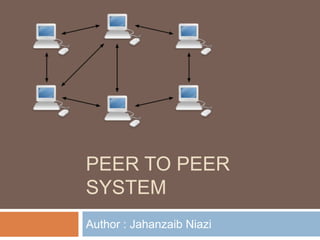
PEER TO PEER
SYSTEM
Author : Jahanzaib Niazi
What is Peer to Peer Architecture?
 Peer to peer is a type of architecture in which nodes are
interconnected with each other and share resources with
each other without the central controlling server.
 P2P system allows us to construct such a distributed system
or a application in which all resources and data is contributed
by the hosts over the network.
 P2P system allows us to sharing of data at very large scale
without the use of any server whose job is to manage the
scaling it means that scaling of data can be done without a
server.
 P2P are used in Filesharing,webcaching and providing
information to user , Bittorrent and etc are examples of P2P
applications which use P2P architecture.
Difference b/w P2P and Client
Server Architecture
 Server is a basically a point of difference
between the P2P and client server
architecture.In c/s architecture there is a
central server which is managing all the
resources across the network but in p2p there
is no server which is completely handling the
complete network all nodes can connect and
share resources with each other.
Advantages of Peer to Peer
 It is easy to install.
 All resources are shared by all nodes with
each other without a server.
 Central dependency is eliminated.
 It is more reliable.
 Cost of building and maintaining this p2p
network is less as compared to other network.
Disadvantages of Peer to Peer
 As we no there is not central server so that
network cannot be administrated for example we
cannot filter the files being shared by the nodes
with each other.
 Security is an other issue in this network as
malware can easily be transmitted across the
network.
 Because of no centralized server we cannot make
a backup of system every node has to make
backup of its own data in his system.
 Transferring of sensitive data through the p2p is
not recommended.
Distributed Nodes location and
Routing
 Distributed nodes are the nodes which are
connected in the p2p network.
 Efficiency of the a peer to system depends
upon the location of nodes and there
interconnection.
Peer to Peer Models
 Purely Decentralized System
 Centralized System
 Hybird System
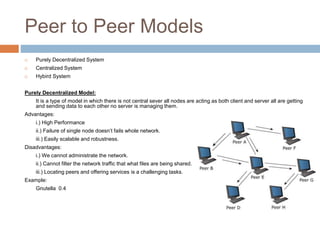
Purely Decentralized Model:
It is a type of model in which there is not central sever all nodes are acting as both client and server all are getting
and sending data to each other no server is managing them.
Advantages:
i.) High Performance
ii.) Failure of single node doesn’t fails whole network.
iii.) Easily scalable and robustness.
Disadvantages:
i.) We cannot administrate the network.
ii.) Cannot filter the network traffic that what files are being shared.
iii.) Locating peers and offering services is a challenging tasks.
Example:
Gnutella 0.4
 Centralized P2P Model:
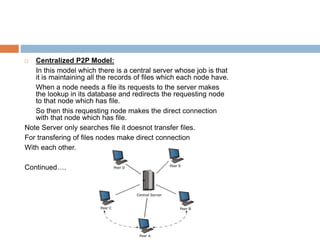
In this model which there is a central server whose job is that
it is maintaining all the records of files which each node have.
When a node needs a file its requests to the server makes
the lookup in its database and redirects the requesting node
to that node which has file.
So then this requesting node makes the direct connection
with that node which has file.
Note Server only searches file it doesnot transfer files.
For transfering of files nodes make direct connection
With each other.
Continued….
Continued….
 Advantages:
i.) Quick searches.
ii.) Low bandwidth required.
iii.) Searches can be filtered to some extent.
iv.) Main advantage of this system is faster resource sharing.
 Disadvantages:
i.) Failure of server fails down whole network.
ii.) This model is more easily be attacked.
iii.) There limitation is that scalabilty of network is affected by
use of server.
Example:
Napster, BitTorent.
Hybird P2P Model:
 Main advantage of Centralized model is faster and reliable resource
sharing.But there limitation is that scalabiilty of system is affected by
use of servers.
 Main advantage of Decentralized model is that they take less time
in locating the resource as compared to the Centralized Model.
 Hybird Model is a type of Model which is introduced to take
advantage of both centralized and decentralized system this model
doesn’t uses the server hence scalability issue got resolved.
 This model introduced the new concept of SUPERNODES.Hybird
model uses Super nodes,they are the more powerful nodes then the
other nodes they are dynamically choosen.By use of super nodes
Resource locating become faster. By using supernodes we can take
advantage of both decentralized search techniques and centralized
search techniques.
 Continued….
Continued….
 Advantages of Hybird Model:
I.) Issue of scalability in centralized model
resolved.
ii.) We can fastly locate the resource by use of
supernodes.
 Disadvantages:
i.) Searching is still based upon the flooding.
ii.) Loss of Distribution , more centralized control.
Example:
Gnutella v0.6
Skype Case Study:
 Skype has basically a hybird peer to peer architecture such
as Kazza or Gnutella v0.6.
 There are three types of nodes in Skype Network.
i.) Ordinary peers
ii.) Super Nodes
iii.) Central Login Server
The login server stores all the usernames and
All passwords and ensures that usernames are
Unique across the skype namespace this node
Authenticates the users.
Continued…
Continued….
 Skype used TCP for signalling and both UDP
and TCP for data transferring.
 All users communication are encrypted using
AES 256-bit.
 Normal Login:
i.) Skype client connects with the supernode.
ii.) Skype client is authenticated using skype
login server.
Some important terminologies:
 Seeder: Seeder is a one whose file is completely downloaded but its
uploading.
 Leecher: Some one who is downloading file.
 Peer: Collective term for seeder and leecher.
 Swarm : A group of peers sending or receiving simultaneously the same
file.
 Torrent file: A file contains information(Address/hostname) about Tracker.
 Tracker : A server that manages the bit torrent transfer process. tracker is
computer which acts as a server, and maintains a list of nodes which are
participating in the system (ie. computers that are currently downloading or
uploading file data). For a new node to join a Bittorrent network, it sends a
message to the tracker requesting the IPs of some of the other participating
nodes, so that it can connect to them and begin downloading. No actual file
data is downloaded from the tracker; its job is simply to facilitate node
discovery.
Bit Torrent Architecture
 Bit torrent is a centralized peer to peer
Application.
 Bit torrent uses a central server to maintain the
records of all shared files of all nodes.
 Below are four steps in Bit torrent.
 Join (Torrent is created)
 Publish (Torrent is published over internet)
 Search (File is searched across the nodes)
 Fetch (File is download)
Overall Architecture
A
B
C
Peer
[Leech]
Downloader
“US”
Peer
[Seed]
Peer
[Leech]
TrackerWeb Server
Overall Architecture
A
B
C
Peer
[Leech]
Downloader
“US”
Peer
[Seed]
Peer
[Leech]
TrackerWeb Server
Overall Architecture
A
B
C
Peer
[Leech]
Downloader
“US”
Peer
[Seed]
Peer
[Leech]
TrackerWeb Server
Overall Architecture
A
B
C
Peer
[Leech]
Downloader
“US”
Peer
[Seed]
Peer
[Leech]
TrackerWeb Server
Overall Architecture
A
B
C
Peer
[Leech]
Downloader
“US”
Peer
[Seed]
Peer
[Leech]
TrackerWeb Server
Overall Architecture
A
B
C
Peer
[Leech]
Downloader
“US”
Peer
[Seed]
Peer
[Leech]
TrackerWeb Server
Overall Architecture
A
B
C
Peer
[Leech]
Downloader
“US”
Peer
[Seed]
Peer
[Leech]
TrackerWeb Server
Query Flooding:
 Query flooding is an old technique of file searching across the
P2P network.
 Gnutella v0.4 used that technique.
 In this technique file is searched across the neighbours , if
they don’t have file these neighbours search file around there
neighbours hence whole network is searched.
 In this technique we can limit the range of search.
 Query flooding use is very poor it is not easily scalable hence
now a days it is not used.
 Now a days it is replaced by Query Routing such as Gnutella
v6.0 is using Query Routing.
 Distributed hashtables are also an alternative.
 Thanks for learning:
For Queries and Feedback email me at :
Jahanzaib.niazi001@gmail.com
Also you can download lecture notes from:
http://www.bscsf11b.blogspot.com

Peer to peer system

  • 1.
    PEER TO PEER SYSTEM Author: Jahanzaib Niazi
  • 2.
    What is Peerto Peer Architecture?  Peer to peer is a type of architecture in which nodes are interconnected with each other and share resources with each other without the central controlling server.  P2P system allows us to construct such a distributed system or a application in which all resources and data is contributed by the hosts over the network.  P2P system allows us to sharing of data at very large scale without the use of any server whose job is to manage the scaling it means that scaling of data can be done without a server.  P2P are used in Filesharing,webcaching and providing information to user , Bittorrent and etc are examples of P2P applications which use P2P architecture.
  • 3.
    Difference b/w P2Pand Client Server Architecture  Server is a basically a point of difference between the P2P and client server architecture.In c/s architecture there is a central server which is managing all the resources across the network but in p2p there is no server which is completely handling the complete network all nodes can connect and share resources with each other.
  • 4.
    Advantages of Peerto Peer  It is easy to install.  All resources are shared by all nodes with each other without a server.  Central dependency is eliminated.  It is more reliable.  Cost of building and maintaining this p2p network is less as compared to other network.
  • 5.
    Disadvantages of Peerto Peer  As we no there is not central server so that network cannot be administrated for example we cannot filter the files being shared by the nodes with each other.  Security is an other issue in this network as malware can easily be transmitted across the network.  Because of no centralized server we cannot make a backup of system every node has to make backup of its own data in his system.  Transferring of sensitive data through the p2p is not recommended.
  • 6.
    Distributed Nodes locationand Routing  Distributed nodes are the nodes which are connected in the p2p network.  Efficiency of the a peer to system depends upon the location of nodes and there interconnection.
  • 7.
    Peer to PeerModels  Purely Decentralized System  Centralized System  Hybird System Purely Decentralized Model: It is a type of model in which there is not central sever all nodes are acting as both client and server all are getting and sending data to each other no server is managing them. Advantages: i.) High Performance ii.) Failure of single node doesn’t fails whole network. iii.) Easily scalable and robustness. Disadvantages: i.) We cannot administrate the network. ii.) Cannot filter the network traffic that what files are being shared. iii.) Locating peers and offering services is a challenging tasks. Example: Gnutella 0.4
  • 8.
     Centralized P2PModel: In this model which there is a central server whose job is that it is maintaining all the records of files which each node have. When a node needs a file its requests to the server makes the lookup in its database and redirects the requesting node to that node which has file. So then this requesting node makes the direct connection with that node which has file. Note Server only searches file it doesnot transfer files. For transfering of files nodes make direct connection With each other. Continued….
  • 9.
    Continued….  Advantages: i.) Quicksearches. ii.) Low bandwidth required. iii.) Searches can be filtered to some extent. iv.) Main advantage of this system is faster resource sharing.  Disadvantages: i.) Failure of server fails down whole network. ii.) This model is more easily be attacked. iii.) There limitation is that scalabilty of network is affected by use of server. Example: Napster, BitTorent.
  • 10.
    Hybird P2P Model: Main advantage of Centralized model is faster and reliable resource sharing.But there limitation is that scalabiilty of system is affected by use of servers.  Main advantage of Decentralized model is that they take less time in locating the resource as compared to the Centralized Model.  Hybird Model is a type of Model which is introduced to take advantage of both centralized and decentralized system this model doesn’t uses the server hence scalability issue got resolved.  This model introduced the new concept of SUPERNODES.Hybird model uses Super nodes,they are the more powerful nodes then the other nodes they are dynamically choosen.By use of super nodes Resource locating become faster. By using supernodes we can take advantage of both decentralized search techniques and centralized search techniques.  Continued….
  • 11.
    Continued….  Advantages ofHybird Model: I.) Issue of scalability in centralized model resolved. ii.) We can fastly locate the resource by use of supernodes.  Disadvantages: i.) Searching is still based upon the flooding. ii.) Loss of Distribution , more centralized control. Example: Gnutella v0.6
  • 12.
    Skype Case Study: Skype has basically a hybird peer to peer architecture such as Kazza or Gnutella v0.6.  There are three types of nodes in Skype Network. i.) Ordinary peers ii.) Super Nodes iii.) Central Login Server The login server stores all the usernames and All passwords and ensures that usernames are Unique across the skype namespace this node Authenticates the users. Continued…
  • 13.
    Continued….  Skype usedTCP for signalling and both UDP and TCP for data transferring.  All users communication are encrypted using AES 256-bit.  Normal Login: i.) Skype client connects with the supernode. ii.) Skype client is authenticated using skype login server.
  • 14.
    Some important terminologies: Seeder: Seeder is a one whose file is completely downloaded but its uploading.  Leecher: Some one who is downloading file.  Peer: Collective term for seeder and leecher.  Swarm : A group of peers sending or receiving simultaneously the same file.  Torrent file: A file contains information(Address/hostname) about Tracker.  Tracker : A server that manages the bit torrent transfer process. tracker is computer which acts as a server, and maintains a list of nodes which are participating in the system (ie. computers that are currently downloading or uploading file data). For a new node to join a Bittorrent network, it sends a message to the tracker requesting the IPs of some of the other participating nodes, so that it can connect to them and begin downloading. No actual file data is downloaded from the tracker; its job is simply to facilitate node discovery.
  • 15.
    Bit Torrent Architecture Bit torrent is a centralized peer to peer Application.  Bit torrent uses a central server to maintain the records of all shared files of all nodes.  Below are four steps in Bit torrent.  Join (Torrent is created)  Publish (Torrent is published over internet)  Search (File is searched across the nodes)  Fetch (File is download)
  • 16.
  • 17.
  • 18.
  • 19.
  • 20.
  • 21.
  • 22.
  • 23.
    Query Flooding:  Queryflooding is an old technique of file searching across the P2P network.  Gnutella v0.4 used that technique.  In this technique file is searched across the neighbours , if they don’t have file these neighbours search file around there neighbours hence whole network is searched.  In this technique we can limit the range of search.  Query flooding use is very poor it is not easily scalable hence now a days it is not used.  Now a days it is replaced by Query Routing such as Gnutella v6.0 is using Query Routing.  Distributed hashtables are also an alternative.
  • 24.
     Thanks forlearning: For Queries and Feedback email me at : Jahanzaib.niazi001@gmail.com Also you can download lecture notes from: http://www.bscsf11b.blogspot.com