Prepared By :
Sukhpreet Kaur( Asst.Prof. )
M.Sc Nursing (MSN)
Organization of
nervous system
INTRODUCTION
 Nervous system helps to maintain
homeostasis, also responsible for our
perception , behavior and memories, and
intitates all voluntary movements .
Overview of the nervous system
 With a mass o only 2 kg , about 3% of total
body weight, the nervous system is an
intricate, highly organized networks of billions
of neurons and even more neuroglia.
 The structures that make up the nervous
system include the brain, cranial nerves and
theirs branches, the spinal cord, spinal nerves
and their branches, ganglia, enteric plexuses ,
and sensory receptors
Overview of the nervous system
 The skull encloses the brain, which contains
about 100 billion neurons. Twelve pairs (right
&left) of cranial nerves, I through XII,
emerge from the base of the brain.
 The spinal cord connects to the brain through
the foramen magnum of the skull and is
encircled by the bones of the vertebral
column. It contains about 100 million neurons.
Overview of the nervous system
 Thirty –one pairs of spinal nerves emerge
from the spinal cord, each serving a specific
region on the right or left side of the body.
 Ganglia are small masses of nervous tissue,
consisting primarily of neuron cell bodies, that
are located outside the brain and spinal cord.
Overview of the nervous system
 In the walls of organs of the GIT, extensive
networks of neurons called enteric plexuses,
help regulates the digestive system.
 The term sensory receptor is used to refer to
the dendrites of sensory neurons. As well as
separate, specialized cells.
Function of nervous system
 The nervous system carries out a complex
array of tasks. It allow us to sense various
smells, produce speech, and remember past
events; in addition it provide signals that
control body movements, and regulates the
operation of internal organs.
Function of nervous system
These diverse activities can be grouped into
three basic functions: sensory, integrative and
motor.
Sensory function: sensory receptors detect
internal stimuli, such as an increase blood
acidity, and external stimuli carry information
into the brain and spinal cord.
Function of nervous system
 Integrative function: the nervous system
integrative( processes) sensory information by
analyzing and storing some of it and by
making decisions for appropriate responses.
 An important integrative function is
perception, the conscious awareness of
sensory stimuli.
Function of nervous system
 Motor function : Once sensory information is
integrated, the nervous system may elicit an
appropriate motor response such as muscle
contraction or gland secretion.
 Motor neurons carry information from the
brain toward the spinal cord or out of the brain
and spinal cord to effectors ( muscles and
glands)
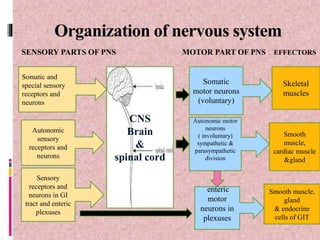
Organization of nervous system
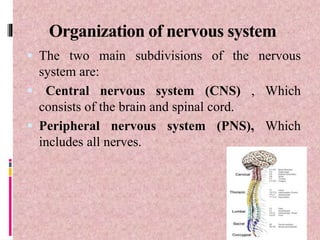
 The two main subdivisions of the nervous
system are:
 Central nervous system (CNS) , Which
consists of the brain and spinal cord.
 Peripheral nervous system (PNS), Which
includes all nerves.
Organization of nervous system
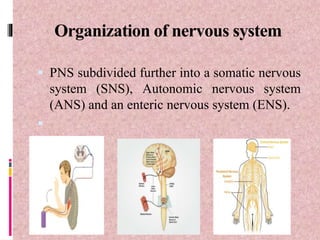
 PNS subdivided further into a somatic nervous
system (SNS), Autonomic nervous system
(ANS) and an enteric nervous system (ENS).

Organization of nervous system
SENSORY PARTS OF PNS MOTOR PART OF PNS EFFECTORS
CNS
Brain
&
spinal cord
Somatic and
special sensory
receptors and
neurons
Autonomic
sensory
receptors and
neurons
Sensory
receptors and
neurons in GI
tract and enteric
plexuses
Somatic
motor neurons
(voluntary)
Autonomic motor
neurons
( involuntary)
sympathetic &
parasympathetic
division
enteric
motor
neurons in
plexuses
Skeletal
muscles
Smooth
muscle,
cardiac muscle
&gland
Smooth muscle,
gland
& endocrine
cells of GIT
TO BE CONTINUE………
THANKYOU

Nervous system ppt

  • 1.
    Prepared By : SukhpreetKaur( Asst.Prof. ) M.Sc Nursing (MSN) Organization of nervous system
  • 2.
    INTRODUCTION  Nervous systemhelps to maintain homeostasis, also responsible for our perception , behavior and memories, and intitates all voluntary movements .
  • 3.
    Overview of thenervous system  With a mass o only 2 kg , about 3% of total body weight, the nervous system is an intricate, highly organized networks of billions of neurons and even more neuroglia.  The structures that make up the nervous system include the brain, cranial nerves and theirs branches, the spinal cord, spinal nerves and their branches, ganglia, enteric plexuses , and sensory receptors
  • 4.
    Overview of thenervous system  The skull encloses the brain, which contains about 100 billion neurons. Twelve pairs (right &left) of cranial nerves, I through XII, emerge from the base of the brain.  The spinal cord connects to the brain through the foramen magnum of the skull and is encircled by the bones of the vertebral column. It contains about 100 million neurons.
  • 5.
    Overview of thenervous system  Thirty –one pairs of spinal nerves emerge from the spinal cord, each serving a specific region on the right or left side of the body.  Ganglia are small masses of nervous tissue, consisting primarily of neuron cell bodies, that are located outside the brain and spinal cord.
  • 6.
    Overview of thenervous system  In the walls of organs of the GIT, extensive networks of neurons called enteric plexuses, help regulates the digestive system.  The term sensory receptor is used to refer to the dendrites of sensory neurons. As well as separate, specialized cells.
  • 7.
    Function of nervoussystem  The nervous system carries out a complex array of tasks. It allow us to sense various smells, produce speech, and remember past events; in addition it provide signals that control body movements, and regulates the operation of internal organs.
  • 8.
    Function of nervoussystem These diverse activities can be grouped into three basic functions: sensory, integrative and motor. Sensory function: sensory receptors detect internal stimuli, such as an increase blood acidity, and external stimuli carry information into the brain and spinal cord.
  • 9.
    Function of nervoussystem  Integrative function: the nervous system integrative( processes) sensory information by analyzing and storing some of it and by making decisions for appropriate responses.  An important integrative function is perception, the conscious awareness of sensory stimuli.
  • 10.
    Function of nervoussystem  Motor function : Once sensory information is integrated, the nervous system may elicit an appropriate motor response such as muscle contraction or gland secretion.  Motor neurons carry information from the brain toward the spinal cord or out of the brain and spinal cord to effectors ( muscles and glands)
  • 11.
    Organization of nervoussystem  The two main subdivisions of the nervous system are:  Central nervous system (CNS) , Which consists of the brain and spinal cord.  Peripheral nervous system (PNS), Which includes all nerves.
  • 12.
    Organization of nervoussystem  PNS subdivided further into a somatic nervous system (SNS), Autonomic nervous system (ANS) and an enteric nervous system (ENS). 
  • 13.
    Organization of nervoussystem SENSORY PARTS OF PNS MOTOR PART OF PNS EFFECTORS CNS Brain & spinal cord Somatic and special sensory receptors and neurons Autonomic sensory receptors and neurons Sensory receptors and neurons in GI tract and enteric plexuses Somatic motor neurons (voluntary) Autonomic motor neurons ( involuntary) sympathetic & parasympathetic division enteric motor neurons in plexuses Skeletal muscles Smooth muscle, cardiac muscle &gland Smooth muscle, gland & endocrine cells of GIT
  • 14.