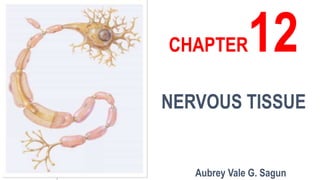
NERVOUS TISSUE
CHAPTER12
Aubrey Vale G. Sagun
OVERVIEW OF THE
NERVOUS SYSTEM
The Nervous System
•The network of nerve cells
and fibers that transmits
nerve impulses between parts
of the body.
Components of Nervous System
Nerve cells /
Neurons
Brain Spinal cord
The Brain - Part of the CNS that is located in the skull.
- Contains about 100 billion neurons
The Spinal
Cord
• The Spinal cord is connected to the brain
through the foramen magnum and is
encircled by the bones of the vertebral
column.
• It contains about 100 million neurons.
Nerve cell /
Neuron
- also known as nerve cells,
communicate within the body by
transmitting electrochemical signals
Two Divisions of Nervous System
Peripheral
Nervous
System
(PNS)
Central
Nervous
System
(CNS)
The Central Nervous System
Consists of:
-Brain
-Spinal Cord
The Peripheral Nervous System
Consists of:
-All nervous tissue outside CNS
- nerves
- ganglia
- enteric plexuses
- sensory receptors
Ganglia - Are small masses of nervous
tissue, consisting primarily of
neuron cell bodies, that are
located outside of the brain and
spinal chord.
Enteric
Plexus
- Are extensive networks of
neurons located in the walls of
organs of the Gastrointestinal
tract.
- The neurons of these plexuses
help regulate the digestive
system.
Sensory
Receptors
- Refers to a structure of the
nervous system that monitors
changes in the external and
internal environment.
Three Divisions of Peripheral Nervous
System
Autonomic
Nervous
System
(ANS)
Enteric
Nervous
System
(ENS)
Somatic
Nervous
System
(SNS)
Somatic Nervous System (SNS)
Consists of :
1. Sensory neurons that convey
information from somatic
receptors in the head, body wall,
and limbs and from receptors for
the special senses of vision,
hearing, taste and smell to the
to the CNS.
2. Motor Neurons that
conduct impulses from the
CNS to skeletal muscles only.
Autonomic Nervous System (ANS)
1. Sensory neurons that convey
information from autonomic
sensory receptors.
2. Motor neurons that conduct
nerve impulses from the CNS to
smooth muscle, cardiac muscle
and glands.
Consists of :
Two branches of the motor part of the ANS
Parasympathetic division
Is responsible for stimulation of
“rest and digest” or “feed and
breed”
.
Sympathetic division
Is responsible for stimulation of
“fight or flight”
Enteric Nervous System (ENS)
•The ENS is the subdivision of the Autonomic Nervous
System that directly control the Gastrointestinal
system.
Three basic Functions of Nervous System
•Sensory Function
•Integrative Function
•Motor Function
Sensory Function
• monitors internal & external environment through presence of
receptors
Integrative Function
 interpretation of sensory information (information processing);
complex (higher order) functions
Motor Function
 response to information processed through stimulation of
effectors
 muscle contraction
 glandular secretion
HISTOLOGY OF
NERVOUS
TISSUE
Nervous
Tissues
Comprises two types of cells.
- Neurons
- Neuroglia
• For processing, transfer, and storage of
information
• are specialized to carry "messages" through
an electrochemical process
• is a basic unit of nervous system
• Properties of neuron:
- Excitability
- Conductivity
Neuron
Parts of a
Neuron
Cell body
(perikaryon /soma)
- Contains the nucleus &
mitochondria, ribosomes, and
other organelles.
Axon
- Propagates nerve impulses
toward another neuron, a
muscle fibre or a gland cell.
Dendrites
- Are the receiving or input
portions of a neuron.
Three Main parts of a Neuron
Other parts of a Neuron
Neurofibrils
• Composed of
bundles of
intermediate
filaments that
provide the cell
shape and
support
Microtubules
• Assist in moving
materials between
the cell body and
axon
Nerve fibre
• Is a general term
for any neural
process that
emerges from the
cell body of a
neuron
Nissl bodies
• Group of
ribosomes used for
protein synthesis
• Synapse
– the site of
communication between
two neurons or between
a neuron and an effector
cell.
• Neurotransmitter
A molecule released
from a synaptic vesicle
that excites or inhibits
another neuron,
muscle fibre or gland
cell
• Synaptic end bulb
Contains synaptic
vesicles which are
filled with a
neurotransmitter
substance
• Synaptic vesicles
Store various
neurotransmitters
that are released at
the synapse
• Node of Ranvier
Periodic gaps in the
myelin sheath
Classification of Neurons
•Multipolar neuron
•Bipolar neuron
•Unipolar neuron
• Bipolar – have one
main dendrite and one
axon.
• Multipolar– have
several dendrites and
one axon.
• Unipolar – have
dendrites and one
axon.
Functional Classification of Neurons
• Sensory (afferent) neurons –
• transmit sensory information from receptors of PNS towards the CNS
• most sensory neurons are unipolar, a few are bipolar
• Motor (efferent) neurons –
• transmit motor information from the CNS to effectors (muscles/glands/adipose tissue) in
the periphery of the body
• all are multipolar
• Association (interneurons) –
• transmit information between neurons within the CNS; analyze inputs, coordinate
outputs
• are the most common type of neuron (20 billion)
• are all multipolar
Functional classification based on type of information & direction of information transmission:
• For support, regulation and protection
of neurons.
• Held nervous tissue together
Neuroglia
Neuroglia of the CNS
• Oligoendrocytes
•create myelin sheath
around axons of
neurons in the CNS.
Myelinated axons
transmit impulses
faster than
unmyelinated axons
• Microglia
•brain
Macrophages
• phagocytize
cellular wastes &
pathogens
• Ependymal cells
•line ventricles of
brain & central canal
of spinal cord
• produce, monitor &
help circulate CSF
(cerebrospinal fluid)
• Astrocytes
•create supportive
framework for neurons
•create “blood-brain
barrier”
•monitor & regulate
interstitial fluid
surrounding neurons
Neuroglia of the PNS
•Satellite Cells
•support groups of
cell bodies of neurons
within ganglia of the
PNS
•surround all axons of neurons
in the PNS creating a
neurilemma around them.
•Neurilemma allows for
potential regeneration of
damaged axons
• creates myelin sheath
around most axons of PNS
• Schwann Cells
Myelination
• Increases the speed
of nerve impulse
conduction.
UnmyelinatedMyelinated
Gray and White Matter
CNS Two kinds of
tissue
Gray Matter contains the cell
bodies, dendrites and axon
terminals of neurons
White Matter is made of axons
connecting different parts of grey
matter to each other.
ELECTRICAL
SIGNALS IN
NEURONS
Ion Channels
• A protein that acts as a pore in a cell membrane and permits
the passage of selective ions.
• Controls the flow of ions
Ion channels in Neurons
Resting Membrane Potential
• Is the voltage (charge) difference across the cell
membrane when the cell is at rest.
Two types of Electric signals
•Action
Potentials
Allow communication
over long distances
•Graded
Potentials
Used in short distance
communication
Graded Potentials - is a small deviation from
the membrane potential
that makes the membrane
either more polarized or
less polarized.
Generation of
Action Potentials
Is the process by which a neuron rapidly
depolarizes from a negative resting potential to
a more positive potential, and is achieved by
influx of cations through ion channels.
After-hyperpolarizing Phase
Describes the
hyperpolarizing phase
of a neuron’s action
potential where the
cell’s membrane falls
below the normal
resting potential
Refractory Period
A period immediately
following stimulation
during which a nerve or
muscle is unresponsive
to further stimulation.
Depolarizing Phase
Is when the membrane
potential becomes
more negative at a
particular spot on the
neuron’s membrane
Repolarizing Phase
Typically results from
the movement of
positively charged ions
out of the cell
Propagation of
Action Potentials
Two types of Propagation
Saltatory
conduction
Continuous
conduction
SIGNAL
TRANSMISSION
AT SYNAPSES
Synapse
• It is the site of communication of neurons which consists of:
A. Presynaptic Neuron
A. Postsynaptic Neuron
Sends the Signal
Receives the message
Two types of Synapses
• Chemical Synapse • Electrical Synapse
Electrical Synapse
•Transmission is DIRECT because of gap junctions.
Action potentials
(impulses) conduct
directly between
adjacent cells through
GAP JUNCTIONS
Electrical Synapse
Two main advantages of Electrical synapse
1. Faster
Communication
2. Synchronization
Transmission of
Signal in an Electrical
Synapse
Chemical Synapse
•Transmission is INDIRECT because of synaptic cleft.
Membranes are close but
do not touch with the
presence of
SYNAPTIC CLEFT
Three types of Chemical Synapse
Axodendritic
Axon to dendrite
Axosomatic
Axon to soma
Axoaxonic
Axon to axon
Transmission of
Signal in a Chemical
Synapse
1
2
3 4
The synapse carries a signal from cell to cell
Excitatory and Inhibitory Postsynaptic
Potentials
• A neurotransmitter causes either an excitatory or an inhibitory graded
potential.
A neurotransmitter : Messenger of the Brain - is a
chemical messenger that transmits signals from a
neuron to a target cell across a synapse.
•A graded potential depolarization is called excitatory
postsynaptic potential (EPSP).
• A graded potential hyperpolarization is called an inhibitory
postsynaptic potentials (IPSP).
Two Classes of Neurotransmitter based on
size.
1. Small-molecule
neurotransmitter
2. Neuropeptides
Acetyl choline, Amino acids,
Biogenic amines, ATP and
other Purines, Nitric Oxide
and Carbon Monoxide
Composed of 3-40 amino
acids
ACETYL CHOLINE
AMINO ACIDS
ATP AND OTHER PURINES
NITRIC OXIDE
CARBON MONOXIDE
1. Small-molecule
neurotransmitter
NEUROPEPTIDES
Are relatively large transmitter
molecules composed of 3-36
amino acids.
INHIBITORY
POSTSYNAPTIC
POTENTIAL
INHIBITORY: IF THE
NEUROTRANSMITTER
DEPOLARIZES THE
POSTSYNAPTIC MEMBRANE
EXCITATORY
POSTSYNAPTIC
POTENTIAL
EXCITATORY: IF THE
NEUROTRANSMITTER
CAUSES
HYPERPOLARIZATION OF
OF THE POSTSYNAPTIC
MEMBRANE
NEUROTRANSMITTER RECEPTOR
•Is a membrane receptor protein that is activated by a
neurotransmitter
Types of Neurotransmitter Receptor
•Ionotropic
Receptor
•Metabotropic
Receptor
Ionotropic Receptor
• a type of neurotransmitter
receptor that contains a
neurotransmitter binding
site and an ion channel.
Metabotropic
Receptor
• a type of neurotransmitter
receptor that contains a
neurotransmitter binding site
but lacks an ion channel as
part of its structure.
Summation of Postsynaptic Potentials
TWO TYPES
SPATIAL
SUMMATION
TEMPORAL
SUMMATION
Results from build-up of
neurotransmitter released
simultaneously by SEVERAL
presynaptic end bulb.
Results from build-up of
neurotransmitter released
by a SINGLE presynaptic
end bulb two or more times
in rapid succession.
NEURAL
CIRCUITS
NEURAL CIRCUITS
• Neurons in the central nervous system are organized into
networks called NEURAL CIRCUITS.
TYPES OF
NEURAL CIRCUIT
DIVERGING CIRCUIT
REVERBERATING
CIRCUIT
4 TYPES
OF A
NEURAL
CIRCUIT
PARALLEL AFTER
DISCHARGE CIRCUIT
CONVERGING CIRCUIT
A mechanism for spreading stimulation
to multiple neurons or neuronal pools
in the CNS
A mechanism for providing input to a
single neuron from multiple sources
A positive feedback mechanism
A combination of
Converging circuit
and Diverging
circuit
REGENRATION AND REPAIR OF NERVOUS
TISSUE
• The Nervous system exhibits plasticity but it has very limited powers
of regeneration.
NEUROGENESIS
The birth of new neurons from undifferentiated stem
cells – occurs regularly in some animal cells.

Nervous

  • 1.
  • 2.
  • 3.
    The Nervous System •Thenetwork of nerve cells and fibers that transmits nerve impulses between parts of the body.
  • 4.
    Components of NervousSystem Nerve cells / Neurons Brain Spinal cord
  • 5.
    The Brain -Part of the CNS that is located in the skull. - Contains about 100 billion neurons
  • 6.
    The Spinal Cord • TheSpinal cord is connected to the brain through the foramen magnum and is encircled by the bones of the vertebral column. • It contains about 100 million neurons.
  • 7.
    Nerve cell / Neuron -also known as nerve cells, communicate within the body by transmitting electrochemical signals
  • 8.
    Two Divisions ofNervous System Peripheral Nervous System (PNS) Central Nervous System (CNS)
  • 9.
    The Central NervousSystem Consists of: -Brain -Spinal Cord
  • 10.
    The Peripheral NervousSystem Consists of: -All nervous tissue outside CNS - nerves - ganglia - enteric plexuses - sensory receptors
  • 11.
    Ganglia - Aresmall masses of nervous tissue, consisting primarily of neuron cell bodies, that are located outside of the brain and spinal chord.
  • 12.
    Enteric Plexus - Are extensivenetworks of neurons located in the walls of organs of the Gastrointestinal tract. - The neurons of these plexuses help regulate the digestive system.
  • 13.
    Sensory Receptors - Refers toa structure of the nervous system that monitors changes in the external and internal environment.
  • 14.
    Three Divisions ofPeripheral Nervous System Autonomic Nervous System (ANS) Enteric Nervous System (ENS) Somatic Nervous System (SNS)
  • 15.
    Somatic Nervous System(SNS) Consists of : 1. Sensory neurons that convey information from somatic receptors in the head, body wall, and limbs and from receptors for the special senses of vision, hearing, taste and smell to the to the CNS. 2. Motor Neurons that conduct impulses from the CNS to skeletal muscles only.
  • 16.
    Autonomic Nervous System(ANS) 1. Sensory neurons that convey information from autonomic sensory receptors. 2. Motor neurons that conduct nerve impulses from the CNS to smooth muscle, cardiac muscle and glands. Consists of :
  • 17.
    Two branches ofthe motor part of the ANS Parasympathetic division Is responsible for stimulation of “rest and digest” or “feed and breed” . Sympathetic division Is responsible for stimulation of “fight or flight”
  • 18.
    Enteric Nervous System(ENS) •The ENS is the subdivision of the Autonomic Nervous System that directly control the Gastrointestinal system.
  • 19.
    Three basic Functionsof Nervous System •Sensory Function •Integrative Function •Motor Function
  • 20.
    Sensory Function • monitorsinternal & external environment through presence of receptors
  • 21.
    Integrative Function  interpretationof sensory information (information processing); complex (higher order) functions
  • 22.
    Motor Function  responseto information processed through stimulation of effectors  muscle contraction  glandular secretion
  • 23.
  • 24.
    Nervous Tissues Comprises two typesof cells. - Neurons - Neuroglia
  • 25.
    • For processing,transfer, and storage of information • are specialized to carry "messages" through an electrochemical process • is a basic unit of nervous system • Properties of neuron: - Excitability - Conductivity Neuron
  • 26.
  • 27.
    Cell body (perikaryon /soma) -Contains the nucleus & mitochondria, ribosomes, and other organelles. Axon - Propagates nerve impulses toward another neuron, a muscle fibre or a gland cell. Dendrites - Are the receiving or input portions of a neuron. Three Main parts of a Neuron
  • 28.
    Other parts ofa Neuron Neurofibrils • Composed of bundles of intermediate filaments that provide the cell shape and support Microtubules • Assist in moving materials between the cell body and axon Nerve fibre • Is a general term for any neural process that emerges from the cell body of a neuron Nissl bodies • Group of ribosomes used for protein synthesis
  • 29.
    • Synapse – thesite of communication between two neurons or between a neuron and an effector cell. • Neurotransmitter A molecule released from a synaptic vesicle that excites or inhibits another neuron, muscle fibre or gland cell • Synaptic end bulb Contains synaptic vesicles which are filled with a neurotransmitter substance • Synaptic vesicles Store various neurotransmitters that are released at the synapse • Node of Ranvier Periodic gaps in the myelin sheath
  • 30.
    Classification of Neurons •Multipolarneuron •Bipolar neuron •Unipolar neuron
  • 31.
    • Bipolar –have one main dendrite and one axon. • Multipolar– have several dendrites and one axon.
  • 32.
    • Unipolar –have dendrites and one axon.
  • 33.
    Functional Classification ofNeurons • Sensory (afferent) neurons – • transmit sensory information from receptors of PNS towards the CNS • most sensory neurons are unipolar, a few are bipolar • Motor (efferent) neurons – • transmit motor information from the CNS to effectors (muscles/glands/adipose tissue) in the periphery of the body • all are multipolar • Association (interneurons) – • transmit information between neurons within the CNS; analyze inputs, coordinate outputs • are the most common type of neuron (20 billion) • are all multipolar Functional classification based on type of information & direction of information transmission:
  • 34.
    • For support,regulation and protection of neurons. • Held nervous tissue together Neuroglia
  • 35.
    Neuroglia of theCNS • Oligoendrocytes •create myelin sheath around axons of neurons in the CNS. Myelinated axons transmit impulses faster than unmyelinated axons • Microglia •brain Macrophages • phagocytize cellular wastes & pathogens • Ependymal cells •line ventricles of brain & central canal of spinal cord • produce, monitor & help circulate CSF (cerebrospinal fluid) • Astrocytes •create supportive framework for neurons •create “blood-brain barrier” •monitor & regulate interstitial fluid surrounding neurons
  • 36.
    Neuroglia of thePNS •Satellite Cells •support groups of cell bodies of neurons within ganglia of the PNS •surround all axons of neurons in the PNS creating a neurilemma around them. •Neurilemma allows for potential regeneration of damaged axons • creates myelin sheath around most axons of PNS • Schwann Cells
  • 37.
    Myelination • Increases thespeed of nerve impulse conduction.
  • 38.
  • 39.
    Gray and WhiteMatter CNS Two kinds of tissue Gray Matter contains the cell bodies, dendrites and axon terminals of neurons White Matter is made of axons connecting different parts of grey matter to each other.
  • 40.
  • 41.
    Ion Channels • Aprotein that acts as a pore in a cell membrane and permits the passage of selective ions. • Controls the flow of ions
  • 42.
  • 43.
    Resting Membrane Potential •Is the voltage (charge) difference across the cell membrane when the cell is at rest.
  • 44.
    Two types ofElectric signals •Action Potentials Allow communication over long distances •Graded Potentials Used in short distance communication
  • 45.
    Graded Potentials -is a small deviation from the membrane potential that makes the membrane either more polarized or less polarized.
  • 46.
    Generation of Action Potentials Isthe process by which a neuron rapidly depolarizes from a negative resting potential to a more positive potential, and is achieved by influx of cations through ion channels.
  • 47.
    After-hyperpolarizing Phase Describes the hyperpolarizingphase of a neuron’s action potential where the cell’s membrane falls below the normal resting potential Refractory Period A period immediately following stimulation during which a nerve or muscle is unresponsive to further stimulation. Depolarizing Phase Is when the membrane potential becomes more negative at a particular spot on the neuron’s membrane Repolarizing Phase Typically results from the movement of positively charged ions out of the cell
  • 48.
  • 49.
    Two types ofPropagation Saltatory conduction Continuous conduction
  • 50.
  • 51.
    Synapse • It isthe site of communication of neurons which consists of: A. Presynaptic Neuron A. Postsynaptic Neuron Sends the Signal Receives the message
  • 52.
    Two types ofSynapses • Chemical Synapse • Electrical Synapse
  • 53.
    Electrical Synapse •Transmission isDIRECT because of gap junctions. Action potentials (impulses) conduct directly between adjacent cells through GAP JUNCTIONS
  • 55.
    Electrical Synapse Two mainadvantages of Electrical synapse 1. Faster Communication 2. Synchronization
  • 56.
    Transmission of Signal inan Electrical Synapse
  • 58.
    Chemical Synapse •Transmission isINDIRECT because of synaptic cleft. Membranes are close but do not touch with the presence of SYNAPTIC CLEFT
  • 59.
    Three types ofChemical Synapse Axodendritic Axon to dendrite Axosomatic Axon to soma Axoaxonic Axon to axon
  • 60.
    Transmission of Signal ina Chemical Synapse
  • 62.
    1 2 3 4 The synapsecarries a signal from cell to cell
  • 63.
    Excitatory and InhibitoryPostsynaptic Potentials • A neurotransmitter causes either an excitatory or an inhibitory graded potential. A neurotransmitter : Messenger of the Brain - is a chemical messenger that transmits signals from a neuron to a target cell across a synapse. •A graded potential depolarization is called excitatory postsynaptic potential (EPSP). • A graded potential hyperpolarization is called an inhibitory postsynaptic potentials (IPSP).
  • 64.
    Two Classes ofNeurotransmitter based on size. 1. Small-molecule neurotransmitter 2. Neuropeptides Acetyl choline, Amino acids, Biogenic amines, ATP and other Purines, Nitric Oxide and Carbon Monoxide Composed of 3-40 amino acids
  • 65.
    ACETYL CHOLINE AMINO ACIDS ATPAND OTHER PURINES NITRIC OXIDE CARBON MONOXIDE 1. Small-molecule neurotransmitter
  • 66.
    NEUROPEPTIDES Are relatively largetransmitter molecules composed of 3-36 amino acids.
  • 67.
  • 68.
  • 69.
    NEUROTRANSMITTER RECEPTOR •Is amembrane receptor protein that is activated by a neurotransmitter
  • 70.
    Types of NeurotransmitterReceptor •Ionotropic Receptor •Metabotropic Receptor
  • 71.
    Ionotropic Receptor • atype of neurotransmitter receptor that contains a neurotransmitter binding site and an ion channel.
  • 72.
    Metabotropic Receptor • a typeof neurotransmitter receptor that contains a neurotransmitter binding site but lacks an ion channel as part of its structure.
  • 73.
    Summation of PostsynapticPotentials TWO TYPES SPATIAL SUMMATION TEMPORAL SUMMATION Results from build-up of neurotransmitter released simultaneously by SEVERAL presynaptic end bulb. Results from build-up of neurotransmitter released by a SINGLE presynaptic end bulb two or more times in rapid succession.
  • 74.
  • 75.
    NEURAL CIRCUITS • Neuronsin the central nervous system are organized into networks called NEURAL CIRCUITS.
  • 76.
  • 77.
    DIVERGING CIRCUIT REVERBERATING CIRCUIT 4 TYPES OFA NEURAL CIRCUIT PARALLEL AFTER DISCHARGE CIRCUIT CONVERGING CIRCUIT A mechanism for spreading stimulation to multiple neurons or neuronal pools in the CNS A mechanism for providing input to a single neuron from multiple sources A positive feedback mechanism A combination of Converging circuit and Diverging circuit
  • 78.
    REGENRATION AND REPAIROF NERVOUS TISSUE • The Nervous system exhibits plasticity but it has very limited powers of regeneration.
  • 79.
    NEUROGENESIS The birth ofnew neurons from undifferentiated stem cells – occurs regularly in some animal cells.