By: Aubrey Vale Sagun
Codes and
Symbols in
Recycling of
Ethene base
addition
Polymer
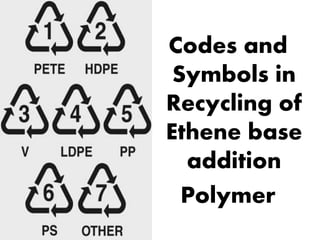
The SPI resin identification coding
system is a set of symbols placed
on plastics to identify the polymer
type. It was developed by the
Society of the Plastics Industry (SPI)
in 1988 and is used internationally.
Plastic bottles are marked at their base
with the Resin identification code to
indicate the material used:
PETE
Polyethylene
Terephthalate
Formula: (C10H8O4)n
IUPAC ID: poly(ethylene)
(terephthalate)
PETE/PET
- is the most common thermoplastic polymer
resin of the polyester family and is used in
fibers for clothing, containers for liquids and
foods, thermoforming for manufacturing, and
in combination with glass fiber for engineering
resins.
Properties:
Usually clear or green, sinks in water, rigid,
glossy
Environmental Qualities:
Recycled into fleece coats, carpet, surf boards
Examples
Soda bottles, furniture
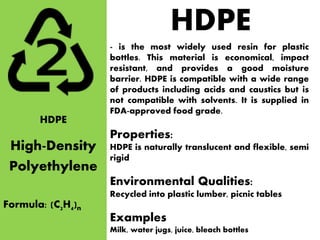
HDPE
High-Density
Polyethylene
Formula: (C2H4)n
- is the most widely used resin for plastic
bottles. This material is economical, impact
resistant, and provides a good moisture
barrier. HDPE is compatible with a wide range
of products including acids and caustics but is
not compatible with solvents. It is supplied in
FDA-approved food grade.
Properties:
HDPE is naturally translucent and flexible, semi
rigid
Environmental Qualities:
Recycled into plastic lumber, picnic tables
Examples
Milk, water jugs, juice, bleach bottles
HDPE
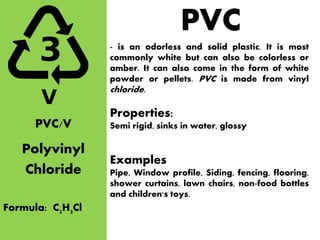
PVC/V
Polyvinyl
Chloride
Formula: C2H3Cl
- is an odorless and solid plastic. It is most
commonly white but can also be colorless or
amber. It can also come in the form of white
powder or pellets. PVC is made from vinyl
chloride.
Properties:
Semi rigid, sinks in water, glossy
Examples
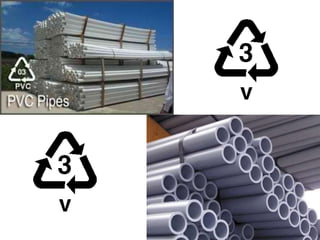
Pipe, Window profile, Siding, fencing, flooring,
shower curtains, lawn chairs, non-food bottles
and children's toys.
PVC
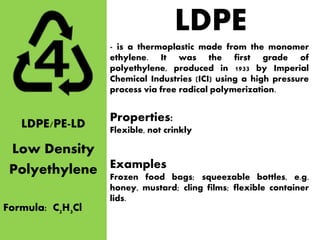
LDPE/PE-LD
Low Density
Polyethylene
Formula: C2H3Cl
- is a thermoplastic made from the monomer
ethylene. It was the first grade of
polyethylene, produced in 1933 by Imperial
Chemical Industries (ICI) using a high pressure
process via free radical polymerization.
Properties:
Flexible, not crinkly
Examples
Frozen food bags; squeezable bottles, e.g.
honey, mustard; cling films; flexible container
lids.
LDPE
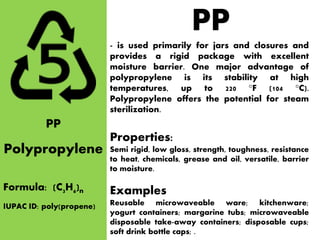
PP
Polypropylene
Formula: (C3H6)n
- is used primarily for jars and closures and
provides a rigid package with excellent
moisture barrier. One major advantage of
polypropylene is its stability at high
temperatures, up to 220 °F (104 °C).
Polypropylene offers the potential for steam
sterilization.
Properties:
Semi rigid, low gloss, strength, toughness, resistance
to heat, chemicals, grease and oil, versatile, barrier
to moisture.
Examples
Reusable microwaveable ware; kitchenware;
yogurt containers; margarine tubs; microwaveable
disposable take-away containers; disposable cups;
soft drink bottle caps; .
PP
IUPAC ID: poly(propene)
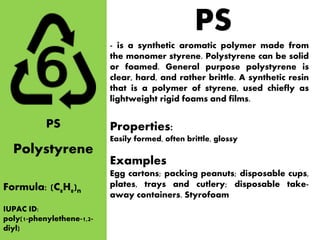
PS
Polystyrene
Formula: (C8H8)n
- is a synthetic aromatic polymer made from
the monomer styrene. Polystyrene can be solid
or foamed. General purpose polystyrene is
clear, hard, and rather brittle. A synthetic resin
that is a polymer of styrene, used chiefly as
lightweight rigid foams and films.
Properties:
Easily formed, often brittle, glossy
Examples
Egg cartons; packing peanuts; disposable cups,
plates, trays and cutlery; disposable take-
away containers. Styrofoam
PS
IUPAC ID:
poly(1-phenylethene-1,2-
diyl)
Polycarbonate
ABS
Acrylonitrile
butadiene
styrene
- is a synthetic aromatic polymer made from
the monomer styrene. Polystyrene can be solid
or foamed. General purpose polystyrene is
clear, hard, and rather brittle. A synthetic resin
that is a polymer of styrene, used chiefly as
lightweight rigid foams and films.
Properties:
Dependent on polymers or combination of polymers
Examples
Beverage bottles; baby milk bottles. Non-
packaging uses for polycarbonate: compact
discs; "unbreakable" glazing; electronic
apparatus housings; lenses including
sunglasses, prescription glasses, automotive
headlamps, riot shields, instrument panels
(often polycarbonate or ABS)
Butadiene based addition polymer

Butadiene based addition polymer

  • 1.
  • 2.
    Codes and Symbols in Recyclingof Ethene base addition Polymer
  • 3.
    The SPI resinidentification coding system is a set of symbols placed on plastics to identify the polymer type. It was developed by the Society of the Plastics Industry (SPI) in 1988 and is used internationally.
  • 4.
    Plastic bottles aremarked at their base with the Resin identification code to indicate the material used:
  • 5.
    PETE Polyethylene Terephthalate Formula: (C10H8O4)n IUPAC ID:poly(ethylene) (terephthalate) PETE/PET - is the most common thermoplastic polymer resin of the polyester family and is used in fibers for clothing, containers for liquids and foods, thermoforming for manufacturing, and in combination with glass fiber for engineering resins. Properties: Usually clear or green, sinks in water, rigid, glossy Environmental Qualities: Recycled into fleece coats, carpet, surf boards Examples Soda bottles, furniture
  • 8.
    HDPE High-Density Polyethylene Formula: (C2H4)n - isthe most widely used resin for plastic bottles. This material is economical, impact resistant, and provides a good moisture barrier. HDPE is compatible with a wide range of products including acids and caustics but is not compatible with solvents. It is supplied in FDA-approved food grade. Properties: HDPE is naturally translucent and flexible, semi rigid Environmental Qualities: Recycled into plastic lumber, picnic tables Examples Milk, water jugs, juice, bleach bottles HDPE
  • 10.
    PVC/V Polyvinyl Chloride Formula: C2H3Cl - isan odorless and solid plastic. It is most commonly white but can also be colorless or amber. It can also come in the form of white powder or pellets. PVC is made from vinyl chloride. Properties: Semi rigid, sinks in water, glossy Examples Pipe, Window profile, Siding, fencing, flooring, shower curtains, lawn chairs, non-food bottles and children's toys. PVC
  • 12.
    LDPE/PE-LD Low Density Polyethylene Formula: C2H3Cl -is a thermoplastic made from the monomer ethylene. It was the first grade of polyethylene, produced in 1933 by Imperial Chemical Industries (ICI) using a high pressure process via free radical polymerization. Properties: Flexible, not crinkly Examples Frozen food bags; squeezable bottles, e.g. honey, mustard; cling films; flexible container lids. LDPE
  • 15.
    PP Polypropylene Formula: (C3H6)n - isused primarily for jars and closures and provides a rigid package with excellent moisture barrier. One major advantage of polypropylene is its stability at high temperatures, up to 220 °F (104 °C). Polypropylene offers the potential for steam sterilization. Properties: Semi rigid, low gloss, strength, toughness, resistance to heat, chemicals, grease and oil, versatile, barrier to moisture. Examples Reusable microwaveable ware; kitchenware; yogurt containers; margarine tubs; microwaveable disposable take-away containers; disposable cups; soft drink bottle caps; . PP IUPAC ID: poly(propene)
  • 17.
    PS Polystyrene Formula: (C8H8)n - isa synthetic aromatic polymer made from the monomer styrene. Polystyrene can be solid or foamed. General purpose polystyrene is clear, hard, and rather brittle. A synthetic resin that is a polymer of styrene, used chiefly as lightweight rigid foams and films. Properties: Easily formed, often brittle, glossy Examples Egg cartons; packing peanuts; disposable cups, plates, trays and cutlery; disposable take- away containers. Styrofoam PS IUPAC ID: poly(1-phenylethene-1,2- diyl)
  • 19.
    Polycarbonate ABS Acrylonitrile butadiene styrene - is asynthetic aromatic polymer made from the monomer styrene. Polystyrene can be solid or foamed. General purpose polystyrene is clear, hard, and rather brittle. A synthetic resin that is a polymer of styrene, used chiefly as lightweight rigid foams and films. Properties: Dependent on polymers or combination of polymers Examples Beverage bottles; baby milk bottles. Non- packaging uses for polycarbonate: compact discs; "unbreakable" glazing; electronic apparatus housings; lenses including sunglasses, prescription glasses, automotive headlamps, riot shields, instrument panels (often polycarbonate or ABS)