How Alkanes affect the Ozone
Layer
By: Aubrey Vale Sagun
The Ozone Layer
• The stratospheric ozone layer shields life
on Earth from the Sun’s harmful ultraviolet
radiation. Chemicals that destroy ozone
are formed by industrial and natural
processes. With the exception of volcanic
injection and aircraft exhaust, these
chemicals are carried up into the
stratosphere by strong upward-moving air
currents in the tropics.
Substances that contributes to
the depletion of the ozone layer
• The major ozone-depleting substances are
chlorofluorocarbons (CFCs), halons,
methane (CH4) and nitrous oxide (N2O).
Methane
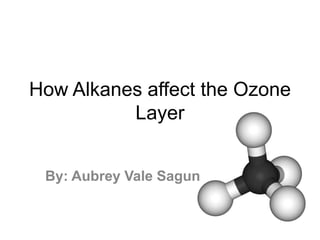
• Methane is the simplest hydrocarbon—a single carbon
atom surrounded by four hydrogen atoms.
• Methane is a colorless, odorless gas with a wide
distribution in nature. It is the principal component of
natural gas.
• Methane plays a double-edged role as an
environmentally important trace gas, both protecting and
altering the earth's atmosphere.
• Methane is a relatively potent greenhouse gas with a
global warming potential.
• Methane acts as a greenhouse gas (a gas
that traps heat from the sun within earth’s
atmosphere) and it also attacks ozone.
CH4
Negative side of Methane
• On methane's negative side, it directly
increases the greenhouse effect in two
ways. First, methane absorbs infrared
radiation well, 20 times better than CO2.
Secondly, increased methane
concentrations increase the amount of
water vapor in the stratosphere, further
trapping heat like the panes
of a greenhouse.
• When burned, methane creates nitrous
oxide (NOx), which is one of the most
detrimental compounds to our environ
ment. NOx is more than 310 times mo
re harmful to the atmosphere than carb
on dioxide.
Positive side of Methane
• On methane's positive side, it protects the
ozone layer. In the stratosphere methane
reacts with and
removes chlorine atoms. If the chlorine did
not react with methane, methane would
quickly react with
ozone, thus destroying it.
How does Methane affect the
ozone layer
• Methane is one of the most harmful green
house gases, twenty one times more harmful
than carbon dioxide.
• The heating effects of methane on the oz
one is 60 percent greater than that of car
bon dioxide
• Methane acts as a greenhouse gas (a gas that
traps heat from the sun within earth’s
atmosphere) and it also attacks ozone.
• Why do I care? Methane is the second
most abundant greenhouse gas. If you
contribute to landfills, use natural gas, or
own livestock, you are contributing to that
concentration.
Other uses of Methane
Methane as bio fuel
Effect of Ozone depletion
• The 11 percent methane increase ''will
make the ozone hole over Antarctica more
severe,'
Global warming
And
Climate Change
Sources of Methane
• Domesticated livestock such as cattle, buffalo, sheep, goat
and also camel produce significant amounts of methane as
part of their normal digestive processes.
• Wastewater treatments
The treatment of sewage and industrial wastewater in
anaerobic conditions produces methane emissions.
• Landfills
Methane is generated in landfills and open dumps as w
aste decomposes under anaerobic (without oxygen) con
ditions.
Prevention of Methane emission
• There's no obvious way to control
methane from natural wetlands other than
to keep them from overheating. But at
least half of methane emissions are from
human activities, ranging from cattle-
rearing and natural gas exploration to coal
mining.
CFC
The
Chlorofluorocarbon
CFC chlorofluorocarbon
• any of a class of compounds of carbon,
hydrogen, chlorine, and fluorine, typically
gases used in refrigerants and aerosol
propellants. They are harmful to the ozone
layer in the earth's atmosphere owing to
the release of chlorine atoms upon
exposure to ultraviolet radiation.
How does CFC affect the ozone
layer
• When UV radiation hits a CFC molecule it
causes one chlorine atom to break away. The
chlorine atom then hits an ozone molecule
consisting of three oxygen atoms and takes
one of the oxygen molecules, destroying the
ozone molecule and turning it into oxygen.
When an oxygen molecule hits the molecule
of chlorine monoxide, the two oxygen atoms
join and form an oxygen molecule
Uses of CFC
• In the past, CFCs have been widely used as
coolants in refrigeration and air conditioners,
as solvents in cleaners, particularly for
electronic circuit boards, as a blowing agents
in the production of foam (e.g. fire
extinguishers), and as propellants in
aerosols. Indeed, much of the modern
lifestyle of the mid-20th century had been
made possible by the use of CFCs.
Sources of CFC
Possible health concerns
• Excessive exposure to some
chlorofluorocarbons may affect the brain,
eye, heart, kidney, liver, pancreas,
reproductive system and skin. The
Environment Agency aims to ensure that
environmental exposures are too low to
harm human health.
Reduction of CFC
• Because CFCs contribute to ozone
depletion in the upper atmosphere, the
manufacture of such compounds has been
phased out under the Montreal Protocol,
and they are being replaced with other
products such as hydrofluorocarbons
(HFCs)
The Montreal Protocol
• The Montreal Protocol on Substances that
Deplete the Ozone Layer (a protocol to the
Vienna Convention for the Protection of the
Ozone Layer) is an international treaty
designed to protect the ozone layer by
phasing out the production of numerous
substances that are responsible for ozon
depletion. It was agreed on 16 September
1987, and entered into force on 1 January
1989,
• Researchers generally agree that by trapping
solar heat in a greenhouse, methane, carbon
dioxide and other pollutants are likely to
warm the earth's lower atmosphere by a few
degrees in the next half century.
• They fear this greenhouse effect may cause
crop-threatening droughts and partly melt
polar ice caps, raising sea levels.
CFC and Methance as greenhouse gases
how alkanes affect ozone layer

how alkanes affect ozone layer

  • 1.
    How Alkanes affectthe Ozone Layer By: Aubrey Vale Sagun
  • 2.
    The Ozone Layer •The stratospheric ozone layer shields life on Earth from the Sun’s harmful ultraviolet radiation. Chemicals that destroy ozone are formed by industrial and natural processes. With the exception of volcanic injection and aircraft exhaust, these chemicals are carried up into the stratosphere by strong upward-moving air currents in the tropics.
  • 5.
    Substances that contributesto the depletion of the ozone layer • The major ozone-depleting substances are chlorofluorocarbons (CFCs), halons, methane (CH4) and nitrous oxide (N2O).
  • 6.
    Methane • Methane isthe simplest hydrocarbon—a single carbon atom surrounded by four hydrogen atoms. • Methane is a colorless, odorless gas with a wide distribution in nature. It is the principal component of natural gas. • Methane plays a double-edged role as an environmentally important trace gas, both protecting and altering the earth's atmosphere. • Methane is a relatively potent greenhouse gas with a global warming potential.
  • 7.
    • Methane actsas a greenhouse gas (a gas that traps heat from the sun within earth’s atmosphere) and it also attacks ozone.
  • 8.
  • 9.
    Negative side ofMethane • On methane's negative side, it directly increases the greenhouse effect in two ways. First, methane absorbs infrared radiation well, 20 times better than CO2. Secondly, increased methane concentrations increase the amount of water vapor in the stratosphere, further trapping heat like the panes of a greenhouse.
  • 10.
    • When burned,methane creates nitrous oxide (NOx), which is one of the most detrimental compounds to our environ ment. NOx is more than 310 times mo re harmful to the atmosphere than carb on dioxide.
  • 11.
    Positive side ofMethane • On methane's positive side, it protects the ozone layer. In the stratosphere methane reacts with and removes chlorine atoms. If the chlorine did not react with methane, methane would quickly react with ozone, thus destroying it.
  • 12.
    How does Methaneaffect the ozone layer • Methane is one of the most harmful green house gases, twenty one times more harmful than carbon dioxide. • The heating effects of methane on the oz one is 60 percent greater than that of car bon dioxide • Methane acts as a greenhouse gas (a gas that traps heat from the sun within earth’s atmosphere) and it also attacks ozone.
  • 14.
    • Why doI care? Methane is the second most abundant greenhouse gas. If you contribute to landfills, use natural gas, or own livestock, you are contributing to that concentration.
  • 15.
  • 16.
  • 17.
    Effect of Ozonedepletion • The 11 percent methane increase ''will make the ozone hole over Antarctica more severe,'
  • 18.
  • 24.
    Sources of Methane •Domesticated livestock such as cattle, buffalo, sheep, goat and also camel produce significant amounts of methane as part of their normal digestive processes. • Wastewater treatments The treatment of sewage and industrial wastewater in anaerobic conditions produces methane emissions. • Landfills Methane is generated in landfills and open dumps as w aste decomposes under anaerobic (without oxygen) con ditions.
  • 27.
    Prevention of Methaneemission • There's no obvious way to control methane from natural wetlands other than to keep them from overheating. But at least half of methane emissions are from human activities, ranging from cattle- rearing and natural gas exploration to coal mining.
  • 28.
  • 29.
    CFC chlorofluorocarbon • anyof a class of compounds of carbon, hydrogen, chlorine, and fluorine, typically gases used in refrigerants and aerosol propellants. They are harmful to the ozone layer in the earth's atmosphere owing to the release of chlorine atoms upon exposure to ultraviolet radiation.
  • 31.
    How does CFCaffect the ozone layer • When UV radiation hits a CFC molecule it causes one chlorine atom to break away. The chlorine atom then hits an ozone molecule consisting of three oxygen atoms and takes one of the oxygen molecules, destroying the ozone molecule and turning it into oxygen. When an oxygen molecule hits the molecule of chlorine monoxide, the two oxygen atoms join and form an oxygen molecule
  • 33.
    Uses of CFC •In the past, CFCs have been widely used as coolants in refrigeration and air conditioners, as solvents in cleaners, particularly for electronic circuit boards, as a blowing agents in the production of foam (e.g. fire extinguishers), and as propellants in aerosols. Indeed, much of the modern lifestyle of the mid-20th century had been made possible by the use of CFCs.
  • 34.
  • 37.
    Possible health concerns •Excessive exposure to some chlorofluorocarbons may affect the brain, eye, heart, kidney, liver, pancreas, reproductive system and skin. The Environment Agency aims to ensure that environmental exposures are too low to harm human health.
  • 38.
    Reduction of CFC •Because CFCs contribute to ozone depletion in the upper atmosphere, the manufacture of such compounds has been phased out under the Montreal Protocol, and they are being replaced with other products such as hydrofluorocarbons (HFCs)
  • 39.
    The Montreal Protocol •The Montreal Protocol on Substances that Deplete the Ozone Layer (a protocol to the Vienna Convention for the Protection of the Ozone Layer) is an international treaty designed to protect the ozone layer by phasing out the production of numerous substances that are responsible for ozon depletion. It was agreed on 16 September 1987, and entered into force on 1 January 1989,
  • 40.
    • Researchers generallyagree that by trapping solar heat in a greenhouse, methane, carbon dioxide and other pollutants are likely to warm the earth's lower atmosphere by a few degrees in the next half century. • They fear this greenhouse effect may cause crop-threatening droughts and partly melt polar ice caps, raising sea levels.
  • 42.
    CFC and Methanceas greenhouse gases