






NIKHIL.V,
Doctor Of Pharmacy,
MGMH,
Wrangal.
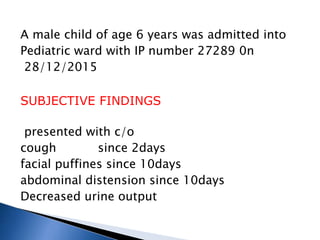
A male child of age 6 years was admitted into
Pediatric ward with IP number 27289 0n
28/12/2015
SUBJECTIVE FINDINGS
presented with c/o
cough since 2days
facial puffines since 10days
abdominal distension since 10days
Decreased urine output
o Haemoglobin - 11.5 gm%
o Sr.creatinine - 0.6 mg/dl
o Urinary protein - 3.8 gm%
o Total cholestrol - 404 mg/dl
o LDL - 300 mg/dl
o HDL - 60 mg/dl
o Triglycerides - 243 mg/dl
o VLDL - 49 mg/dl
o Urine output - 1.5lit
o normal :1ml / kg/hr
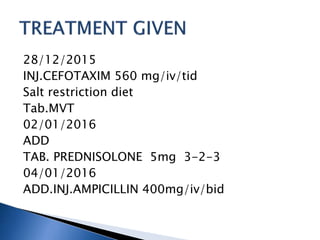
28/12/2015
INJ.CEFOTAXIM 560 mg/iv/tid
Salt restriction diet
Tab.MVT
02/01/2016
ADD
TAB. PREDNISOLONE 5mg 3-2-3
04/01/2016
ADD.INJ.AMPICILLIN 400mg/iv/bid
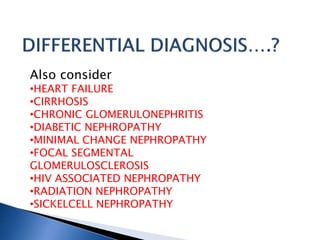
Also consider
•HEART FAILURE
•CIRRHOSIS
•CHRONIC GLOMERULONEPHRITIS
•DIABETIC NEPHROPATHY
•MINIMAL CHANGE NEPHROPATHY
•FOCAL SEGMENTAL
GLOMERULOSCLEROSIS
•HIV ASSOCIATED NEPHROPATHY
•RADIATION NEPHROPATHY
•SICKELCELL NEPHROPATHY
UNDERSTAND NEPHROTIC SYNDROME
 PHYSIOLOGY
 PATHOGENESIS
 DIAGNOSIS
 TREATMENT
 COUNSELLING
 INTERACTIONS
 INTERVENTIONS
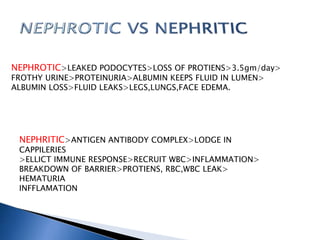
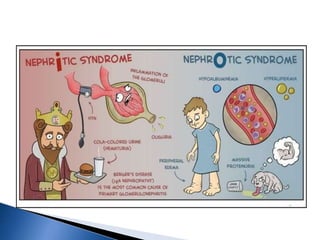
NEPHROTIC ? NEPHRITIC
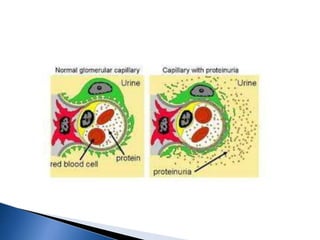
NEPHROTIC>LEAKED PODOCYTES>LOSS OF PROTIENS>3.5gm/day>
FROTHY URINE>PROTEINURIA>ALBUMIN KEEPS FLUID IN LUMEN>
ALBUMIN LOSS>FLUID LEAKS>LEGS,LUNGS,FACE EDEMA.
NEPHRITIC>ANTIGEN ANTIBODY COMPLEX>LODGE IN
CAPPILERIES
>ELLICT IMMUNE RESPONSE>RECRUIT WBC>INFLAMMATION>
BREAKDOWN OF BARRIER>PROTIENS, RBC,WBC LEAK>
HEMATURIA
INFFLAMATION
 The nephrotic syndrome is a clinical complex
characterised by a number of reanal and
external features , the most prominent are
 Albumin decrease
 Hypercoagulability.
 Hyperlipidemia
 Edema
 Lipiduria
 Proteinuria of ›3.5g/day
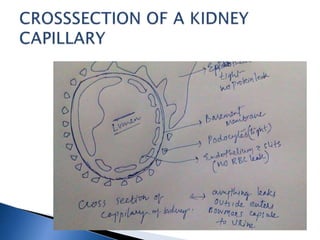
When the components of the filtration barrier
Are disrupted leads to protein loss and
worsens renal function
Complictions:
o Albumin : edema
o Transferin: anemia
o Vit.D binding globulin :
hypocalcemia>convulsions
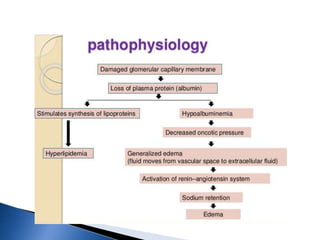
Due to urinary loss of albumin , liver tries to
Compensate this protein loss by increasing the
synthesis of albumin as well as other
molecules like VLDL nd LDL contributing to
development of Hperlipidemia.
Protien synthesis and lipid accumulation:
http://www.ncbi.nlm.nih.gov/pmc/articles/PM
C2224672/
It results from the loss of inhibitors of
coagulation in the urine and increased
synthesis of procoagulatory factors by the
liver.
COMPLICATIONS:
o Renal vein thrombosis
o Peripheral vein thrombosis
o Cerebral vein thrombosis
 It is due to a combination of a decrease in
oncotic pressure from the hypoalbuminaemia
as well a primary renal sodium retention in
the collecting tubules.
Patients with nephrotic syndrome are at
increased risk of infections due to loss of
immunoglobulins and complement being lost
in the urine.
 Minimal change disease- tissue normal under microscope
 Focal segmental glomerulosclerosis- scarring of glomeruli
 Membraneous nephropathy-thickened membrane
 Diabetic kidney disease
 Systemic lupus erythematosus
 Amyloidosis-amyloid build up
 Blod clot in renal vein
 CHF
 are responsible for increasing the glomerular permiability and
protienuria.
• Bed rest in edema
•Regulate body water balance by Salt and fluid
restriction depending upon edema
•Replace the protein loss by having intake of protiens,
avoid high intake of protiens to prevent any tubular
damage.
•Fat intake should also be low
•Calcium intake of 800mg/day either by diet or a
tablet with VIT-D is necessary.
•Iron supplementation
 Diuretics is a double edge weapon, so use with caution
 Use spironolactone if given with hydrochlorothiazide @
4mg/kg
 NSIDS, ACE inhibitors reduce protienuria
(selective COX2inhibition decreses protienuria:
www.medscpe.com/viewarticle/704078 )
 Vitamin D
 Lipid lowering drugs
 Anticoagulants
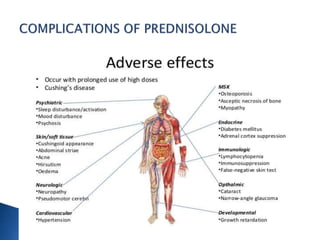
 Prednisolone 1mg/kg in children as a single or
divided doses for 4 weeks and then single dose
in the morning on alternate days.
 If proteinuria relapses then the child is steroid
dependent , continue prednisolone for 8 weeks
and taper the dose, so that the entire course lasts
for 6 months
 If resistant to prednisolone , cyclophosphamide
2mg/kg, cyclosporin,chlorambucil are used to
retard progression.
 Blocks the action of migratory
inhibiting factor (MIF) and chemotactic
factor, inhibits the endothelial
adherence of macrophages and
leukocytes , blocks the antigen
processing function of macrophages,
stablises lysosomal membrne and
prevents the increase in capillary
permiability and diapedesis.
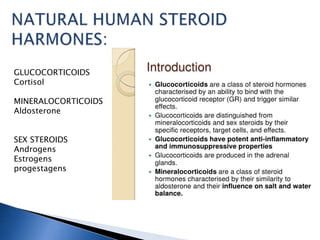
GLUCOCORTICOIDS
Cortisol
MINERALOCORTICOIDS
Aldosterone
SEX STEROIDS
Androgens
Estrogens
progestagens
 Nephrotic Syndrome is associated with
immune complexes depositing in the kidneys.
When you get fever, cold or infection,
excessive immune complexes come into
being and deposit in the kidneys, triggering
the relapse of Nephrotic Syndrome.
Antibiotics can kill the bacteria invading into
your body so as to reduce their damage to
your body.
 If you do not want to use antibiotics, you
should improve your immunity to fight
against infections. In the daily, you should do
some gentle exercise, such as walking,
jogging, yoga and tai chi to strengthen your
immunity. You should also add fresh
vegetables and fruits into your diet, which is
packed with rich vitamins, which can also
boost your immune system
NEPHROTIC SYNDROME

NEPHROTIC SYNDROME

  • 1.
  • 2.
    A male childof age 6 years was admitted into Pediatric ward with IP number 27289 0n 28/12/2015 SUBJECTIVE FINDINGS presented with c/o cough since 2days facial puffines since 10days abdominal distension since 10days Decreased urine output
  • 4.
    o Haemoglobin -11.5 gm% o Sr.creatinine - 0.6 mg/dl o Urinary protein - 3.8 gm% o Total cholestrol - 404 mg/dl o LDL - 300 mg/dl o HDL - 60 mg/dl o Triglycerides - 243 mg/dl o VLDL - 49 mg/dl o Urine output - 1.5lit o normal :1ml / kg/hr
  • 5.
    28/12/2015 INJ.CEFOTAXIM 560 mg/iv/tid Saltrestriction diet Tab.MVT 02/01/2016 ADD TAB. PREDNISOLONE 5mg 3-2-3 04/01/2016 ADD.INJ.AMPICILLIN 400mg/iv/bid
  • 7.
    Also consider •HEART FAILURE •CIRRHOSIS •CHRONICGLOMERULONEPHRITIS •DIABETIC NEPHROPATHY •MINIMAL CHANGE NEPHROPATHY •FOCAL SEGMENTAL GLOMERULOSCLEROSIS •HIV ASSOCIATED NEPHROPATHY •RADIATION NEPHROPATHY •SICKELCELL NEPHROPATHY
  • 8.
    UNDERSTAND NEPHROTIC SYNDROME PHYSIOLOGY  PATHOGENESIS  DIAGNOSIS  TREATMENT  COUNSELLING  INTERACTIONS  INTERVENTIONS
  • 9.
  • 12.
    NEPHROTIC>LEAKED PODOCYTES>LOSS OFPROTIENS>3.5gm/day> FROTHY URINE>PROTEINURIA>ALBUMIN KEEPS FLUID IN LUMEN> ALBUMIN LOSS>FLUID LEAKS>LEGS,LUNGS,FACE EDEMA. NEPHRITIC>ANTIGEN ANTIBODY COMPLEX>LODGE IN CAPPILERIES >ELLICT IMMUNE RESPONSE>RECRUIT WBC>INFLAMMATION> BREAKDOWN OF BARRIER>PROTIENS, RBC,WBC LEAK> HEMATURIA INFFLAMATION
  • 14.
     The nephroticsyndrome is a clinical complex characterised by a number of reanal and external features , the most prominent are  Albumin decrease  Hypercoagulability.  Hyperlipidemia  Edema  Lipiduria  Proteinuria of ›3.5g/day
  • 15.
    When the componentsof the filtration barrier Are disrupted leads to protein loss and worsens renal function Complictions: o Albumin : edema o Transferin: anemia o Vit.D binding globulin : hypocalcemia>convulsions
  • 16.
    Due to urinaryloss of albumin , liver tries to Compensate this protein loss by increasing the synthesis of albumin as well as other molecules like VLDL nd LDL contributing to development of Hperlipidemia. Protien synthesis and lipid accumulation: http://www.ncbi.nlm.nih.gov/pmc/articles/PM C2224672/
  • 17.
    It results fromthe loss of inhibitors of coagulation in the urine and increased synthesis of procoagulatory factors by the liver. COMPLICATIONS: o Renal vein thrombosis o Peripheral vein thrombosis o Cerebral vein thrombosis
  • 19.
     It isdue to a combination of a decrease in oncotic pressure from the hypoalbuminaemia as well a primary renal sodium retention in the collecting tubules.
  • 20.
    Patients with nephroticsyndrome are at increased risk of infections due to loss of immunoglobulins and complement being lost in the urine.
  • 21.
     Minimal changedisease- tissue normal under microscope  Focal segmental glomerulosclerosis- scarring of glomeruli  Membraneous nephropathy-thickened membrane  Diabetic kidney disease  Systemic lupus erythematosus  Amyloidosis-amyloid build up  Blod clot in renal vein  CHF  are responsible for increasing the glomerular permiability and protienuria.
  • 22.
    • Bed restin edema •Regulate body water balance by Salt and fluid restriction depending upon edema •Replace the protein loss by having intake of protiens, avoid high intake of protiens to prevent any tubular damage. •Fat intake should also be low •Calcium intake of 800mg/day either by diet or a tablet with VIT-D is necessary. •Iron supplementation
  • 23.
     Diuretics isa double edge weapon, so use with caution  Use spironolactone if given with hydrochlorothiazide @ 4mg/kg  NSIDS, ACE inhibitors reduce protienuria (selective COX2inhibition decreses protienuria: www.medscpe.com/viewarticle/704078 )  Vitamin D  Lipid lowering drugs  Anticoagulants
  • 24.
     Prednisolone 1mg/kgin children as a single or divided doses for 4 weeks and then single dose in the morning on alternate days.  If proteinuria relapses then the child is steroid dependent , continue prednisolone for 8 weeks and taper the dose, so that the entire course lasts for 6 months  If resistant to prednisolone , cyclophosphamide 2mg/kg, cyclosporin,chlorambucil are used to retard progression.
  • 25.
     Blocks theaction of migratory inhibiting factor (MIF) and chemotactic factor, inhibits the endothelial adherence of macrophages and leukocytes , blocks the antigen processing function of macrophages, stablises lysosomal membrne and prevents the increase in capillary permiability and diapedesis.
  • 26.
  • 30.
     Nephrotic Syndromeis associated with immune complexes depositing in the kidneys. When you get fever, cold or infection, excessive immune complexes come into being and deposit in the kidneys, triggering the relapse of Nephrotic Syndrome. Antibiotics can kill the bacteria invading into your body so as to reduce their damage to your body.
  • 31.
     If youdo not want to use antibiotics, you should improve your immunity to fight against infections. In the daily, you should do some gentle exercise, such as walking, jogging, yoga and tai chi to strengthen your immunity. You should also add fresh vegetables and fruits into your diet, which is packed with rich vitamins, which can also boost your immune system