NEPHROTIC & NEPHRITIC SYNDROME
IBRAHIM SANDOKJI, MD, FAAP
Pediatric Nephrologist, Assistant Professor
Board Certified by the American Board of Pediatrics
Taibah University
isandokji@taibahu.edu.sa
+966 50 632 5770
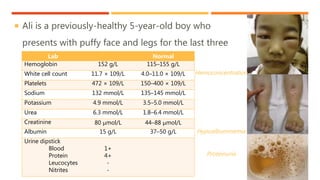
 Ali is a previously-healthy 5-year-old boy who
presents with puffy face and legs for the last three
days. Lab Normal
Hemoglobin 152 g/L 115–155 g/L
White cell count 11.7 × 10⁹/L 4.0–11.0 × 10⁹/L
Platelets 472 × 109/L 150–400 × 109/L
Sodium 132 mmol/L 135–145 mmol/L
Potassium 4.9 mmol/L 3.5–5.0 mmol/L
Urea 6.3 mmol/L 1.8–6.4 mmol/L
Creatinine 80 μmol/L 44–88 μmol/L
Albumin 15 g/L 37–50 g/L
Urine dipstick
Blood
Protein
Leucocytes
Nitrites
1+
4+
-
-
Hemoconcentration
Hypoalbuminemia
Proteinuria
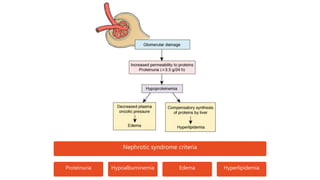
Nephrotic syndrome criteria
Proteinuria Hypoalbuminemia Edema Hyperlipidemia
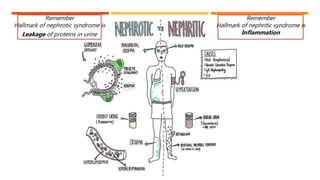
Remember
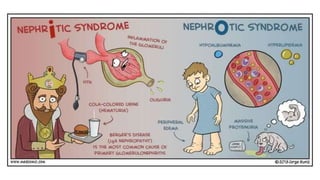
Hallmark of nephrotic syndrome is
Leakage of proteins in urine
Remember
Hallmark of nephritic syndrome is
Inflammation
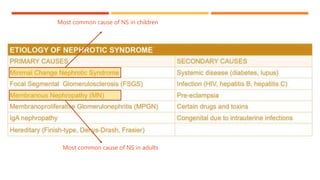
Most common cause of NS in children
Most common cause of NS in adults
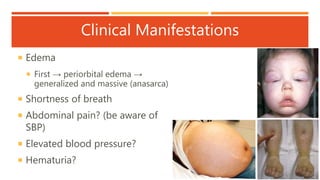
Clinical Manifestations
 Edema
 First → periorbital edema →
generalized and massive (anasarca)
 Shortness of breath
 Abdominal pain? (be aware of
SBP)
 Elevated blood pressure?
 Hematuria?
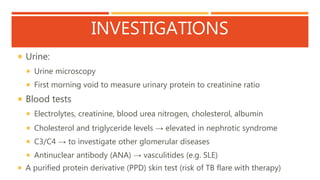
INVESTIGATIONS
 Urine:
 Urine microscopy
 First morning void to measure urinary protein to creatinine ratio
 Blood tests
 Electrolytes, creatinine, blood urea nitrogen, cholesterol, albumin
 Cholesterol and triglyceride levels → elevated in nephrotic syndrome
 C3/C4 → to investigate other glomerular diseases
 Antinuclear antibody (ANA) → vasculitides (e.g. SLE)
 A purified protein derivative (PPD) skin test (risk of TB flare with therapy)
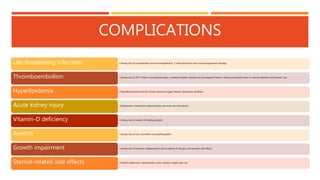
COMPLICATIONS
• Urinary loss of complements and immunoglobulins, T-cell dysfunction and immunosuppressive therapy
Life-threatening infections
• Urinary loss of AT3, Protein S and plasminogen, increased hepatic synthesis of procoagulant factors, hemoconcentration due to volume depletion and diuretic use
Thromboembolism
• Hypoalbuminemia and low oncotic pressure trigger hepatic lipoprotein synthesis
Hyperlipidemia
• Dehydration, medication nephrotoxicity and renal vein thrombosis
Acute kidney injury
• Urinary loss of vitamin-D binding protein
Vitamin-D deficiency
• Urinary loss of iron, transferrin and erythropoietin
Anemia
• Urinary loss of proteins, malabsorption due to edema of the gut, and steroids side effects
Growth impairment
• Growth impairment, hypertension, acne, cataract, weight gain, etc.
Steroid-related side effects
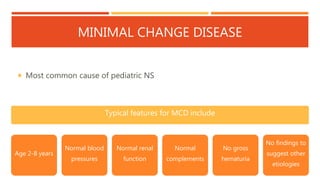
MINIMAL CHANGE DISEASE
 Most common cause of pediatric NS
Typical features for MCD include
Age 2-8 years
Normal blood
pressures
Normal renal
function
Normal
complements
No gross
hematuria
No findings to
suggest other
etiologies
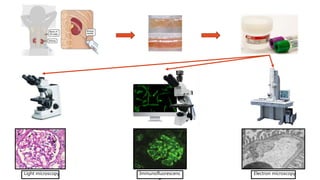
Electron microscopy
Light microscopy Immunofluorescenc
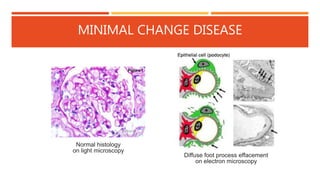
MINIMAL CHANGE DISEASE
Diffuse foot process effacement
on electron microscopy
Normal histology
on light microscopy
TREATMENT
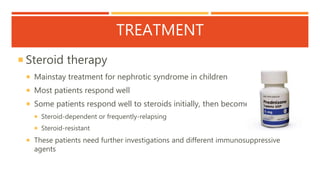
 Steroid therapy
 Mainstay treatment for nephrotic syndrome in children
 Most patients respond well
 Some patients respond well to steroids initially, then become
 Steroid-dependent or frequently-relapsing
 Steroid-resistant
 These patients need further investigations and different immunosuppressive
agents
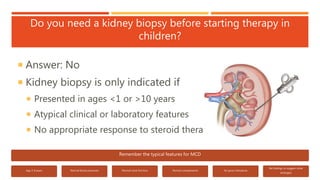
Do you need a kidney biopsy before starting therapy in
children?
 Answer: No
 Kidney biopsy is only indicated if
 Presented in ages <1 or >10 years
 Atypical clinical or laboratory features
 No appropriate response to steroid therapy
Remember the typical features for MCD
Age 2-8 years Normal blood pressures Normal renal function Normal complements No gross hematuria
No findings to suggest other
etiologies
MEMBRANOUS
NEPHROPATHY
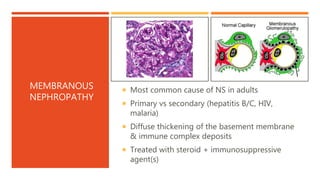
 Most common cause of NS in adults
 Primary vs secondary (hepatitis B/C, HIV,
malaria)
 Diffuse thickening of the basement membrane
& immune complex deposits
 Treated with steroid + immunosuppressive
agent(s)
FOCAL
SEGMENTAL
GLOMERULO-
SCLEROSIS
(FSGS)
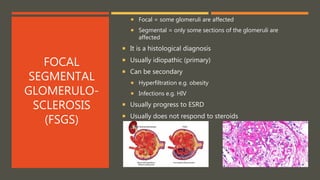
 Focal = some glomeruli are affected
 Segmental = only some sections of the glomeruli are
affected
 It is a histological diagnosis
 Usually idiopathic (primary)
 Can be secondary
 Hyperfiltration e.g. obesity
 Infections e.g. HIV
 Usually progress to ESRD
 Usually does not respond to steroids
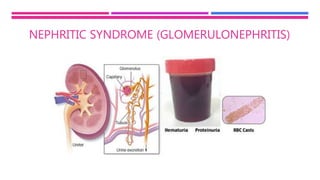
NEPHRITIC SYNDROME (GLOMERULONEPHRITIS)
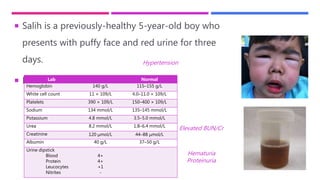
 Salih is a previously-healthy 5-year-old boy who
presents with puffy face and red urine for three
days.
 His blood pressure is 125/85.
Lab Normal
Hemoglobin 140 g/L 115–155 g/L
White cell count 11 × 109/L 4.0–11.0 × 10⁹/L
Platelets 390 × 109/L 150–400 × 109/L
Sodium 134 mmol/L 135–145 mmol/L
Potassium 4.8 mmol/L 3.5–5.0 mmol/L
Urea 8.2 mmol/L 1.8–6.4 mmol/L
Creatinine 120 μmol/L 44–88 μmol/L
Albumin 40 g/L 37–50 g/L
Urine dipstick
Blood
Protein
Leucocytes
Nitrites
4+
4+
+1
-
Elevated BUN/Cr
Hematuria
Proteinuria
Hypertension
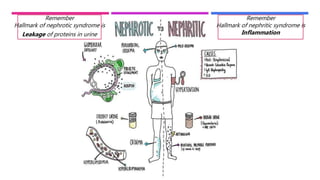
Remember
Hallmark of nephrotic syndrome is
Leakage of proteins in urine
Remember
Hallmark of nephritic syndrome is
Inflammation
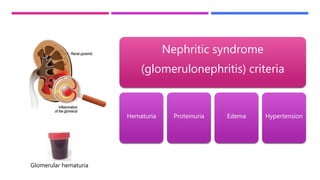
Nephritic syndrome
(glomerulonephritis) criteria
Hematuria Proteinuria Edema Hypertension
Glomerular hematuria
CAUSES OF GLOMERULONEPHRITIS IN CHILDREN
Primary glomerulonephritis
 IgA nephropathy*
 Membranous nephropathy
 Membranoproliferative
glomerulonephritis
Secondary glomerulonephritis
 Post-infectious glomerulonephritis*
 HSP nephritis
 Systemic lupus erythematosus nephritis
*See the other lecture
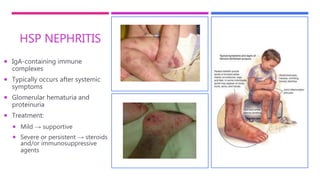
HSP NEPHRITIS
 IgA-containing immune
complexes
 Typically occurs after systemic
symptoms
 Glomerular hematuria and
proteinuria
 Treatment:
 Mild → supportive
 Severe or persistent → steroids
and/or immunosuppressive
agents
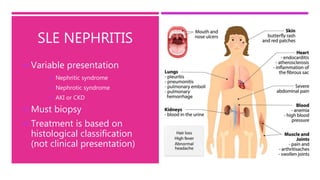
SLE NEPHRITIS
 Variable presentation
 Nephritic syndrome
 Nephrotic syndrome
 AKI or CKD
 Must biopsy
 Treatment is based on
histological classification
(not clinical presentation)
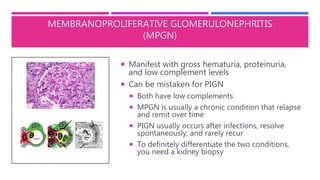
MEMBRANOPROLIFERATIVE GLOMERULONEPHRITIS
(MPGN)
 Manifest with gross hematuria, proteinuria,
and low complement levels
 Can be mistaken for PIGN
 Both have low complements
 MPGN is usually a chronic condition that relapse
and remit over time
 PIGN usually occurs after infections, resolve
spontaneously, and rarely recur
 To definitely differentiate the two conditions,
you need a kidney biopsy
RAPIDLY
PROGRESSIVE
GN
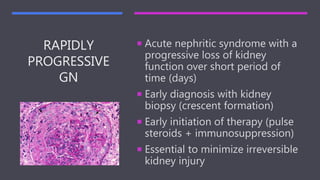
 Acute nephritic syndrome with a
progressive loss of kidney
function over short period of
time (days)
 Early diagnosis with kidney
biopsy (crescent formation)
 Early initiation of therapy (pulse
steroids + immunosuppression)
 Essential to minimize irreversible
kidney injury
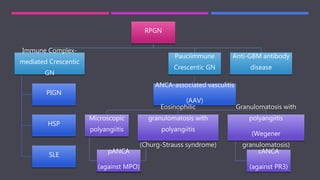
RPGN
Immune Complex-
mediated Crescentic
GN
PIGN
HSP
SLE
Pauciimmune
Crescentic GN
ANCA-associated vasculitis
(AAV)
Microscopic
polyangiitis
pANCA
(against MPO)
Eosinophilic
granulomatosis with
polyangiitis
(Churg-Strauss syndrome)
pANCA
(against MPO)
Granulomatosis with
polyangiitis
(Wegener
granulomatosis)
cANCA
(against PR3)
Anti-GBM antibody
disease
HOME READING
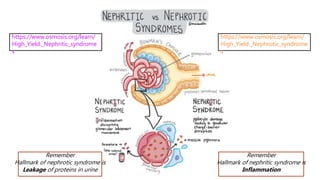
https://www.osmosis.org/learn/
High_Yield:_Nephritic_syndrome
s
https://www.osmosis.org/learn/
High_Yield:_Nephrotic_syndrome
s
Remember
Hallmark of nephrotic syndrome is
Leakage of proteins in urine
Remember
Hallmark of nephritic syndrome is
Inflammation
HYPERTENSION IN CHILDREN
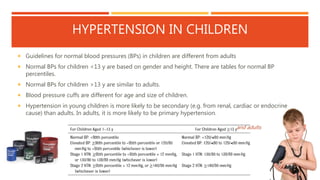
 Guidelines for normal blood pressures (BPs) in children are different from adults
 Normal BPs for children <13 y are based on gender and height. There are tables for normal BP
percentiles.
 Normal BPs for children >13 y are similar to adults.
 Blood pressure cuffs are different for age and size of children.
 Hypertension in young children is more likely to be secondary (e.g. from renal, cardiac or endocrine
cause) than adults. In adults, it is more likely to be primary hypertension.
and adults

Nephrotic & Nephritic Syndromes in Children.pptx

  • 1.
    NEPHROTIC & NEPHRITICSYNDROME IBRAHIM SANDOKJI, MD, FAAP Pediatric Nephrologist, Assistant Professor Board Certified by the American Board of Pediatrics Taibah University isandokji@taibahu.edu.sa +966 50 632 5770
  • 2.
     Ali isa previously-healthy 5-year-old boy who presents with puffy face and legs for the last three days. Lab Normal Hemoglobin 152 g/L 115–155 g/L White cell count 11.7 × 10⁹/L 4.0–11.0 × 10⁹/L Platelets 472 × 109/L 150–400 × 109/L Sodium 132 mmol/L 135–145 mmol/L Potassium 4.9 mmol/L 3.5–5.0 mmol/L Urea 6.3 mmol/L 1.8–6.4 mmol/L Creatinine 80 μmol/L 44–88 μmol/L Albumin 15 g/L 37–50 g/L Urine dipstick Blood Protein Leucocytes Nitrites 1+ 4+ - - Hemoconcentration Hypoalbuminemia Proteinuria
  • 4.
    Nephrotic syndrome criteria ProteinuriaHypoalbuminemia Edema Hyperlipidemia
  • 5.
    Remember Hallmark of nephroticsyndrome is Leakage of proteins in urine Remember Hallmark of nephritic syndrome is Inflammation
  • 6.
    Most common causeof NS in children Most common cause of NS in adults
  • 7.
    Clinical Manifestations  Edema First → periorbital edema → generalized and massive (anasarca)  Shortness of breath  Abdominal pain? (be aware of SBP)  Elevated blood pressure?  Hematuria?
  • 8.
    INVESTIGATIONS  Urine:  Urinemicroscopy  First morning void to measure urinary protein to creatinine ratio  Blood tests  Electrolytes, creatinine, blood urea nitrogen, cholesterol, albumin  Cholesterol and triglyceride levels → elevated in nephrotic syndrome  C3/C4 → to investigate other glomerular diseases  Antinuclear antibody (ANA) → vasculitides (e.g. SLE)  A purified protein derivative (PPD) skin test (risk of TB flare with therapy)
  • 9.
    COMPLICATIONS • Urinary lossof complements and immunoglobulins, T-cell dysfunction and immunosuppressive therapy Life-threatening infections • Urinary loss of AT3, Protein S and plasminogen, increased hepatic synthesis of procoagulant factors, hemoconcentration due to volume depletion and diuretic use Thromboembolism • Hypoalbuminemia and low oncotic pressure trigger hepatic lipoprotein synthesis Hyperlipidemia • Dehydration, medication nephrotoxicity and renal vein thrombosis Acute kidney injury • Urinary loss of vitamin-D binding protein Vitamin-D deficiency • Urinary loss of iron, transferrin and erythropoietin Anemia • Urinary loss of proteins, malabsorption due to edema of the gut, and steroids side effects Growth impairment • Growth impairment, hypertension, acne, cataract, weight gain, etc. Steroid-related side effects
  • 10.
    MINIMAL CHANGE DISEASE Most common cause of pediatric NS Typical features for MCD include Age 2-8 years Normal blood pressures Normal renal function Normal complements No gross hematuria No findings to suggest other etiologies
  • 11.
  • 12.
    MINIMAL CHANGE DISEASE Diffusefoot process effacement on electron microscopy Normal histology on light microscopy
  • 13.
    TREATMENT  Steroid therapy Mainstay treatment for nephrotic syndrome in children  Most patients respond well  Some patients respond well to steroids initially, then become  Steroid-dependent or frequently-relapsing  Steroid-resistant  These patients need further investigations and different immunosuppressive agents
  • 14.
    Do you needa kidney biopsy before starting therapy in children?  Answer: No  Kidney biopsy is only indicated if  Presented in ages <1 or >10 years  Atypical clinical or laboratory features  No appropriate response to steroid therapy Remember the typical features for MCD Age 2-8 years Normal blood pressures Normal renal function Normal complements No gross hematuria No findings to suggest other etiologies
  • 15.
    MEMBRANOUS NEPHROPATHY  Most commoncause of NS in adults  Primary vs secondary (hepatitis B/C, HIV, malaria)  Diffuse thickening of the basement membrane & immune complex deposits  Treated with steroid + immunosuppressive agent(s)
  • 16.
    FOCAL SEGMENTAL GLOMERULO- SCLEROSIS (FSGS)  Focal =some glomeruli are affected  Segmental = only some sections of the glomeruli are affected  It is a histological diagnosis  Usually idiopathic (primary)  Can be secondary  Hyperfiltration e.g. obesity  Infections e.g. HIV  Usually progress to ESRD  Usually does not respond to steroids
  • 17.
  • 18.
     Salih isa previously-healthy 5-year-old boy who presents with puffy face and red urine for three days.  His blood pressure is 125/85. Lab Normal Hemoglobin 140 g/L 115–155 g/L White cell count 11 × 109/L 4.0–11.0 × 10⁹/L Platelets 390 × 109/L 150–400 × 109/L Sodium 134 mmol/L 135–145 mmol/L Potassium 4.8 mmol/L 3.5–5.0 mmol/L Urea 8.2 mmol/L 1.8–6.4 mmol/L Creatinine 120 μmol/L 44–88 μmol/L Albumin 40 g/L 37–50 g/L Urine dipstick Blood Protein Leucocytes Nitrites 4+ 4+ +1 - Elevated BUN/Cr Hematuria Proteinuria Hypertension
  • 19.
    Remember Hallmark of nephroticsyndrome is Leakage of proteins in urine Remember Hallmark of nephritic syndrome is Inflammation
  • 20.
    Nephritic syndrome (glomerulonephritis) criteria HematuriaProteinuria Edema Hypertension Glomerular hematuria
  • 21.
    CAUSES OF GLOMERULONEPHRITISIN CHILDREN Primary glomerulonephritis  IgA nephropathy*  Membranous nephropathy  Membranoproliferative glomerulonephritis Secondary glomerulonephritis  Post-infectious glomerulonephritis*  HSP nephritis  Systemic lupus erythematosus nephritis *See the other lecture
  • 22.
    HSP NEPHRITIS  IgA-containingimmune complexes  Typically occurs after systemic symptoms  Glomerular hematuria and proteinuria  Treatment:  Mild → supportive  Severe or persistent → steroids and/or immunosuppressive agents
  • 23.
    SLE NEPHRITIS  Variablepresentation  Nephritic syndrome  Nephrotic syndrome  AKI or CKD  Must biopsy  Treatment is based on histological classification (not clinical presentation)
  • 24.
    MEMBRANOPROLIFERATIVE GLOMERULONEPHRITIS (MPGN)  Manifestwith gross hematuria, proteinuria, and low complement levels  Can be mistaken for PIGN  Both have low complements  MPGN is usually a chronic condition that relapse and remit over time  PIGN usually occurs after infections, resolve spontaneously, and rarely recur  To definitely differentiate the two conditions, you need a kidney biopsy
  • 25.
    RAPIDLY PROGRESSIVE GN  Acute nephriticsyndrome with a progressive loss of kidney function over short period of time (days)  Early diagnosis with kidney biopsy (crescent formation)  Early initiation of therapy (pulse steroids + immunosuppression)  Essential to minimize irreversible kidney injury
  • 26.
    RPGN Immune Complex- mediated Crescentic GN PIGN HSP SLE Pauciimmune CrescenticGN ANCA-associated vasculitis (AAV) Microscopic polyangiitis pANCA (against MPO) Eosinophilic granulomatosis with polyangiitis (Churg-Strauss syndrome) pANCA (against MPO) Granulomatosis with polyangiitis (Wegener granulomatosis) cANCA (against PR3) Anti-GBM antibody disease
  • 27.
  • 28.
  • 30.
    HYPERTENSION IN CHILDREN Guidelines for normal blood pressures (BPs) in children are different from adults  Normal BPs for children <13 y are based on gender and height. There are tables for normal BP percentiles.  Normal BPs for children >13 y are similar to adults.  Blood pressure cuffs are different for age and size of children.  Hypertension in young children is more likely to be secondary (e.g. from renal, cardiac or endocrine cause) than adults. In adults, it is more likely to be primary hypertension. and adults