
PRE-HISTORY
• History tells the story of humankind.
• Historians mostly use written records to gather
information about the past.
• History is said to begin with the invention of writing
about 5,500 yrs. Ago.
• But the story of humankind really begins in the time
before people developed writing – the period called
pre-history.
PALEOLITHIC
PALEOLITHIC PERIOD
•Historians call the earliest period of human history the
old stone age, or the Paleolithic Period.
•They lived in small hunting and food-gathering bands
of about 20 to 30 people.
•Stone age people learned to adapt to their environment
for survival.
•Men and women made simple tools and weapon such
as digging sticks, spears and axes.
•They developed spoken languages , which let them
cooperate as they worked.
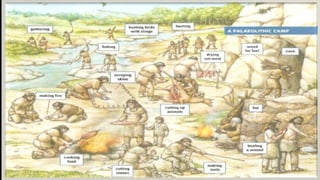
HUNTING and GATHERING
• Lived from hunting,
fishing and gathering
• Could not produce their
own food: predators
• Men: organized hunting
and fishing
• Women: Gathering
• Used meat for food, skins
for clothes and bones and
horns for tools
NOMADIC LIFE
• Nomads: they did not
live in a fixed place –
followed animals,
searched water, food
and shelter
• Lived outdoors – in
caves and huts
• Organized in small
tribes, made up of
members of the same
family
STONE AGE
•Tools and
objects of
stone
•Used to hunt,
cut animal’s
skin and
meat
TOOLS
• At first,
tools were
simple
sharpened
stones
TOOLS (II)
•Tools were
perfected
(using flint)
•Specialized
tools:
scrapers,
spear heads
TOOLS (III)
•And later,
new
materials
were used:
bone, horn
How were tools made?
Paleolithic bark canoes
• Home Erectus started to use
fire 500,000 years ago
• It was used to cook food,
heat and light caves and
huts, and drive wild
animals away
• Bonding
RITES and BELIEFS
• Believed in
supernatural forces
• Rites to ask
divinities for help
• Buried the dead….
But we don’t know
why.
PALEOLITHIC ART
• Around 30,000
years ago Homo
sapiens sapiens
began painting on
the walls of caves.
• It showed an
artistic sensibility
CHARACTERISTICS OF
PALEOLITHIC ART
• Animals were represented – deer, bison,
horses, mammoth
• the paintings were realistic – the rough
surface of the caves gave them a 3D effect
• Colours included red, brown, yellow &
black made from natural materials
• Animal hairs were used to make brushes
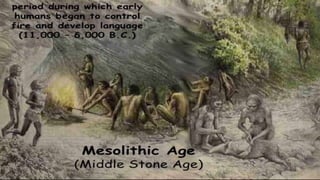
•At about the same time, theses early
humans also had learned how to make fire.
• Protected themselves from the weather
• Allow them to cook
• Enabled them to live in caves.
Why did they paint the cave? What do the paintings mean?
NEOLITHIC
NEOLITHIC
• It means “New Stone Age”
• Started around 8,000 BC
• New way of life: agriculture + sedentarism
• New technology: pottery, textiles, stone
polishing
• Neolithic centres: Fertile Crescent (Middle
East), Ganges river valley (India), SE Asia,
Mexico, Andes valleys
Where did agriculture start?
‘Revolution’: a new way of life
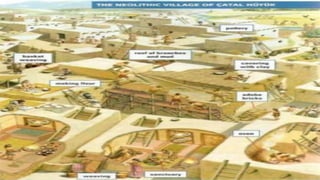
FARMING SEDENTARY
LIFE VILLAGES
• Grow crops
like wheat,
barley, rye,
lentils, maize,
potatoes
• Domesticate
animals like
sheep, goats,
pigs
• When people
start to grown
their own food,
they don’t need
to move around
looking for food
• Look after crops
and animals
• Close to the
rivers (water to
irrigate crops
and drink)
• Protection
• Organization +
leader
A Neolithic Village
A Neolithic Activities
New Activities
Pre-History
Pre-History
Pre-History
Pre-History
Pre-History
Pre-History
Pre-History
Pre-History
Pre-History

Pre-History

  • 2.
    PRE-HISTORY • History tellsthe story of humankind. • Historians mostly use written records to gather information about the past. • History is said to begin with the invention of writing about 5,500 yrs. Ago. • But the story of humankind really begins in the time before people developed writing – the period called pre-history.
  • 3.
  • 5.
    PALEOLITHIC PERIOD •Historians callthe earliest period of human history the old stone age, or the Paleolithic Period. •They lived in small hunting and food-gathering bands of about 20 to 30 people. •Stone age people learned to adapt to their environment for survival. •Men and women made simple tools and weapon such as digging sticks, spears and axes. •They developed spoken languages , which let them cooperate as they worked.
  • 6.
    HUNTING and GATHERING •Lived from hunting, fishing and gathering • Could not produce their own food: predators • Men: organized hunting and fishing • Women: Gathering • Used meat for food, skins for clothes and bones and horns for tools
  • 7.
    NOMADIC LIFE • Nomads:they did not live in a fixed place – followed animals, searched water, food and shelter • Lived outdoors – in caves and huts • Organized in small tribes, made up of members of the same family
  • 8.
    STONE AGE •Tools and objectsof stone •Used to hunt, cut animal’s skin and meat
  • 9.
    TOOLS • At first, toolswere simple sharpened stones
  • 10.
    TOOLS (II) •Tools were perfected (usingflint) •Specialized tools: scrapers, spear heads
  • 11.
  • 12.
  • 13.
  • 14.
    • Home Erectusstarted to use fire 500,000 years ago • It was used to cook food, heat and light caves and huts, and drive wild animals away • Bonding
  • 15.
    RITES and BELIEFS •Believed in supernatural forces • Rites to ask divinities for help • Buried the dead…. But we don’t know why.
  • 16.
    PALEOLITHIC ART • Around30,000 years ago Homo sapiens sapiens began painting on the walls of caves. • It showed an artistic sensibility
  • 17.
    CHARACTERISTICS OF PALEOLITHIC ART •Animals were represented – deer, bison, horses, mammoth • the paintings were realistic – the rough surface of the caves gave them a 3D effect • Colours included red, brown, yellow & black made from natural materials • Animal hairs were used to make brushes
  • 18.
    •At about thesame time, theses early humans also had learned how to make fire. • Protected themselves from the weather • Allow them to cook • Enabled them to live in caves.
  • 19.
    Why did theypaint the cave? What do the paintings mean?
  • 37.
  • 38.
    NEOLITHIC • It means“New Stone Age” • Started around 8,000 BC • New way of life: agriculture + sedentarism • New technology: pottery, textiles, stone polishing • Neolithic centres: Fertile Crescent (Middle East), Ganges river valley (India), SE Asia, Mexico, Andes valleys
  • 39.
  • 40.
    ‘Revolution’: a newway of life FARMING SEDENTARY LIFE VILLAGES • Grow crops like wheat, barley, rye, lentils, maize, potatoes • Domesticate animals like sheep, goats, pigs • When people start to grown their own food, they don’t need to move around looking for food • Look after crops and animals • Close to the rivers (water to irrigate crops and drink) • Protection • Organization + leader
  • 41.
  • 43.
  • 44.

Editor's Notes

  • #6 nomads= moving from place to place