Architecture with allvarying phases and
complex development must have
a simple origin in the primitive efforts
of mankind to secure protection against
weather, wild beasts and enemies.
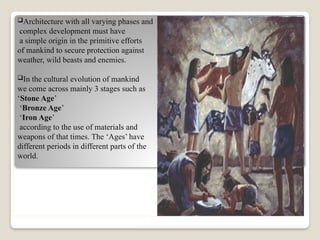
In the cultural evolution of mankind
we come across mainly 3 stages such as
‘Stone Age’
‘Bronze Age’
‘Iron Age’
according to the use of materials and
weapons of that times. The ‘Ages’ have
different periods in different parts of the
world.
3.
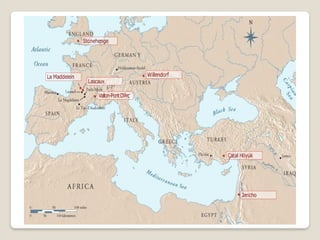
Stone Age
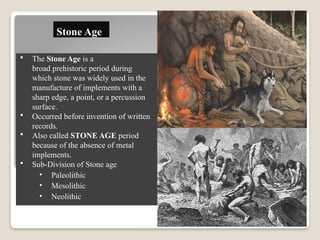
TheStone Age is a
broad prehistoric period during
which stone was widely used in the
manufacture of implements with a
sharp edge, a point, or a percussion
surface.
Occurred before invention of written
records.
Also called STONE AGE period
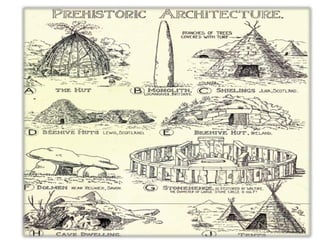
because of the absence of metal
implements.
Sub-Division of Stone age
• Paleolithic
• Mesolithic
• Neolithic
4.
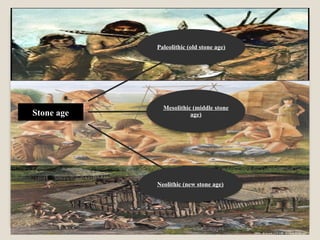
Paleolithic (old stoneage)
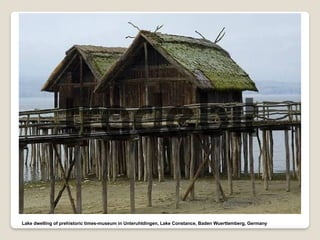
Mesolithic (middle stone
age)
Neolithic (new stone age)
Stone age
5.
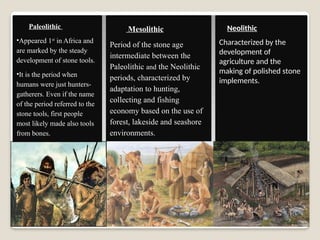
Paleolithic
•Appeared 1st
in Africaand
are marked by the steady
development of stone tools.
•It is the period when
humans were just hunters-
gatherers. Even if the name
of the period referred to the
stone tools, first people
most likely made also tools
from bones.
Mesolithic
Period of the stone age
intermediate between the
Paleolithic and the Neolithic
periods, characterized by
adaptation to hunting,
collecting and fishing
economy based on the use of
forest, lakeside and seashore
environments.
Neolithic
Characterized by the
development of
agriculture and the
making of polished stone
implements.
6.
It coversthe greatest portion of humanity's
time (roughly 99% of human history) on
Earth, extending from 2.5 or 2.6 million
years ago, with the introduction of stone
tools by hominids such as Homo habilis , to
the introduction of agriculture and the end of
the Pleistocene around 10,000BC.
The Paleolithic era ended with the
Mesolithic, or in areas with an early
neolithisation.
During the Paleolithic humans were
grouped together in small scale societies
such as bands and gained their subsistence
from gathering plants and hunting wild
animals.
Paleolithic age has been subdivided into 3
parts
Lower Paleolithic age
Middle Paleolithic age
Upper Paleolithic age
Paleolithic (old stone age)
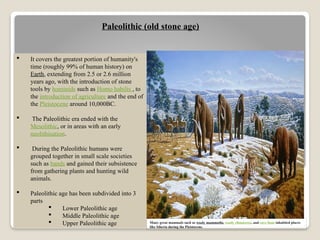
Many great mammals such as wooly mammoths, wooly rhinoceros, and cave lions inhabited places
like Siberia during the Pleistocene.
7.
Lower Paleolithic Age
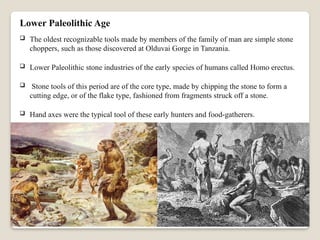
The oldest recognizable tools made by members of the family of man are simple stone
choppers, such as those discovered at Olduvai Gorge in Tanzania.
Lower Paleolithic stone industries of the early species of humans called Homo erectus.
Stone tools of this period are of the core type, made by chipping the stone to form a
cutting edge, or of the flake type, fashioned from fragments struck off a stone.
Hand axes were the typical tool of these early hunters and food-gatherers.
8.
Middle Paleolithic Age
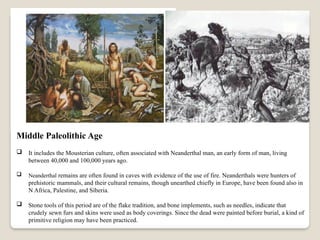
It includes the Mousterian culture, often associated with Neanderthal man, an early form of man, living
between 40,000 and 100,000 years ago.
Neanderthal remains are often found in caves with evidence of the use of fire. Neanderthals were hunters of
prehistoric mammals, and their cultural remains, though unearthed chiefly in Europe, have been found also in
N Africa, Palestine, and Siberia.
Stone tools of this period are of the flake tradition, and bone implements, such as needles, indicate that
crudely sewn furs and skins were used as body coverings. Since the dead were painted before burial, a kind of
primitive religion may have been practiced.
9.
Upper Paleolithic Age
In this period Neanderthal man disappears and is replaced by a variety of Homo sapiens such as Cro-Magnon
man and Grimaldiman.
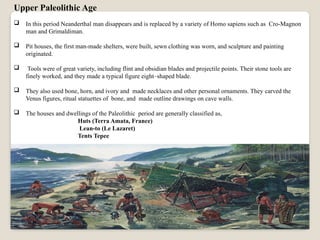
Pit houses, the first man-made shelters, were built, sewn clothing was worn, and sculpture and painting
originated.
Tools were of great variety, including flint and obsidian blades and projectile points. Their stone tools are
finely worked, and they made a typical figure eight–shaped blade.
They also used bone, horn, and ivory and made necklaces and other personal ornaments. They carved the
Venus figures, ritual statuettes of bone, and made outline drawings on cave walls.
The houses and dwellings of the Paleolithic period are generally classified as,
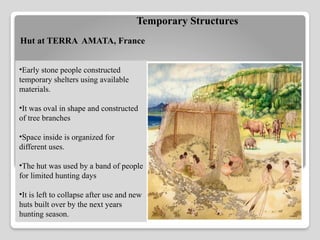
Huts (Terra Amata, France)
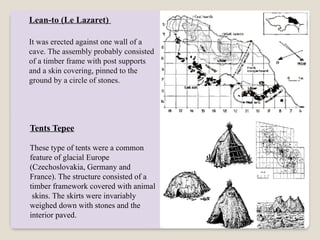
Lean-to (Le Lazaret)
Tents Tepee
10.
Temporary Structures
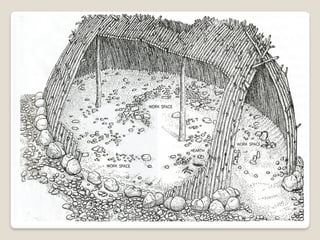
Hut atTERRA AMATA, France
•Early stone people constructed
temporary shelters using available
materials.
•It was oval in shape and constructed
of tree branches
•Space inside is organized for
different uses.
•The hut was used by a band of people
for limited hunting days
•It is left to collapse after use and new
huts built over by the next years
hunting season.
12.
Lean-to (Le Lazaret)
Itwas erected against one wall of a
cave. The assembly probably consisted
of a timber frame with post supports
and a skin covering, pinned to the
ground by a circle of stones.
Tents Tepee
These type of tents were a common
feature of glacial Europe
(Czechoslovakia, Germany and
France). The structure consisted of a
timber framework covered with animal
skins. The skirts were invariably
weighed down with stones and the
interior paved.
13.
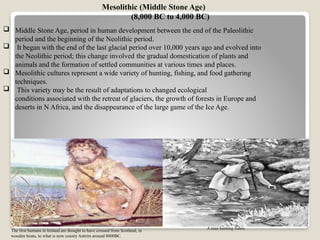
Middle StoneAge, period in human development between the end of the Paleolithic
period and the beginning of the Neolithic period.
It began with the end of the last glacial period over 10,000 years ago and evolved into
the Neolithic period; this change involved the gradual domestication of plants and
animals and the formation of settled communities at various times and places.
Mesolithic cultures represent a wide variety of hunting, fishing, and food gathering
techniques.
This variety may be the result of adaptations to changed ecological
conditions associated with the retreat of glaciers, the growth of forests in Europe and
deserts in N Africa, and the disappearance of the large game of the Ice Age.
Mesolithic (Middle Stone Age)
(8,000 BC to 4,000 BC)
The first humans in Ireland are thought to have crossed from Scotland, in
wooden boats, to what is now county Antrim around 8000BC.
A man hunting fishes
14.
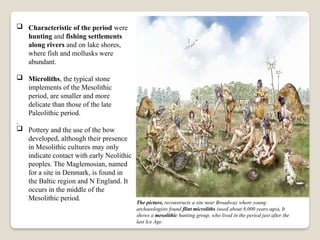
The picture, reconstructsa site near Broadway where young
archaeologists found flint microliths (used about 8,000 years ago). It
shows a mesolithic hunting group, who lived in the period just after the
last Ice Age.
Characteristic of the period were
hunting and fishing settlements
along rivers and on lake shores,
where fish and mollusks were
abundant.
Microliths, the typical stone
implements of the Mesolithic
period, are smaller and more
delicate than those of the late
Paleolithic period.
.
Pottery and the use of the bow
developed, although their presence
in Mesolithic cultures may only
indicate contact with early Neolithic
peoples. The Maglemosian, named
for a site in Denmark, is found in
the Baltic region and N England. It
occurs in the middle of the
Mesolithic period.
15.
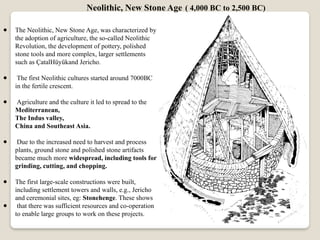
● The Neolithic,New Stone Age, was characterized by
the adoption of agriculture, the so-called Neolithic
Revolution, the development of pottery, polished
stone tools and more complex, larger settlements
such as ÇatalHüyükand Jericho.
● The first Neolithic cultures started around 7000BC
in the fertile crescent.
● Agriculture and the culture it led to spread to the
Mediterranean,
The Indus valley,
China and Southeast Asia.
● Due to the increased need to harvest and process
plants, ground stone and polished stone artifacts
became much more widespread, including tools for
grinding, cutting, and chopping.
● The first large-scale constructions were built,
including settlement towers and walls, e.g., Jericho
and ceremonial sites, eg: Stonehenge. These shows
● that there was sufficient resources and co-operation
to enable large groups to work on these projects.
Neolithic, New Stone Age ( 4,000 BC to 2,500 BC)
16.
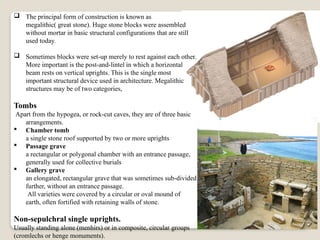
The principalform of construction is known as
megalithic( great stone). Huge stone blocks were assembled
without mortar in basic structural configurations that are still
used today.
Sometimes blocks were set-up merely to rest against each other.
More important is the post-and-lintel in which a horizontal
beam rests on vertical uprights. This is the single most
important structural device used in architecture. Megalithic
structures may be of two categories,
Tombs
Apart from the hypogea, or rock-cut caves, they are of three basic
arrangements.
Chamber tomb
a single stone roof supported by two or more uprights
Passage grave
a rectangular or polygonal chamber with an entrance passage,
generally used for collective burials
Gallery grave
an elongated, rectangular grave that was sometimes sub-divided
further, without an entrance passage.
All varieties were covered by a circular or oval mound of
earth, often fortified with retaining walls of stone.
Non-sepulchral single uprights.
Usually standing alone (menhirs) or in composite, circular groups
(cromlechs or henge monuments).
17.
By 8000B.C. people began to grow wheat, barley and peas instead of gathering them wild.
By 7000 B.C. they domesticated sheep , pigs and goats.
By 6000 B.C. they also domesticated cattle.
By 5000 B.C. farming has started in China And In Indus Valley Civilization.
By 4000 B.C. people used oxen to plough and even wagons.
Donkey was also used.
Also by 5000 B.C. they learnt to dig canals to bring water from rivers to their crops. As a
result they began to farm the arid land between the Tigris And Euphrates. This area came to
be known as Mesopotamia.
People began to lived in settled communities instead of being Nomadic, when food supply
improved . New skills were developed example, making pottery using metals. Finally they
invented writing. Pottery was 1st
made in the middle-east and South Africa about 7000 B.C.
Also around the same time horses were domesticated in the steppes of Eurasia.
Agricultural Revolution
18.
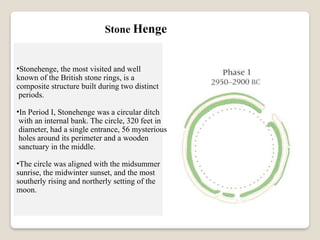
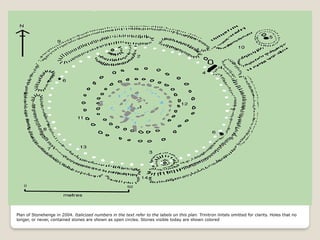
Stone Henge
•Stonehenge, themost visited and well
known of the British stone rings, is a
composite structure built during two distinct
periods.
•In Period I, Stonehenge was a circular ditch
with an internal bank. The circle, 320 feet in
diameter, had a single entrance, 56 mysterious
holes around its perimeter and a wooden
sanctuary in the middle.
•The circle was aligned with the midsummer
sunrise, the midwinter sunset, and the most
southerly rising and northerly setting of the
moon.
19.
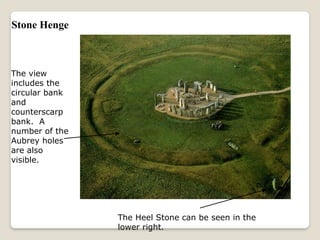
Stone Henge
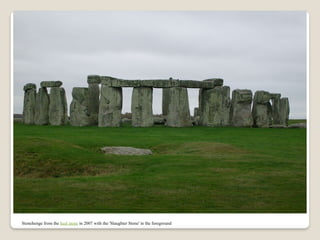
The HeelStone can be seen in the
lower right.
The view
includes the
circular bank
and
counterscarp
bank. A
number of the
Aubrey holes
are also
visible.
21.
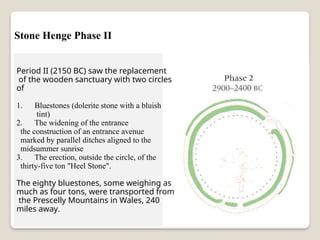
Stone Henge PhaseII
Period II (2150 BC) saw the replacement
of the wooden sanctuary with two circles
of
1. Bluestones (dolerite stone with a bluish
tint)
2. The widening of the entrance
the construction of an entrance avenue
marked by parallel ditches aligned to the
midsummer sunrise
3. The erection, outside the circle, of the
thirty-five ton "Heel Stone".
The eighty bluestones, some weighing as
much as four tons, were transported from
the Prescelly Mountains in Wales, 240
miles away.
22.
Plan of Stonehengein 2004. Italicized numbers in the text refer to the labels on this plan. Trinitron lintels omitted for clarity. Holes that no
longer, or never, contained stones are shown as open circles. Stones visible today are shown colored
23.
Stonehenge from theheel stone in 2007 with the 'Slaughter Stone' in the foreground
24.
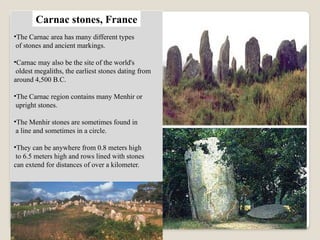
•The Carnac areahas many different types
of stones and ancient markings.
•Carnac may also be the site of the world's
oldest megaliths, the earliest stones dating from
around 4,500 B.C.
•The Carnac region contains many Menhir or
upright stones.
•The Menhir stones are sometimes found in
a line and sometimes in a circle.
•They can be anywhere from 0.8 meters high
to 6.5 meters high and rows lined with stones
can extend for distances of over a kilometer.
Carnac stones, France
25.
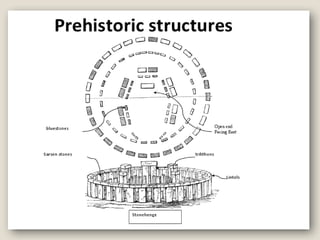
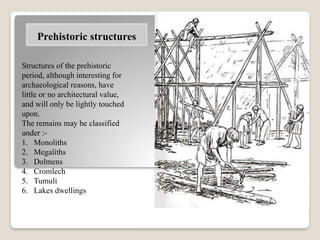
Structures of theprehistoric
period, although interesting for
archaeological reasons, have
little or no architectural value,
and will only be lightly touched
upon.
The remains may be classified
under :-
1. Monoliths
2. Megaliths
3. Dolmens
4. Cromlech
5. Tumuli
6. Lakes dwellings
Prehistoric structures
26.
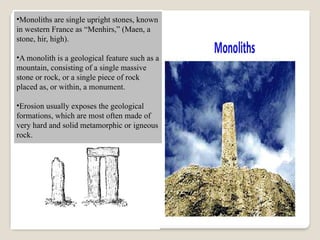
•Monoliths are singleupright stones, known
in western France as “Menhirs,” (Maen, a
stone, hir, high).
•A monolith is a geological feature such as a
mountain, consisting of a single massive
stone or rock, or a single piece of rock
placed as, or within, a monument.
•Erosion usually exposes the geological
formations, which are most often made of
very hard and solid metamorphic or igneous
rock.
27.
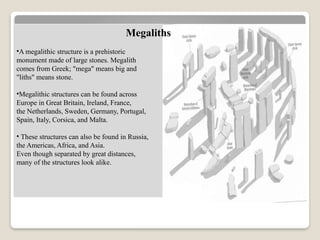
•A megalithic structureis a prehistoric
monument made of large stones. Megalith
comes from Greek; "mega" means big and
"liths" means stone.
•Megalithic structures can be found across
Europe in Great Britain, Ireland, France,
the Netherlands, Sweden, Germany, Portugal,
Spain, Italy, Corsica, and Malta.
• These structures can also be found in Russia,
the Americas, Africa, and Asia.
Even though separated by great distances,
many of the structures look alike.
Megaliths
28.
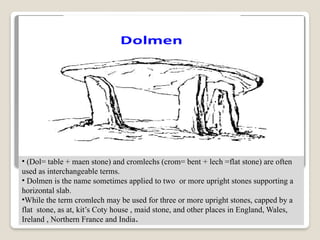
• (Dol= table+ maen stone) and cromlechs (crom= bent + lech =flat stone) are often
used as interchangeable terms.
• Dolmen is the name sometimes applied to two or more upright stones supporting a
horizontal slab.
•While the term cromlech may be used for three or more upright stones, capped by a
flat stone, as at, kit’s Coty house , maid stone, and other places in England, Wales,
Ireland , Northern France and India.
29.
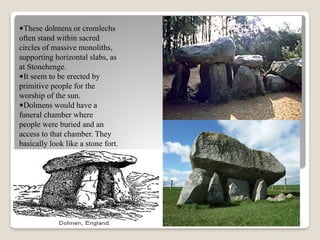
•These dolmens orcromlechs
often stand within sacred
circles of massive monoliths,
supporting horizontal slabs, as
at Stonehenge.
•It seem to be erected by
primitive people for the
worship of the sun.
•Dolmens would have a
funeral chamber where
people were buried and an
access to that chamber. They
basically look like a stone fort.
30.
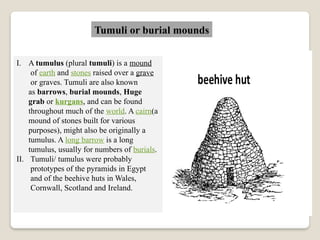
Tumuli or burialmounds
I. A tumulus (plural tumuli) is a mound
of earth and stones raised over a grave
or graves. Tumuli are also known
as barrows, burial mounds, Huge
grab or kurgans, and can be found
throughout much of the world. A cairn(a
mound of stones built for various
purposes), might also be originally a
tumulus. A long barrow is a long
tumulus, usually for numbers of burials.
II. Tumuli/ tumulus were probably
prototypes of the pyramids in Egypt
and of the beehive huts in Wales,
Cornwall, Scotland and Ireland.
31.
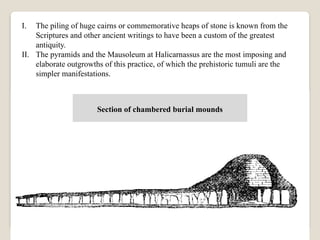
Section of chamberedburial mounds
I. The piling of huge cairns or commemorative heaps of stone is known from the
Scriptures and other ancient writings to have been a custom of the greatest
antiquity.
II. The pyramids and the Mausoleum at Halicarnassus are the most imposing and
elaborate outgrowths of this practice, of which the prehistoric tumuli are the
simpler manifestations.
32.
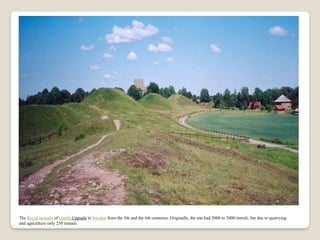
The Royal moundsof Gamla Uppsala in Sweden from the 5th and the 6th centuries. Originally, the site had 2000 to 3000 tumuli, but due to quarrying
and agriculture only 250 remain.
33.
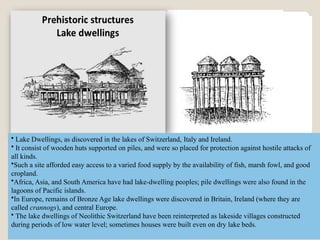
• Lake Dwellings,as discovered in the lakes of Switzerland, Italy and Ireland.
• It consist of wooden huts supported on piles, and were so placed for protection against hostile attacks of
all kinds.
•Such a site afforded easy access to a varied food supply by the availability of fish, marsh fowl, and good
cropland.
•Africa, Asia, and South America have had lake-dwelling peoples; pile dwellings were also found in the
lagoons of Pacific islands.
•In Europe, remains of Bronze Age lake dwellings were discovered in Britain, Ireland (where they are
called crannogs), and central Europe.
• The lake dwellings of Neolithic Switzerland have been reinterpreted as lakeside villages constructed
during periods of low water level; sometimes houses were built even on dry lake beds.
34.
Lake dwelling ofprehistoric times-museum in Unteruhldingen, Lake Constance, Baden Wuerttemberg, Germany