I N F L U E N C E &
N E G O T I A T I O N
2 Competencies to be
successful…in LIFE
André Harrell
I N T RO D U C T I O N
As a professional, your ability to influence and negotiate
both corporately and externally is critical to your
business success.These skills are natural to some and
more difficult for others. But like many soft skills,
influence and negotiation takes time to master and
requires continuous learning, implementation, and
refinement by anyone who has customers.
P R I N C I P L E D N E G O T I AT I O N
Principled Negotiation was developed by the Harvard Negotiation Project, a research project
at Harvard University that works on negotiation problems and produces improved methods
of negotiation and mediation.
It is part of the Program on Negotiation at Harvard Law School, a consortium of scholars and
projects from Harvard, MIT, Simons, and Tufts working to improve the theory and practice of
conflict resolution.
These practices have been used successfully at the highest levels of international diplomacy as
well as in common business practice. Principled Negotiation was chosen for this training
because it is particularly effective in business negotiations.
The Principled Negotiation method is further explained in the book Getting to Yes, by Roger
Fisher and William Ury.
C O N T E N T S
• Distinguish Positional Bargaining from Principled Negotiation
• Apply Principled Negotiation techniques to ensure favorable negotiations
• Identify and overcome typical problem scenarios
• Create win/win outcomes and lasting relationships
I & N C O M P E T E N C I E S
Persuades others to pursue positive actions and structures win-win agreements to
achieve mutually agreed upon goals, maximize business results, and maintain
strong relationships:
• Can utilize resources (internal and external) that result in gaining support and
overcoming resistance in order to meet customer needs
• Maintains and enhances positive relationships throughout the course of
negotiations
• Strives for balance between customers’ and personal goals
• Maintains positive relationships at the conclusion of the negotiations
• Anticipates other’s needs and reactions and takes appropriate steps to
influence them
• Demonstrates respect for all parties and negotiates successfully, then follows
through on all commitments
• Leads the initiative to develop new resources that create value in the negotiation
process so that it’s a “win/win” outcome
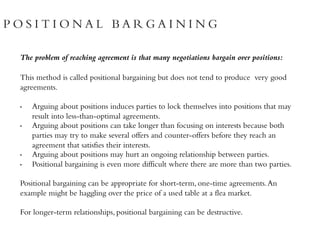
P O S I T I O N A L B A R G A I N I N G
The problem of reaching agreement is that many negotiations bargain over positions:
This method is called positional bargaining but does not tend to produce very good
agreements.
• Arguing about positions induces parties to lock themselves into positions that may
result into less-than-optimal agreements.
• Arguing about positions can take longer than focusing on interests because both
parties may try to make several offers and counter-offers before they reach an
agreement that satisfies their interests.
• Arguing about positions may hurt an ongoing relationship between parties.
• Positional bargaining is even more difficult where there are more than two parties.
Positional bargaining can be appropriate for short-term, one-time agreements.An
example might be haggling over the price of a used table at a flea market.
For longer-term relationships, positional bargaining can be destructive.
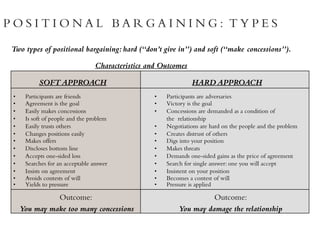
P O S I T I O N A L B A R G A I N I N G : T Y P E S
Two types of positional bargaining: hard (“don’t give in”) and soft (“make concessions”).
Characteristics and Outcomes
SOFT APPROACH HARD APPROACH
• Participants are friends
• Agreement is the goal
• Easily makes concessions
• Is soft of people and the problem
• Easily trusts others
• Changes positions easily
• Makes offers
• Discloses bottom line
• Accepts one-sided loss
• Searches for an acceptable answer
• Insists on agreement
• Avoids contests of will
• Yields to pressure
• Participants are adversaries
• Victory is the goal
• Concessions are demanded as a condition of
the relationship
• Negotiations are hard on the people and the problem
• Creates distrust of others
• Digs into your position
• Makes threats
• Demands one-sided gains as the price of agreement
• Search for single answer: one you will accept
• Insistent on your position
• Becomes a contest of will
• Pressure is applied
Outcome:
You may make too many concessions
Outcome:
You may damage the relationship
A P P LY I N G
P R I N C I P L E D
N E G O T I AT I O N
T E C H N I Q U E S
Ensuring Favorable Outcomes
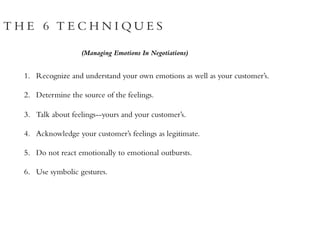
T H E 6 T E C H N I Q U E S
1. Recognize and understand your own emotions as well as your customer’s.
2. Determine the source of the feelings.
3. Talk about feelings--yours and your customer’s.
4. Acknowledge your customer’s feelings as legitimate.
5. Do not react emotionally to emotional outbursts.
6. Use symbolic gestures.
(Managing Emotions In Negotiations)
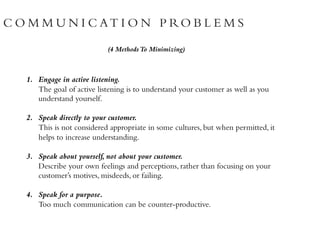
C O M M U N I C AT I O N P RO B L E M S
(4 MethodsTo Minimizing)
1. Engage in active listening.
The goal of active listening is to understand your customer as well as you
understand yourself.
2. Speak directly to your customer.
This is not considered appropriate in some cultures, but when permitted, it
helps to increase understanding.
3. Speak about yourself, not about your customer.
Describe your own feelings and perceptions, rather than focusing on your
customer’s motives, misdeeds, or failing.
4. Speak for a purpose.
Too much communication can be counter-productive.
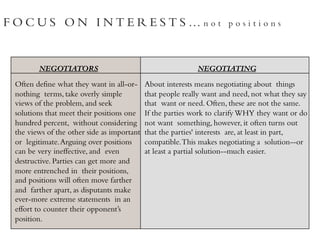
F O C U S O N I N T E R E S T S … n o t p o s i t i o n s
NEGOTIATORS NEGOTIATING
Often define what they want in all-or-
nothing terms, take overly simple
views of the problem, and seek
solutions that meet their positions one
hundred percent, without considering
the views of the other side as important
or legitimate.Arguing over positions
can be very ineffective, and even
destructive. Parties can get more and
more entrenched in their positions,
and positions will often move farther
and farther apart, as disputants make
ever-more extreme statements in an
effort to counter their opponent’s
position.
About interests means negotiating about things
that people really want and need, not what they say
that want or need. Often, these are not the same.
If the parties work to clarify WHY they want or do
not want something, however, it often turns out
that the parties' interests are, at least in part,
compatible.This makes negotiating a solution--or
at least a partial solution--much easier.
I D E N T I F Y A N D
O V E R C O M E
T Y P I C A L
P RO B L E M
S C E N A R I O S
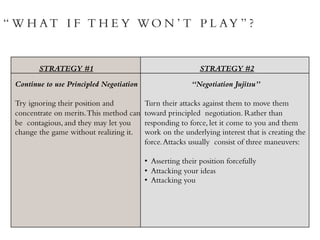
“ W H AT I F T H E Y WO N ’ T P L AY ” ?
STRATEGY #1 STRATEGY #2
Continue to use Principled Negotiation
Try ignoring their position and
concentrate on merits.This method can
be contagious, and they may let you
change the game without realizing it.
“Negotiation Jujitsu”
Turn their attacks against them to move them
toward principled negotiation. Rather than
responding to force, let it come to you and them
work on the underlying interest that is creating the
force.Attacks usually consist of three maneuvers:
• Asserting their position forcefully
• Attacking your ideas
• Attacking you
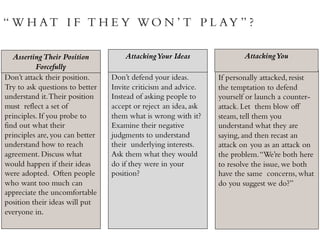
“ W H AT I F T H E Y WO N ’ T P L AY ” ?
Don’t attack their position.
Try to ask questions to better
understand it.Their position
must reflect a set of
principles. If you probe to
find out what their
principles are, you can better
understand how to reach
agreement. Discuss what
would happen if their ideas
were adopted. Often people
who want too much can
appreciate the uncomfortable
position their ideas will put
everyone in.
Don’t defend your ideas.
Invite criticism and advice.
Instead of asking people to
accept or reject an idea, ask
them what is wrong with it?
Examine their negative
judgments to understand
their underlying interests.
Ask them what they would
do if they were in your
position?
If personally attacked, resist
the temptation to defend
yourself or launch a counter-
attack. Let them blow off
steam, tell them you
understand what they are
saying, and then recast an
attack on you as an attack on
the problem.“We’re both here
to resolve the issue, we both
have the same concerns, what
do you suggest we do?”
AssertingTheir Position
Forcefully
AttackingYour Ideas AttackingYou
F R E Q U E N T LY
A S K E D
Q U E S T I O N S
F R E Q U E N T LY A S K E D Q U E S T I O N S
1. DOES POSITIONAL BARGAINING EVER MAKE SENSE?
The short answer is yes, if one of several conditions applies:You don’t plan
on having an ongoing relationship with the other side, you don’t want to
spend the time arguing a point on its merits, and it can be a quick way to
finalize a deal after you’ve used Principled Negotiation to identify each
other’s interests, invented options for mutual gain and discussed relevant
standards of fairness.
F R E Q U E N T LY A S K E D Q U E S T I O N S
2. What if the customer believes in a different Standard of Fairness?
Agreement on the “best” standard is not necessary.You and your customer may have
two different standards in mind based on individual values, culture, experience, and
perception.That’s why it is best to use a standard that comes outside of the
negotiation. People can argue on why a car should cost more money or less money.
They often use to a separate standard like Kelly’s Blue Book as a fair and impartial
standard.
F R E Q U E N T LY A S K E D Q U E S T I O N S
3. When does it make sense not to negotiate?
However unsavory your customer, unless you have a better “BATNA”, the question
you face is not whether to negotiate but how to negotiate. Negotiation does not
mean giving in.
T H A N K
YO U !
André Harrell
AH2 Management

INFLUENCE AND NEGOTIATION

  • 1.
    I N FL U E N C E & N E G O T I A T I O N 2 Competencies to be successful…in LIFE André Harrell
  • 2.
    I N TRO D U C T I O N As a professional, your ability to influence and negotiate both corporately and externally is critical to your business success.These skills are natural to some and more difficult for others. But like many soft skills, influence and negotiation takes time to master and requires continuous learning, implementation, and refinement by anyone who has customers.
  • 3.
    P R IN C I P L E D N E G O T I AT I O N Principled Negotiation was developed by the Harvard Negotiation Project, a research project at Harvard University that works on negotiation problems and produces improved methods of negotiation and mediation. It is part of the Program on Negotiation at Harvard Law School, a consortium of scholars and projects from Harvard, MIT, Simons, and Tufts working to improve the theory and practice of conflict resolution. These practices have been used successfully at the highest levels of international diplomacy as well as in common business practice. Principled Negotiation was chosen for this training because it is particularly effective in business negotiations. The Principled Negotiation method is further explained in the book Getting to Yes, by Roger Fisher and William Ury.
  • 4.
    C O NT E N T S • Distinguish Positional Bargaining from Principled Negotiation • Apply Principled Negotiation techniques to ensure favorable negotiations • Identify and overcome typical problem scenarios • Create win/win outcomes and lasting relationships
  • 5.
    I & NC O M P E T E N C I E S Persuades others to pursue positive actions and structures win-win agreements to achieve mutually agreed upon goals, maximize business results, and maintain strong relationships: • Can utilize resources (internal and external) that result in gaining support and overcoming resistance in order to meet customer needs • Maintains and enhances positive relationships throughout the course of negotiations • Strives for balance between customers’ and personal goals • Maintains positive relationships at the conclusion of the negotiations • Anticipates other’s needs and reactions and takes appropriate steps to influence them • Demonstrates respect for all parties and negotiates successfully, then follows through on all commitments • Leads the initiative to develop new resources that create value in the negotiation process so that it’s a “win/win” outcome
  • 6.
    P O SI T I O N A L B A R G A I N I N G The problem of reaching agreement is that many negotiations bargain over positions: This method is called positional bargaining but does not tend to produce very good agreements. • Arguing about positions induces parties to lock themselves into positions that may result into less-than-optimal agreements. • Arguing about positions can take longer than focusing on interests because both parties may try to make several offers and counter-offers before they reach an agreement that satisfies their interests. • Arguing about positions may hurt an ongoing relationship between parties. • Positional bargaining is even more difficult where there are more than two parties. Positional bargaining can be appropriate for short-term, one-time agreements.An example might be haggling over the price of a used table at a flea market. For longer-term relationships, positional bargaining can be destructive.
  • 7.
    P O SI T I O N A L B A R G A I N I N G : T Y P E S Two types of positional bargaining: hard (“don’t give in”) and soft (“make concessions”). Characteristics and Outcomes SOFT APPROACH HARD APPROACH • Participants are friends • Agreement is the goal • Easily makes concessions • Is soft of people and the problem • Easily trusts others • Changes positions easily • Makes offers • Discloses bottom line • Accepts one-sided loss • Searches for an acceptable answer • Insists on agreement • Avoids contests of will • Yields to pressure • Participants are adversaries • Victory is the goal • Concessions are demanded as a condition of the relationship • Negotiations are hard on the people and the problem • Creates distrust of others • Digs into your position • Makes threats • Demands one-sided gains as the price of agreement • Search for single answer: one you will accept • Insistent on your position • Becomes a contest of will • Pressure is applied Outcome: You may make too many concessions Outcome: You may damage the relationship
  • 8.
    A P PLY I N G P R I N C I P L E D N E G O T I AT I O N T E C H N I Q U E S Ensuring Favorable Outcomes
  • 9.
    T H E6 T E C H N I Q U E S 1. Recognize and understand your own emotions as well as your customer’s. 2. Determine the source of the feelings. 3. Talk about feelings--yours and your customer’s. 4. Acknowledge your customer’s feelings as legitimate. 5. Do not react emotionally to emotional outbursts. 6. Use symbolic gestures. (Managing Emotions In Negotiations)
  • 10.
    C O MM U N I C AT I O N P RO B L E M S (4 MethodsTo Minimizing) 1. Engage in active listening. The goal of active listening is to understand your customer as well as you understand yourself. 2. Speak directly to your customer. This is not considered appropriate in some cultures, but when permitted, it helps to increase understanding. 3. Speak about yourself, not about your customer. Describe your own feelings and perceptions, rather than focusing on your customer’s motives, misdeeds, or failing. 4. Speak for a purpose. Too much communication can be counter-productive.
  • 11.
    F O CU S O N I N T E R E S T S … n o t p o s i t i o n s NEGOTIATORS NEGOTIATING Often define what they want in all-or- nothing terms, take overly simple views of the problem, and seek solutions that meet their positions one hundred percent, without considering the views of the other side as important or legitimate.Arguing over positions can be very ineffective, and even destructive. Parties can get more and more entrenched in their positions, and positions will often move farther and farther apart, as disputants make ever-more extreme statements in an effort to counter their opponent’s position. About interests means negotiating about things that people really want and need, not what they say that want or need. Often, these are not the same. If the parties work to clarify WHY they want or do not want something, however, it often turns out that the parties' interests are, at least in part, compatible.This makes negotiating a solution--or at least a partial solution--much easier.
  • 12.
    I D EN T I F Y A N D O V E R C O M E T Y P I C A L P RO B L E M S C E N A R I O S
  • 13.
    “ W HAT I F T H E Y WO N ’ T P L AY ” ? STRATEGY #1 STRATEGY #2 Continue to use Principled Negotiation Try ignoring their position and concentrate on merits.This method can be contagious, and they may let you change the game without realizing it. “Negotiation Jujitsu” Turn their attacks against them to move them toward principled negotiation. Rather than responding to force, let it come to you and them work on the underlying interest that is creating the force.Attacks usually consist of three maneuvers: • Asserting their position forcefully • Attacking your ideas • Attacking you
  • 14.
    “ W HAT I F T H E Y WO N ’ T P L AY ” ? Don’t attack their position. Try to ask questions to better understand it.Their position must reflect a set of principles. If you probe to find out what their principles are, you can better understand how to reach agreement. Discuss what would happen if their ideas were adopted. Often people who want too much can appreciate the uncomfortable position their ideas will put everyone in. Don’t defend your ideas. Invite criticism and advice. Instead of asking people to accept or reject an idea, ask them what is wrong with it? Examine their negative judgments to understand their underlying interests. Ask them what they would do if they were in your position? If personally attacked, resist the temptation to defend yourself or launch a counter- attack. Let them blow off steam, tell them you understand what they are saying, and then recast an attack on you as an attack on the problem.“We’re both here to resolve the issue, we both have the same concerns, what do you suggest we do?” AssertingTheir Position Forcefully AttackingYour Ideas AttackingYou
  • 15.
    F R EQ U E N T LY A S K E D Q U E S T I O N S
  • 16.
    F R EQ U E N T LY A S K E D Q U E S T I O N S 1. DOES POSITIONAL BARGAINING EVER MAKE SENSE? The short answer is yes, if one of several conditions applies:You don’t plan on having an ongoing relationship with the other side, you don’t want to spend the time arguing a point on its merits, and it can be a quick way to finalize a deal after you’ve used Principled Negotiation to identify each other’s interests, invented options for mutual gain and discussed relevant standards of fairness.
  • 17.
    F R EQ U E N T LY A S K E D Q U E S T I O N S 2. What if the customer believes in a different Standard of Fairness? Agreement on the “best” standard is not necessary.You and your customer may have two different standards in mind based on individual values, culture, experience, and perception.That’s why it is best to use a standard that comes outside of the negotiation. People can argue on why a car should cost more money or less money. They often use to a separate standard like Kelly’s Blue Book as a fair and impartial standard.
  • 18.
    F R EQ U E N T LY A S K E D Q U E S T I O N S 3. When does it make sense not to negotiate? However unsavory your customer, unless you have a better “BATNA”, the question you face is not whether to negotiate but how to negotiate. Negotiation does not mean giving in.
  • 19.
    T H AN K YO U ! André Harrell AH2 Management