CIS PRESENTATION
Presented By : (Group11) Archa Nair
Abhishek Prabhu
Syed Salman
Ram Brahma
Hema
Harsh Kukreti
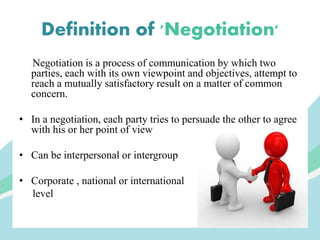
Definition of 'Negotiation'
Negotiation is a process of communication by which two
parties, each with its own viewpoint and objectives, attempt to
reach a mutually satisfactory result on a matter of common
concern.
• In a negotiation, each party tries to persuade the other to agree
with his or her point of view
• Can be interpersonal or intergroup
• Corporate , national or international
level
Characteristics of Negotiation
•Conflict of interest
•Some form of interdependence
•Formal affair
•Requires special communication tactics
•Mutually agree rather than being openly
aggressive or passively submissive
•Task aspect and relationship aspect
•Intricate and lengthy process
•Culture bound
Culture bound Negotiations
Examples :
• German Negotiators place high
premium on Timeliness - interpreted
as impatience
• American negotiators associate
distance with professionalism
• French negotiators associate
animation with passion and self belief
• Indian negotiators do not prefer eye
contact and is interpreted as shifty and
dishonest
• Italian negotiators speak loudly and is
considered to be too boisterous
Why Negotiations ??
Organizations
are becoming
diverse
Organizations are
changing
Constant
interactions of
team members
Organizations nowadays
are matrix-base
Effective Negotiator
• Thorough understanding of the psychology of the
opponents
• Good listener
• Exchange of information done cautiously
• Assertive language and minimal body language
• Focuses on company’s needs rather than individual
concerns
• Open about other options
• Clearly communicates by preparing well in advance
• Responds to other party with stimulating questions
• Take notes
Planning for Negotiation
• Essential planning is required so that
there is mutual agreement and
satisfaction
• Poor planning results in allowing the
other party to take more concessions
than you were originally willing to give
The more time you dedicate to preparing and planning for a
negotiation meeting , the better your final outcome.
Step 1 : Framing the issue
• Assessment of perceptions that each party has of other, on the
basis of which one’s own position may be identified
• It involves an investigation of the opponent’s past behaviour
in similar settings and determining the manner in which this
may predict future behavior
Cont.
Questions answered in the process includes :
• What is the purpose of negotiation?
• What outcomes do we seek?
• What roadblocks do we anticipate?
• How much is to be conceded?
• Who is the opponent?
• What are their needs and wants?
• What motivates them?
• What is their reputation?
• What is the nature of our relationship with the opponent and are we
looking to change it or not?
• What line of arguments , facts and evidence needs to be assembled
to get the better deal?
• How much flexibility should be accommodated to get what we
desire?
• What alternatives do we have?
Frames can be attempted in two ways:
•Behind the scenes ( where individual parties frame their
position )
•Shared framing ( where both parties meet to discuss
conceptions )
The ideal approach is to seek a position where frames of both
the parties “match ’’.When frames match , it implies that both
the parties have a similar outlook on an issue and only their
approach is different.
Step 2: Setting the norms of
negotiation
• Listing the common issues that are at stake
• Assistance from an outside consultant or an expert may also
be taken
Allows agreement on :
 Agenda
 Location
 Duration
 Names of parties involved in the negotiation process
 Procedures
 Order of issues to be addressed
 Actions to be taken if the negotiation fails
Power bases in Influencing
Power Bases are the inherent “ influencers” that help people
gain compliance from others . They help in deciding the
position of the negotiator .They include :
• Authority
People who influence through formal power vested in them
almost coerce others into action. In negotiations , it may
work when the interdependency is skewed towards the
people in authority.
• Expert power
Derived from one’s expertise and credibility .It may be used
when one party uses expertise as a basis for action.
Cont. .
• Connection power
Used to show the other party one’s connections and influence
with them. A show of strength, it is used to argue one’s
superior networking ability.
• Empathy
Emanates from understanding and concern and is used to
demonstrate a superior understanding of people and situations.
• Information power
Comes from selective access to information that is privy to a
privileged few.
Presentation of Facts and
Evidences
• Presentation of facts and evidences is an important part of
negotiations as we have to convince the opponent
• Facts and evidences should be expressed in an effective
manner such that the opponent should accept the offer
• Benefits must be highlighted so that the opponent may be
impressed
• Obtain agreements on minor points so that major point can
be accepted without much resistance
Cont.
• Facts and evidences must be
communicated in an effective manner
• The effectiveness of communication
depends upon:
oWhat ideas , facts , evidence , and
data are selected(content and
structure of the message) ,and
oHow these are presented to the
opponent (the delivery style)
Barriers to Negotiation Process
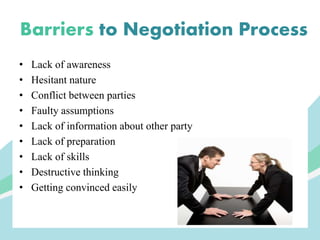
• Lack of awareness
• Hesitant nature
• Conflict between parties
• Faulty assumptions
• Lack of information about other party
• Lack of preparation
• Lack of skills
• Destructive thinking
• Getting convinced easily
Approaches to Negotiation
• Competitive approach
win-lose
• Collaborative approach
win-win
Outcomes
• If both collaborate, outcome will leave parties satisfied
• If one party competes and other collaborates, collaborator
will have tough time and competitor gets the benefit
• If both compete then the outcome will be mediocre
• If there is uncertainty on both sides, best strategy is to
compete
Communication
• Major role in resolution of deep-rooted conflicts
• Prejudice, anger, and hostility, create a chasm of distrust and
suspicion.
• Often, third party intervention is necessary
• Mediator trusted by both parties
• Available alternatives and best alternatives are listed to bring
parties to common understanding
Negotiation Semantics
• Negotiating a price
•Unclear about her
own need
•Led to a unfruitful
conversation
•No one gained
anything
•Express price
expectation clearly
less than what is
quoted
•Be crisp and
precise
Cont.
• Negotiating a Salary
•Indecisive nature
•Failed to express
salary expectation
•Express your salary
expectations clearly in front
of the recruiter
•Basis of argument
•Justify increase once you
join organization
•lay emphasis on words that
you feel are important
•Be tactful
What’s your
negotiating style ?

NEGOTIATIONS IN BUSINESS

  • 1.
    CIS PRESENTATION Presented By: (Group11) Archa Nair Abhishek Prabhu Syed Salman Ram Brahma Hema Harsh Kukreti
  • 3.
    Definition of 'Negotiation' Negotiationis a process of communication by which two parties, each with its own viewpoint and objectives, attempt to reach a mutually satisfactory result on a matter of common concern. • In a negotiation, each party tries to persuade the other to agree with his or her point of view • Can be interpersonal or intergroup • Corporate , national or international level
  • 4.
    Characteristics of Negotiation •Conflictof interest •Some form of interdependence •Formal affair •Requires special communication tactics •Mutually agree rather than being openly aggressive or passively submissive •Task aspect and relationship aspect •Intricate and lengthy process •Culture bound
  • 5.
    Culture bound Negotiations Examples: • German Negotiators place high premium on Timeliness - interpreted as impatience • American negotiators associate distance with professionalism • French negotiators associate animation with passion and self belief • Indian negotiators do not prefer eye contact and is interpreted as shifty and dishonest • Italian negotiators speak loudly and is considered to be too boisterous
  • 6.
    Why Negotiations ?? Organizations arebecoming diverse Organizations are changing Constant interactions of team members Organizations nowadays are matrix-base
  • 7.
    Effective Negotiator • Thoroughunderstanding of the psychology of the opponents • Good listener • Exchange of information done cautiously • Assertive language and minimal body language • Focuses on company’s needs rather than individual concerns • Open about other options • Clearly communicates by preparing well in advance • Responds to other party with stimulating questions • Take notes
  • 8.
    Planning for Negotiation •Essential planning is required so that there is mutual agreement and satisfaction • Poor planning results in allowing the other party to take more concessions than you were originally willing to give The more time you dedicate to preparing and planning for a negotiation meeting , the better your final outcome.
  • 9.
    Step 1 :Framing the issue • Assessment of perceptions that each party has of other, on the basis of which one’s own position may be identified • It involves an investigation of the opponent’s past behaviour in similar settings and determining the manner in which this may predict future behavior
  • 10.
    Cont. Questions answered inthe process includes : • What is the purpose of negotiation? • What outcomes do we seek? • What roadblocks do we anticipate? • How much is to be conceded? • Who is the opponent? • What are their needs and wants? • What motivates them? • What is their reputation? • What is the nature of our relationship with the opponent and are we looking to change it or not? • What line of arguments , facts and evidence needs to be assembled to get the better deal? • How much flexibility should be accommodated to get what we desire? • What alternatives do we have?
  • 11.
    Frames can beattempted in two ways: •Behind the scenes ( where individual parties frame their position ) •Shared framing ( where both parties meet to discuss conceptions ) The ideal approach is to seek a position where frames of both the parties “match ’’.When frames match , it implies that both the parties have a similar outlook on an issue and only their approach is different.
  • 12.
    Step 2: Settingthe norms of negotiation • Listing the common issues that are at stake • Assistance from an outside consultant or an expert may also be taken Allows agreement on :  Agenda  Location  Duration  Names of parties involved in the negotiation process  Procedures  Order of issues to be addressed  Actions to be taken if the negotiation fails
  • 13.
    Power bases inInfluencing Power Bases are the inherent “ influencers” that help people gain compliance from others . They help in deciding the position of the negotiator .They include : • Authority People who influence through formal power vested in them almost coerce others into action. In negotiations , it may work when the interdependency is skewed towards the people in authority. • Expert power Derived from one’s expertise and credibility .It may be used when one party uses expertise as a basis for action.
  • 14.
    Cont. . • Connectionpower Used to show the other party one’s connections and influence with them. A show of strength, it is used to argue one’s superior networking ability. • Empathy Emanates from understanding and concern and is used to demonstrate a superior understanding of people and situations. • Information power Comes from selective access to information that is privy to a privileged few.
  • 15.
    Presentation of Factsand Evidences • Presentation of facts and evidences is an important part of negotiations as we have to convince the opponent • Facts and evidences should be expressed in an effective manner such that the opponent should accept the offer • Benefits must be highlighted so that the opponent may be impressed • Obtain agreements on minor points so that major point can be accepted without much resistance
  • 16.
    Cont. • Facts andevidences must be communicated in an effective manner • The effectiveness of communication depends upon: oWhat ideas , facts , evidence , and data are selected(content and structure of the message) ,and oHow these are presented to the opponent (the delivery style)
  • 17.
    Barriers to NegotiationProcess • Lack of awareness • Hesitant nature • Conflict between parties • Faulty assumptions • Lack of information about other party • Lack of preparation • Lack of skills • Destructive thinking • Getting convinced easily
  • 18.
    Approaches to Negotiation •Competitive approach win-lose • Collaborative approach win-win
  • 19.
    Outcomes • If bothcollaborate, outcome will leave parties satisfied • If one party competes and other collaborates, collaborator will have tough time and competitor gets the benefit • If both compete then the outcome will be mediocre • If there is uncertainty on both sides, best strategy is to compete
  • 20.
    Communication • Major rolein resolution of deep-rooted conflicts • Prejudice, anger, and hostility, create a chasm of distrust and suspicion. • Often, third party intervention is necessary • Mediator trusted by both parties • Available alternatives and best alternatives are listed to bring parties to common understanding
  • 21.
    Negotiation Semantics • Negotiatinga price •Unclear about her own need •Led to a unfruitful conversation •No one gained anything •Express price expectation clearly less than what is quoted •Be crisp and precise
  • 22.
    Cont. • Negotiating aSalary •Indecisive nature •Failed to express salary expectation •Express your salary expectations clearly in front of the recruiter •Basis of argument •Justify increase once you join organization •lay emphasis on words that you feel are important •Be tactful
  • 23.