1
Needle punch nonwoven applications
A.T.E. Enterprises Private Limited
V2.1 Mar 2018
2
Web-forming
Web-bonding
Web-treatment
Web-handling
Melt spun Dry laid Air laid Wet laid
§ Meltblown
§ Carded
§ Air laid § Wet laid
§ Spunlaid
Thermal Chemical
§ Hydro-
entanglement
§ Calender § Padder
§ Needle punch
Dewatering Drying Dyeing Chemical
§ Vacuum § TAD § Padder § Padder
§ Squeezer
Winding Slitting Packaging Control
§ Winder § Slitter § Packaging § Line control
§ Oven
§ Low add-on
Mechanical
§ Quality control
Nonwoven technologies – needle punch
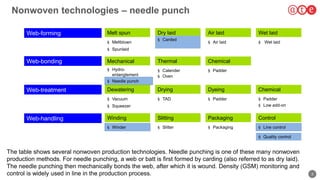
The table shows several nonwoven production technologies. Needle punching is one of these many nonwoven
production methods. For needle punching, a web or batt is first formed by carding (also referred to as dry laid).
The needle punching then mechanically bonds the web, after which it is wound. Density (GSM) monitoring and
control is widely used in line in the production process.
3
Needle punch technology
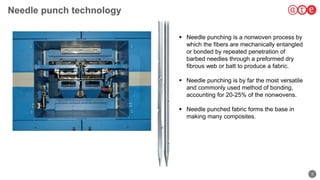
 Needle punching is a nonwoven process by
which the fibers are mechanically entangled
or bonded by repeated penetration of
barbed needles through a preformed dry
fibrous web or batt to produce a fabric.
 Needle punching is by far the most versatile
and commonly used method of bonding,
accounting for 20-25% of the nonwovens.
 Needle punched fabric forms the base in
making many composites.
4
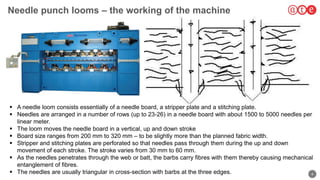
Needle punch looms – the working of the machine
 A needle loom consists essentially of a needle board, a stripper plate and a stitching plate.
 Needles are arranged in a number of rows (up to 23-26) in a needle board with about 1500 to 5000 needles per
linear meter.
 The loom moves the needle board in a vertical, up and down stroke
 Board size ranges from 200 mm to 320 mm – to be slightly more than the planned fabric width.
 Stripper and stitching plates are perforated so that needles pass through them during the up and down
movement of each stroke. The stroke varies from 30 mm to 60 mm.
 As the needles penetrates through the web or batt, the barbs carry fibres with them thereby causing mechanical
entanglement of fibres.
 The needles are usually triangular in cross-section with barbs at the three edges.
5
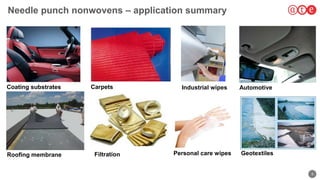
Needle punch nonwovens – application summary
Automotive
Geotextiles
Carpets
Filtration
Coating substrates
Roofing membrane
Industrial wipes
Personal care wipes
6
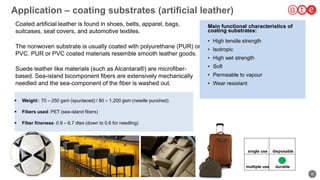
Application – coating substrates (artificial leather)
118
 Weight:: 70 – 250 gsm (spunlaced) / 80 – 1,200 gsm (needle punched)
 Fibers used: PET (sea-island fibers)
 Fiber fineness: 0.9 – 6.7 dtex (down to 0.6 for needling)
Coated artificial leather is found in shoes, belts, apparel, bags,
suitcases, seat covers, and automotive textiles.
The nonwoven substrate is usually coated with polyurethane (PUR) or
PVC. PUR or PVC coated materials resemble smooth leather goods.
Suede leather like materials (such as Alcantara®) are microfiber-
based. Sea-island bicomponent fibers are extensively mechanically
needled and the sea-component of the fiber is washed out.
Main functional characteristics of
coating substrates:
• High tensile strength
• Isotropic
• High wet strength
• Soft
• Permeable to vapour
• Wear resistant
single use
multiple use durable
disposable
7
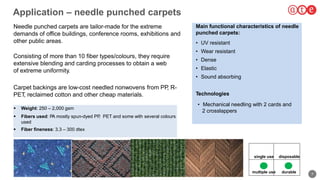
Application – needle punched carpets
 Weight: 250 – 2,000 gsm
 Fibers used: PA mostly spun-dyed PP, PET and some with several colours
used
 Fiber fineness: 3.3 – 300 dtex
165
Needle punched carpets are tailor-made for the extreme
demands of office buildings, conference rooms, exhibitions and
other public areas.
Consisting of more than 10 fiber types/colours, they require
extensive blending and carding processes to obtain a web
of extreme uniformity.
Carpet backings are low-cost needled nonwovens from PP, R-
PET, reclaimed cotton and other cheap materials.
Main functional characteristics of needle
punched carpets:
• UV resistant
• Wear resistant
• Dense
• Elastic
• Sound absorbing
Technologies
• Mechanical needling with 2 cards and
2 crosslappers
single use
multiple use durable
disposable
8
Application – wipes
to ap
283
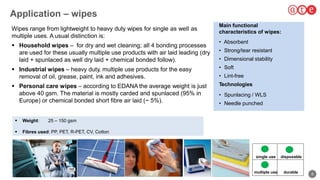
Wipes range from lightweight to heavy duty wipes for single as well as
multiple uses. A usual distinction is:
 Household wipes – for dry and wet cleaning; all 4 bonding processes
are used for these usually multiple use products with air laid leading (dry
laid + spunlaced as well dry laid + chemical bonded follow).
 Industrial wipes – heavy duty, multiple use products for the easy
removal of oil, grease, paint, ink and adhesives.
 Personal care wipes – according to EDANA the average weight is just
above 40 gsm. The material is mostly carded and spunlaced (95% in
Europe) or chemical bonded short fibre air laid (~ 5%).
Main functional
characteristics of wipes:
• Absorbent
• Strong/tear resistant
• Dimensional stability
• Soft
• Lint-free
Technologies
• Spunlacing / WLS
• Needle punched
 Weight: 25 – 150 gsm
 Fibres used: PP, PET, R-PET, CV, Cotton
single use
multiple use durable
disposable
9
Application – automotive nonwovens
Weight:: 80 – 450 gsm up to 1,500 gsm for paddings etc.
Fibers used: PP, PA, PET, PET+BiCo, glass
to applications
157
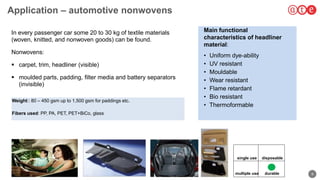
In every passenger car some 20 to 30 kg of textile materials
(woven, knitted, and nonwoven goods) can be found.
Nonwovens:
 carpet, trim, headliner (visible)
 moulded parts, padding, filter media and battery separators
(invisible)
Main functional
characteristics of headliner
material:
• Uniform dye-ability
• UV resistant
• Mouldable
• Wear resistant
• Flame retardant
• Bio resistant
• Thermoformable
single use
multiple use durable
disposable
10
Application – roofing membranes
 Weight: 120 – 250 gsm
 Fibers used: PET
 Fineness: 4 – 10 dtex
251
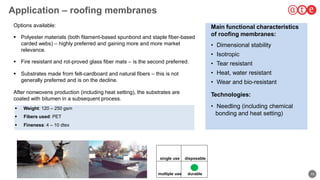
Options available:
 Polyester materials (both filament-based spunbond and staple fiber-based
carded webs) – highly preferred and gaining more and more market
relevance.
 Fire resistant and rot-proved glass fiber mats – is the second preferred.
 Substrates made from felt-cardboard and natural fibers – this is not
generally preferred and is on the decline.
After nonwovens production (including heat setting), the substrates are
coated with bitumen in a subsequent process.
Main functional characteristics
of roofing membranes:
• Dimensional stability
• Isotropic
• Tear resistant
• Heat, water resistant
• Wear and bio-resistant
Technologies:
• Needling (including chemical
bonding and heat setting)
single use
multiple use durable
disposable
11
Application – filtration
 Weight: 20 – 650 gsm for air purifying > 400 gsm for hot-air filtration
 Fibers used: PET + bico fibers for household/automotive filters, high performance
fibers (PPS, aramide) for hot-air filtration
185
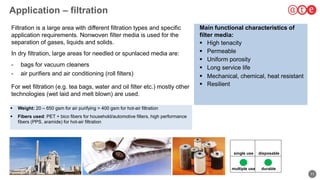
Filtration is a large area with different filtration types and specific
application requirements. Nonwoven filter media is used for the
separation of gases, liquids and solids.
In dry filtration, large areas for needled or spunlaced media are:
- bags for vacuum cleaners
- air purifiers and air conditioning (roll filters)
For wet filtration (e.g. tea bags, water and oil filter etc.) mostly other
technologies (wet laid and melt blown) are used.
Main functional characteristics of
filter media:
 High tenacity
 Permeable
 Uniform porosity
 Long service life
 Mechanical, chemical, heat resistant
 Resilient
single use
multiple use durable
disposable
12
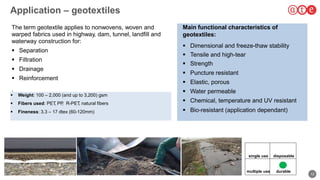
Application – geotextiles
 Weight: 100 – 2,000 (and up to 3,200) gsm
 Fibers used: PET, PP, R-PET, natural fibers
 Fineness: 3.3 – 17 dtex (60-120mm)
210
The term geotextile applies to nonwovens, woven and
warped fabrics used in highway, dam, tunnel, landfill and
waterway construction for:
 Separation
 Filtration
 Drainage
 Reinforcement
.
Main functional characteristics of
geotextiles:
 Dimensional and freeze-thaw stability
 Tensile and high-tear
 Strength
 Puncture resistant
 Elastic, porous
 Water permeable
 Chemical, temperature and UV resistant
 Bio-resistant (application dependant)
single use
multiple use durable
disposable
13
THANK YOU

Needle punch nonwoven applications

  • 1.
    1 Needle punch nonwovenapplications A.T.E. Enterprises Private Limited V2.1 Mar 2018
  • 2.
    2 Web-forming Web-bonding Web-treatment Web-handling Melt spun Drylaid Air laid Wet laid § Meltblown § Carded § Air laid § Wet laid § Spunlaid Thermal Chemical § Hydro- entanglement § Calender § Padder § Needle punch Dewatering Drying Dyeing Chemical § Vacuum § TAD § Padder § Padder § Squeezer Winding Slitting Packaging Control § Winder § Slitter § Packaging § Line control § Oven § Low add-on Mechanical § Quality control Nonwoven technologies – needle punch The table shows several nonwoven production technologies. Needle punching is one of these many nonwoven production methods. For needle punching, a web or batt is first formed by carding (also referred to as dry laid). The needle punching then mechanically bonds the web, after which it is wound. Density (GSM) monitoring and control is widely used in line in the production process.
  • 3.
    3 Needle punch technology Needle punching is a nonwoven process by which the fibers are mechanically entangled or bonded by repeated penetration of barbed needles through a preformed dry fibrous web or batt to produce a fabric.  Needle punching is by far the most versatile and commonly used method of bonding, accounting for 20-25% of the nonwovens.  Needle punched fabric forms the base in making many composites.
  • 4.
    4 Needle punch looms– the working of the machine  A needle loom consists essentially of a needle board, a stripper plate and a stitching plate.  Needles are arranged in a number of rows (up to 23-26) in a needle board with about 1500 to 5000 needles per linear meter.  The loom moves the needle board in a vertical, up and down stroke  Board size ranges from 200 mm to 320 mm – to be slightly more than the planned fabric width.  Stripper and stitching plates are perforated so that needles pass through them during the up and down movement of each stroke. The stroke varies from 30 mm to 60 mm.  As the needles penetrates through the web or batt, the barbs carry fibres with them thereby causing mechanical entanglement of fibres.  The needles are usually triangular in cross-section with barbs at the three edges.
  • 5.
    5 Needle punch nonwovens– application summary Automotive Geotextiles Carpets Filtration Coating substrates Roofing membrane Industrial wipes Personal care wipes
  • 6.
    6 Application – coatingsubstrates (artificial leather) 118  Weight:: 70 – 250 gsm (spunlaced) / 80 – 1,200 gsm (needle punched)  Fibers used: PET (sea-island fibers)  Fiber fineness: 0.9 – 6.7 dtex (down to 0.6 for needling) Coated artificial leather is found in shoes, belts, apparel, bags, suitcases, seat covers, and automotive textiles. The nonwoven substrate is usually coated with polyurethane (PUR) or PVC. PUR or PVC coated materials resemble smooth leather goods. Suede leather like materials (such as Alcantara®) are microfiber- based. Sea-island bicomponent fibers are extensively mechanically needled and the sea-component of the fiber is washed out. Main functional characteristics of coating substrates: • High tensile strength • Isotropic • High wet strength • Soft • Permeable to vapour • Wear resistant single use multiple use durable disposable
  • 7.
    7 Application – needlepunched carpets  Weight: 250 – 2,000 gsm  Fibers used: PA mostly spun-dyed PP, PET and some with several colours used  Fiber fineness: 3.3 – 300 dtex 165 Needle punched carpets are tailor-made for the extreme demands of office buildings, conference rooms, exhibitions and other public areas. Consisting of more than 10 fiber types/colours, they require extensive blending and carding processes to obtain a web of extreme uniformity. Carpet backings are low-cost needled nonwovens from PP, R- PET, reclaimed cotton and other cheap materials. Main functional characteristics of needle punched carpets: • UV resistant • Wear resistant • Dense • Elastic • Sound absorbing Technologies • Mechanical needling with 2 cards and 2 crosslappers single use multiple use durable disposable
  • 8.
    8 Application – wipes toap 283 Wipes range from lightweight to heavy duty wipes for single as well as multiple uses. A usual distinction is:  Household wipes – for dry and wet cleaning; all 4 bonding processes are used for these usually multiple use products with air laid leading (dry laid + spunlaced as well dry laid + chemical bonded follow).  Industrial wipes – heavy duty, multiple use products for the easy removal of oil, grease, paint, ink and adhesives.  Personal care wipes – according to EDANA the average weight is just above 40 gsm. The material is mostly carded and spunlaced (95% in Europe) or chemical bonded short fibre air laid (~ 5%). Main functional characteristics of wipes: • Absorbent • Strong/tear resistant • Dimensional stability • Soft • Lint-free Technologies • Spunlacing / WLS • Needle punched  Weight: 25 – 150 gsm  Fibres used: PP, PET, R-PET, CV, Cotton single use multiple use durable disposable
  • 9.
    9 Application – automotivenonwovens Weight:: 80 – 450 gsm up to 1,500 gsm for paddings etc. Fibers used: PP, PA, PET, PET+BiCo, glass to applications 157 In every passenger car some 20 to 30 kg of textile materials (woven, knitted, and nonwoven goods) can be found. Nonwovens:  carpet, trim, headliner (visible)  moulded parts, padding, filter media and battery separators (invisible) Main functional characteristics of headliner material: • Uniform dye-ability • UV resistant • Mouldable • Wear resistant • Flame retardant • Bio resistant • Thermoformable single use multiple use durable disposable
  • 10.
    10 Application – roofingmembranes  Weight: 120 – 250 gsm  Fibers used: PET  Fineness: 4 – 10 dtex 251 Options available:  Polyester materials (both filament-based spunbond and staple fiber-based carded webs) – highly preferred and gaining more and more market relevance.  Fire resistant and rot-proved glass fiber mats – is the second preferred.  Substrates made from felt-cardboard and natural fibers – this is not generally preferred and is on the decline. After nonwovens production (including heat setting), the substrates are coated with bitumen in a subsequent process. Main functional characteristics of roofing membranes: • Dimensional stability • Isotropic • Tear resistant • Heat, water resistant • Wear and bio-resistant Technologies: • Needling (including chemical bonding and heat setting) single use multiple use durable disposable
  • 11.
    11 Application – filtration Weight: 20 – 650 gsm for air purifying > 400 gsm for hot-air filtration  Fibers used: PET + bico fibers for household/automotive filters, high performance fibers (PPS, aramide) for hot-air filtration 185 Filtration is a large area with different filtration types and specific application requirements. Nonwoven filter media is used for the separation of gases, liquids and solids. In dry filtration, large areas for needled or spunlaced media are: - bags for vacuum cleaners - air purifiers and air conditioning (roll filters) For wet filtration (e.g. tea bags, water and oil filter etc.) mostly other technologies (wet laid and melt blown) are used. Main functional characteristics of filter media:  High tenacity  Permeable  Uniform porosity  Long service life  Mechanical, chemical, heat resistant  Resilient single use multiple use durable disposable
  • 12.
    12 Application – geotextiles Weight: 100 – 2,000 (and up to 3,200) gsm  Fibers used: PET, PP, R-PET, natural fibers  Fineness: 3.3 – 17 dtex (60-120mm) 210 The term geotextile applies to nonwovens, woven and warped fabrics used in highway, dam, tunnel, landfill and waterway construction for:  Separation  Filtration  Drainage  Reinforcement . Main functional characteristics of geotextiles:  Dimensional and freeze-thaw stability  Tensile and high-tear  Strength  Puncture resistant  Elastic, porous  Water permeable  Chemical, temperature and UV resistant  Bio-resistant (application dependant) single use multiple use durable disposable
  • 13.