Kwame Nkrumah University of
Science & Technology, Kumasi, Ghana
Topic: WEB PREPARATION
Name GROUP 3
Department: Industrial Art
Faculty & College: Art Faculty
www.knust.edu.gh
GROUP MEMBERS
Yeboah Oforiwaa
Yaa Ladzaglah Millicent - Leader
Serwaa Bonsu Afram
Sintim-Aboagye Akosua Serwaa
Boateng Edmund
Tawiah Gyanea Forkuo
EdnaFirdaus Ezomah Musah
Babangida Ilhaam
Frimpong Lilian Korantemaa
Berko Benedicta
Elizabeth OtooKessey
FrancisAntwi Boahemaa
Eunice Kyei-Baffour Kerfa
www.knust.edu.gh
Introduction
Nonwoven fabrics are one type of textile fabrics or a manufactured sheet
made of a fibrous layer, which may be a carded web, a fiber web,
or any system of randomly laid or oriented fibers or threads, possibly
combined with textile or non-textile materials such as conventional
woven fabrics, plastic films, foam layers, metal foils, etc., & forming
them with a mechanically bound or chemically bonded textile product
www.knust.edu.gh
There are three basic methods of web formation:
• Dry Laid
• Wet Laid
• Polymer Laid
Introduction
• Nonwoven manufacturing techniques is basically a continuous process
in which the web laying and web bonding are performed by two
consecutive machines.
• In general, the nonwoven formation processes consists of two basic
steps, web formation followed by bonding.
• The web formation in nonwoven production is a critical contributor of
the end-use product performance.
www.knust.edu.gh
Introduction
• The latter one classified as spun laid and melt blown web formations
which are particularly applicable for synthetic polymers.
In web formation the characteristics of the fibrous web are a key
determinant of the physical properties of the final product.
In web formation, methods for forming webs is determined by fibre
length.
• Staple Fibres uses Dry-laid and Wet-laid Methods.
• Filament fibres uses Spun laid and melt blown
www.knust.edu.gh
Introduction
• There are three basic types of bonding: chemical, thermal, and
mechanical. The natural fiber webs can be successfully bonded by
mechanical process without any additives.
• Additional binder polymer or synthetic fiber is required for the
chemical or thermal bonding.
www.knust.edu.gh
Introduction
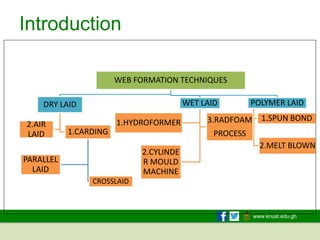
WEB FORMATION TECHNIQUES
DRY LAID
1.CARDING
PARALLEL
LAID
CROSSLAID
2.AIR
LAID
WET LAID
1.HYDROFORMER 3.RADFOAM
PROCESS
2.CYLINDE
R MOULD
MACHINE
POLYMER LAID
1.SPUN BOND
2.MELT BLOWN
www.knust.edu.gh
DRY LAID
• Dry laid is the staple fiber based web laying process involves three
major steps.
• They are fiber preparation (by opening and mixing processes), web
formation (by carding) and finally web stacking (by parallel-lay, cross-
lay, and perpendicular-lay processes).
www.knust.edu.gh
DRY LAID
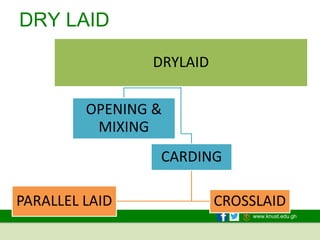
DRYLAID
CARDING
PARALLEL LAID CROSSLAID
OPENING &
MIXING
www.knust.edu.gh
OPENING, CLEANING, MIXING
AND BLENDING
Machines used could be;
✓ Bale opener
✓ Cleaning machine
✓ Blending machine
• The bale are dispersed on a conveyor belt.
• At this stage there is Opening, Cleaning, Mixing and blending
• The correct choice of fibre opening, cleaning and system is therefore
of utmost importance to ensure a profitable nonwoven manufacturing
operation
www.knust.edu.gh
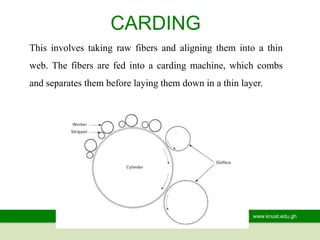
This involves taking raw fibers and aligning them into a thin
web. The fibers are fed into a carding machine, which combs
and separates them before laying them down in a thin layer.
CARDING
www.knust.edu.gh
CARDING
• Purpose of carding: Carding is done to disentangle and mix fibres to
form a homogeneous web of uniform weight per unit area.
✓ Cylinder: Heart of carding machine and is the central distributor of
fibres during the process.
✓ The worker-stripper pairings: Have both carding and mixing function.
✓ Doffer rollers: Condense and remove fibre from cylinder in the form of
continuous web and a proportion of circulating fibre is recycled to
combined with fresh fibre.
www.knust.edu.gh
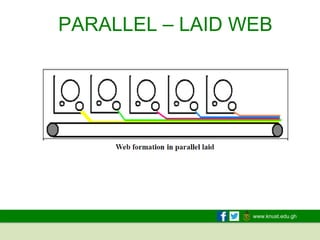
PARALLEL – LAID WEB
• Several carding machines are placed one behind another in a long line.
• The web from the first card is allowed to fall on conveyor which runs
along the full length of the production line underneath the card.
• As the web from the first card passes from the second card, the web from
the second card is superimposed upon it.
• This process is repeated along the line until a fleece of the correct mass
per unit area is achieved.
• This system mostly used for light weight nonwoven.
www.knust.edu.gh
PARALLEL – LAID WEB
www.knust.edu.gh
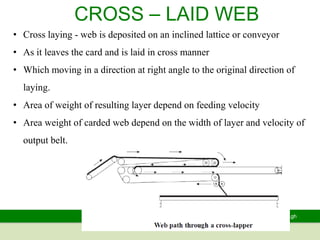
CROSS – LAID WEB
• Cross laying - web is deposited on an inclined lattice or conveyor
• As it leaves the card and is laid in cross manner
• Which moving in a direction at right angle to the original direction of
laying.
• Area of weight of resulting layer depend on feeding velocity
• Area weight of carded web depend on the width of layer and velocity of
output belt.
www.knust.edu.gh
• Air laid aim to overcome the high degree of anisotropy of fiber
direction in non woven formed by carded web.
• The fibres are dispersed in air and deposited from a suspended
state onto a perforated screen to form a web.
Benefit:
• Deliver web with high isotropy
• High porosity
• Utilized short fibre which are not possible to be processed by
using carding technology.
CROSS – LAID WEB
www.knust.edu.gh
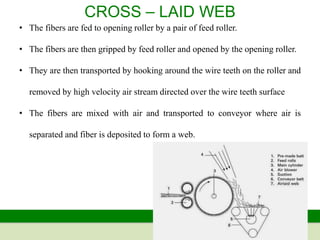
• The fibers are fed to opening roller by a pair of feed roller.
• The fibers are then gripped by feed roller and opened by the opening roller.
• They are then transported by hooking around the wire teeth on the roller and
removed by high velocity air stream directed over the wire teeth surface
• The fibers are mixed with air and transported to conveyor where air is
separated and fiber is deposited to form a web.
CROSS – LAID WEB
www.knust.edu.gh
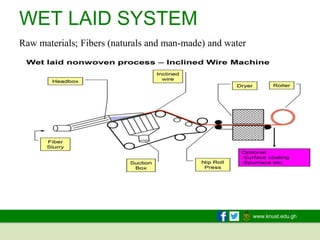
WET LAID SYSTEM
Raw materials; Fibers (naturals and man-made) and water
www.knust.edu.gh
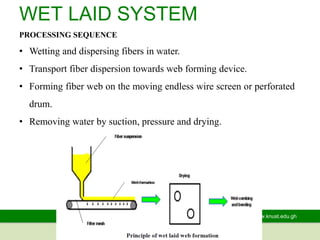
WET LAID SYSTEM
PROCESSING SEQUENCE
• Wetting and dispersing fibers in water.
• Transport fiber dispersion towards web forming device.
• Forming fiber web on the moving endless wire screen or perforated
drum.
• Removing water by suction, pressure and drying.
www.knust.edu.gh
WET LAYING PROCESS
• Fibers are dispersed in water and laid on wire mesh to filter the liquid
• Fibers then transferred to drying felt and being heat cured in continuous
process
• A web will be produced where fiber was random oriented
• It later will be superimposed on one another on parallel fashion
• Application: surgical gowns, gloves, mask, medical care bed sheet,
clothes liner, dust-proof clothing, protective clothing, vacuum filter bag,
sofa cloth
www.knust.edu.gh
WET LAYING PROCESS
• To increased volume flow onto the wire had to be drained, the
modification of wire section is needed.
• Early experimental work showed that inclination of the wire and the
use of vacuum boxes under the wire to increase drainage resulted in
a machine configuration that could handle these materials.
www.knust.edu.gh
POLYMER-LAID
• Manufacturing of non woven web directly from the
thermoplastic polymer
The two types of Polymer-laid non woven fabrics. They are;
➢ Spunbond
➢ Melt blown
www.knust.edu.gh
SPUNBOND
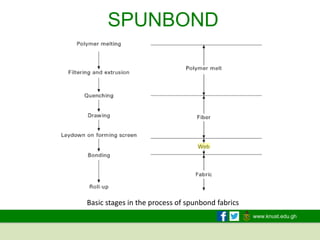
• Polymer granule are melted and then the molten polymer is extruded
throughout the spinnerets
• The continuous filaments are chilled and transported onto conveyor
belt to structure a uniform web
• In spunbond method, the raw material elasticity is more controlled
and gives non woven superior strength.
• Application: Surgical gowns, home furnishing, geotextile fabrics,
house wrap
www.knust.edu.gh
Basic stages in the process of spunbond fabrics
SPUNBOND
www.knust.edu.gh
MELT BLOWN
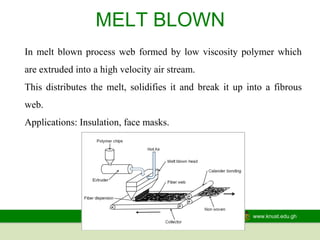
In melt blown process web formed by low viscosity polymer which
are extruded into a high velocity air stream.
This distributes the melt, solidifies it and break it up into a fibrous
web.
Applications: Insulation, face masks.
www.knust.edu.gh
• Needle punched nonwovens are created by mechanically orienting and
interlocking the fibers of a spunbonded or carded web.
• This mechanical interlocking is achieved with thousands of barbed
felting needles repeatedly passing into and out of the web.
NEEDLE PUNCHING
www.knust.edu.gh
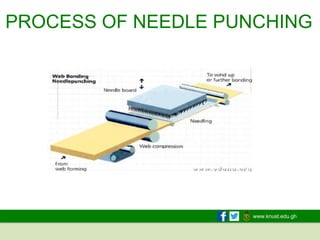
• Needle punching is carried out passing a number of needles with barbs,
mounted in a board, through the batt at a high reciprocating speed.
• Needles are arranged in a number of rows (up to 23 -26) in a needle
board with about 1500 to 5000 needles per 1 m working width.
• The needles are usually triangular in cross-section with barbs at the
three edges.
• As the needle penetrates through the batt, the barbs carry fibres with
them thereby causing mechanical entanglement of fibres.
• This gives strength and dimensional stability to the batt.
PROCESS OF NEEDLE PUNCHING
www.knust.edu.gh
• Punch density is dependent upon the number of needles per board, number
of boards, stroke frequency and delivery rate.
• Stroke frequency is indicated by the number of up and down strokes made
by the needle board per min. This is usually 1000 in old machines and has
gone up progressively upto 3000 in latest models.
• Width of needle punching machine ranges from 2 to 10 m.
PROCESS OF NEEDLE PUNCHING
www.knust.edu.gh
PROCESS OF NEEDLE PUNCHING
www.knust.edu.gh
• Thus finer the needles, higher the punch density.
• Coarse fibers use the lower punch density, and fine fibers and
delicate fibers use the higher punch density.
• For example, a coarse fiber product may use a 12 to 16 punch
density and fine synthetics may use 25 to 40 punch density.
TYPES OF NEEDLES USED IN
NEEDLE PUNCHING

WEB FORMATION

  • 1.
    Kwame Nkrumah Universityof Science & Technology, Kumasi, Ghana Topic: WEB PREPARATION Name GROUP 3 Department: Industrial Art Faculty & College: Art Faculty
  • 2.
    www.knust.edu.gh GROUP MEMBERS Yeboah Oforiwaa YaaLadzaglah Millicent - Leader Serwaa Bonsu Afram Sintim-Aboagye Akosua Serwaa Boateng Edmund Tawiah Gyanea Forkuo EdnaFirdaus Ezomah Musah Babangida Ilhaam Frimpong Lilian Korantemaa Berko Benedicta Elizabeth OtooKessey FrancisAntwi Boahemaa Eunice Kyei-Baffour Kerfa
  • 3.
    www.knust.edu.gh Introduction Nonwoven fabrics areone type of textile fabrics or a manufactured sheet made of a fibrous layer, which may be a carded web, a fiber web, or any system of randomly laid or oriented fibers or threads, possibly combined with textile or non-textile materials such as conventional woven fabrics, plastic films, foam layers, metal foils, etc., & forming them with a mechanically bound or chemically bonded textile product
  • 4.
    www.knust.edu.gh There are threebasic methods of web formation: • Dry Laid • Wet Laid • Polymer Laid Introduction • Nonwoven manufacturing techniques is basically a continuous process in which the web laying and web bonding are performed by two consecutive machines. • In general, the nonwoven formation processes consists of two basic steps, web formation followed by bonding. • The web formation in nonwoven production is a critical contributor of the end-use product performance.
  • 5.
    www.knust.edu.gh Introduction • The latterone classified as spun laid and melt blown web formations which are particularly applicable for synthetic polymers. In web formation the characteristics of the fibrous web are a key determinant of the physical properties of the final product. In web formation, methods for forming webs is determined by fibre length. • Staple Fibres uses Dry-laid and Wet-laid Methods. • Filament fibres uses Spun laid and melt blown
  • 6.
    www.knust.edu.gh Introduction • There arethree basic types of bonding: chemical, thermal, and mechanical. The natural fiber webs can be successfully bonded by mechanical process without any additives. • Additional binder polymer or synthetic fiber is required for the chemical or thermal bonding.
  • 7.
    www.knust.edu.gh Introduction WEB FORMATION TECHNIQUES DRYLAID 1.CARDING PARALLEL LAID CROSSLAID 2.AIR LAID WET LAID 1.HYDROFORMER 3.RADFOAM PROCESS 2.CYLINDE R MOULD MACHINE POLYMER LAID 1.SPUN BOND 2.MELT BLOWN
  • 8.
    www.knust.edu.gh DRY LAID • Drylaid is the staple fiber based web laying process involves three major steps. • They are fiber preparation (by opening and mixing processes), web formation (by carding) and finally web stacking (by parallel-lay, cross- lay, and perpendicular-lay processes).
  • 9.
  • 10.
    www.knust.edu.gh OPENING, CLEANING, MIXING ANDBLENDING Machines used could be; ✓ Bale opener ✓ Cleaning machine ✓ Blending machine • The bale are dispersed on a conveyor belt. • At this stage there is Opening, Cleaning, Mixing and blending • The correct choice of fibre opening, cleaning and system is therefore of utmost importance to ensure a profitable nonwoven manufacturing operation
  • 11.
    www.knust.edu.gh This involves takingraw fibers and aligning them into a thin web. The fibers are fed into a carding machine, which combs and separates them before laying them down in a thin layer. CARDING
  • 12.
    www.knust.edu.gh CARDING • Purpose ofcarding: Carding is done to disentangle and mix fibres to form a homogeneous web of uniform weight per unit area. ✓ Cylinder: Heart of carding machine and is the central distributor of fibres during the process. ✓ The worker-stripper pairings: Have both carding and mixing function. ✓ Doffer rollers: Condense and remove fibre from cylinder in the form of continuous web and a proportion of circulating fibre is recycled to combined with fresh fibre.
  • 13.
    www.knust.edu.gh PARALLEL – LAIDWEB • Several carding machines are placed one behind another in a long line. • The web from the first card is allowed to fall on conveyor which runs along the full length of the production line underneath the card. • As the web from the first card passes from the second card, the web from the second card is superimposed upon it. • This process is repeated along the line until a fleece of the correct mass per unit area is achieved. • This system mostly used for light weight nonwoven.
  • 14.
  • 15.
    www.knust.edu.gh CROSS – LAIDWEB • Cross laying - web is deposited on an inclined lattice or conveyor • As it leaves the card and is laid in cross manner • Which moving in a direction at right angle to the original direction of laying. • Area of weight of resulting layer depend on feeding velocity • Area weight of carded web depend on the width of layer and velocity of output belt.
  • 16.
    www.knust.edu.gh • Air laidaim to overcome the high degree of anisotropy of fiber direction in non woven formed by carded web. • The fibres are dispersed in air and deposited from a suspended state onto a perforated screen to form a web. Benefit: • Deliver web with high isotropy • High porosity • Utilized short fibre which are not possible to be processed by using carding technology. CROSS – LAID WEB
  • 17.
    www.knust.edu.gh • The fibersare fed to opening roller by a pair of feed roller. • The fibers are then gripped by feed roller and opened by the opening roller. • They are then transported by hooking around the wire teeth on the roller and removed by high velocity air stream directed over the wire teeth surface • The fibers are mixed with air and transported to conveyor where air is separated and fiber is deposited to form a web. CROSS – LAID WEB
  • 18.
    www.knust.edu.gh WET LAID SYSTEM Rawmaterials; Fibers (naturals and man-made) and water
  • 19.
    www.knust.edu.gh WET LAID SYSTEM PROCESSINGSEQUENCE • Wetting and dispersing fibers in water. • Transport fiber dispersion towards web forming device. • Forming fiber web on the moving endless wire screen or perforated drum. • Removing water by suction, pressure and drying.
  • 20.
    www.knust.edu.gh WET LAYING PROCESS •Fibers are dispersed in water and laid on wire mesh to filter the liquid • Fibers then transferred to drying felt and being heat cured in continuous process • A web will be produced where fiber was random oriented • It later will be superimposed on one another on parallel fashion • Application: surgical gowns, gloves, mask, medical care bed sheet, clothes liner, dust-proof clothing, protective clothing, vacuum filter bag, sofa cloth
  • 21.
    www.knust.edu.gh WET LAYING PROCESS •To increased volume flow onto the wire had to be drained, the modification of wire section is needed. • Early experimental work showed that inclination of the wire and the use of vacuum boxes under the wire to increase drainage resulted in a machine configuration that could handle these materials.
  • 22.
    www.knust.edu.gh POLYMER-LAID • Manufacturing ofnon woven web directly from the thermoplastic polymer The two types of Polymer-laid non woven fabrics. They are; ➢ Spunbond ➢ Melt blown
  • 23.
    www.knust.edu.gh SPUNBOND • Polymer granuleare melted and then the molten polymer is extruded throughout the spinnerets • The continuous filaments are chilled and transported onto conveyor belt to structure a uniform web • In spunbond method, the raw material elasticity is more controlled and gives non woven superior strength. • Application: Surgical gowns, home furnishing, geotextile fabrics, house wrap
  • 24.
    www.knust.edu.gh Basic stages inthe process of spunbond fabrics SPUNBOND
  • 25.
    www.knust.edu.gh MELT BLOWN In meltblown process web formed by low viscosity polymer which are extruded into a high velocity air stream. This distributes the melt, solidifies it and break it up into a fibrous web. Applications: Insulation, face masks.
  • 26.
    www.knust.edu.gh • Needle punchednonwovens are created by mechanically orienting and interlocking the fibers of a spunbonded or carded web. • This mechanical interlocking is achieved with thousands of barbed felting needles repeatedly passing into and out of the web. NEEDLE PUNCHING
  • 27.
    www.knust.edu.gh • Needle punchingis carried out passing a number of needles with barbs, mounted in a board, through the batt at a high reciprocating speed. • Needles are arranged in a number of rows (up to 23 -26) in a needle board with about 1500 to 5000 needles per 1 m working width. • The needles are usually triangular in cross-section with barbs at the three edges. • As the needle penetrates through the batt, the barbs carry fibres with them thereby causing mechanical entanglement of fibres. • This gives strength and dimensional stability to the batt. PROCESS OF NEEDLE PUNCHING
  • 28.
    www.knust.edu.gh • Punch densityis dependent upon the number of needles per board, number of boards, stroke frequency and delivery rate. • Stroke frequency is indicated by the number of up and down strokes made by the needle board per min. This is usually 1000 in old machines and has gone up progressively upto 3000 in latest models. • Width of needle punching machine ranges from 2 to 10 m. PROCESS OF NEEDLE PUNCHING
  • 29.
  • 30.
    www.knust.edu.gh • Thus finerthe needles, higher the punch density. • Coarse fibers use the lower punch density, and fine fibers and delicate fibers use the higher punch density. • For example, a coarse fiber product may use a 12 to 16 punch density and fine synthetics may use 25 to 40 punch density. TYPES OF NEEDLES USED IN NEEDLE PUNCHING