SURGICAL
INFECTIONS
Dr. SUNDARPRAKASH SIVALINGAM
ASSOCIATE PROFESSOR IN SURGERY
SURGICAL INFECTIONS
&
ANTIBIOTICS






Definition
Pathogenesis
Clinical features & investigations (general)
Common pathogens
Common infections
Antibiotics use
Therapeutic
Prophylactic
INFECTION
Invasion of the body by pathogenic
microorganisms and reaction of the
host to organisms and their toxins
SURGICAL INFECTIONS
 A surgical infection is an infection
which requires surgical treatment and
has developed before, or as a
complication of surgical treatment.
Surgical Infection
 A major challenge
 Accounts for 1/3 of surgical patients
 Increased cost to healthcare
Factors contributing to infections
 Adequate dose of microorganisms
 Virulence of microorganisms
 Suitable environment ( closed space )
 Susceptible host
Pathogenicity of bacteria
Exotoxins: specific, soluble proteins, remote cytotoxic effect
Cl.Tetani, Strep. pyogenes
Endotoxins: part of gram-negative bacterial wall,
lipopolysaccharides e.g., E coli
Resist phagocytosis: Protective capsule
Klebsiela and Strep. pneumoniae
Host Resistance
 Intact skin / mucous membrane.
 Immunity:
Cellular (phagocytes )
Antibodies
Prevention of surgical infection
 Patient in best general condition.
(host defense)
 Minimize introduction of pathogens during
surgery.
 Good surgical technique.
 Peri-operative care (support defense)
Clinical features
 Local- pain, heat, redness, swelling, loss of function
(apparent in superficial infections)
 Systemic- fever, tachycardia, chills
 Investigations:
Leukocytosis
Exudates- Gram stain, culture
Blood culture ( chills & fever )
Special investigations ( radiology, biopsy )
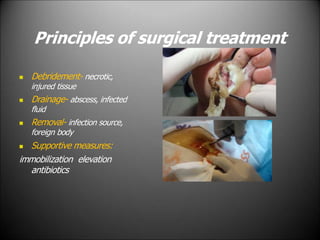
Principles of surgical treatment
 Debridement- necrotic,
injured tissue
 Drainage- abscess, infected
fluid
 Removal- infection source,
foreign body
 Supportive measures:
immobilization elevation
antibiotics
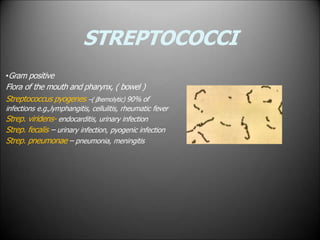
STREPTOCOCCI
•Gram positive
Flora of the mouth and pharynx, ( bowel )
Streptococcus pyogenes –( βhemolytic) 90% of
infections e.g.,lymphangitis, cellulitis, rheumatic fever
Strep. viridens- endocarditis, urinary infection
Strep. fecalis – urinary infection, pyogenic infection
Strep. pneumonae – pneumonia, meningitis
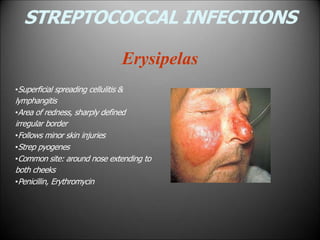
STREPTOCOCCAL INFECTIONS
Erysipelas
•Superficial spreading cellulitis &
lymphangitis
•Area of redness, sharply defined
irregular border
•Follows minor skin injuries
•Strep pyogenes
•Common site: around nose extending to
both cheeks
•Penicillin, Erythromycin
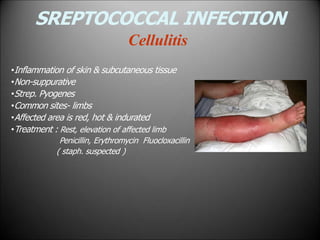
SREPTOCOCCAL INFECTION
Cellulitis
•Inflammation of skin & subcutaneous tissue
•Non-suppurative
•Strep. Pyogenes
•Common sites- limbs
•Affected area is red, hot & indurated
•Treatment : Rest, elevation of affected limb
Penicillin, Erythromycin Fluocloxacillin
( staph. suspected )
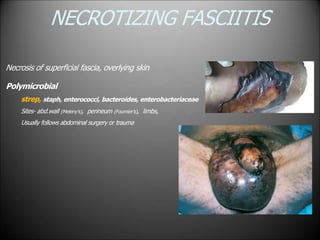
NECROTIZING FASCIITIS
Necrosis of superficial fascia, overlying skin
Polymicrobial
strep, staph, enterococci, bacteroides, enterobacteriaceae
Sites- abd.wall (Meleny’s), perineum (Fournier’s), limbs,
Usually follows abdominal surgery or trauma
NECROTIZING FASCIITIS
 More in diabetic patient
 Starts as cellulitis, edema, systemic toxicity
 Appears less extensive than actual necrosis
 Treatment:
Debridement , repeated dressings, skin grafting
Broad spectrum antibiotics
ampicillin, clindamycin, aminoglycosides
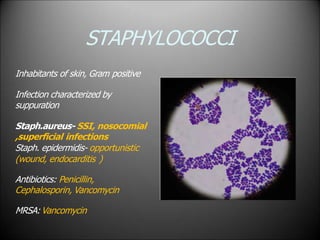
STAPHYLOCOCCI
Inhabitants of skin, Gram positive
Infection characterized by
suppuration
Staph.aureus- SSI, nosocomial
,superficial infections
Staph. epidermidis- opportunistic
(wound, endocarditis )
Antibiotics: Penicillin,
Cephalosporin, Vancomycin
MRSA: Vancomycin
STAPHYLCOCCAL INFECTIONS
 Abscess- localized pus collection
Treatment- drainage, antibiotics
 Furuncle- infection of hair follicle / sweat glands
 Carbuncle- extension of furuncle into subcut. tissue
common in diabetics
common sites- back, back of neck
Treatment: drainage, antibiotics, control diabetes
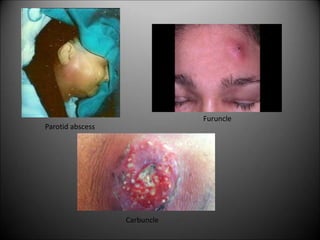
Parotid abscess
Furuncle
Carbuncle
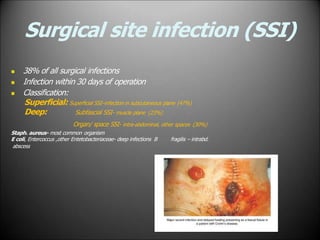
Surgical site infection (SSI)
 38% of all surgical infections
 Infection within 30 days of operation
 Classification:
Superficial: Superficial SSI–infection in subcutaneous plane (47%)
Deep: Subfascial SSI- muscle plane (23%)
Organ/ space SSI- intra-abdominal, other spaces (30%)
Staph. aureus- most common organism
E coli, Entercoccus ,other Entetobacteriaceae- deep infections B fragilis – intrabd.
abscess
Surgical site infection (SSI)
 Risk factors: age, malnutrition, obesity,
immunocompromised, poor surg. tech,
prolonged surgery, preop. shaving and
type of surgery.
 Diagnosis:
Sup.SSI- erythema, oedema, discharge and pain
Deep infections- no local signs, fever, pain, hypotension.
need investigations.
 Treatment: surgical / radiological intervention.
Surgical site infection (SSI)
Intra-abdominal infections
 Generalized
 Localized
 Prevention- good tech., avoid bowel
injury, good anastomosis.
 Diagnosis- History, exam., investigations.
 Treatment- surgery/ intervention
Antibiotics (aerobe+ anaerobe)
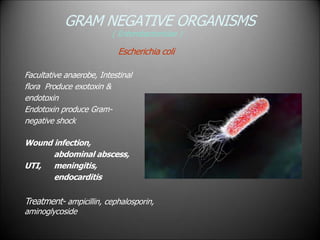
GRAM NEGATIVE ORGANISMS
( Enterobactericiae )
Escherichia coli
Facultative anaerobe, Intestinal
flora Produce exotoxin &
endotoxin
Endotoxin produce Gram-
negative shock
Wound infection,
abdominal abscess,
UTI, meningitis,
endocarditis
Treatment- ampicillin, cephalosporin,
aminoglycoside
GRAM NEGATIVE ORGANISMS
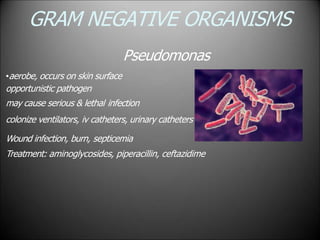
Pseudomonas
•aerobe, occurs on skin surface
opportunistic pathogen
may cause serious & lethal infection
colonize ventilators, iv catheters, urinary catheters
Wound infection, burn, septicemia
Treatment: aminoglycosides, piperacillin, ceftazidime
CLOSTRIDIA





Gram positive, anaerobe
Rod shaped microorganisms
Live in bowel & soil
Produce exotoxin for pathogenicity
Important members:
Cl. Perfringens, Cl. Septicum ( gas gangrene )
Cl. Tetani ( tetanus )
Cl. Difficile ( pseudomembranous colitis )
GAS GANGRENE
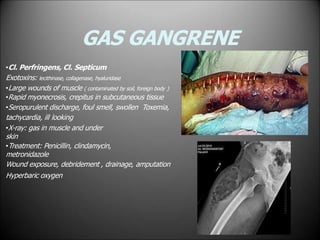
•Cl. Perfringens, Cl. Septicum
Exotoxins: lecithinase, collagenase, hyaluridase
•Large wounds of muscle ( contaminated by soil, foreign body )
•Rapid myonecrosis, crepitus in subcutaneous tissue
•Seropurulent discharge, foul smell, swollen Toxemia,
tachycardia, ill looking
•X-ray: gas in muscle and under
skin
•Treatment: Penicillin, clindamycin,
metronidazole
Wound exposure, debridement , drainage, amputation
Hyperbaric oxygen
TETANUS
Cl. Tetani, produce neurotoxin Penetrating wound
(rusty nail, thorn)
Usually wound healed when symptoms appear
Incubation period:7-10 days
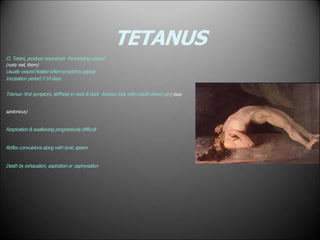
Trismus- first symptom, stiffness in neck & back Anxious look with mouth drawn up ( risus
sardonicus)
Respiration & swallowing progressively difficult
Reflex convulsions along with tonic spasm
Death by exhaustion, aspiration or asphyxiation
TETANUS
 Treatment:
wound debridement, penicillin
Muscle relaxants, ventilatory support
Nutritional support
 Prophylaxis:
wound care, antibiotics
Human TIG in high risk ( un-immunized )
Commence active immunization ( T toxoid)
Previously immunized-
booster >10 years needs a booster dose
booster <10 years- no treatment in low risk wounds
PSEUDOMEMBRANOUS COLITIS






Cl. Difficile
Overtakes normal flora in patients on antibiotics
Watery diarrhea, abdominal pain, fever
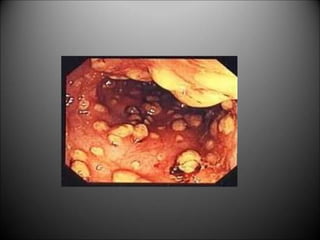
Sigmoidoscopy: membrane of exudates (pseudomembranes)
Stool- culture and toxin assay
Treatment :
stop offending antibiotic
oral vancomycin/ metronidazole
rehydration, isolate patient
GRAM NEGATVE ANAEROBES
Bacteroides fragilis







Normal flora in oral cavity, colon
Intra-abdominal & gynecologic infections ( 90% )
Foul smelling pus, gas in surrounding tissue, necrosis
Spiking fever, jaundice, Leukocytosis
No growth on standard culture
Needs anaerobe culture media
Treatment:
Surgical drainage
Antibiotics- clindamycin, metronidazole
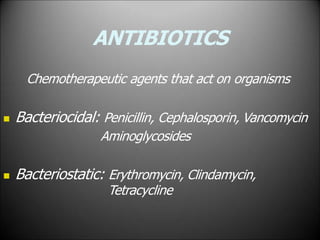
ANTIBIOTICS
Chemotherapeutic agents that act on organisms
 Bacteriocidal: Penicillin, Cephalosporin, Vancomycin
Aminoglycosides
 Bacteriostatic: Erythromycin, Clindamycin,
Tetracycline
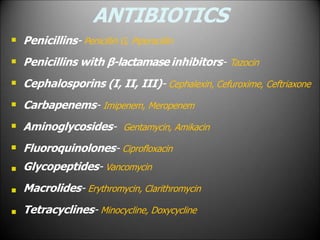
ANTIBIOTICS




Penicillins- Penicillin G, Piperacillin
Penicillins with β-lactamase inhibitors- Tazocin
Cephalosporins (I, II, III)- Cephalexin, Cefuroxime, Ceftriaxone
Carbapenems- Imipenem, Meropenem
 Aminoglycosides- Gentamycin, Amikacin




Fluoroquinolones- Ciprofloxacin
Glycopeptides- Vancomycin
Macrolides- Erythromycin, Clarithromycin
Tetracyclines- Minocycline, Doxycycline
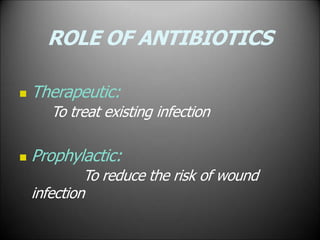
ROLE OF ANTIBIOTICS
 Therapeutic:
To treat existing infection
 Prophylactic:
To reduce the risk of wound
infection
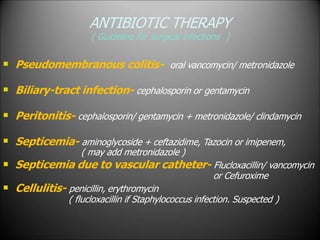
ANTIBIOTIC THERAPY
( Guideline for surgical infections )
 Pseudomembranous colitis- oral vancomycin/ metronidazole
 Biliary-tract infection- cephalosporin or gentamycin
 Peritonitis- cephalosporin/ gentamycin + metronidazole/ clindamycin



Septicemia- aminoglycoside + ceftazidime, Tazocin or imipenem,
( may add metronidazole )
Septicemia due to vascular catheter- Flucloxacillin/ vancomycin
or Cefuroxime
Cellulitis- penicillin, erythromycin
( flucloxacillin if Staphylococcus infection. Suspected )
ANTIBIOTIC PROPHYLAXIS

Prophylaxis in clean-contaminated/
high risk clean wounds
Antibiotic is given just before patient
sent for surgery
Duration of antibiotic is controversial
( one dose- 24 hour regimen )
ANTIBIOTIC PROPHYLAXIS
BASED ON SURGICAL WOUND CLASSIFICATION


A. Clean : CLASS I e.g. surgeries on thyroid gland,
breast, hernia,
• No need for prophylaxis in clean surgeries, except for :
oImmunucompromised patients, e.g. diabetics, patients
using corticosteroids.
oIf the surgery include inserting foreign materials such as
artificial valves.
oHigh risk patients like those with infective endocarditis.
The risk of postoperative wound infection is around
2%.
ANTIBIOTIC PROPHYLAXIS
 B. Clean/Contaminated (minimal
contamination) : CLASS II
e.g., biliary,urinary, GI tract surgery
 Prophylaxis is advisable, and the risk of
infection is about 5-10%.
ANTIBIOTIC PROPHYLAXIS
 C. Contaminated (gross contamination) :
CLASS III e.g. during bowel surgery
 Prophylaxis is advisable and the risk of infection
is up to 20%.
ANTIBIOTIC PROPHYLAXIS
 D. Dirty : CLASS IV through established
infection
e.g., peritonitis ( up to 50% )
 The use of antibiotic is considered to be of
therapeutic nature (not prophylactic).
 The risk of infec@on is up to 5CD.
Surgical infections

Surgical infections

  • 1.
  • 2.
    SURGICAL INFECTIONS & ANTIBIOTICS       Definition Pathogenesis Clinical features& investigations (general) Common pathogens Common infections Antibiotics use Therapeutic Prophylactic
  • 3.
    INFECTION Invasion of thebody by pathogenic microorganisms and reaction of the host to organisms and their toxins
  • 4.
    SURGICAL INFECTIONS  Asurgical infection is an infection which requires surgical treatment and has developed before, or as a complication of surgical treatment.
  • 5.
    Surgical Infection  Amajor challenge  Accounts for 1/3 of surgical patients  Increased cost to healthcare
  • 6.
    Factors contributing toinfections  Adequate dose of microorganisms  Virulence of microorganisms  Suitable environment ( closed space )  Susceptible host
  • 7.
    Pathogenicity of bacteria Exotoxins:specific, soluble proteins, remote cytotoxic effect Cl.Tetani, Strep. pyogenes Endotoxins: part of gram-negative bacterial wall, lipopolysaccharides e.g., E coli Resist phagocytosis: Protective capsule Klebsiela and Strep. pneumoniae
  • 8.
    Host Resistance  Intactskin / mucous membrane.  Immunity: Cellular (phagocytes ) Antibodies
  • 9.
    Prevention of surgicalinfection  Patient in best general condition. (host defense)  Minimize introduction of pathogens during surgery.  Good surgical technique.  Peri-operative care (support defense)
  • 10.
    Clinical features  Local-pain, heat, redness, swelling, loss of function (apparent in superficial infections)  Systemic- fever, tachycardia, chills  Investigations: Leukocytosis Exudates- Gram stain, culture Blood culture ( chills & fever ) Special investigations ( radiology, biopsy )
  • 11.
    Principles of surgicaltreatment  Debridement- necrotic, injured tissue  Drainage- abscess, infected fluid  Removal- infection source, foreign body  Supportive measures: immobilization elevation antibiotics
  • 12.
    STREPTOCOCCI •Gram positive Flora ofthe mouth and pharynx, ( bowel ) Streptococcus pyogenes –( βhemolytic) 90% of infections e.g.,lymphangitis, cellulitis, rheumatic fever Strep. viridens- endocarditis, urinary infection Strep. fecalis – urinary infection, pyogenic infection Strep. pneumonae – pneumonia, meningitis
  • 13.
    STREPTOCOCCAL INFECTIONS Erysipelas •Superficial spreadingcellulitis & lymphangitis •Area of redness, sharply defined irregular border •Follows minor skin injuries •Strep pyogenes •Common site: around nose extending to both cheeks •Penicillin, Erythromycin
  • 14.
    SREPTOCOCCAL INFECTION Cellulitis •Inflammation ofskin & subcutaneous tissue •Non-suppurative •Strep. Pyogenes •Common sites- limbs •Affected area is red, hot & indurated •Treatment : Rest, elevation of affected limb Penicillin, Erythromycin Fluocloxacillin ( staph. suspected )
  • 15.
    NECROTIZING FASCIITIS Necrosis ofsuperficial fascia, overlying skin Polymicrobial strep, staph, enterococci, bacteroides, enterobacteriaceae Sites- abd.wall (Meleny’s), perineum (Fournier’s), limbs, Usually follows abdominal surgery or trauma
  • 16.
    NECROTIZING FASCIITIS  Morein diabetic patient  Starts as cellulitis, edema, systemic toxicity  Appears less extensive than actual necrosis  Treatment: Debridement , repeated dressings, skin grafting Broad spectrum antibiotics ampicillin, clindamycin, aminoglycosides
  • 17.
    STAPHYLOCOCCI Inhabitants of skin,Gram positive Infection characterized by suppuration Staph.aureus- SSI, nosocomial ,superficial infections Staph. epidermidis- opportunistic (wound, endocarditis ) Antibiotics: Penicillin, Cephalosporin, Vancomycin MRSA: Vancomycin
  • 18.
    STAPHYLCOCCAL INFECTIONS  Abscess-localized pus collection Treatment- drainage, antibiotics  Furuncle- infection of hair follicle / sweat glands  Carbuncle- extension of furuncle into subcut. tissue common in diabetics common sites- back, back of neck Treatment: drainage, antibiotics, control diabetes
  • 19.
  • 20.
    Surgical site infection(SSI)  38% of all surgical infections  Infection within 30 days of operation  Classification: Superficial: Superficial SSI–infection in subcutaneous plane (47%) Deep: Subfascial SSI- muscle plane (23%) Organ/ space SSI- intra-abdominal, other spaces (30%) Staph. aureus- most common organism E coli, Entercoccus ,other Entetobacteriaceae- deep infections B fragilis – intrabd. abscess
  • 21.
    Surgical site infection(SSI)  Risk factors: age, malnutrition, obesity, immunocompromised, poor surg. tech, prolonged surgery, preop. shaving and type of surgery.  Diagnosis: Sup.SSI- erythema, oedema, discharge and pain Deep infections- no local signs, fever, pain, hypotension. need investigations.  Treatment: surgical / radiological intervention.
  • 22.
    Surgical site infection(SSI) Intra-abdominal infections  Generalized  Localized  Prevention- good tech., avoid bowel injury, good anastomosis.  Diagnosis- History, exam., investigations.  Treatment- surgery/ intervention Antibiotics (aerobe+ anaerobe)
  • 23.
    GRAM NEGATIVE ORGANISMS (Enterobactericiae ) Escherichia coli Facultative anaerobe, Intestinal flora Produce exotoxin & endotoxin Endotoxin produce Gram- negative shock Wound infection, abdominal abscess, UTI, meningitis, endocarditis Treatment- ampicillin, cephalosporin, aminoglycoside
  • 24.
    GRAM NEGATIVE ORGANISMS Pseudomonas •aerobe,occurs on skin surface opportunistic pathogen may cause serious & lethal infection colonize ventilators, iv catheters, urinary catheters Wound infection, burn, septicemia Treatment: aminoglycosides, piperacillin, ceftazidime
  • 25.
    CLOSTRIDIA      Gram positive, anaerobe Rodshaped microorganisms Live in bowel & soil Produce exotoxin for pathogenicity Important members: Cl. Perfringens, Cl. Septicum ( gas gangrene ) Cl. Tetani ( tetanus ) Cl. Difficile ( pseudomembranous colitis )
  • 26.
    GAS GANGRENE •Cl. Perfringens,Cl. Septicum Exotoxins: lecithinase, collagenase, hyaluridase •Large wounds of muscle ( contaminated by soil, foreign body ) •Rapid myonecrosis, crepitus in subcutaneous tissue •Seropurulent discharge, foul smell, swollen Toxemia, tachycardia, ill looking •X-ray: gas in muscle and under skin •Treatment: Penicillin, clindamycin, metronidazole Wound exposure, debridement , drainage, amputation Hyperbaric oxygen
  • 27.
    TETANUS Cl. Tetani, produceneurotoxin Penetrating wound (rusty nail, thorn) Usually wound healed when symptoms appear Incubation period:7-10 days Trismus- first symptom, stiffness in neck & back Anxious look with mouth drawn up ( risus sardonicus) Respiration & swallowing progressively difficult Reflex convulsions along with tonic spasm Death by exhaustion, aspiration or asphyxiation
  • 28.
    TETANUS  Treatment: wound debridement,penicillin Muscle relaxants, ventilatory support Nutritional support  Prophylaxis: wound care, antibiotics Human TIG in high risk ( un-immunized ) Commence active immunization ( T toxoid) Previously immunized- booster >10 years needs a booster dose booster <10 years- no treatment in low risk wounds
  • 29.
    PSEUDOMEMBRANOUS COLITIS       Cl. Difficile Overtakesnormal flora in patients on antibiotics Watery diarrhea, abdominal pain, fever Sigmoidoscopy: membrane of exudates (pseudomembranes) Stool- culture and toxin assay Treatment : stop offending antibiotic oral vancomycin/ metronidazole rehydration, isolate patient
  • 31.
    GRAM NEGATVE ANAEROBES Bacteroidesfragilis        Normal flora in oral cavity, colon Intra-abdominal & gynecologic infections ( 90% ) Foul smelling pus, gas in surrounding tissue, necrosis Spiking fever, jaundice, Leukocytosis No growth on standard culture Needs anaerobe culture media Treatment: Surgical drainage Antibiotics- clindamycin, metronidazole
  • 32.
    ANTIBIOTICS Chemotherapeutic agents thatact on organisms  Bacteriocidal: Penicillin, Cephalosporin, Vancomycin Aminoglycosides  Bacteriostatic: Erythromycin, Clindamycin, Tetracycline
  • 33.
    ANTIBIOTICS     Penicillins- Penicillin G,Piperacillin Penicillins with β-lactamase inhibitors- Tazocin Cephalosporins (I, II, III)- Cephalexin, Cefuroxime, Ceftriaxone Carbapenems- Imipenem, Meropenem  Aminoglycosides- Gentamycin, Amikacin     Fluoroquinolones- Ciprofloxacin Glycopeptides- Vancomycin Macrolides- Erythromycin, Clarithromycin Tetracyclines- Minocycline, Doxycycline
  • 34.
    ROLE OF ANTIBIOTICS Therapeutic: To treat existing infection  Prophylactic: To reduce the risk of wound infection
  • 35.
    ANTIBIOTIC THERAPY ( Guidelinefor surgical infections )  Pseudomembranous colitis- oral vancomycin/ metronidazole  Biliary-tract infection- cephalosporin or gentamycin  Peritonitis- cephalosporin/ gentamycin + metronidazole/ clindamycin    Septicemia- aminoglycoside + ceftazidime, Tazocin or imipenem, ( may add metronidazole ) Septicemia due to vascular catheter- Flucloxacillin/ vancomycin or Cefuroxime Cellulitis- penicillin, erythromycin ( flucloxacillin if Staphylococcus infection. Suspected )
  • 36.
    ANTIBIOTIC PROPHYLAXIS  Prophylaxis inclean-contaminated/ high risk clean wounds Antibiotic is given just before patient sent for surgery Duration of antibiotic is controversial ( one dose- 24 hour regimen )
  • 37.
    ANTIBIOTIC PROPHYLAXIS BASED ONSURGICAL WOUND CLASSIFICATION   A. Clean : CLASS I e.g. surgeries on thyroid gland, breast, hernia, • No need for prophylaxis in clean surgeries, except for : oImmunucompromised patients, e.g. diabetics, patients using corticosteroids. oIf the surgery include inserting foreign materials such as artificial valves. oHigh risk patients like those with infective endocarditis. The risk of postoperative wound infection is around 2%.
  • 38.
    ANTIBIOTIC PROPHYLAXIS  B.Clean/Contaminated (minimal contamination) : CLASS II e.g., biliary,urinary, GI tract surgery  Prophylaxis is advisable, and the risk of infection is about 5-10%.
  • 39.
    ANTIBIOTIC PROPHYLAXIS  C.Contaminated (gross contamination) : CLASS III e.g. during bowel surgery  Prophylaxis is advisable and the risk of infection is up to 20%.
  • 40.
    ANTIBIOTIC PROPHYLAXIS  D.Dirty : CLASS IV through established infection e.g., peritonitis ( up to 50% )  The use of antibiotic is considered to be of therapeutic nature (not prophylactic).  The risk of infec@on is up to 5CD.