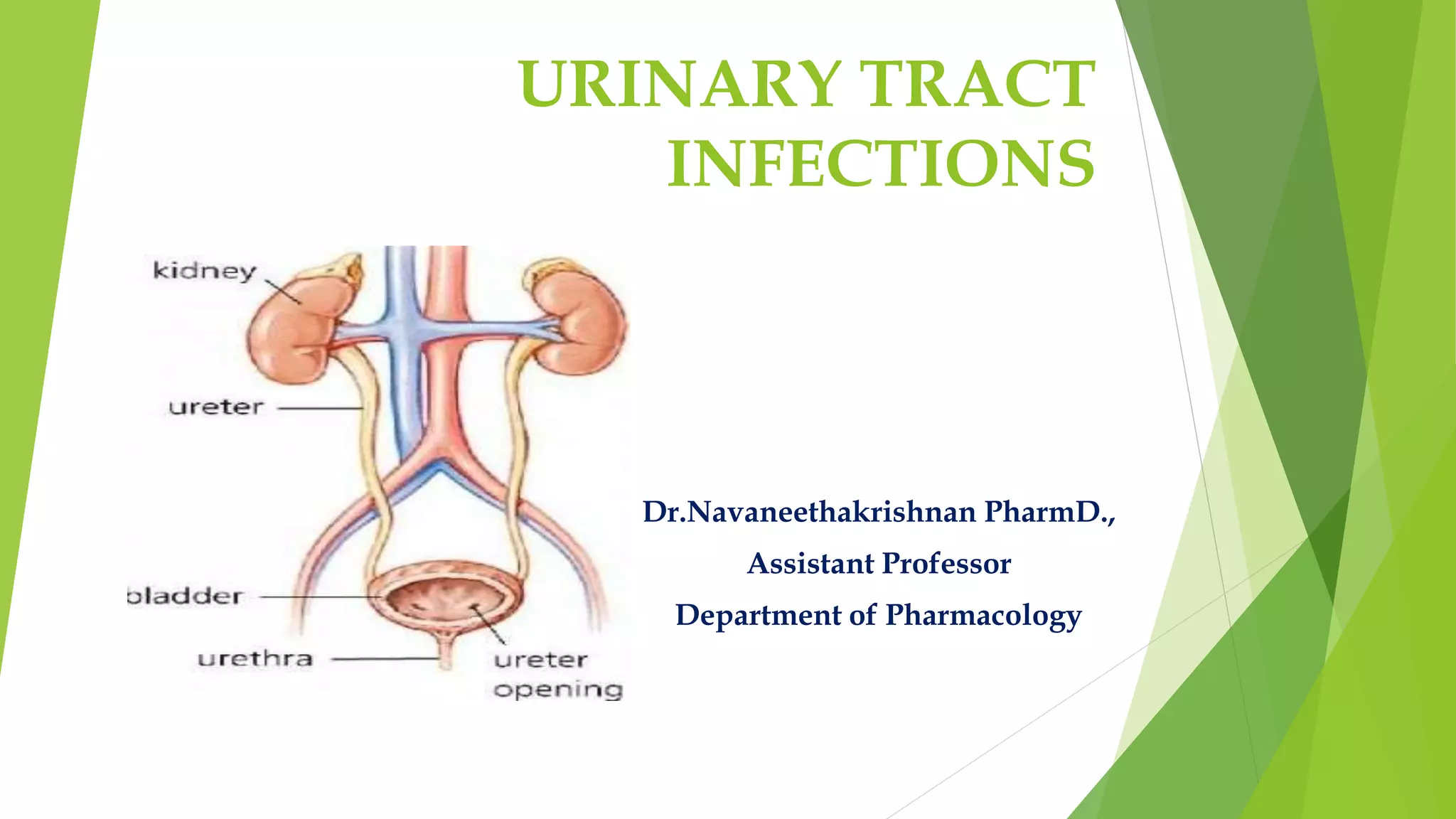
URINARY TRACT
INFECTIONS
Dr.Navaneethakrishnan PharmD.,
Assistant Professor
Department of Pharmacology
Introduction
 The urinary tract is normally sterile and so normal urine is sterile
Sterility is normally maintained by
 Free flow of urine
 The low pH (acidic)
 High osmotic pressure
 High NH3 content of urine
 Urethral length
 Ureterovesical and urethral sphincters
 Prostatic secretions (bacteriostatic) and the anti-bacterial
antibodies (by bladder mucus)
Infection occur mostly in lower UT rarely in upper UT / both
Mostly affects female (no prostate, pregnancy, short urethra)
 Urinary tract infection is defined as the presence of organisms
in the urinary tract along with the signs and symptoms of
inflammation.
 It is also defined as the presence of at least 1 lakh bacteria/ml
of urine not normal bacteria count is 1000/ml of urine.
 If the inflammatory conditions are confined to urethra and
bladder, then it is known as lower urinary tract infection and if
it involves the ureters and kidneys, then it is known as upper
urinary tract infection.
 Various urinary tract infection is include,
1. Ureteritis
2. Cystitis
3. Pyelitis
4. Pyelonephritis
1. Ureteritis
It is the inflammation of the ureters, mainly due to
descending infection.
2. Cystitis
It is the inflammation of the urinary bladder, which is
more common in females than in males. This is because, females
have shorter urethra and hence the microbes can easily enter into
the bladder.
3. Pyelitis
It is the inflammation of the renal pelvis and calyces,
Which occurs due to bacteria (Escherichia coli). It is more
common in women than in men.
4. Pyelonephritis
Inflammation of the kidneys which impairs their function.
1. Ureteritis
 Inflammation of urethra
 Classified into gonococcal and non gonococcal urethritis
 Urethritis often accompanied by cystitis in women and
prostatistis in men
Morphology
 Accumulation /aggregation of lymphocytes in the
subepithelial region – fine granular mucosal surface
(ureteritis follicularis)
 At other times mucosa become sprinkled with fine cysts
uretritis cystica.
2. Cystitis
 Cystitis is a term that refers to urinary bladder inflammation
Morphology - Cystitis
 Hyperemia of mucosa
 Ulcerative cystitis – ulceration of large areas of the mucosa
sometimes seen
 Persistence of the infection leads to chronic cystitis
Morphology – chronic cystitis
 There is more extreme heaping up of infection gives rise to fibrous
thickening and consequently inelasticity of the bladder wall
 Follicular cystitis - aggregation of lymphocytes into lymphoid
follicles
3. Pyelitis
It is the inflammation of the renal pelvis and calyces, Which
occurs due to bacteria (Escherichia coli) It is more common in
women than in men.
 Escherichia coli (E.Coli) – most common
Other organisms include
 Proteus
 Klebsiella
 Enterobacter
 Pseudomonas
 Staphylococci
4. Pyelonephritis
Pyelonephritis is a renal disorder affecting the tubules,
interstitium and renal pelvis
Acute Pyelonephritis is the commonest form of UTI which is
caused by bacterial infection
Occurs in two forms
Acute pyelonephritis
Chronic pyelonephritis
other factors (vesico-ureteral reflux, obstruction) are involved in
addition to bacterial infection.
Acute pyelonephritis:
Gross changes:
The kidneys are enlarged, swollen and the cut surface
shows yellow or white abscess with haemorrhagic lining.
Microscopic changes:
Patchy interstitial inflammation is seen with tubular
destruction due to accumulation of neutrophils
Chronic pyelonephritis:
It occurs due to repeated attacks of inflammation and
scarring Which leads to complete failure of the kidneys
chronic pyelonephritis is of two types.
Reflux nephropathy:
It occurs due to vesico-ureteral reflux.
Obstructive pyelonephritis:
Due to obstruction of urine outflow at different levels
Chronic pyelonephritis:
Gross changes:
Kidneys shrink and get constricted. weight of the kidneys also
decreases and they weigh less than 100 gram (normal weight is 135
to 150g). The surface of the kidney shows irregular scars.
Microscopic changes:
Inflammation is seen due to inflammatory infiltrate of
lymphocytes, plasma cells and macrophages. Kidney tubules, renal
pelvis and calyces Show dilatation and inflammatory reaction.
Aetiology
 Causative organisms of urinary tract infections (UTI) are
E.coli, Pseudomonas aeroginosa, Streptococcus faecalis,
Staphylococcus epidermis and Proteus mirabilis.
 Organisms which cause UTI in hospitals are E.coli,
Streptococci and Klebsiella.
 Sexual intercourse
 Sexually transmitted diseases like gonorrhoea causes
urethritis.
 Having bubble bath, wearing tight fitting clothes or holding
urine for long time can cause the microorganism to enter into
the bladder or kidneys and cause UTI.
 Risk factors for developing UTI include, pregnancy, diabetes,
presence of tumour, stones or any foreign bodies in the
urinary tract.
Types of UTIs
Acute Infection :
Acute infection involves infection of the urinary bladder
termed as cystitis and urethra known as urethritis. This
condition or infection is collectively termed as cysto-urethritis.
Symptoms:
 Frequent micturition
 Dysuria (painful micturition)
 Pain in the perineum (region between the anus and
urethral opening)
 Loin pain (Loin is the region between thorax and pelvis)
 Chills, Fever and leukocytosis are seen when kidneys are
also involved.
Symptoms:
 Pyuria (presence of pus cells in urine)
 Significant bacteriuria (presence of bacteria in urine)
 Septicaemia occurs in pregnant women
 In patients on immunosuppressants and those suffering
from lynphoproliferative disorders.
If acute infections are not treated properly, then they may lead to
recurrent and chronic infection (pyelonephritis)
Chronic Infection :
Chronic infection involves infection of kidneys. It includes
acute pyelonephritis and chronic pyelonephritis. Acute
pyelonephritis involves acute infection of one or both kidneys
along with lower urinary tract.
The cause of chronic pyelonephritis is unclear as it may be
due to an infection while in some cases it may occur due to other
reasons also.
Symptoms:
 Polyuria (production of large volumes of urine)
 Weight loss
 Anaemia and hypertension, Pyuria
 Fever, vomiting and vague abdominal pain are seen in
infants and children
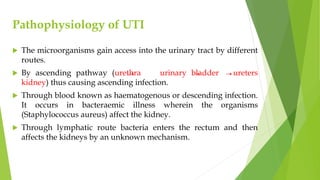
Pathophysiology of UTI
 The microorganisms gain access into the urinary tract by different
routes.
 By ascending pathway (urethra urinary bladder ureters
kidney) thus causing ascending infection.
 Through blood known as haematogenous or descending infection.
It occurs in bacteraemic illness wherein the organisms
(Staphylococcus aureus) affect the kidney.
 Through lymphatic route bacteria enters the rectum and then
affects the kidneys by an unknown mechanism.
Pathophysiology of Ascending
Infection
 It is common in females (due to short urethra and secretion of
menopause hormones), diabetic patients, pregnant women and
in persons suffering from obstruction in the urinary tract.
 It is also seen during instrumentation (catheterization).
Step 1: Colonization of Bacteria
The bacteria gains access into the urethra from the colon.
Colonization of bacteria occurs in the urethra. This is facilitated by
adhesion of bacteria (by pili) to the uroepithelial surface.
Pathophysiology of Ascending
Infection
Step 2: Transfer of Bacteria from urethra to urinary
bladder
The bacteria then enters the urinary bladder by moving against
the flow of urine. This occurs during,
 Instrumentation (catheterisation or cystoscopy)
 Sexual intercourse
 Obstruction of urine outflow (due to which incomplete
emptying of bladder occurs and the microorganisms multiply in
the retained urine).
Pathophysiology of Ascending
Infection
Step 3: Establishment of Bacteria in the bladder
From urinary bladder, the microorganisms enter the ureters. The
opening of the ureters into the bladder is closed due to the
contraction of bladder which occurs during micturition. This
opening is known as vesico-ureteral orifice.
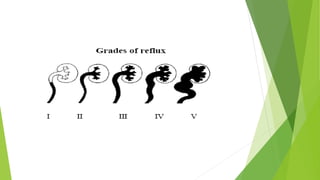
In some cases, vesico-ureteral orifice does not close completely
during micturition, so urine enters the ureters from urinary bladder
(urine flows in opposite direction) which is known as vesico-ureteral
reflux (VUR).
The microorganisms then enter the ureters and then kidneys.
This is called upper UTI. This results in pyelitis (inflammation of
renal pelvis) and pyelonephritis (inflammation of the kidney and
pelvis).
Thankyou..

Urinary Tract Infection.pptx

  • 1.
  • 2.
    Introduction  The urinarytract is normally sterile and so normal urine is sterile Sterility is normally maintained by  Free flow of urine  The low pH (acidic)  High osmotic pressure  High NH3 content of urine  Urethral length  Ureterovesical and urethral sphincters  Prostatic secretions (bacteriostatic) and the anti-bacterial antibodies (by bladder mucus) Infection occur mostly in lower UT rarely in upper UT / both Mostly affects female (no prostate, pregnancy, short urethra)
  • 3.
     Urinary tractinfection is defined as the presence of organisms in the urinary tract along with the signs and symptoms of inflammation.  It is also defined as the presence of at least 1 lakh bacteria/ml of urine not normal bacteria count is 1000/ml of urine.  If the inflammatory conditions are confined to urethra and bladder, then it is known as lower urinary tract infection and if it involves the ureters and kidneys, then it is known as upper urinary tract infection.  Various urinary tract infection is include, 1. Ureteritis 2. Cystitis 3. Pyelitis 4. Pyelonephritis
  • 4.
    1. Ureteritis It isthe inflammation of the ureters, mainly due to descending infection. 2. Cystitis It is the inflammation of the urinary bladder, which is more common in females than in males. This is because, females have shorter urethra and hence the microbes can easily enter into the bladder. 3. Pyelitis It is the inflammation of the renal pelvis and calyces, Which occurs due to bacteria (Escherichia coli). It is more common in women than in men. 4. Pyelonephritis Inflammation of the kidneys which impairs their function.
  • 5.
    1. Ureteritis  Inflammationof urethra  Classified into gonococcal and non gonococcal urethritis  Urethritis often accompanied by cystitis in women and prostatistis in men Morphology  Accumulation /aggregation of lymphocytes in the subepithelial region – fine granular mucosal surface (ureteritis follicularis)  At other times mucosa become sprinkled with fine cysts uretritis cystica.
  • 6.
    2. Cystitis  Cystitisis a term that refers to urinary bladder inflammation Morphology - Cystitis  Hyperemia of mucosa  Ulcerative cystitis – ulceration of large areas of the mucosa sometimes seen  Persistence of the infection leads to chronic cystitis Morphology – chronic cystitis  There is more extreme heaping up of infection gives rise to fibrous thickening and consequently inelasticity of the bladder wall  Follicular cystitis - aggregation of lymphocytes into lymphoid follicles
  • 7.
    3. Pyelitis It isthe inflammation of the renal pelvis and calyces, Which occurs due to bacteria (Escherichia coli) It is more common in women than in men.  Escherichia coli (E.Coli) – most common Other organisms include  Proteus  Klebsiella  Enterobacter  Pseudomonas  Staphylococci
  • 8.
    4. Pyelonephritis Pyelonephritis isa renal disorder affecting the tubules, interstitium and renal pelvis Acute Pyelonephritis is the commonest form of UTI which is caused by bacterial infection Occurs in two forms Acute pyelonephritis Chronic pyelonephritis other factors (vesico-ureteral reflux, obstruction) are involved in addition to bacterial infection.
  • 9.
    Acute pyelonephritis: Gross changes: Thekidneys are enlarged, swollen and the cut surface shows yellow or white abscess with haemorrhagic lining. Microscopic changes: Patchy interstitial inflammation is seen with tubular destruction due to accumulation of neutrophils
  • 10.
    Chronic pyelonephritis: It occursdue to repeated attacks of inflammation and scarring Which leads to complete failure of the kidneys chronic pyelonephritis is of two types. Reflux nephropathy: It occurs due to vesico-ureteral reflux. Obstructive pyelonephritis: Due to obstruction of urine outflow at different levels
  • 11.
    Chronic pyelonephritis: Gross changes: Kidneysshrink and get constricted. weight of the kidneys also decreases and they weigh less than 100 gram (normal weight is 135 to 150g). The surface of the kidney shows irregular scars. Microscopic changes: Inflammation is seen due to inflammatory infiltrate of lymphocytes, plasma cells and macrophages. Kidney tubules, renal pelvis and calyces Show dilatation and inflammatory reaction.
  • 12.
    Aetiology  Causative organismsof urinary tract infections (UTI) are E.coli, Pseudomonas aeroginosa, Streptococcus faecalis, Staphylococcus epidermis and Proteus mirabilis.  Organisms which cause UTI in hospitals are E.coli, Streptococci and Klebsiella.  Sexual intercourse  Sexually transmitted diseases like gonorrhoea causes urethritis.  Having bubble bath, wearing tight fitting clothes or holding urine for long time can cause the microorganism to enter into the bladder or kidneys and cause UTI.  Risk factors for developing UTI include, pregnancy, diabetes, presence of tumour, stones or any foreign bodies in the urinary tract.
  • 13.
    Types of UTIs AcuteInfection : Acute infection involves infection of the urinary bladder termed as cystitis and urethra known as urethritis. This condition or infection is collectively termed as cysto-urethritis. Symptoms:  Frequent micturition  Dysuria (painful micturition)  Pain in the perineum (region between the anus and urethral opening)  Loin pain (Loin is the region between thorax and pelvis)  Chills, Fever and leukocytosis are seen when kidneys are also involved.
  • 14.
    Symptoms:  Pyuria (presenceof pus cells in urine)  Significant bacteriuria (presence of bacteria in urine)  Septicaemia occurs in pregnant women  In patients on immunosuppressants and those suffering from lynphoproliferative disorders. If acute infections are not treated properly, then they may lead to recurrent and chronic infection (pyelonephritis)
  • 15.
    Chronic Infection : Chronicinfection involves infection of kidneys. It includes acute pyelonephritis and chronic pyelonephritis. Acute pyelonephritis involves acute infection of one or both kidneys along with lower urinary tract. The cause of chronic pyelonephritis is unclear as it may be due to an infection while in some cases it may occur due to other reasons also. Symptoms:  Polyuria (production of large volumes of urine)  Weight loss  Anaemia and hypertension, Pyuria  Fever, vomiting and vague abdominal pain are seen in infants and children
  • 16.
    Pathophysiology of UTI The microorganisms gain access into the urinary tract by different routes.  By ascending pathway (urethra urinary bladder ureters kidney) thus causing ascending infection.  Through blood known as haematogenous or descending infection. It occurs in bacteraemic illness wherein the organisms (Staphylococcus aureus) affect the kidney.  Through lymphatic route bacteria enters the rectum and then affects the kidneys by an unknown mechanism.
  • 17.
    Pathophysiology of Ascending Infection It is common in females (due to short urethra and secretion of menopause hormones), diabetic patients, pregnant women and in persons suffering from obstruction in the urinary tract.  It is also seen during instrumentation (catheterization). Step 1: Colonization of Bacteria The bacteria gains access into the urethra from the colon. Colonization of bacteria occurs in the urethra. This is facilitated by adhesion of bacteria (by pili) to the uroepithelial surface.
  • 18.
    Pathophysiology of Ascending Infection Step2: Transfer of Bacteria from urethra to urinary bladder The bacteria then enters the urinary bladder by moving against the flow of urine. This occurs during,  Instrumentation (catheterisation or cystoscopy)  Sexual intercourse  Obstruction of urine outflow (due to which incomplete emptying of bladder occurs and the microorganisms multiply in the retained urine).
  • 19.
    Pathophysiology of Ascending Infection Step3: Establishment of Bacteria in the bladder From urinary bladder, the microorganisms enter the ureters. The opening of the ureters into the bladder is closed due to the contraction of bladder which occurs during micturition. This opening is known as vesico-ureteral orifice. In some cases, vesico-ureteral orifice does not close completely during micturition, so urine enters the ureters from urinary bladder (urine flows in opposite direction) which is known as vesico-ureteral reflux (VUR). The microorganisms then enter the ureters and then kidneys. This is called upper UTI. This results in pyelitis (inflammation of renal pelvis) and pyelonephritis (inflammation of the kidney and pelvis).
  • 21.