NECESSITY FOR
DRYERS
Gauravsinh Parmar
(170410117023)
AAdarsh Patel
(170410117025)
DRYERS
• dryers are used to efficiently process large quantities of bulk materials
that need reduced moisture levels.
• Depending on the amount and the makeup of material needing to be
dried, industrial dryers come in many different models constructed
specifically for the type and quantity of material to be processed
Drying
• Drying is commonly the last stage in a manufacture process.
• Drying is the final removal of water from material (usually by heat)
Non –thermal drying
• 1-Adsorption by desiccant (desiccation)
Purposes of drying
In pharmaceutical technology, drying is carried out for one or more of the
following reasons:
1-To avoid or eliminate moisture which may lead to corrosion and decrease the product or
drug stability.
2-To improve or keep the good properties of a material, e.g. flowability, compressibility.
3-To reduce the cost of transportation of large volume materials ( liquids)
4-To make the material easy or more suitable for handling.
5- Preservative.
6-The final step in: Evaporation- Filtration- Crystallization.
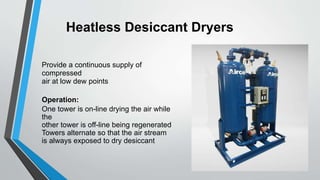
Heatless Desiccant Dryers
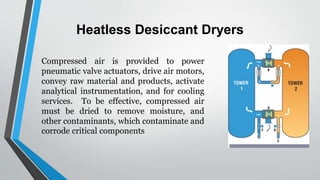
Compressed air is provided to power
pneumatic valve actuators, drive air motors,
convey raw material and products, activate
analytical instrumentation, and for cooling
services. To be effective, compressed air
must be dried to remove moisture, and
other contaminants, which contaminate and
corrode critical components
Heatless Desiccant Dryers
Provide a continuous supply of
compressed
air at low dew points
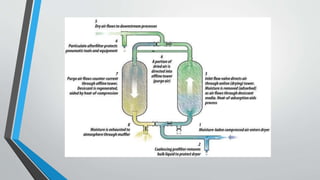
Operation:
One tower is on-line drying the air while
the
other tower is off-line being regenerated
Towers alternate so that the air stream
is always exposed to dry desiccant
REFRIGERANT DRYER
• A refrigerant dryer uses a refrigerant circuit and heat exchanger(s) to pre-cool
air, refrigerate it to condense out moisture vapor, and then re-heat the air to
prevent pipe sweating downstream. Refrigerant dryers can lead to a pressure
dewpoint (PDP) as low as +3°C/+37.4°F for many applications where there is a
need for dry air. They can be used at different pressures and consume no
processed compressed air.
REFRIGERANT DRYER
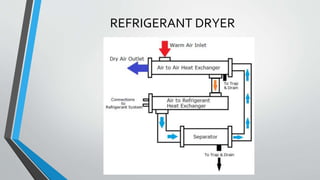
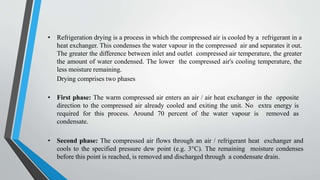
• Refrigeration drying is a process in which the compressed air is cooled by a refrigerant in a
heat exchanger. This condenses the water vapour in the compressed air and separates it out.
The greater the difference between inlet and outlet compressed air temperature, the greater
the amount of water condensed. The lower the compressed air's cooling temperature, the
less moisture remaining.
Drying comprises two phases
• First phase: The warm compressed air enters an air / air heat exchanger in the opposite
direction to the compressed air already cooled and exiting the unit. No extra energy is
required for this process. Around 70 percent of the water vapour is removed as
condensate.
• Second phase: The compressed air flows through an air / refrigerant heat exchanger and
cools to the specified pressure dew point (e.g. 3°C). The remaining moisture condenses
before this point is reached, is removed and discharged through a condensate drain.
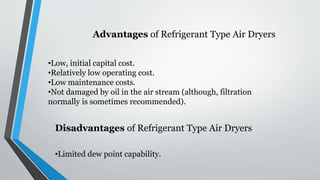
Advantages of Refrigerant Type Air Dryers
•Low, initial capital cost.
•Relatively low operating cost.
•Low maintenance costs.
•Not damaged by oil in the air stream (although, filtration
normally is sometimes recommended).
•Limited dew point capability.
Disadvantages of Refrigerant Type Air Dryers
Air Dryer Selection Factors
• Flow Capacity
• Drying Capacity
• Air Compressor Duty Cycle
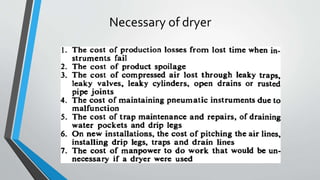
Necessary of dryer
Criteria for Dryer
• Distribution System
• Header and branch sizing
• Material
• Take off and valving
• Control room air supply
• Purging
Necessity for dryers

Necessity for dryers

  • 1.
  • 2.
    DRYERS • dryers areused to efficiently process large quantities of bulk materials that need reduced moisture levels. • Depending on the amount and the makeup of material needing to be dried, industrial dryers come in many different models constructed specifically for the type and quantity of material to be processed
  • 3.
    Drying • Drying iscommonly the last stage in a manufacture process. • Drying is the final removal of water from material (usually by heat) Non –thermal drying • 1-Adsorption by desiccant (desiccation)
  • 4.
    Purposes of drying Inpharmaceutical technology, drying is carried out for one or more of the following reasons: 1-To avoid or eliminate moisture which may lead to corrosion and decrease the product or drug stability. 2-To improve or keep the good properties of a material, e.g. flowability, compressibility. 3-To reduce the cost of transportation of large volume materials ( liquids) 4-To make the material easy or more suitable for handling. 5- Preservative. 6-The final step in: Evaporation- Filtration- Crystallization.
  • 5.
    Heatless Desiccant Dryers Compressedair is provided to power pneumatic valve actuators, drive air motors, convey raw material and products, activate analytical instrumentation, and for cooling services. To be effective, compressed air must be dried to remove moisture, and other contaminants, which contaminate and corrode critical components
  • 6.
    Heatless Desiccant Dryers Providea continuous supply of compressed air at low dew points Operation: One tower is on-line drying the air while the other tower is off-line being regenerated Towers alternate so that the air stream is always exposed to dry desiccant
  • 7.
    REFRIGERANT DRYER • Arefrigerant dryer uses a refrigerant circuit and heat exchanger(s) to pre-cool air, refrigerate it to condense out moisture vapor, and then re-heat the air to prevent pipe sweating downstream. Refrigerant dryers can lead to a pressure dewpoint (PDP) as low as +3°C/+37.4°F for many applications where there is a need for dry air. They can be used at different pressures and consume no processed compressed air.
  • 9.
  • 10.
    • Refrigeration dryingis a process in which the compressed air is cooled by a refrigerant in a heat exchanger. This condenses the water vapour in the compressed air and separates it out. The greater the difference between inlet and outlet compressed air temperature, the greater the amount of water condensed. The lower the compressed air's cooling temperature, the less moisture remaining. Drying comprises two phases • First phase: The warm compressed air enters an air / air heat exchanger in the opposite direction to the compressed air already cooled and exiting the unit. No extra energy is required for this process. Around 70 percent of the water vapour is removed as condensate. • Second phase: The compressed air flows through an air / refrigerant heat exchanger and cools to the specified pressure dew point (e.g. 3°C). The remaining moisture condenses before this point is reached, is removed and discharged through a condensate drain.
  • 11.
    Advantages of RefrigerantType Air Dryers •Low, initial capital cost. •Relatively low operating cost. •Low maintenance costs. •Not damaged by oil in the air stream (although, filtration normally is sometimes recommended). •Limited dew point capability. Disadvantages of Refrigerant Type Air Dryers
  • 12.
    Air Dryer SelectionFactors • Flow Capacity • Drying Capacity • Air Compressor Duty Cycle
  • 13.
  • 14.
    Criteria for Dryer •Distribution System • Header and branch sizing • Material • Take off and valving • Control room air supply • Purging