Vacuum Oven
(Vacuum Tray dryer)
Content
• Introduction
• Vacuum oven construction
• Mechanism of action
• Standard Operating Procedure
• Equation represents drying
• Factors affects vacuum oven
• Advantages
• Disadvantages
• Pharmaceutical uses
• Photo of the equipment
• References
Introduction
• Definition: It is a reduction in moisture content from an
initial amount to an acceptable form (EMC equilibrium
moisture content).
• Drying is an essential unit operation in a variety of chemical
process industries (CPI) sectors.
• Food, pharmaceuticals, chemicals, plastics, timber, paper and
other industries use drying equipment to eliminate moisture
during product processing.
• Most dryers are classified as direct dryers, where hot air is
used to supply the heat to evaporate water. Another
important dryer category, vacuum dryers, involves the use of
a reduced-pressure atmosphere to surround the product.
Introduction Cont.
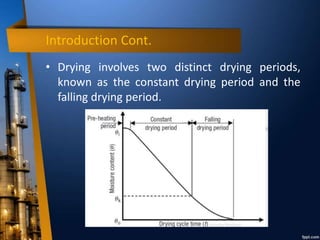
• Drying involves two distinct drying periods,
known as the constant drying period and the
falling drying period.
Vacuum oven construction
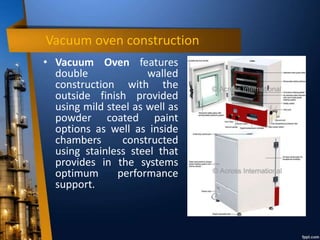
• Vacuum Oven features
double walled
construction with the
outside finish provided
using mild steel as well as
powder coated paint
options as well as inside
chambers constructed
using stainless steel that
provides in the systems
optimum performance
support.
Mechanism of action
Heat is usually supplied by passing steam or hot water
through hollow shelves.
The shelves are heated inside the vacuum chamber. This technique can apply
heat indirectly to the product by forcing physical contact with the shelf. Hot
medium flows through the shelves, thus enabling it to conduct heat to the
tray, which is positioned on the shelves.
The trays are enclosed in a large cabinet, which is
evacuated.
The water vapor produced is generally condensed, so
that the vacuum pumps have only to deal with non-
condensable gases.
Tray dryers are reliable and have no moving parts, but
operation and cleaning are labor-intensive.
Mechanism of action Cont.
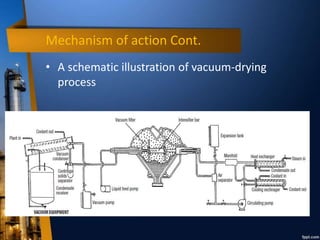
• A schematic illustration of vacuum-drying
process
Standard Operating Procedure
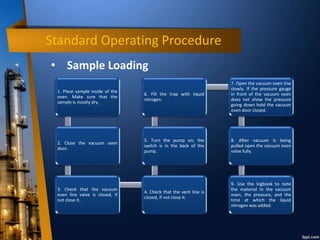
1. Place sample inside of the
oven. Make sure that the
sample is mostly dry.
2. Close the vacuum oven
door.
3. Check that the vacuum
oven line valve is closed, if
not close it.
4. Check that the vent line is
closed, if not close it.
5. Turn the pump on; the
switch is in the back of the
pump.
6. Fill the trap with liquid
nitrogen.
7. Open the vacuum oven line
slowly. If the pressure gauge
in front of the vacuum oven
does not show the pressure
going down hold the vacuum
oven door closed.
8. After vacuum is being
pulled open the vacuum oven
valve fully.
9. Use the logbook to note
the material in the vacuum
oven, the pressure, and the
time at which the liquid
nitrogen was added.
• Sample Loading
Equation represents drying
 To understand how vacuum operation can aid drying,
consider the following equation, which represents a
simplified drying theory:
Q = U A ΔT
• Q is the total heat.
• U is the overall heat-transfer coefficient.
• A is the effective heat transfer surface area.
• ΔT is the temperature difference between the liquid’s
boiling point (that is, its vaporization temperature) and
the heating media’s temperature (in °F).
Factors affecting vacuum oven
 According to the previous equation:
• The material’s properties and the dryer type
effectively establish the U and A values for the
process.
• The process-efficiency objective should be to
maximize the ΔT value, in order to increase the Q
value.
• By controlling atmospheric pressure, the vacuum
dryer increases the effective ΔT for a given process.
Advantages
Energy conservation — less energy is
needed for drying, cutting down on the
economic and environmental costs
associated with drying a product for
storage, sale or other purposes.
Vacuum drying tends to retain the
integrity of the original item without
damaging it with heat.
Using vacuum-drying equipment also
reduces risks to workers. With other
types of drying equipment, there are
vented fumes and particles that can
make people sick
It is also possible to recover the
precipitated moisture collected during
the drying for further use.
Advantages
Disadvantages
• High labor cost(Batch; Loading & unloading).
• Used for thermostable materials only.
• Soluble materials may migrate to surface layers.
• Requires large floor space.
• A vacuum dryer’s upper temperature limit
(typically about 600°F) is lower than that of a
direct-heat dryer.
• Solvents cannot be recovered from the dry air.
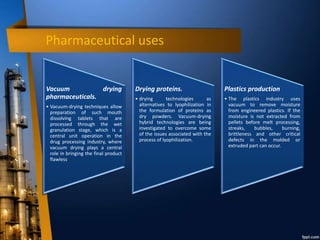
Pharmaceutical uses
Vacuum drying
pharmaceuticals.
• Vacuum-drying techniques allow
preparation of such mouth
dissolving tablets that are
processed through the wet
granulation stage, which is a
central unit operation in the
drug processing industry, where
vacuum drying plays a central
role in bringing the final product
flawless
Drying proteins.
• drying technologies as
alternatives to lyophilization in
the formulation of proteins as
dry powders. Vacuum-drying
hybrid technologies are being
investigated to overcome some
of the issues associated with the
process of lyophilization.
Plastics production
• The plastics industry uses
vacuum to remove moisture
from engineered plastics. If the
moisture is not extracted from
pellets before melt processing,
streaks, bubbles, burning,
brittleness and other critical
defects in the molded or
extruded part can occur.
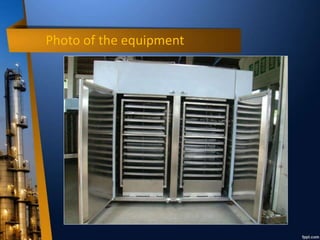
Photo of the equipment
Reference
• Parikh, D. M., 2015. Vacuum Drying: Basics and
Application. Chemical Engineering, 3(2), pp. 48-54.
• Agrawal, Megha & Biswas, Shyamasri & Vliet, Kim.
(2015). Application of Vacuum Drying in the Drug
Processing and Drug Delivery Systems. Vacuum
Technology & coating. 16. 31-33.
Vacuum Oven (Vacuum Tray Dryer)

Vacuum Oven (Vacuum Tray Dryer)

  • 1.
  • 2.
    Content • Introduction • Vacuumoven construction • Mechanism of action • Standard Operating Procedure • Equation represents drying • Factors affects vacuum oven • Advantages • Disadvantages • Pharmaceutical uses • Photo of the equipment • References
  • 3.
    Introduction • Definition: Itis a reduction in moisture content from an initial amount to an acceptable form (EMC equilibrium moisture content). • Drying is an essential unit operation in a variety of chemical process industries (CPI) sectors. • Food, pharmaceuticals, chemicals, plastics, timber, paper and other industries use drying equipment to eliminate moisture during product processing. • Most dryers are classified as direct dryers, where hot air is used to supply the heat to evaporate water. Another important dryer category, vacuum dryers, involves the use of a reduced-pressure atmosphere to surround the product.
  • 4.
    Introduction Cont. • Dryinginvolves two distinct drying periods, known as the constant drying period and the falling drying period.
  • 5.
    Vacuum oven construction •Vacuum Oven features double walled construction with the outside finish provided using mild steel as well as powder coated paint options as well as inside chambers constructed using stainless steel that provides in the systems optimum performance support.
  • 6.
    Mechanism of action Heatis usually supplied by passing steam or hot water through hollow shelves. The shelves are heated inside the vacuum chamber. This technique can apply heat indirectly to the product by forcing physical contact with the shelf. Hot medium flows through the shelves, thus enabling it to conduct heat to the tray, which is positioned on the shelves. The trays are enclosed in a large cabinet, which is evacuated. The water vapor produced is generally condensed, so that the vacuum pumps have only to deal with non- condensable gases. Tray dryers are reliable and have no moving parts, but operation and cleaning are labor-intensive.
  • 7.
    Mechanism of actionCont. • A schematic illustration of vacuum-drying process
  • 8.
    Standard Operating Procedure 1.Place sample inside of the oven. Make sure that the sample is mostly dry. 2. Close the vacuum oven door. 3. Check that the vacuum oven line valve is closed, if not close it. 4. Check that the vent line is closed, if not close it. 5. Turn the pump on; the switch is in the back of the pump. 6. Fill the trap with liquid nitrogen. 7. Open the vacuum oven line slowly. If the pressure gauge in front of the vacuum oven does not show the pressure going down hold the vacuum oven door closed. 8. After vacuum is being pulled open the vacuum oven valve fully. 9. Use the logbook to note the material in the vacuum oven, the pressure, and the time at which the liquid nitrogen was added. • Sample Loading
  • 9.
    Equation represents drying To understand how vacuum operation can aid drying, consider the following equation, which represents a simplified drying theory: Q = U A ΔT • Q is the total heat. • U is the overall heat-transfer coefficient. • A is the effective heat transfer surface area. • ΔT is the temperature difference between the liquid’s boiling point (that is, its vaporization temperature) and the heating media’s temperature (in °F).
  • 10.
    Factors affecting vacuumoven  According to the previous equation: • The material’s properties and the dryer type effectively establish the U and A values for the process. • The process-efficiency objective should be to maximize the ΔT value, in order to increase the Q value. • By controlling atmospheric pressure, the vacuum dryer increases the effective ΔT for a given process.
  • 11.
    Advantages Energy conservation —less energy is needed for drying, cutting down on the economic and environmental costs associated with drying a product for storage, sale or other purposes. Vacuum drying tends to retain the integrity of the original item without damaging it with heat. Using vacuum-drying equipment also reduces risks to workers. With other types of drying equipment, there are vented fumes and particles that can make people sick It is also possible to recover the precipitated moisture collected during the drying for further use. Advantages
  • 12.
    Disadvantages • High laborcost(Batch; Loading & unloading). • Used for thermostable materials only. • Soluble materials may migrate to surface layers. • Requires large floor space. • A vacuum dryer’s upper temperature limit (typically about 600°F) is lower than that of a direct-heat dryer. • Solvents cannot be recovered from the dry air.
  • 13.
    Pharmaceutical uses Vacuum drying pharmaceuticals. •Vacuum-drying techniques allow preparation of such mouth dissolving tablets that are processed through the wet granulation stage, which is a central unit operation in the drug processing industry, where vacuum drying plays a central role in bringing the final product flawless Drying proteins. • drying technologies as alternatives to lyophilization in the formulation of proteins as dry powders. Vacuum-drying hybrid technologies are being investigated to overcome some of the issues associated with the process of lyophilization. Plastics production • The plastics industry uses vacuum to remove moisture from engineered plastics. If the moisture is not extracted from pellets before melt processing, streaks, bubbles, burning, brittleness and other critical defects in the molded or extruded part can occur.
  • 14.
    Photo of theequipment
  • 15.
    Reference • Parikh, D.M., 2015. Vacuum Drying: Basics and Application. Chemical Engineering, 3(2), pp. 48-54. • Agrawal, Megha & Biswas, Shyamasri & Vliet, Kim. (2015). Application of Vacuum Drying in the Drug Processing and Drug Delivery Systems. Vacuum Technology & coating. 16. 31-33.