Types of Winding in
3-Phase transformer
Gauravsinh Parmar
(170410117023)
INTRODUCTION
A three-phase transformer can be obtained in two different ways
 Three numbers of identical single-phase transformers can be
suitably connected to make a three-phase transformer. Such
three-phase transformers are called a bank of three-phase
transformer.
 Alternatively, a three-phase transformer can be constructed as
a single unit.
ADVANTAGES OF SINGLE UNIT 3-PHASE
TRANSFORMER
1. It occupies less space
2. Its weight is less
3. Its cost is comparatively less
4. It is much easier to transport
5. It is more efficient
6. Core size is comparatively small.
DISADVANTAGES OF SINGLE UNIT 3-
PHASE TRANSFORMER
 When one of the phases of a single-unit three-phase
transformer becomes faulty, the entire unit of three-phase
transformer needs to be removed from the supply for repair.
 But in the case of a bank of three-phase transformer, only the
faulty transformer is removed from the supply for repair while
the other two transformers remain connected in the system
without interrupting the supply completely.
3 phase Transformer connections
 By connecting three single phase transformers
1. Star- Star connection
2. Delta- Delta connection
3. Star – Delta connection
4. Delta – Star connection
5. Scott (T–T) Connection
6. Open Delta (V–V) Connection
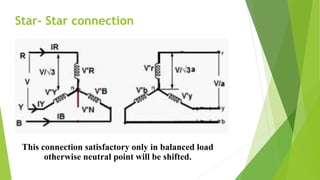
Star- Star connection
This connection satisfactory only in balanced load
otherwise neutral point will be shifted.
Star- Star connection
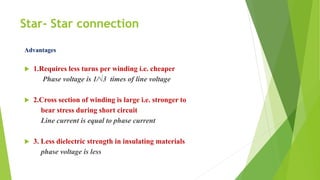
Advantages
 1.Requires less turns per winding i.e. cheaper
Phase voltage is 1/√3 times of line voltage
 2.Cross section of winding is large i.e. stronger to
bear stress during short circuit
Line current is equal to phase current
 3. Less dielectric strength in insulating materials
phase voltage is less
Star- Star connection
Disadvantages
1. If the load on the secondary side unbalanced
then the shifting of neutral point is possible
2. The third harmonic present in the alternator
voltage may appear on the secondary side. This
causes distortion in the secondary phase
voltages
3. Magnetizing current of transformer has 3rd
harmonic component
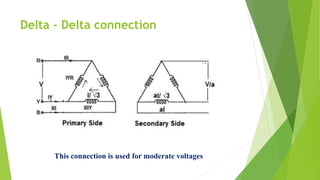
Delta - Delta connection
This connection is used for moderate voltages
Delta - Delta connection
Advantages
1. System voltages are more stable in relation to
unbalanced load
2. If one t/f is failed it may be used for low power
level i.e. V-V connection
3. No distortion of flux i.e. 3rd harmonic current not
flowing to the line wire
Delta - Delta connection
Disadvantages
1.Compare to Y-Y require more insulation.
2. Absence of star point i.e. fault may severe.
Delta - Star connection
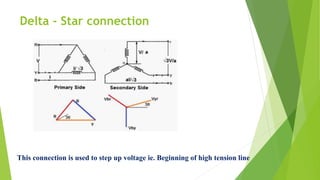
This connection is used to step up voltage ie. Beginning of high tension line
Delta - Star connection
Features
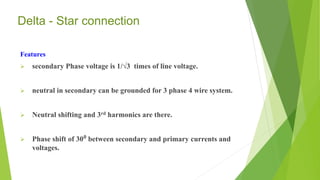
 secondary Phase voltage is 1/√3 times of line voltage.
 neutral in secondary can be grounded for 3 phase 4 wire system.
 Neutral shifting and 3rd harmonics are there.
 Phase shift of 30⁰ between secondary and primary currents and
voltages.
Star- Delta connection
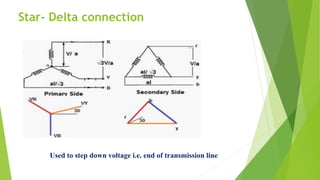
Used to step down voltage i.e. end of transmission line
Star- Delta connection
Advantages
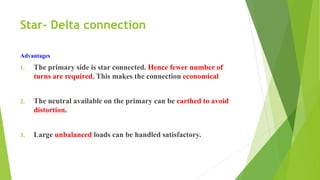
1. The primary side is star connected. Hence fewer number of
turns are required. This makes the connection economical
2. The neutral available on the primary can be earthed to avoid
distortion.
3. Large unbalanced loads can be handled satisfactory.
Star- Delta connection
Disadvantages
 The secondary voltage is not in phase with the primary. (30 ⁰
phase difference )
 Hence it is not possible to operate this connection in parallel with
star-star or delta-delta connected transformer.
Open Delta (V–V) Connection
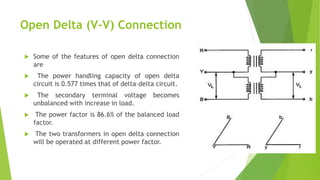
 Some of the features of open delta connection
are
 The power handling capacity of open delta
circuit is 0.577 times that of delta–delta circuit.
 The secondary terminal voltage becomes
unbalanced with increase in load.
 The power factor is 86.6% of the balanced load
factor.
 The two transformers in open delta connection
will be operated at different power factor.
Scott (T–T) Connection
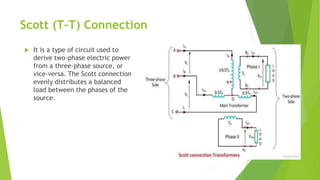
 It is a type of circuit used to
derive two-phase electric power
from a three-phase source, or
vice-versa. The Scott connection
evenly distributes a balanced
load between the phases of the
source.
3 phase x'mer windings

3 phase x'mer windings

  • 1.
    Types of Windingin 3-Phase transformer Gauravsinh Parmar (170410117023)
  • 2.
    INTRODUCTION A three-phase transformercan be obtained in two different ways  Three numbers of identical single-phase transformers can be suitably connected to make a three-phase transformer. Such three-phase transformers are called a bank of three-phase transformer.  Alternatively, a three-phase transformer can be constructed as a single unit.
  • 3.
    ADVANTAGES OF SINGLEUNIT 3-PHASE TRANSFORMER 1. It occupies less space 2. Its weight is less 3. Its cost is comparatively less 4. It is much easier to transport 5. It is more efficient 6. Core size is comparatively small.
  • 4.
    DISADVANTAGES OF SINGLEUNIT 3- PHASE TRANSFORMER  When one of the phases of a single-unit three-phase transformer becomes faulty, the entire unit of three-phase transformer needs to be removed from the supply for repair.  But in the case of a bank of three-phase transformer, only the faulty transformer is removed from the supply for repair while the other two transformers remain connected in the system without interrupting the supply completely.
  • 5.
    3 phase Transformerconnections  By connecting three single phase transformers 1. Star- Star connection 2. Delta- Delta connection 3. Star – Delta connection 4. Delta – Star connection 5. Scott (T–T) Connection 6. Open Delta (V–V) Connection
  • 6.
    Star- Star connection Thisconnection satisfactory only in balanced load otherwise neutral point will be shifted.
  • 7.
    Star- Star connection Advantages 1.Requires less turns per winding i.e. cheaper Phase voltage is 1/√3 times of line voltage  2.Cross section of winding is large i.e. stronger to bear stress during short circuit Line current is equal to phase current  3. Less dielectric strength in insulating materials phase voltage is less
  • 8.
    Star- Star connection Disadvantages 1.If the load on the secondary side unbalanced then the shifting of neutral point is possible 2. The third harmonic present in the alternator voltage may appear on the secondary side. This causes distortion in the secondary phase voltages 3. Magnetizing current of transformer has 3rd harmonic component
  • 9.
    Delta - Deltaconnection This connection is used for moderate voltages
  • 10.
    Delta - Deltaconnection Advantages 1. System voltages are more stable in relation to unbalanced load 2. If one t/f is failed it may be used for low power level i.e. V-V connection 3. No distortion of flux i.e. 3rd harmonic current not flowing to the line wire
  • 11.
    Delta - Deltaconnection Disadvantages 1.Compare to Y-Y require more insulation. 2. Absence of star point i.e. fault may severe.
  • 12.
    Delta - Starconnection This connection is used to step up voltage ie. Beginning of high tension line
  • 13.
    Delta - Starconnection Features  secondary Phase voltage is 1/√3 times of line voltage.  neutral in secondary can be grounded for 3 phase 4 wire system.  Neutral shifting and 3rd harmonics are there.  Phase shift of 30⁰ between secondary and primary currents and voltages.
  • 14.
    Star- Delta connection Usedto step down voltage i.e. end of transmission line
  • 15.
    Star- Delta connection Advantages 1.The primary side is star connected. Hence fewer number of turns are required. This makes the connection economical 2. The neutral available on the primary can be earthed to avoid distortion. 3. Large unbalanced loads can be handled satisfactory.
  • 16.
    Star- Delta connection Disadvantages The secondary voltage is not in phase with the primary. (30 ⁰ phase difference )  Hence it is not possible to operate this connection in parallel with star-star or delta-delta connected transformer.
  • 17.
    Open Delta (V–V)Connection  Some of the features of open delta connection are  The power handling capacity of open delta circuit is 0.577 times that of delta–delta circuit.  The secondary terminal voltage becomes unbalanced with increase in load.  The power factor is 86.6% of the balanced load factor.  The two transformers in open delta connection will be operated at different power factor.
  • 18.
    Scott (T–T) Connection It is a type of circuit used to derive two-phase electric power from a three-phase source, or vice-versa. The Scott connection evenly distributes a balanced load between the phases of the source.