Near-Field
Communication
SANU G VARGHESE
S7 D 50
Outline
• Introduction to Near Field Communication (NFC)
• NFC Applications
• NFC working & operating Modes
• Conclusion
IMAGINE…...
Outline
•
•
•
•
Introduction to Near Field Communication (NFC)
NFC Applications
NFC Working & Operating Modes
Conclusion
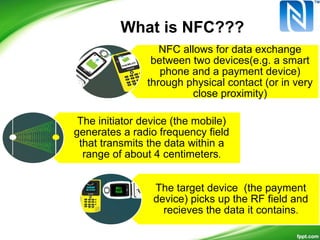
NFC allows for data exchange
between two devices(e.g. a smart
phone and a payment device)
through physical contact (or in very
close proximity)
The initiator device (the mobile)
generates a radio frequency field
that transmits the data within a
range of about 4 centimeters.
The target device (the payment
device) picks up the RF field and
recieves the data it contains.
What is NFC???
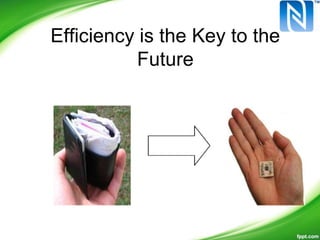
Efficiency is the Key to the
Future
Near Field Communication
•
•
•
•
•
•
Developed by Sony and Philips in late 2002
Evolved from Radio Frequency Identification(RFID)
Short Range Radio Communication Technology
Frequency: 13.56 MHz.
Max. Bandwidth: 424Kbits/sec
technology
Communication starts when two NFC-compatible devices
brought together less than four centimeters
NFC Forum is the leading organization that organizes the
efforts
•
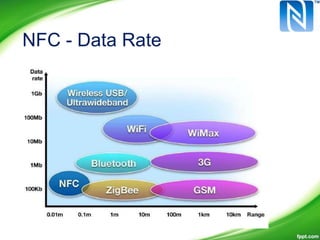
NFC - Data Rate
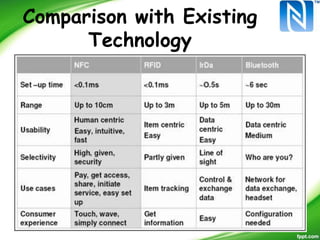
Comparison with Existing
Technology
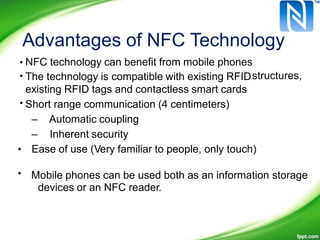
Advantages of NFC Technology
•
•
NFC technology can benefit from mobile phones
The technology is compatible with existing RFID
existing RFID tags and contactless smart cards
Short range communication (4 centimeters)
– Automatic coupling
– Inherent security
Ease of use (Very familiar to people, only touch)
Mobile phones can be used both as an information storage
devices or an NFC reader.
structures,
•
•
•
Outline
•
•
•
•
Introduction to Near Field Communication (NFC)
NFC Applications
NFC Working & Operating Modes
Conclusion
Applications of NFC
• NFC applications can be split into the
following three basic categories:
Touch and Go
Touch and Confirm
Touch and Connect
Applications Of NFC
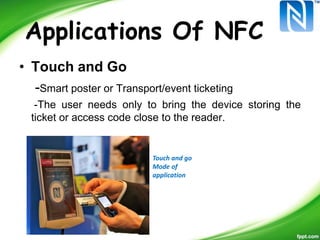
• Touch and Go
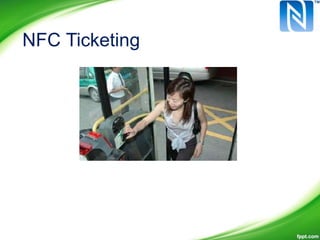
-Smart poster or Transport/event ticketing
-The user needs only to bring the device storing the
ticket or access code close to the reader.
Touch and go
Mode of
application
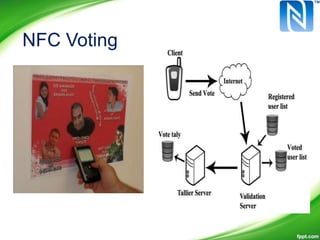
Information Gathering
NFC Voting
Applications Of NFC
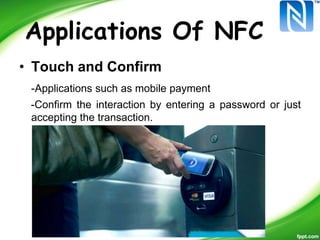
• Touch and Confirm
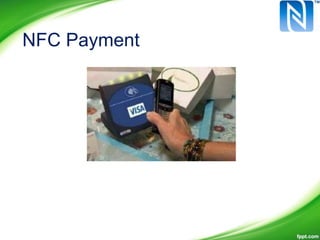
-Applications such as mobile payment
-Confirm the interaction by entering a password or just
accepting the transaction.
NFC Ticketing
NFC Payment
Applications Of NFC
• Touch and Connect
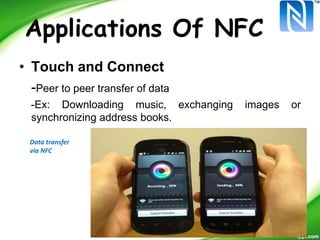
-Peer to peer transfer of data
-Ex: Downloading music, exchanging images or
synchronizing address books.
Data transfer
via NFC
Outline
•
•
•
•
Introduction to Near Field Communication (NFC)
NFC Applications
NFC Working & Operating Modes
Conclusion
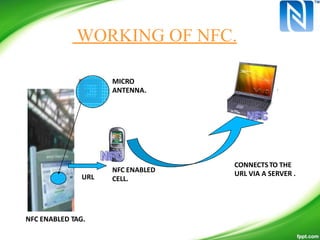
WORKING OF NFC.
MICRO
ANTENNA.
CONNECTSTO THE
URL VIA A SERVER .NFC ENABLED
CELL.URL
NFC ENABLED TAG.
Working Principle
• NFC works on the principle of RFID (Radio
Frequency Identification).
• Types of Coupling in RFID:
 BackScatter Coupling
 Capacitive Coupling
 Inductive Coupling.
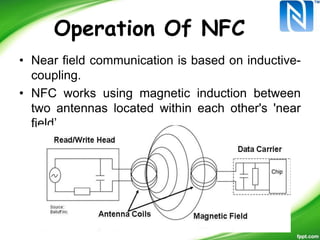
Operation Of NFC
• Near field communication is based on inductive-
coupling.
• NFC works using magnetic induction between
two antennas located within each other's 'near
field’.
Active vs. Passive Device
• Devices containing power sources are called
as active
– Mobile phone
– NFC reader
• Devices without any available power sources
are called as passive
– RFID tag
NFC Model
• In an NFC model two devices are involved in the
communication
Initiator:
– Initiator starts the communication
– Can be either a mobile phone or an NFC reader
which are active devices
Target:
– Responses the initiator’s requests
– Can be either a RFID tag or a mobile phone
•
•
• Single RF band is used; communication is half-duplex
NFC Operating Modes
• NFC has three operating modes as defined by
NFC forum:
–
–
–
Reader/Writer mode
Card Emulation Mode
Peer-to-Peer mode
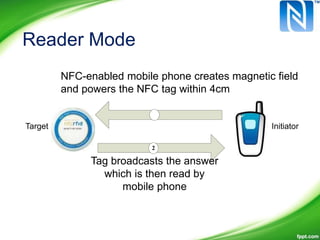
Reader Mode
NFC-enabled mobile phone creates magnetic field
and powers the NFC tag within 4cm
Target Initiator
2
Tag broadcasts the answer
which is then read by
mobile phone
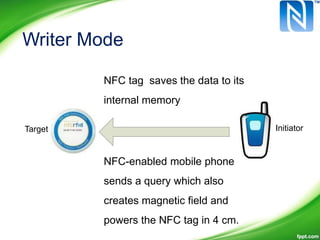
Writer Mode
NFC tag saves the data to its
internal memory
NFC-enabled mobile phone
sends a query which also
creates magnetic field and
powers the NFC tag in 4 cm.
InitiatorTarget
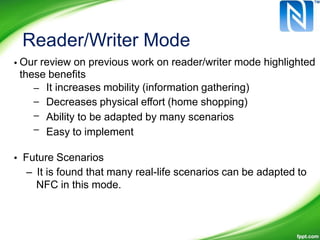
Reader/Writer Mode
• NFC phones can read and write data from/to NFC tags
and
smart cards
Initiator: NFC-enabled mobile phone
Target: Passive tag
Passive tag does not need any source of power.
•
•
•
• Active NFC device creates magnetic inductive
coupling and transfers energy to smart card. After
the smart card is powered, communication starts.
Applications•
–
–
Information gathering
NFC Voting
Reader/Writer Mode
• Our review on previous work on reader/writer mode highlighted
these benefits
–
–
–
–
It increases mobility (information gathering)
Decreases physical effort (home shopping)
Ability to be adapted by many scenarios
Easy to implement
• Future Scenarios
– It is found that many real-life scenarios can be adapted to
NFC in this mode.
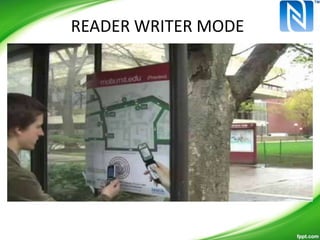
READER WRITER MODE
Card Emulation Mode
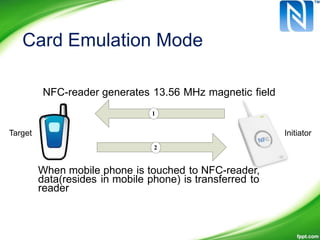
NFC-reader generates 13.56 MHz magnetic field
1
Target Initiator
2
When mobile phone is touched to NFC-reader,
data(resides in mobile phone) is transferred to
reader
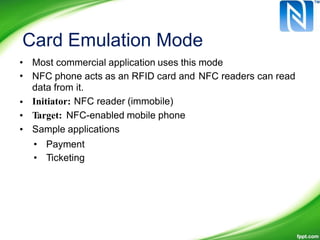
Card Emulation Mode
•
•
Most commercial application uses this mode
NFC phone acts as an RFID card and
data from it.
Initiator: NFC reader (immobile)
Target: NFC-enabled mobile phone
Sample applications
NFC readers can read
•
•
•
•
•
Payment
Ticketing
Card Emulation Mode
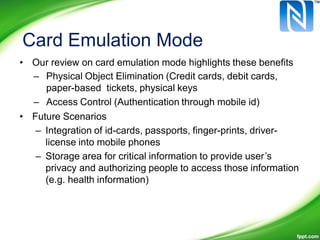
• Our review on card emulation mode highlights these benefits
– Physical Object Elimination (Credit cards, debit cards,
paper-based tickets, physical keys
– Access Control (Authentication through mobile id)
• Future Scenarios
– Integration of id-cards, passports, finger-prints, driver-
license into mobile phones
– Storage area for critical information to provide user’s
privacy and authorizing people to access those information
(e.g. health information)
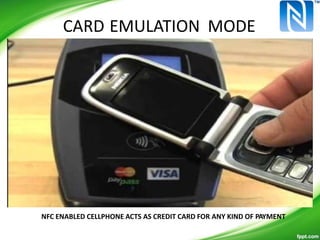
CARD EMULATION MODE
NFC ENABLED CELLPHONE ACTS AS CREDIT CARD FOR ANY KIND OF PAYMENT
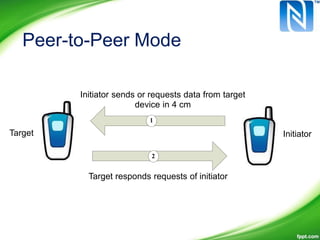
Peer-to-Peer Mode
Initiator sends or requests data
device in 4 cm
1
from target
Target Initiator
2
Target responds requests of initiator
Peer to Peer Mode
•
•
•
•
Two NFC phones can exchange data at link-level.
Initiator: NFC-enabled mobile phone
Target: NFC-enabled mobile phone
Applications
• Money transfer
• Our review on previous work on this mode showed that there is
not so much work done. Following benefits are highlighted
–
–
Easy data exchange between devices
Device pairing
• Future Scenarios
– Secure exchange of critical data
– Gossiping
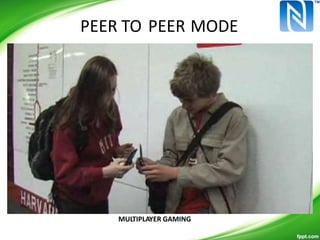
PEER TO PEER MODE
MULTIPLAYER GAMING
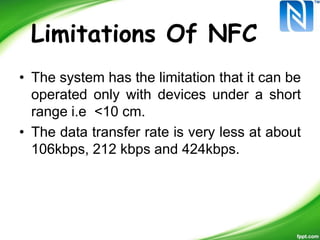
Limitations Of NFC
• The system has the limitation that it can be
operated only with devices under a short
range i.e <10 cm.
• The data transfer rate is very less at about
106kbps, 212 kbps and 424kbps.
SECURITY ASPECTS
• Eavesdropping: The RF signal for the wireless data
transfer can be picked up with antennas.
• Data modification: It is easy to destroy data by using a
jammer. There is no way currently to prevent such an
attack.
• Lost property: Losing the NFC RFID card or the mobile
phone will give open access.
Outline
•
•
•
•
Introduction to Near Field Communication (NFC)
NFC Applications
NFC Operating Modes
Conclusion
Conclusion of NFC
•
•
NFC is an integration of RFID technology with mobile phones.
Connectivity distance is 4-5 centimeters and it brings inherent
security
NFC has three operating modes; Reader/Writer, Card
Emulation and Peer-to-Peer.All of the modes have different
usage areas and provides different benefits.
Integration of NFC technology with mobile phones which
consists of mobility, relatively high processing power, Internet
access ability etc. has a great potential to bring new
opportunities to our lives.
•
•
• José Bravo, Ramón Hervás , Gabriel Chavira From
Implicit to Touching Interaction: RFID and NFC
Approaches ,Sixth International Conference on the
Management of Mobile Business (ICMB 2008)0-7695-
2803-1/07 $25.00 © 2012 IEEE
• Anokwa, Y., et al. A User Interaction Model for NFC
Enabled Applications . in IEEE International Conference
on Pervasive Computing and Communications
Workshops 2011.
• Near Field Communication and Bluetooth Bridge
System for Mobile Commerce C.Y. Leong, K. C. Ong , K.
K. Tan*, O.P. GAN 2011 IEEE International Conference
on Industrial Informatics
• WIKIPEDIA
• www.nfcforum.com
• www.ecma-international.org
REFERENCE
Near field communication new

Near field communication new

  • 1.
  • 2.
    Outline • Introduction toNear Field Communication (NFC) • NFC Applications • NFC working & operating Modes • Conclusion
  • 3.
  • 4.
    Outline • • • • Introduction to NearField Communication (NFC) NFC Applications NFC Working & Operating Modes Conclusion
  • 5.
    NFC allows fordata exchange between two devices(e.g. a smart phone and a payment device) through physical contact (or in very close proximity) The initiator device (the mobile) generates a radio frequency field that transmits the data within a range of about 4 centimeters. The target device (the payment device) picks up the RF field and recieves the data it contains. What is NFC???
  • 6.
    Efficiency is theKey to the Future
  • 7.
    Near Field Communication • • • • • • Developedby Sony and Philips in late 2002 Evolved from Radio Frequency Identification(RFID) Short Range Radio Communication Technology Frequency: 13.56 MHz. Max. Bandwidth: 424Kbits/sec technology Communication starts when two NFC-compatible devices brought together less than four centimeters NFC Forum is the leading organization that organizes the efforts •
  • 8.
  • 9.
  • 10.
    Advantages of NFCTechnology • • NFC technology can benefit from mobile phones The technology is compatible with existing RFID existing RFID tags and contactless smart cards Short range communication (4 centimeters) – Automatic coupling – Inherent security Ease of use (Very familiar to people, only touch) Mobile phones can be used both as an information storage devices or an NFC reader. structures, • • •
  • 11.
    Outline • • • • Introduction to NearField Communication (NFC) NFC Applications NFC Working & Operating Modes Conclusion
  • 12.
    Applications of NFC •NFC applications can be split into the following three basic categories: Touch and Go Touch and Confirm Touch and Connect
  • 13.
    Applications Of NFC •Touch and Go -Smart poster or Transport/event ticketing -The user needs only to bring the device storing the ticket or access code close to the reader. Touch and go Mode of application
  • 14.
  • 15.
  • 16.
    Applications Of NFC •Touch and Confirm -Applications such as mobile payment -Confirm the interaction by entering a password or just accepting the transaction.
  • 17.
  • 18.
  • 19.
    Applications Of NFC •Touch and Connect -Peer to peer transfer of data -Ex: Downloading music, exchanging images or synchronizing address books. Data transfer via NFC
  • 20.
    Outline • • • • Introduction to NearField Communication (NFC) NFC Applications NFC Working & Operating Modes Conclusion
  • 21.
    WORKING OF NFC. MICRO ANTENNA. CONNECTSTOTHE URL VIA A SERVER .NFC ENABLED CELL.URL NFC ENABLED TAG.
  • 22.
    Working Principle • NFCworks on the principle of RFID (Radio Frequency Identification). • Types of Coupling in RFID:  BackScatter Coupling  Capacitive Coupling  Inductive Coupling.
  • 23.
    Operation Of NFC •Near field communication is based on inductive- coupling. • NFC works using magnetic induction between two antennas located within each other's 'near field’.
  • 24.
    Active vs. PassiveDevice • Devices containing power sources are called as active – Mobile phone – NFC reader • Devices without any available power sources are called as passive – RFID tag
  • 25.
    NFC Model • Inan NFC model two devices are involved in the communication Initiator: – Initiator starts the communication – Can be either a mobile phone or an NFC reader which are active devices Target: – Responses the initiator’s requests – Can be either a RFID tag or a mobile phone • • • Single RF band is used; communication is half-duplex
  • 26.
    NFC Operating Modes •NFC has three operating modes as defined by NFC forum: – – – Reader/Writer mode Card Emulation Mode Peer-to-Peer mode
  • 27.
    Reader Mode NFC-enabled mobilephone creates magnetic field and powers the NFC tag within 4cm Target Initiator 2 Tag broadcasts the answer which is then read by mobile phone
  • 28.
    Writer Mode NFC tagsaves the data to its internal memory NFC-enabled mobile phone sends a query which also creates magnetic field and powers the NFC tag in 4 cm. InitiatorTarget
  • 29.
    Reader/Writer Mode • NFCphones can read and write data from/to NFC tags and smart cards Initiator: NFC-enabled mobile phone Target: Passive tag Passive tag does not need any source of power. • • • • Active NFC device creates magnetic inductive coupling and transfers energy to smart card. After the smart card is powered, communication starts. Applications• – – Information gathering NFC Voting
  • 30.
    Reader/Writer Mode • Ourreview on previous work on reader/writer mode highlighted these benefits – – – – It increases mobility (information gathering) Decreases physical effort (home shopping) Ability to be adapted by many scenarios Easy to implement • Future Scenarios – It is found that many real-life scenarios can be adapted to NFC in this mode.
  • 31.
  • 32.
    Card Emulation Mode NFC-readergenerates 13.56 MHz magnetic field 1 Target Initiator 2 When mobile phone is touched to NFC-reader, data(resides in mobile phone) is transferred to reader
  • 33.
    Card Emulation Mode • • Mostcommercial application uses this mode NFC phone acts as an RFID card and data from it. Initiator: NFC reader (immobile) Target: NFC-enabled mobile phone Sample applications NFC readers can read • • • • • Payment Ticketing
  • 34.
    Card Emulation Mode •Our review on card emulation mode highlights these benefits – Physical Object Elimination (Credit cards, debit cards, paper-based tickets, physical keys – Access Control (Authentication through mobile id) • Future Scenarios – Integration of id-cards, passports, finger-prints, driver- license into mobile phones – Storage area for critical information to provide user’s privacy and authorizing people to access those information (e.g. health information)
  • 35.
    CARD EMULATION MODE NFCENABLED CELLPHONE ACTS AS CREDIT CARD FOR ANY KIND OF PAYMENT
  • 36.
    Peer-to-Peer Mode Initiator sendsor requests data device in 4 cm 1 from target Target Initiator 2 Target responds requests of initiator
  • 37.
    Peer to PeerMode • • • • Two NFC phones can exchange data at link-level. Initiator: NFC-enabled mobile phone Target: NFC-enabled mobile phone Applications • Money transfer • Our review on previous work on this mode showed that there is not so much work done. Following benefits are highlighted – – Easy data exchange between devices Device pairing • Future Scenarios – Secure exchange of critical data – Gossiping
  • 38.
    PEER TO PEERMODE MULTIPLAYER GAMING
  • 39.
    Limitations Of NFC •The system has the limitation that it can be operated only with devices under a short range i.e <10 cm. • The data transfer rate is very less at about 106kbps, 212 kbps and 424kbps.
  • 40.
    SECURITY ASPECTS • Eavesdropping:The RF signal for the wireless data transfer can be picked up with antennas. • Data modification: It is easy to destroy data by using a jammer. There is no way currently to prevent such an attack. • Lost property: Losing the NFC RFID card or the mobile phone will give open access.
  • 41.
    Outline • • • • Introduction to NearField Communication (NFC) NFC Applications NFC Operating Modes Conclusion
  • 42.
    Conclusion of NFC • • NFCis an integration of RFID technology with mobile phones. Connectivity distance is 4-5 centimeters and it brings inherent security NFC has three operating modes; Reader/Writer, Card Emulation and Peer-to-Peer.All of the modes have different usage areas and provides different benefits. Integration of NFC technology with mobile phones which consists of mobility, relatively high processing power, Internet access ability etc. has a great potential to bring new opportunities to our lives. • •
  • 43.
    • José Bravo,Ramón Hervás , Gabriel Chavira From Implicit to Touching Interaction: RFID and NFC Approaches ,Sixth International Conference on the Management of Mobile Business (ICMB 2008)0-7695- 2803-1/07 $25.00 © 2012 IEEE • Anokwa, Y., et al. A User Interaction Model for NFC Enabled Applications . in IEEE International Conference on Pervasive Computing and Communications Workshops 2011. • Near Field Communication and Bluetooth Bridge System for Mobile Commerce C.Y. Leong, K. C. Ong , K. K. Tan*, O.P. GAN 2011 IEEE International Conference on Industrial Informatics • WIKIPEDIA • www.nfcforum.com • www.ecma-international.org REFERENCE