Near Field Communication(NFC)
Jagadish Mohanty
Regd No-1721109165,8th Semester
Computer Science and Engineering
Parala Maharaja Engineering College
March 6, 2020
Jagadish Mohanty (8th Semester,CSE) Near Field Communication(NFC) March 6, 2020 1 / 17
Contents
1 Introduction
2 Working Of NFC
3 NFC Mode Of Operation For Device Communication
4 NFC VS. Other Technology
NFC vs RFID
NFC vs Bluetooth
NFC vs QRcode
5 NFC Application
6 Advantages
7 Disadvantages
8 Conclusion
9 References
Jagadish Mohanty (8th Semester,CSE) Near Field Communication(NFC) March 6, 2020 2 / 17
Introduction
Near Field Communication (NFC) is a wireless communication technology extension of
Radio Frequency Identification (RFID) technology that operates in short range communi-
cation.
NFC operates on low-range 13.56 MHz frequency within distance from 4cm to 10cm and
has a maximum data rate of 424 kilobits per second (kbps).
In an NFC communication, two devices are needed. First device is called the initiator which
is an active device and is responsible for starting the communication, whereas second device
is called the target and responds to the initiator’s requests.The target device may be active
or passive.
The communication starts when the active device gets close to the target and generates a
13.56 MHz magnetic field and powers the target device.
The NFC technology works via magnetic field induction and operates on an unlicensed
radio frequency band. Also it includes an embedded energy source component whereas
the target can be a RFID card, tag or an NFC device which gives the reply to initiator’s
request.
Jagadish Mohanty (8th Semester,CSE) Near Field Communication(NFC) March 6, 2020 3 / 17
NFC Mode Of Operation For Device Communication
Reader/Writer mode
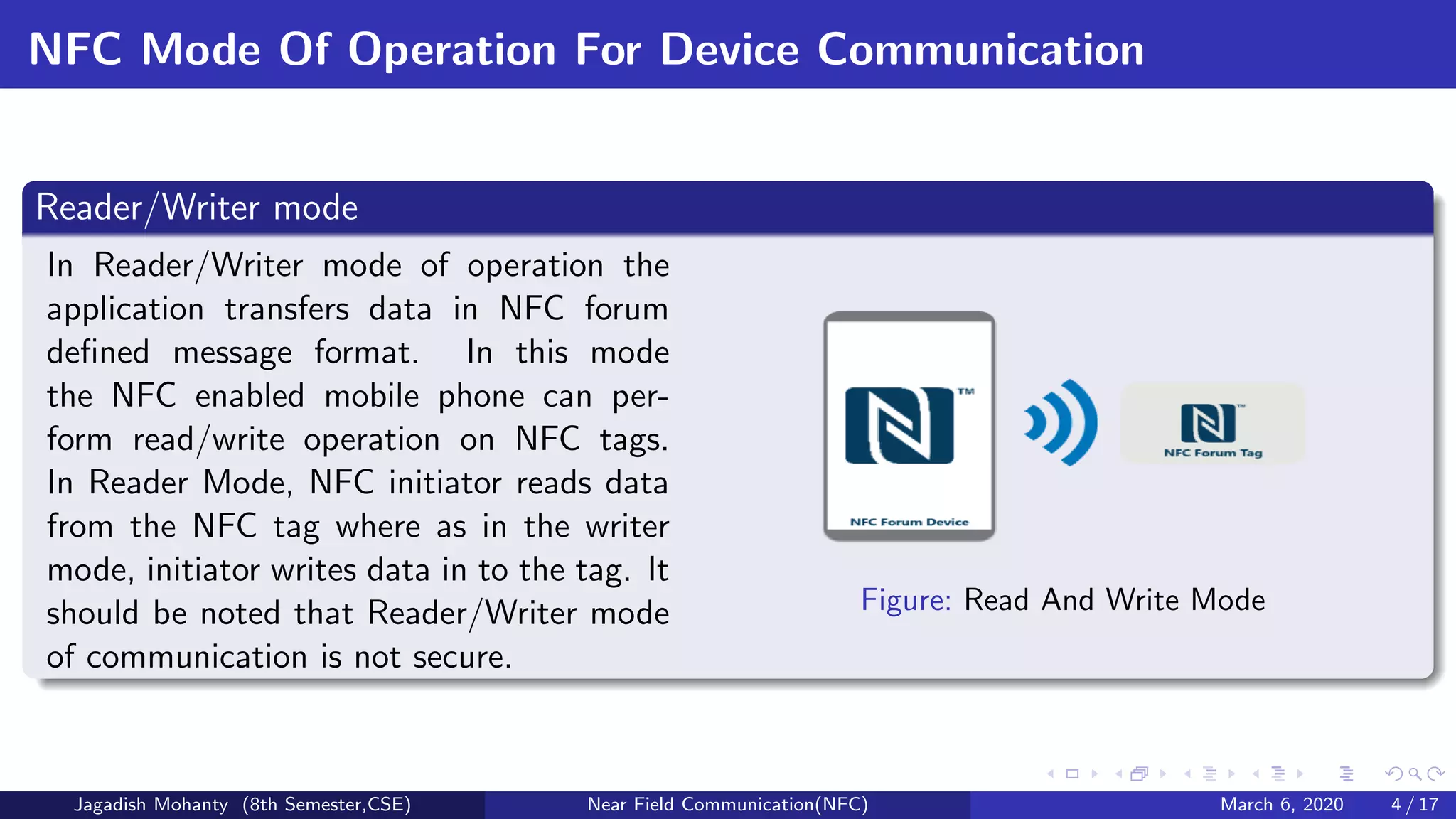
In Reader/Writer mode of operation the
application transfers data in NFC forum
defined message format. In this mode
the NFC enabled mobile phone can per-
form read/write operation on NFC tags.
In Reader Mode, NFC initiator reads data
from the NFC tag where as in the writer
mode, initiator writes data in to the tag. It
should be noted that Reader/Writer mode
of communication is not secure.
Figure: Read And Write Mode
Jagadish Mohanty (8th Semester,CSE) Near Field Communication(NFC) March 6, 2020 4 / 17
NFC Mode Of Operation For Device Communication
Working Of Reader/Writer mode
When we are accessing the data or information using smart phones from the NFC tag .
So in this mode the active device like tablets reads or writes on the NFC tag using the
principle of Electromagnetic Induction.
Now it read the information from the NFC tag.
The active device generate the radio waves carrier frequency of 13.56 MHz.
So the waves used to get coupled to the antenna of passive tag and from this electromag-
netic wave NFC tag receives the power.
So this time wiring electromagnetic field generates the EMF or voltage in this passive tag.
The generated voltage is rectified by using the rectifier. It is use to power up the chip
inside the NFC tag.
Jagadish Mohanty (8th Semester,CSE) Near Field Communication(NFC) March 6, 2020 5 / 17
NFC Mode Of Operation For Device Communication
Working Of Reader/Writer mode
Now this small chip generally comprise of clock, EPROM, rectifier circuit and the small
controller.
Once the chip is powered up then the tag response back to the active device by the
technique which is known as the load modulation.
In this technique the tag use the internet clock of the chip and generates the auxiliary
carrier frequency of the 848 KHz.
Now depending upon the stored data inside this chip the load which is connected in
parallel to antenna is turned on and off. In this way the data is sent back to the active
device.
By the principle of electromagnetic Induction the passive tag use the power and in the
load modulation the data is sent back to the active device.
Jagadish Mohanty (8th Semester,CSE) Near Field Communication(NFC) March 6, 2020 6 / 17
Working Of Reader/Writer mode
Jagadish Mohanty (8th Semester,CSE) Near Field Communication(NFC) March 6, 2020 7 / 17
NFC Mode Of Operation For Device Communication
Card Emulation Mode
In card emulation mode, the NFC enabled
mobile device acts as a contactless smart
card. The examples of smart card are debit
card, credit card, access cards etc. Data
transfer in this mode is highly secure.
Figure: Card Emulation Mode
Jagadish Mohanty (8th Semester,CSE) Near Field Communication(NFC) March 6, 2020 8 / 17
NFC Mode Of Operation For Device Communication
Peer to Peer mode
Peer to peer mode supports link level com-
munication. It supports two NFC enabled
device to exchange information such as a
text message, contact record or data of any
other kind. NFCIP-1 and LLCP are the two
standardized options in peer to peer mode.
Figure: Peer to Peer Mode
Jagadish Mohanty (8th Semester,CSE) Near Field Communication(NFC) March 6, 2020 9 / 17
NFC VS. Other Technology
NFC VS. RFID
RFID work on different frequency but
NFC work on 13.56MHz frequency.
RFID perform one way communica-
tion. Where as NFC perform two way
communication.
Figure: NFC vs RFID
Jagadish Mohanty (8th Semester,CSE) Near Field Communication(NFC) March 6, 2020 10 / 17
NFC VS. Other Technology
NFC VS. Bluetooth
Bluetooth takes more time for opera-
tion as compare to NFC.
It is useful in crowded location.
Figure: NFC vs Bluetooth
Jagadish Mohanty (8th Semester,CSE) Near Field Communication(NFC) March 6, 2020 11 / 17
NFC VS. Other Technology
NFC VS. QRcode
Quick Response Code(QRcode) scan
then confirm it after working but NFC
tag just tab for working.
NFC more secure from QRcode.
Figure: NFC vs QRcode
Jagadish Mohanty (8th Semester,CSE) Near Field Communication(NFC) March 6, 2020 12 / 17
NFC Application
Figure: NFC Application
Jagadish Mohanty (8th Semester,CSE) Near Field Communication(NFC) March 6, 2020 13 / 17
Advantages and Disadvantages
Advantages
It is very convenient to perform payments and other transactions using smartphones with
the help of wallet app.
It helps both customers and enterprises.
It provides secured access for students and employees in their premises.
It provides more security compare to magnetic strip based debit and credit cards.
It does not require search and pair procedure like bluetooth and other methods to establish
connectivity.
It does not require manual configurations and settings.
It is compatible with existing RFID networks.
Disadvantages
It can only works in shorter distances.
It is very expensive for the companies to adopt the NFC enabled devices.
Though it is more secure compare to credit/debit card based system, it is not completely
risk free.
Jagadish Mohanty (8th Semester,CSE) Near Field Communication(NFC) March 6, 2020 14 / 17
Conclusion
Conclusion
NFC can be combined with existing infrared, Bluetooth technologies for improving the range of
NFC. NFC offers a secure and simple way for transferring data between two electronic devices.
Another advantage of NFC is its compatibility with RFID technology. NFC is actually based
on RFID technology. RFID uses magnetic field induction to initiate communication between
electronic devices in close vicinity.NFC operates at 13.56MHz and has 424kbps maximum data
transfer rate. NFC is complementary to Bluetooth and 802.11 with their long distance capa-
bilities. This paper discussed the concepts of NFC technology in a detailed manner including
working, transmission details, protocols and standards, application scenarios, future market,
security standards and vendors’ chipsets available for this standard.
Jagadish Mohanty (8th Semester,CSE) Near Field Communication(NFC) March 6, 2020 15 / 17
References
International Journal on Cybernetics & Informatics (IJCI) Vol. 4, No. 2, April 2015, Near
Field Communication (NFC) Technology: A Survey.
International Journal of Engineering & Technology, 7 (4.31) (2018) 298-305, Near Field
Communication (NFC) Technology Security Vulnerabilities and Countermeasures.
IJCSNS International Journal of Computer Science and Network Security, VOL.12 No.2,
February 2012, Near Field Communication (NFC).
A text book of RFID Design Principles.
10.1109/IC3I.2014.7019680,2014 International Conference on Contemporary Computing
and Informatics (IC3I), NFC Technology: Current and Future Trends in India.
NFC Forum. Home. http://nfc-forum.org/. Accessed September 3, 2015.
Rohde & Schwarz, NFC technology and measurements White Paper, June 2011.
Ecma International, Near Field Communication - White Paper, 2005, Ecma/TC32-TG19/2005/
Available: http://www.ecma-international.org/
Jagadish Mohanty (8th Semester,CSE) Near Field Communication(NFC) March 6, 2020 16 / 17
Thank You
Jagadish Mohanty (8th Semester,CSE) Near Field Communication(NFC) March 6, 2020 17 / 17

Near field communication (NFC)

  • 1.
    Near Field Communication(NFC) JagadishMohanty Regd No-1721109165,8th Semester Computer Science and Engineering Parala Maharaja Engineering College March 6, 2020 Jagadish Mohanty (8th Semester,CSE) Near Field Communication(NFC) March 6, 2020 1 / 17
  • 2.
    Contents 1 Introduction 2 WorkingOf NFC 3 NFC Mode Of Operation For Device Communication 4 NFC VS. Other Technology NFC vs RFID NFC vs Bluetooth NFC vs QRcode 5 NFC Application 6 Advantages 7 Disadvantages 8 Conclusion 9 References Jagadish Mohanty (8th Semester,CSE) Near Field Communication(NFC) March 6, 2020 2 / 17
  • 3.
    Introduction Near Field Communication(NFC) is a wireless communication technology extension of Radio Frequency Identification (RFID) technology that operates in short range communi- cation. NFC operates on low-range 13.56 MHz frequency within distance from 4cm to 10cm and has a maximum data rate of 424 kilobits per second (kbps). In an NFC communication, two devices are needed. First device is called the initiator which is an active device and is responsible for starting the communication, whereas second device is called the target and responds to the initiator’s requests.The target device may be active or passive. The communication starts when the active device gets close to the target and generates a 13.56 MHz magnetic field and powers the target device. The NFC technology works via magnetic field induction and operates on an unlicensed radio frequency band. Also it includes an embedded energy source component whereas the target can be a RFID card, tag or an NFC device which gives the reply to initiator’s request. Jagadish Mohanty (8th Semester,CSE) Near Field Communication(NFC) March 6, 2020 3 / 17
  • 4.
    NFC Mode OfOperation For Device Communication Reader/Writer mode In Reader/Writer mode of operation the application transfers data in NFC forum defined message format. In this mode the NFC enabled mobile phone can per- form read/write operation on NFC tags. In Reader Mode, NFC initiator reads data from the NFC tag where as in the writer mode, initiator writes data in to the tag. It should be noted that Reader/Writer mode of communication is not secure. Figure: Read And Write Mode Jagadish Mohanty (8th Semester,CSE) Near Field Communication(NFC) March 6, 2020 4 / 17
  • 5.
    NFC Mode OfOperation For Device Communication Working Of Reader/Writer mode When we are accessing the data or information using smart phones from the NFC tag . So in this mode the active device like tablets reads or writes on the NFC tag using the principle of Electromagnetic Induction. Now it read the information from the NFC tag. The active device generate the radio waves carrier frequency of 13.56 MHz. So the waves used to get coupled to the antenna of passive tag and from this electromag- netic wave NFC tag receives the power. So this time wiring electromagnetic field generates the EMF or voltage in this passive tag. The generated voltage is rectified by using the rectifier. It is use to power up the chip inside the NFC tag. Jagadish Mohanty (8th Semester,CSE) Near Field Communication(NFC) March 6, 2020 5 / 17
  • 6.
    NFC Mode OfOperation For Device Communication Working Of Reader/Writer mode Now this small chip generally comprise of clock, EPROM, rectifier circuit and the small controller. Once the chip is powered up then the tag response back to the active device by the technique which is known as the load modulation. In this technique the tag use the internet clock of the chip and generates the auxiliary carrier frequency of the 848 KHz. Now depending upon the stored data inside this chip the load which is connected in parallel to antenna is turned on and off. In this way the data is sent back to the active device. By the principle of electromagnetic Induction the passive tag use the power and in the load modulation the data is sent back to the active device. Jagadish Mohanty (8th Semester,CSE) Near Field Communication(NFC) March 6, 2020 6 / 17
  • 7.
    Working Of Reader/Writermode Jagadish Mohanty (8th Semester,CSE) Near Field Communication(NFC) March 6, 2020 7 / 17
  • 8.
    NFC Mode OfOperation For Device Communication Card Emulation Mode In card emulation mode, the NFC enabled mobile device acts as a contactless smart card. The examples of smart card are debit card, credit card, access cards etc. Data transfer in this mode is highly secure. Figure: Card Emulation Mode Jagadish Mohanty (8th Semester,CSE) Near Field Communication(NFC) March 6, 2020 8 / 17
  • 9.
    NFC Mode OfOperation For Device Communication Peer to Peer mode Peer to peer mode supports link level com- munication. It supports two NFC enabled device to exchange information such as a text message, contact record or data of any other kind. NFCIP-1 and LLCP are the two standardized options in peer to peer mode. Figure: Peer to Peer Mode Jagadish Mohanty (8th Semester,CSE) Near Field Communication(NFC) March 6, 2020 9 / 17
  • 10.
    NFC VS. OtherTechnology NFC VS. RFID RFID work on different frequency but NFC work on 13.56MHz frequency. RFID perform one way communica- tion. Where as NFC perform two way communication. Figure: NFC vs RFID Jagadish Mohanty (8th Semester,CSE) Near Field Communication(NFC) March 6, 2020 10 / 17
  • 11.
    NFC VS. OtherTechnology NFC VS. Bluetooth Bluetooth takes more time for opera- tion as compare to NFC. It is useful in crowded location. Figure: NFC vs Bluetooth Jagadish Mohanty (8th Semester,CSE) Near Field Communication(NFC) March 6, 2020 11 / 17
  • 12.
    NFC VS. OtherTechnology NFC VS. QRcode Quick Response Code(QRcode) scan then confirm it after working but NFC tag just tab for working. NFC more secure from QRcode. Figure: NFC vs QRcode Jagadish Mohanty (8th Semester,CSE) Near Field Communication(NFC) March 6, 2020 12 / 17
  • 13.
    NFC Application Figure: NFCApplication Jagadish Mohanty (8th Semester,CSE) Near Field Communication(NFC) March 6, 2020 13 / 17
  • 14.
    Advantages and Disadvantages Advantages Itis very convenient to perform payments and other transactions using smartphones with the help of wallet app. It helps both customers and enterprises. It provides secured access for students and employees in their premises. It provides more security compare to magnetic strip based debit and credit cards. It does not require search and pair procedure like bluetooth and other methods to establish connectivity. It does not require manual configurations and settings. It is compatible with existing RFID networks. Disadvantages It can only works in shorter distances. It is very expensive for the companies to adopt the NFC enabled devices. Though it is more secure compare to credit/debit card based system, it is not completely risk free. Jagadish Mohanty (8th Semester,CSE) Near Field Communication(NFC) March 6, 2020 14 / 17
  • 15.
    Conclusion Conclusion NFC can becombined with existing infrared, Bluetooth technologies for improving the range of NFC. NFC offers a secure and simple way for transferring data between two electronic devices. Another advantage of NFC is its compatibility with RFID technology. NFC is actually based on RFID technology. RFID uses magnetic field induction to initiate communication between electronic devices in close vicinity.NFC operates at 13.56MHz and has 424kbps maximum data transfer rate. NFC is complementary to Bluetooth and 802.11 with their long distance capa- bilities. This paper discussed the concepts of NFC technology in a detailed manner including working, transmission details, protocols and standards, application scenarios, future market, security standards and vendors’ chipsets available for this standard. Jagadish Mohanty (8th Semester,CSE) Near Field Communication(NFC) March 6, 2020 15 / 17
  • 16.
    References International Journal onCybernetics & Informatics (IJCI) Vol. 4, No. 2, April 2015, Near Field Communication (NFC) Technology: A Survey. International Journal of Engineering & Technology, 7 (4.31) (2018) 298-305, Near Field Communication (NFC) Technology Security Vulnerabilities and Countermeasures. IJCSNS International Journal of Computer Science and Network Security, VOL.12 No.2, February 2012, Near Field Communication (NFC). A text book of RFID Design Principles. 10.1109/IC3I.2014.7019680,2014 International Conference on Contemporary Computing and Informatics (IC3I), NFC Technology: Current and Future Trends in India. NFC Forum. Home. http://nfc-forum.org/. Accessed September 3, 2015. Rohde & Schwarz, NFC technology and measurements White Paper, June 2011. Ecma International, Near Field Communication - White Paper, 2005, Ecma/TC32-TG19/2005/ Available: http://www.ecma-international.org/ Jagadish Mohanty (8th Semester,CSE) Near Field Communication(NFC) March 6, 2020 16 / 17
  • 17.
    Thank You Jagadish Mohanty(8th Semester,CSE) Near Field Communication(NFC) March 6, 2020 17 / 17