SEMINAR ON
NEAR FIELD COMMUNICATION
Presented by : Gopinath Mahakud
Regd. No : 1305106010
Guided by : Mr. Debasis Gountia
Department of
Computer Science and Application
College of Engineering and Tchnology
Biju Patnaik University of Technology
Contents
 Introduction
 Communication Mode
 Tag and Reader
 Operating Modes
 Architecture
 Application
 Advantages
 Disadvantages
 Future Technology
 Conclusion
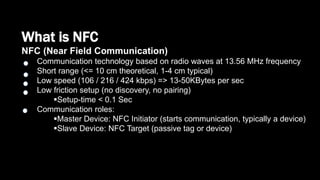
What is NFC
NFC (Near Field Communication)
Communication technology based on radio waves at 13.56 MHz frequency
Short range (<= 10 cm theoretical, 1-4 cm typical)
Low speed (106 / 216 / 424 kbps) => 13-50KBytes per sec
Low friction setup (no discovery, no pairing)
Setup-time < 0.1 Sec
Communication roles:
Master Device: NFC Initiator (starts communication, typically a device)
Slave Device: NFC Target (passive tag or device)
Communication modes
NFC devices support two communication modes.
1- Active
In this mode, the target and the initiator devices have power
supplies and can communicate with one another by alternate signal
transmission.
2- Passive
In this mode, the initiator device generates radio signals and the
target device is powered by this electromagnetic field. The target
device responds to the initiator by modulating the existing
electromagnetic field.
Tag and reader
NFC-based communication between two devices is possible when one device
acts as a reader/writer and the other as a tag.
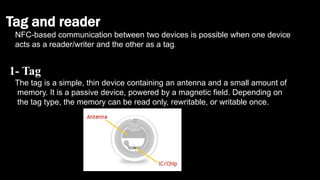
1- Tag
The tag is a simple, thin device containing an antenna and a small amount of
memory. It is a passive device, powered by a magnetic field. Depending on
the tag type, the memory can be read only, rewritable, or writable once.
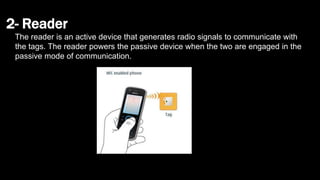
2- Reader
The reader is an active device that generates radio signals to communicate with
the tags. The reader powers the passive device when the two are engaged in the
passive mode of communication.
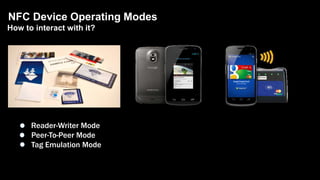
NFC Device Operating Modes
How to interact with it?
Reader-Writer Mode
Peer-To-Peer Mode
Tag Emulation Mode
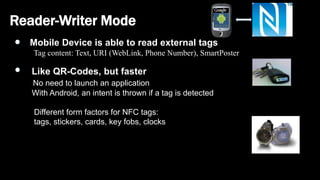
Reader-Writer Mode
Mobile Device is able to read external tags
Tag content: Text, URI (WebLink, Phone Number), SmartPoster
Like QR-Codes, but faster
No need to launch an application
With Android, an intent is thrown if a tag is detected
Different form factors for NFC tags:
tags, stickers, cards, key fobs, clocks
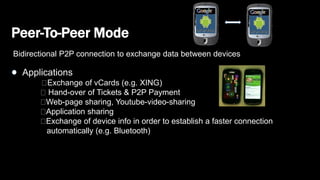
Peer-To-Peer Mode
Bidirectional P2P connection to exchange data between devices
Applications
Exchange of vCards (e.g. XING)
Hand-over of Tickets & P2P Payment
Web-page sharing, Youtube-video-sharing
Application sharing
Exchange of device info in order to establish a faster connection
automatically (e.g. Bluetooth)
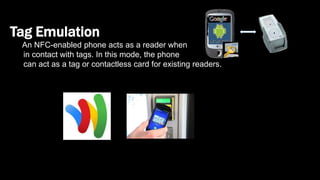
Tag Emulation
An NFC-enabled phone acts as a reader when
in contact with tags. In this mode, the phone
can act as a tag or contactless card for existing readers.
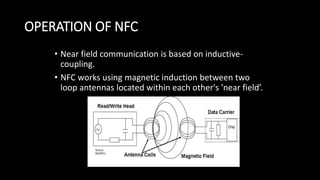
OPERATION OF NFC
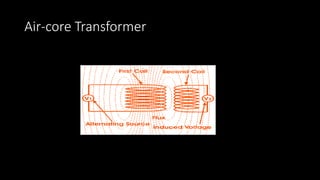
• Near field communication is based on inductive-
coupling.
• NFC works using magnetic induction between two
loop antennas located within each other's 'near field’.
Air-core Transformer
APPLICATION OF NFC
• NFC applications can be split into the
following three basic categories:
Touch and Go
Touch and Confirm
Touch and Connect
APPLICATION OF NFC
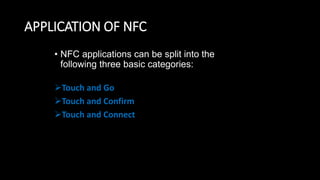
• Touch and Go
Touch and go
Mode of
application
APPLICATION OF NFC
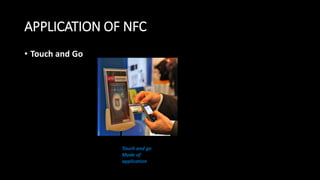
Movie
buff
gathering
info
about a
movie
using his
NFC
enabled
Mobile
Phone
APPLICATION OF NFC
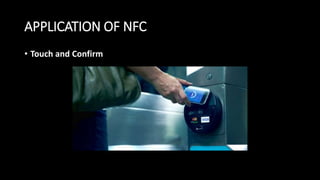
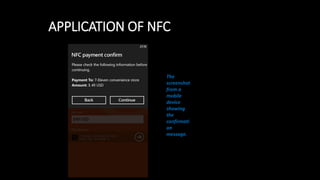
• Touch and Confirm
APPLICATION OF NFC
The
screenshot
from a
mobile
device
showing
the
confirmati
on
message.
APPLICATION OF NFC
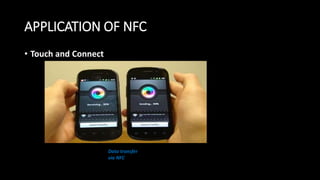
• Touch and Connect
Data transfer
via NFC
ADVANTAGES OF NFC
• High convenience to the user, because the data
exchange is done by bringing two mobiles together.
• Reduces cost of electronic issuance .
• Secure communication.
• No special software.
• No manual configuration and settings.
• No search and pair procedure.
DISADVANTAGES OF NFC
• The system has the limitation that it can be operated
only with devices under a short range i.e around 10
cm.
• The data transfer rate is very less at about 106kbps,
212 kbps and 424kbps.
SOME DEVICES USING NFC
TECHNOLOGY
• Nexus S
• Google Nexus S 4G
• Samsung Galaxy S II
• Samsung Galaxy Note
• Galaxy Nexus
• Nokia 6212 Classic
• Nokia 6131 NFC
FUTURE SCOPE
• New generations of iPhone, iPod and iPad products would reportedly
be equipped with NFC capability which would enable small-scale
monetary transactions.
• On May 2, 2011, RIM announced the Blackberry Bold 9900, a new
device that will use NFC technology.
• Recently, Microsoft announced that all Windows Phone 8 devices will
make use of the NFC technology.
CONCLUSION
• Mobile handsets are the primary target for NFC and soon NFC will be
implemented in most handheld devices. Even though NFC have the
shortest range among radio frequency technologies, combining them
with other technologies like Bluetooth or Infrared can increase its
range of applications.
THANK YOU

NFC TECHNOLOGY

  • 1.
    SEMINAR ON NEAR FIELDCOMMUNICATION Presented by : Gopinath Mahakud Regd. No : 1305106010 Guided by : Mr. Debasis Gountia Department of Computer Science and Application College of Engineering and Tchnology Biju Patnaik University of Technology
  • 2.
    Contents  Introduction  CommunicationMode  Tag and Reader  Operating Modes  Architecture  Application  Advantages  Disadvantages  Future Technology  Conclusion
  • 3.
    What is NFC NFC(Near Field Communication) Communication technology based on radio waves at 13.56 MHz frequency Short range (<= 10 cm theoretical, 1-4 cm typical) Low speed (106 / 216 / 424 kbps) => 13-50KBytes per sec Low friction setup (no discovery, no pairing) Setup-time < 0.1 Sec Communication roles: Master Device: NFC Initiator (starts communication, typically a device) Slave Device: NFC Target (passive tag or device)
  • 4.
    Communication modes NFC devicessupport two communication modes. 1- Active In this mode, the target and the initiator devices have power supplies and can communicate with one another by alternate signal transmission. 2- Passive In this mode, the initiator device generates radio signals and the target device is powered by this electromagnetic field. The target device responds to the initiator by modulating the existing electromagnetic field.
  • 5.
    Tag and reader NFC-basedcommunication between two devices is possible when one device acts as a reader/writer and the other as a tag. 1- Tag The tag is a simple, thin device containing an antenna and a small amount of memory. It is a passive device, powered by a magnetic field. Depending on the tag type, the memory can be read only, rewritable, or writable once.
  • 6.
    2- Reader The readeris an active device that generates radio signals to communicate with the tags. The reader powers the passive device when the two are engaged in the passive mode of communication.
  • 7.
    NFC Device OperatingModes How to interact with it? Reader-Writer Mode Peer-To-Peer Mode Tag Emulation Mode
  • 8.
    Reader-Writer Mode Mobile Deviceis able to read external tags Tag content: Text, URI (WebLink, Phone Number), SmartPoster Like QR-Codes, but faster No need to launch an application With Android, an intent is thrown if a tag is detected Different form factors for NFC tags: tags, stickers, cards, key fobs, clocks
  • 9.
    Peer-To-Peer Mode Bidirectional P2Pconnection to exchange data between devices Applications Exchange of vCards (e.g. XING) Hand-over of Tickets & P2P Payment Web-page sharing, Youtube-video-sharing Application sharing Exchange of device info in order to establish a faster connection automatically (e.g. Bluetooth)
  • 10.
    Tag Emulation An NFC-enabledphone acts as a reader when in contact with tags. In this mode, the phone can act as a tag or contactless card for existing readers.
  • 11.
    OPERATION OF NFC •Near field communication is based on inductive- coupling. • NFC works using magnetic induction between two loop antennas located within each other's 'near field’.
  • 12.
  • 13.
    APPLICATION OF NFC •NFC applications can be split into the following three basic categories: Touch and Go Touch and Confirm Touch and Connect
  • 14.
    APPLICATION OF NFC •Touch and Go Touch and go Mode of application
  • 15.
    APPLICATION OF NFC Movie buff gathering info abouta movie using his NFC enabled Mobile Phone
  • 16.
    APPLICATION OF NFC •Touch and Confirm
  • 17.
    APPLICATION OF NFC The screenshot froma mobile device showing the confirmati on message.
  • 18.
    APPLICATION OF NFC •Touch and Connect Data transfer via NFC
  • 19.
    ADVANTAGES OF NFC •High convenience to the user, because the data exchange is done by bringing two mobiles together. • Reduces cost of electronic issuance . • Secure communication. • No special software. • No manual configuration and settings. • No search and pair procedure.
  • 20.
    DISADVANTAGES OF NFC •The system has the limitation that it can be operated only with devices under a short range i.e around 10 cm. • The data transfer rate is very less at about 106kbps, 212 kbps and 424kbps.
  • 21.
    SOME DEVICES USINGNFC TECHNOLOGY • Nexus S • Google Nexus S 4G • Samsung Galaxy S II • Samsung Galaxy Note • Galaxy Nexus • Nokia 6212 Classic • Nokia 6131 NFC
  • 22.
    FUTURE SCOPE • Newgenerations of iPhone, iPod and iPad products would reportedly be equipped with NFC capability which would enable small-scale monetary transactions. • On May 2, 2011, RIM announced the Blackberry Bold 9900, a new device that will use NFC technology. • Recently, Microsoft announced that all Windows Phone 8 devices will make use of the NFC technology.
  • 23.
    CONCLUSION • Mobile handsetsare the primary target for NFC and soon NFC will be implemented in most handheld devices. Even though NFC have the shortest range among radio frequency technologies, combining them with other technologies like Bluetooth or Infrared can increase its range of applications.
  • 24.