
Near Field Communication


By,
Siddharth D.C.(1RV09IT043)
Shomik.M .(1RV09IT040)
Varun .R. Athreya .(1RV09IT065)
                                  IT   Dept., RVCE
Outline
 Brief introduction
 History
 Key benefits
 NFC Operation
 NFC tags & Security Threats
 NFC and other wireless technologies
 NFC Application
 NFC in Market

                             IT   Dept., RVCE
What is NFC ?
   Standards based technology used to provide
    short range wireless connectivity, that carry
    secure two way interactions between electronic
    devices.

   Provides contact-less communication up to
    distance of 5 cm.This makes it more “secure”.

   Utilizes inductive coupling for its operation.

   Form of RFID but has specific standards of
    operation.
                                          IT   Dept., RVCE
Origins
   NFC traces its roots back to Radio-frequency
    identification, or RFID. RFID allows a reader to
    send radio waves to a passive electronic tag for
    identification and tracking.

   1983 The first patent to be associated with the
    abbreviation RFID was granted to Charles
    Walton.

   2004 Nokia, Philips and Sony established the
    Near
    Field Communication (NFC) Forum

   2006 Specification for "Smart Poster" records
                                         IT   Dept., RVCE
….
   2006 Nokia 6131 was the first NFC phone
   2009 In January, NFC Forum released Peer-to-
    Peer standards to transfer contact, URL, initiate
    Bluetooth.
   2010 Samsung Nexus S: First Android NFC
    phone
   2011 Google I/O "How to NFC" demonstrates
    NFC to initiate a game and to share a contact,
    URL, app, video,
   2011 NFC support becomes part of the Symbian
    mobile operating system with the release of
    Symbian Anna version.

                                         IT   Dept., RVCE
Key benefits
   NFC provides a range of benefits to consumers
    and businesses, such as:
   Intuitive: NFC interactions require no more than a
    simple touch
   Versatile: NFC is ideally suited to the broadest
    range of industries, environments.
   Open and standards-based: The underlying layers
    of NFC technology follow universally implemented
    ISO, ECMA, and ETSI standards
   Technology-enabling: NFC facilitates fast and
    simple setup of wireless technologies, such as
    Bluetooth, Wi-Fi, etc.)
                                                 …..
                                          IT   Dept., RVCE
…
 Inherently secure: NFC transmissions are short
  range (from a touch to a few centimeters)
 Interoperable: NFC works with existing
  contactless card technologies
 Security-ready: NFC has built-in capabilities to
  support secure applications


                                       IT   Dept., RVCE
Inductive coupling

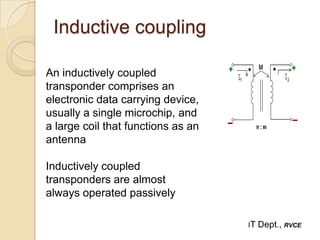
An inductively coupled
transponder comprises an
electronic data carrying device,
usually a single microchip, and
a large coil that functions as an
antenna

Inductively coupled
transponders are almost
always operated passively

                                    IT   Dept., RVCE
NFC Tech Device Types &
Oper’n near field communication standard
 The NFC
  defines two types of NFC device.
  - Initiator
  -Target
• Active mode of communication: In the active
  NFC mode of communication, both devices
  generate an RF signal on which the data is
  carried.
• Passive mode of communication: In this mode
  of communication, only one NFC device
  generates an RF field. The second passive
  device which is the target uses a technique
  called load modulation to transfer the data back
  to the primary device or initiator.
                                             ….
                                        IT Dept., RVCE
….
 NFC- wireless technology
   Operating frequency-13.56 MHz (unregulated
  13.56 MHz frequency band).
   As a result no licenses are required for operation
  on these frequencies.
 NFC -Half duplex as the same channel is used
  for both transmit and receive.
 Technique- Listen before talk protocol


                                        IT   Dept., RVCE
Data Transfer & Tags
   NFC Tag- passive device
     The users touches an NFC enabled device onto
    the tag. A small amount of power is taken by the
    NFC tag from the reader/writer to power the tag
    electronics. The tag is then enabled to transfer a
    small amount of information to the reader/writer.

   The data stored in the tag memory is transferred
    to the NFC enabled device. Although normally
    only a small amount of data, this may be used to
    direct the device to a website URL, it may be a
    small amount of text, or other data.
                                                   …..
                                          IT   Dept., RVCE
…
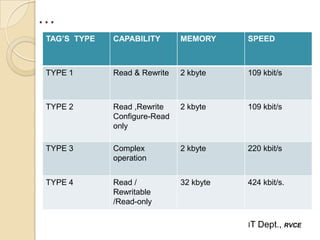
TAG’S TYPE   CAPABILITY       MEMORY     SPEED


TYPE 1       Read & Rewrite   2 kbyte    109 kbit/s


TYPE 2       Read ,Rewrite    2 kbyte    109 kbit/s
             Configure-Read
             only

TYPE 3       Complex          2 kbyte    220 kbit/s
             operation


TYPE 4       Read /           32 kbyte   424 kbit/s.
             Rewritable
             /Read-only

                                         IT   Dept., RVCE
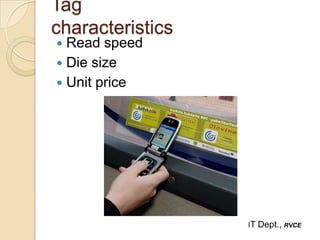
Tag
characteristics
 Read speed
 Die size
 Unit price


                  IT   Dept., RVCE
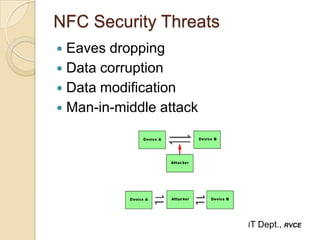
NFC Security Threats
 Eaves dropping
 Data corruption
 Data modification
 Man-in-middle attack


                         IT   Dept., RVCE
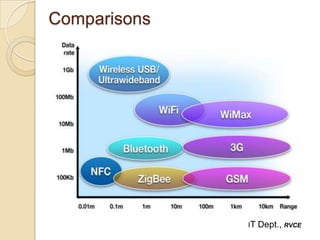
Comparisons


              IT   Dept., RVCE
 Bluetooth: Although both Bluetooth and NFC
  can be used to transfer data, Bluetooth has
  been designed to transfer data over much
  greater distances. NFC is designed to be
  close proximity only.
 Wi-Fi / IEEE 802.11: Wi-Fi is designed for
  local area networks, and is not a short range
  peer to peer technology.
 RFID: Although RFID is very similar to NFC
  in many respects, RFID is a much broader
  technology. NFC is a specific case which is
  defined by standards enabling it to be
  interoperable.

                                    IT   Dept., RVCE
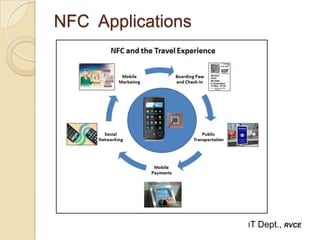
NFC Applications


                   IT   Dept., RVCE
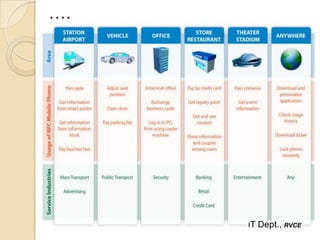
….


     IT   Dept., RVCE
NFC in Market
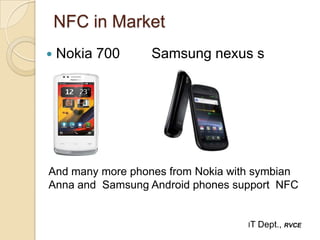
   Nokia 700     Samsung nexus s


And many more phones from Nokia with symbian
Anna and Samsung Android phones support NFC


                                   IT   Dept., RVCE
Bibliography
 www.nfcforum.com
 www.radioelectronics.com
 www.gizmodo.com
 www.blognfc.com
 www.engadget.com
IT   Dept., RVCE

Near field communication

  • 1.
    Near Field Communication By, SiddharthD.C.(1RV09IT043) Shomik.M .(1RV09IT040) Varun .R. Athreya .(1RV09IT065) IT Dept., RVCE
  • 2.
    Outline  Brief introduction History  Key benefits  NFC Operation  NFC tags & Security Threats  NFC and other wireless technologies  NFC Application  NFC in Market IT Dept., RVCE
  • 3.
    What is NFC?  Standards based technology used to provide short range wireless connectivity, that carry secure two way interactions between electronic devices.  Provides contact-less communication up to distance of 5 cm.This makes it more “secure”.  Utilizes inductive coupling for its operation.  Form of RFID but has specific standards of operation. IT Dept., RVCE
  • 4.
    Origins  NFC traces its roots back to Radio-frequency identification, or RFID. RFID allows a reader to send radio waves to a passive electronic tag for identification and tracking.  1983 The first patent to be associated with the abbreviation RFID was granted to Charles Walton.  2004 Nokia, Philips and Sony established the Near Field Communication (NFC) Forum  2006 Specification for "Smart Poster" records IT Dept., RVCE
  • 5.
    ….  2006 Nokia 6131 was the first NFC phone  2009 In January, NFC Forum released Peer-to- Peer standards to transfer contact, URL, initiate Bluetooth.  2010 Samsung Nexus S: First Android NFC phone  2011 Google I/O "How to NFC" demonstrates NFC to initiate a game and to share a contact, URL, app, video,  2011 NFC support becomes part of the Symbian mobile operating system with the release of Symbian Anna version. IT Dept., RVCE
  • 6.
    Key benefits  NFC provides a range of benefits to consumers and businesses, such as:  Intuitive: NFC interactions require no more than a simple touch  Versatile: NFC is ideally suited to the broadest range of industries, environments.  Open and standards-based: The underlying layers of NFC technology follow universally implemented ISO, ECMA, and ETSI standards  Technology-enabling: NFC facilitates fast and simple setup of wireless technologies, such as Bluetooth, Wi-Fi, etc.) ….. IT Dept., RVCE
  • 7.
    …  Inherently secure:NFC transmissions are short range (from a touch to a few centimeters)  Interoperable: NFC works with existing contactless card technologies  Security-ready: NFC has built-in capabilities to support secure applications IT Dept., RVCE
  • 8.
    Inductive coupling An inductivelycoupled transponder comprises an electronic data carrying device, usually a single microchip, and a large coil that functions as an antenna Inductively coupled transponders are almost always operated passively IT Dept., RVCE
  • 9.
    NFC Tech DeviceTypes & Oper’n near field communication standard  The NFC defines two types of NFC device. - Initiator -Target • Active mode of communication: In the active NFC mode of communication, both devices generate an RF signal on which the data is carried. • Passive mode of communication: In this mode of communication, only one NFC device generates an RF field. The second passive device which is the target uses a technique called load modulation to transfer the data back to the primary device or initiator. …. IT Dept., RVCE
  • 10.
    ….  NFC- wirelesstechnology Operating frequency-13.56 MHz (unregulated 13.56 MHz frequency band). As a result no licenses are required for operation on these frequencies.  NFC -Half duplex as the same channel is used for both transmit and receive.  Technique- Listen before talk protocol IT Dept., RVCE
  • 11.
    Data Transfer &Tags  NFC Tag- passive device The users touches an NFC enabled device onto the tag. A small amount of power is taken by the NFC tag from the reader/writer to power the tag electronics. The tag is then enabled to transfer a small amount of information to the reader/writer.  The data stored in the tag memory is transferred to the NFC enabled device. Although normally only a small amount of data, this may be used to direct the device to a website URL, it may be a small amount of text, or other data. ….. IT Dept., RVCE
  • 12.
    … TAG’S TYPE CAPABILITY MEMORY SPEED TYPE 1 Read & Rewrite 2 kbyte 109 kbit/s TYPE 2 Read ,Rewrite 2 kbyte 109 kbit/s Configure-Read only TYPE 3 Complex 2 kbyte 220 kbit/s operation TYPE 4 Read / 32 kbyte 424 kbit/s. Rewritable /Read-only IT Dept., RVCE
  • 13.
    Tag characteristics  Read speed Die size  Unit price IT Dept., RVCE
  • 14.
    NFC Security Threats Eaves dropping  Data corruption  Data modification  Man-in-middle attack IT Dept., RVCE
  • 15.
    Comparisons IT Dept., RVCE
  • 16.
     Bluetooth: Althoughboth Bluetooth and NFC can be used to transfer data, Bluetooth has been designed to transfer data over much greater distances. NFC is designed to be close proximity only.  Wi-Fi / IEEE 802.11: Wi-Fi is designed for local area networks, and is not a short range peer to peer technology.  RFID: Although RFID is very similar to NFC in many respects, RFID is a much broader technology. NFC is a specific case which is defined by standards enabling it to be interoperable. IT Dept., RVCE
  • 17.
    NFC Applications IT Dept., RVCE
  • 18.
    …. IT Dept., RVCE
  • 19.
    NFC in Market  Nokia 700 Samsung nexus s And many more phones from Nokia with symbian Anna and Samsung Android phones support NFC IT Dept., RVCE
  • 20.
    Bibliography  www.nfcforum.com  www.radioelectronics.com www.gizmodo.com  www.blognfc.com  www.engadget.com
  • 21.
    IT Dept., RVCE