NEAR FIELD
COMMUNICAITON
ByNeha Singh
NFC – What is it ???
 NFC or Near Field Communication is a short range high
frequency wireless communication technology.
 A radio communication is established by touching the two
phones or keeping them in a proximity of a few centimeters.
 NFC is mainly aimed for mobile or handheld devices.
 NFC is an extension of Radio frequency identification.
 It is a form of contactless communication between devices.
EVOLUTION OF NFC TECHNOLOGY
I.

In 2004, NFC Forum was formed by
Nokia, Philips, Sony to set standards for NFC . Every
NFC enabled device will have an “N-Mark” trademark
,developed by NFC Forum.

II.

In 2006, first mobile phone( nokia 6131) with NFC was
released by NOKIA.

III.

In 2010, first android phone SAMSUNG NEXUS S with
NFC support was released.

IV.

Sony introduced "Smart Tags", which use NFC
technology to change modes and profiles on sony
smartphones.
OPERATION OF NFC








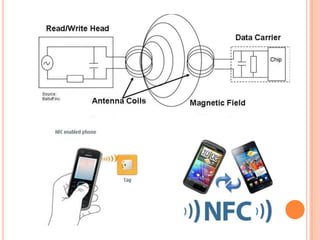
Near field communication is based on inductive-coupling.
NFC works using magnetic induction between two loop
antennas.
A reader emits a small electric current, which creates a
magnetic field that in turn bridges the physical space
between the devices. That field is received by a similar coil
in the client device, where it is turned back into electrical
impulses to communicate data such as identification
number, status information, or any other information.
So, NFC use an initiator and a target; the initiator actively
generates an RF field that can power a passive
target, while 'active' or 'peer-to-peer' tags have their own
power source and respond to the reader using their own
electromagnetic fields.
Operating frequency is 13.56 
MHz and data rate varies
from106 Kbit/s to 424 Kbit/s.
BLOCK DIAGRAM
EXPLANATION












The analog circuitry handles the modulation and
demodulation of analog signals.
RF level detector detects the presence of an external RF field
at 13.56Mhz.
UART handles the protocol requirements for the
communication schemes.
FIFO BUFFER allows a fast and convenient data transfer
from the host to the UART and vice versa.
MICRO CONTROLLER allows autonomous management of
communication both on RF interface and with the host.
HOST INTERFACES are implemented to fulfill different
customer requirements.
MODES OF OPERATION


Active mode-

Inducing magnetic
field

In this mode, both devices with NFC chip can generate an
electromagnetic field and exchange information with each
other.

Two NFC enabled devices transferring
data in active mode


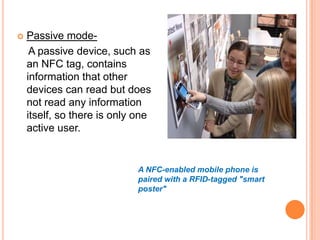
Passive modeA passive device, such as
an NFC tag, contains
information that other
devices can read but does
not read any information
itself, so there is only one
active user.

A NFC-enabled mobile phone is
paired with a RFID-tagged "smart
poster"
COMMUNICATION PROTOCOLS













NFC was approved as an ISO/IEC standard on December 8, 2003
and later as an ECMA standard.
NFC is an open platform technology standardized in ECMA-340 and
ISO/IEC 18092.
These standards specify the modulation schemes, coding, transfer
speeds and frame format of the RF interface of NFC devices, as well
as initialization schemes and conditions required for data collisioncontrol during initialization for both passive and active NFC modes.
Furthermore, they also define the transport protocol, including
protocol activation and data-exchange methods.
Thus inpassive mode an NFC device can communicate with an existing
ISO/IEC smartcard or reader.
active mode an NFC device can interact with other such device.
APPLICATIONS OF NFC
1) TOUCH AND GO
Applications such as access control, where the user needs
only to bring the device storing the ticket or access code close
to the reader.

A person gathering info
about a movie using his
NFC enabled Mobile
Phone
2) TOUCH AND CONFIRM
Applications such as mobile payment where the
user has to confirm the interaction by entering a
password or just accepting the transaction.
3) TOUCH AND CONNECT
Linking two NFC-enabled devices to
enable peer to peer transfer of data.

4) A latest development is that NFC
can be used to configure Wi-Fi
networks through mobile devices.
M-COMMERCE









The key feature that led to the development of this technology is
defining an organization’s mobile commerce business strategies.
The NFC based mobile devices and contactless credit cards can
engage with PoS devices, to enable contactless payments.
The ISO/IEC 14443 standards define the framework to manage the
contactless payment communications between a payment card reader
(or NFC capable POS device) and an associated payment card
device.
Enables the users to buy the selected product or service with their Mwallet account, using NFC.
Security is an important and integral part of the mobile commerce
transaction processing model, so we have mobile transaction
processing solution framework to ensure end-to-end security of the
sensitive data using strong encryption across all paths of the
transactions.
The point to point encryption practice is known to reduce the scope of
PCI-DSS assessment and hence P2PE encryption practices are
widely being used for security of card holder data.
CARRY YOUR WORLD AROUND
ADVANTAGES OF NFC
High convenience to the user, because the data
exchange is done just by bringing two mobiles
together.
 Reduces cost of electronic issuance .
 Secure communication.
 No special software.
 No manual configuration and settings.
 No search and pair procedure.
 NFC can be used together with existing
technologies like Bluetooth and thus act for longer
range also.
 NFC uses are practically limitless.

DISADVANTAGES OF NFC








The system has the limitation that it can be operated only with
devices under a short range i.e. around 10 cm.
The data transfer rate is very less at about 106kbps, 212 kbps
and 424kbps.
Eavesdropping
Data Corruption and Manipulation
Theft

COUNTER MEASURES
o Use secure channel (so that only the authorized device could

decode the encrypted information).
o Some NFC devices “listen” for data corruption attacks and
prevent them before they have a chance to get up and running.
o Use Active – Passive modes with encrypted keys (this means
one device receives info and the other sends it instead of both
devices receiving and passing information).
o Keeping phones password protected.
SOME DEVICES USING NFC
TECHNOLOGY
FUTURE OF NFC






New generations of iPhone, iPod and iPad products would
reportedly be equipped with NFC capability which would
enable small-scale monetary transactions.
On May 2, 2011, RIM announced the Blackberry Bold 9900, a
new device that will use NFC technology.
Recently, Microsoft announced that all Windows Phone 8
devices will make use of the NFC technology.
CONCLUSION








Mobile handsets are the primary target for NFC and soon NFC
will be implemented in most handheld devices.
The advancements in mobile wireless technology and
communication standards have enabled usage of contactless
and NFC based payment models.
The mobile wallet based payment model is gaining
considerable momentum and is currently being seen as one of
the key payment model, to promote contactless payment
processing practices.
The mobile wallet technology enables the end-users to make
payments with their mobile wallet accounts, without having to
use credit or debit cards and hence this technology can also
help users that do not use credit or debit cards.
REFERENCES










http://www.nfc-forum.org
http://en.wikipedia.org/wiki/Near_field_communication
http://www.nearfield communiaction.org
http://apcmag.com/inside-nfc-how-near-field-communicationworks.htm
http://www.mobilecommercepress.com
Google. "Google Wallet: How it Works." (Jan. 28, 2012)
http://www.google.com/wallet/how-it-works.html#in-store
Kessler, Sarah. "NFC Technology: 6 Ways it Could Change Our
Daily Lives." Mashable. May 6, 2010. (Feb. 6, 2012)
http://mashable.com/2010/05/06/near-field-communication/
THANK YOU!!!

NFC Technology

  • 1.
  • 2.
    NFC – Whatis it ???  NFC or Near Field Communication is a short range high frequency wireless communication technology.  A radio communication is established by touching the two phones or keeping them in a proximity of a few centimeters.  NFC is mainly aimed for mobile or handheld devices.  NFC is an extension of Radio frequency identification.  It is a form of contactless communication between devices.
  • 3.
    EVOLUTION OF NFCTECHNOLOGY I. In 2004, NFC Forum was formed by Nokia, Philips, Sony to set standards for NFC . Every NFC enabled device will have an “N-Mark” trademark ,developed by NFC Forum. II. In 2006, first mobile phone( nokia 6131) with NFC was released by NOKIA. III. In 2010, first android phone SAMSUNG NEXUS S with NFC support was released. IV. Sony introduced "Smart Tags", which use NFC technology to change modes and profiles on sony smartphones.
  • 4.
    OPERATION OF NFC      Nearfield communication is based on inductive-coupling. NFC works using magnetic induction between two loop antennas. A reader emits a small electric current, which creates a magnetic field that in turn bridges the physical space between the devices. That field is received by a similar coil in the client device, where it is turned back into electrical impulses to communicate data such as identification number, status information, or any other information. So, NFC use an initiator and a target; the initiator actively generates an RF field that can power a passive target, while 'active' or 'peer-to-peer' tags have their own power source and respond to the reader using their own electromagnetic fields. Operating frequency is 13.56  MHz and data rate varies from106 Kbit/s to 424 Kbit/s.
  • 6.
  • 7.
    EXPLANATION       The analog circuitryhandles the modulation and demodulation of analog signals. RF level detector detects the presence of an external RF field at 13.56Mhz. UART handles the protocol requirements for the communication schemes. FIFO BUFFER allows a fast and convenient data transfer from the host to the UART and vice versa. MICRO CONTROLLER allows autonomous management of communication both on RF interface and with the host. HOST INTERFACES are implemented to fulfill different customer requirements.
  • 8.
    MODES OF OPERATION  Activemode- Inducing magnetic field In this mode, both devices with NFC chip can generate an electromagnetic field and exchange information with each other. Two NFC enabled devices transferring data in active mode
  • 9.
     Passive modeA passivedevice, such as an NFC tag, contains information that other devices can read but does not read any information itself, so there is only one active user. A NFC-enabled mobile phone is paired with a RFID-tagged "smart poster"
  • 10.
    COMMUNICATION PROTOCOLS        NFC wasapproved as an ISO/IEC standard on December 8, 2003 and later as an ECMA standard. NFC is an open platform technology standardized in ECMA-340 and ISO/IEC 18092. These standards specify the modulation schemes, coding, transfer speeds and frame format of the RF interface of NFC devices, as well as initialization schemes and conditions required for data collisioncontrol during initialization for both passive and active NFC modes. Furthermore, they also define the transport protocol, including protocol activation and data-exchange methods. Thus inpassive mode an NFC device can communicate with an existing ISO/IEC smartcard or reader. active mode an NFC device can interact with other such device.
  • 11.
    APPLICATIONS OF NFC 1)TOUCH AND GO Applications such as access control, where the user needs only to bring the device storing the ticket or access code close to the reader. A person gathering info about a movie using his NFC enabled Mobile Phone
  • 12.
    2) TOUCH ANDCONFIRM Applications such as mobile payment where the user has to confirm the interaction by entering a password or just accepting the transaction.
  • 13.
    3) TOUCH ANDCONNECT Linking two NFC-enabled devices to enable peer to peer transfer of data. 4) A latest development is that NFC can be used to configure Wi-Fi networks through mobile devices.
  • 14.
    M-COMMERCE       The key featurethat led to the development of this technology is defining an organization’s mobile commerce business strategies. The NFC based mobile devices and contactless credit cards can engage with PoS devices, to enable contactless payments. The ISO/IEC 14443 standards define the framework to manage the contactless payment communications between a payment card reader (or NFC capable POS device) and an associated payment card device. Enables the users to buy the selected product or service with their Mwallet account, using NFC. Security is an important and integral part of the mobile commerce transaction processing model, so we have mobile transaction processing solution framework to ensure end-to-end security of the sensitive data using strong encryption across all paths of the transactions. The point to point encryption practice is known to reduce the scope of PCI-DSS assessment and hence P2PE encryption practices are widely being used for security of card holder data.
  • 15.
  • 16.
    ADVANTAGES OF NFC Highconvenience to the user, because the data exchange is done just by bringing two mobiles together.  Reduces cost of electronic issuance .  Secure communication.  No special software.  No manual configuration and settings.  No search and pair procedure.  NFC can be used together with existing technologies like Bluetooth and thus act for longer range also.  NFC uses are practically limitless. 
  • 17.
    DISADVANTAGES OF NFC      Thesystem has the limitation that it can be operated only with devices under a short range i.e. around 10 cm. The data transfer rate is very less at about 106kbps, 212 kbps and 424kbps. Eavesdropping Data Corruption and Manipulation Theft COUNTER MEASURES o Use secure channel (so that only the authorized device could decode the encrypted information). o Some NFC devices “listen” for data corruption attacks and prevent them before they have a chance to get up and running. o Use Active – Passive modes with encrypted keys (this means one device receives info and the other sends it instead of both devices receiving and passing information). o Keeping phones password protected.
  • 18.
    SOME DEVICES USINGNFC TECHNOLOGY
  • 19.
    FUTURE OF NFC    Newgenerations of iPhone, iPod and iPad products would reportedly be equipped with NFC capability which would enable small-scale monetary transactions. On May 2, 2011, RIM announced the Blackberry Bold 9900, a new device that will use NFC technology. Recently, Microsoft announced that all Windows Phone 8 devices will make use of the NFC technology.
  • 20.
    CONCLUSION     Mobile handsets arethe primary target for NFC and soon NFC will be implemented in most handheld devices. The advancements in mobile wireless technology and communication standards have enabled usage of contactless and NFC based payment models. The mobile wallet based payment model is gaining considerable momentum and is currently being seen as one of the key payment model, to promote contactless payment processing practices. The mobile wallet technology enables the end-users to make payments with their mobile wallet accounts, without having to use credit or debit cards and hence this technology can also help users that do not use credit or debit cards.
  • 21.
    REFERENCES        http://www.nfc-forum.org http://en.wikipedia.org/wiki/Near_field_communication http://www.nearfield communiaction.org http://apcmag.com/inside-nfc-how-near-field-communicationworks.htm http://www.mobilecommercepress.com Google. "GoogleWallet: How it Works." (Jan. 28, 2012) http://www.google.com/wallet/how-it-works.html#in-store Kessler, Sarah. "NFC Technology: 6 Ways it Could Change Our Daily Lives." Mashable. May 6, 2010. (Feb. 6, 2012) http://mashable.com/2010/05/06/near-field-communication/
  • 22.