ND Unit 02
Computer Hardware

  Internal components
Session Objectives
 This session looks at what is inside the system
 unit and what options you may have when
 purchasing a new system.

1. You will learn to recognise these components

2. You will learn what these components do

3. You will learn where these components go
  inside the system unit.
System unit components
We will look at the following system unit components:
Processor (CPU)
Fan and Heat Sink
Motherboard
BIOS
Power Supply
Hard disk drive – SATA, IDE,EIDE,master/slave
Ports – USB, parallel, serial
Internal Memory – RAM, ROM, Cache
Specialised cards
    Network Interface Card (NIC)
    Graphics Card
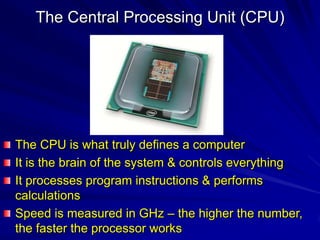
The Central Processing Unit (CPU)


The CPU is what truly defines a computer
It is the brain of the system & controls everything
It processes program instructions & performs
calculations
Speed is measured in GHz – the higher the number,
the faster the processor works
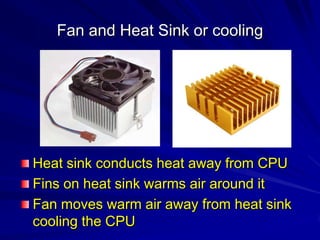
Fan and Heat Sink or cooling


Heat sink conducts heat away from CPU
Fins on heat sink warms air around it
Fan moves warm air away from heat sink
cooling the CPU
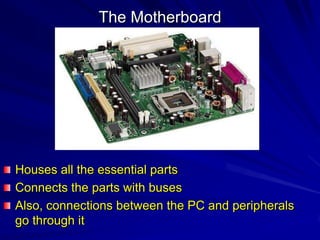
The Motherboard


Houses all the essential parts
Connects the parts with buses
Also, connections between the PC and peripherals
go through it
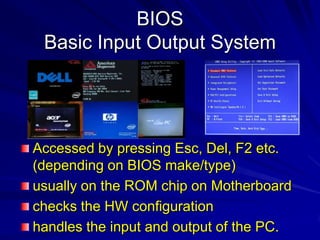
BIOS
 Basic Input Output System


Accessed by pressing Esc, Del, F2 etc.
(depending on BIOS make/type)
usually on the ROM chip on Motherboard
checks the HW configuration
handles the input and output of the PC.
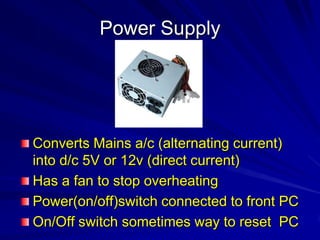
Power Supply


Converts Mains a/c (alternating current)
into d/c 5V or 12v (direct current)
Has a fan to stop overheating
Power(on/off)switch connected to front PC
On/Off switch sometimes way to reset PC
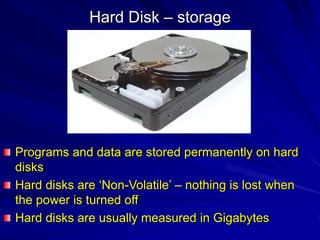
Hard Disk – storage


Programs and data are stored permanently on hard
disks
Hard disks are ‘Non-Volatile’ – nothing is lost when
the power is turned off
Hard disks are usually measured in Gigabytes
Internal Memory
RAM
ROM
Cache
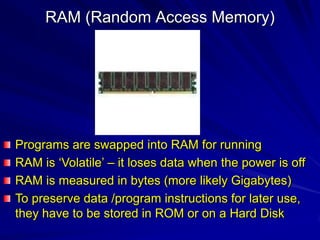
RAM (Random Access Memory)


Programs are swapped into RAM for running
RAM is ‘Volatile’ – it loses data when the power is off
RAM is measured in bytes (more likely Gigabytes)
To preserve data /program instructions for later use,
they have to be stored in ROM or on a Hard Disk
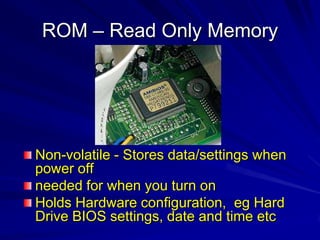
ROM – Read Only Memory


Non-volatile - Stores data/settings when
power off
needed for when you turn on
Holds Hardware configuration, eg Hard
Drive BIOS settings, date and time etc
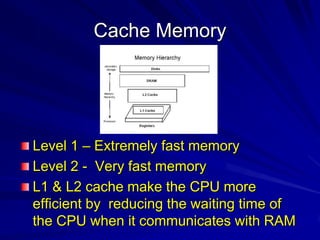
Cache Memory


Level 1 – Extremely fast memory
Level 2 - Very fast memory
L1 & L2 cache make the CPU more
efficient by reducing the waiting time of
the CPU when it communicates with RAM
Ports
Ports provide the link between peripheral
 and the CPU

 Parallel – transfers 1 byte (8 bits at a time)
 Serial – transfers 1 bit at a time
 USB – (Universal Serial Bus)
 – A higher speed serial connection
 ………………………………………
 ………………………………………
Specialised Cards
Network Card (NIC)
graphics card
……………..
……………..
……………..
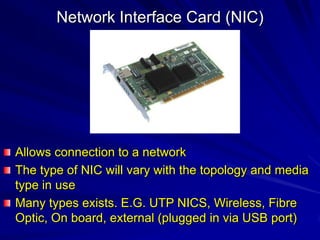
Network Interface Card (NIC)


Allows connection to a network
The type of NIC will vary with the topology and media
type in use
Many types exists. E.G. UTP NICS, Wireless, Fibre
Optic, On board, external (plugged in via USB port)
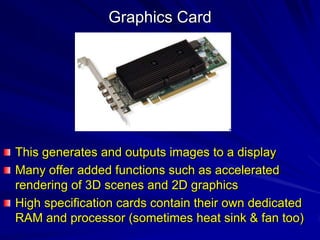
Graphics Card


This generates and outputs images to a display
Many offer added functions such as accelerated
rendering of 3D scenes and 2D graphics
High specification cards contain their own dedicated
RAM and processor (sometimes heat sink & fan too)

Nd0201 systemcomponents internal

  • 1.
    ND Unit 02 ComputerHardware Internal components
  • 2.
    Session Objectives Thissession looks at what is inside the system unit and what options you may have when purchasing a new system. 1. You will learn to recognise these components 2. You will learn what these components do 3. You will learn where these components go inside the system unit.
  • 3.
    System unit components Wewill look at the following system unit components: Processor (CPU) Fan and Heat Sink Motherboard BIOS Power Supply Hard disk drive – SATA, IDE,EIDE,master/slave Ports – USB, parallel, serial Internal Memory – RAM, ROM, Cache Specialised cards Network Interface Card (NIC) Graphics Card
  • 4.
    The Central ProcessingUnit (CPU) The CPU is what truly defines a computer It is the brain of the system & controls everything It processes program instructions & performs calculations Speed is measured in GHz – the higher the number, the faster the processor works
  • 5.
    Fan and HeatSink or cooling Heat sink conducts heat away from CPU Fins on heat sink warms air around it Fan moves warm air away from heat sink cooling the CPU
  • 6.
    The Motherboard Houses allthe essential parts Connects the parts with buses Also, connections between the PC and peripherals go through it
  • 7.
    BIOS Basic InputOutput System Accessed by pressing Esc, Del, F2 etc. (depending on BIOS make/type) usually on the ROM chip on Motherboard checks the HW configuration handles the input and output of the PC.
  • 8.
    Power Supply Converts Mainsa/c (alternating current) into d/c 5V or 12v (direct current) Has a fan to stop overheating Power(on/off)switch connected to front PC On/Off switch sometimes way to reset PC
  • 9.
    Hard Disk –storage Programs and data are stored permanently on hard disks Hard disks are ‘Non-Volatile’ – nothing is lost when the power is turned off Hard disks are usually measured in Gigabytes
  • 10.
  • 11.
    RAM (Random AccessMemory) Programs are swapped into RAM for running RAM is ‘Volatile’ – it loses data when the power is off RAM is measured in bytes (more likely Gigabytes) To preserve data /program instructions for later use, they have to be stored in ROM or on a Hard Disk
  • 12.
    ROM – ReadOnly Memory Non-volatile - Stores data/settings when power off needed for when you turn on Holds Hardware configuration, eg Hard Drive BIOS settings, date and time etc
  • 13.
    Cache Memory Level 1– Extremely fast memory Level 2 - Very fast memory L1 & L2 cache make the CPU more efficient by reducing the waiting time of the CPU when it communicates with RAM
  • 14.
    Ports Ports provide thelink between peripheral and the CPU Parallel – transfers 1 byte (8 bits at a time) Serial – transfers 1 bit at a time USB – (Universal Serial Bus) – A higher speed serial connection ……………………………………… ………………………………………
  • 15.
    Specialised Cards Network Card(NIC) graphics card …………….. …………….. ……………..
  • 16.
    Network Interface Card(NIC) Allows connection to a network The type of NIC will vary with the topology and media type in use Many types exists. E.G. UTP NICS, Wireless, Fibre Optic, On board, external (plugged in via USB port)
  • 17.
    Graphics Card This generatesand outputs images to a display Many offer added functions such as accelerated rendering of 3D scenes and 2D graphics High specification cards contain their own dedicated RAM and processor (sometimes heat sink & fan too)