ARTIFICIAL FABRICS
Group Name:
Kawther Hameed
Azra Maliha
INDEX
1. Nylon
2. Polyester
3. Acrylic
4. Lyocell
5. Acetate
6. Metallic fiber
7. Olefin
8. Synthetic organza
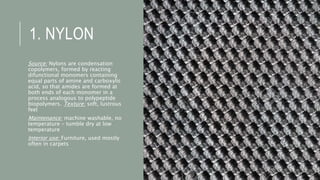
1. NYLON
Source: Nylons are condensation
copolymers, formed by reacting
difunctional monomers containing
equal parts of amine and carboxylic
acid, so that amides are formed at
both ends of each monomer in a
process analogous to polypeptide
biopolymers. Texture: soft, lustrous
feel
Maintenance: machine washable, no
temperature – tumble dry at low
temperature
Interior use: Furniture, used mostly
often in carpets
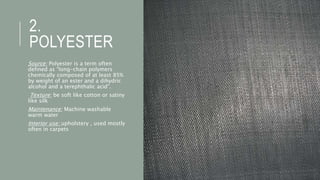
2.
POLYESTER
Source: Polyester is a term often
defined as “long-chain polymers
chemically composed of at least 85%
by weight of an ester and a dihydric
alcohol and a terephthalic acid”.
Texture: be soft like cotton or satiny
like silk
Maintenance: Machine washable
warm water
Interior use: upholstery , used mostly
often in carpets
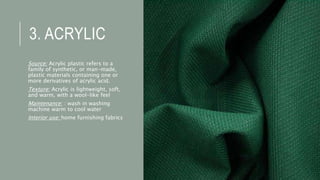
3. ACRYLIC
Source: Acrylic plastic refers to a
family of synthetic, or man-made,
plastic materials containing one or
more derivatives of acrylic acid.
Texture: Acrylic is lightweight, soft,
and warm, with a wool-like feel
Maintenance: : wash in washing
machine warm to cool water
Interior use: home furnishing fabrics
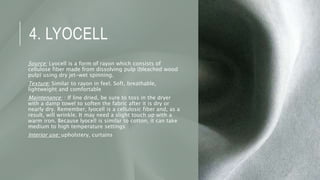
4. LYOCELL
Source: Lyocell is a form of rayon which consists of
cellulose fiber made from dissolving pulp (bleached wood
pulp) using dry jet-wet spinning.
Texture: Similar to rayon in feel. Soft, breathable,
lightweight and comfortable
Maintenance: : If line dried, be sure to toss in the dryer
with a damp towel to soften the fabric after it is dry or
nearly dry. Remember, lyocell is a cellulosic fiber and, as a
result, will wrinkle. It may need a slight touch up with a
warm iron. Because lyocell is similar to cotton, it can take
medium to high temperature settings
Interior use: upholstery, curtains
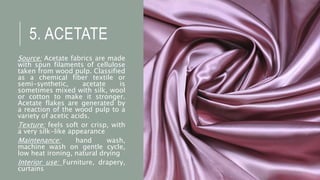
5. ACETATE
Source: Acetate fabrics are made
with spun filaments of cellulose
taken from wood pulp. Classified
as a chemical fiber textile or
semi-synthetic, acetate is
sometimes mixed with silk, wool
or cotton to make it stronger.
Acetate flakes are generated by
a reaction of the wood pulp to a
variety of acetic acids.
Texture: feels soft or crisp, with
a very silk-like appearance
Maintenance: hand wash,
machine wash on gentle cycle,
low heat ironing, natural drying
Interior use: Furniture, drapery,
curtains
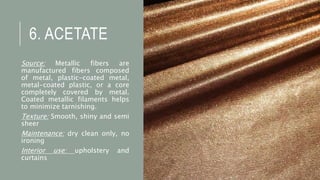
6. ACETATE
Source: Metallic fibers are
manufactured fibers composed
of metal, plastic-coated metal,
metal-coated plastic, or a core
completely covered by metal.
Coated metallic filaments helps
to minimize tarnishing.
Texture: Smooth, shiny and semi
sheer
Maintenance: dry clean only, no
ironing
Interior use: upholstery and
curtains
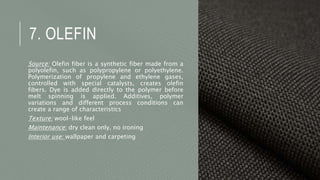
7. OLEFIN
Source: Olefin fiber is a synthetic fiber made from a
polyolefin, such as polypropylene or polyethylene.
Polymerization of propylene and ethylene gases,
controlled with special catalysts, creates olefin
fibers. Dye is added directly to the polymer before
melt spinning is applied. Additives, polymer
variations and different process conditions can
create a range of characteristics
Texture: wool-like feel
Maintenance: dry clean only, no ironing
Interior use: wallpaper and carpeting
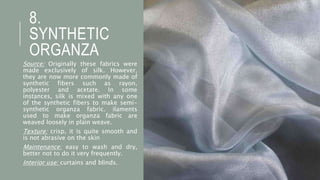
8.
SYNTHETIC
ORGANZA
Source: Originally these fabrics were
made exclusively of silk. However,
they are now more commonly made of
synthetic fibers such as rayon,
polyester and acetate. In some
instances, silk is mixed with any one
of the synthetic fibers to make semi-
synthetic organza fabric. ilaments
used to make organza fabric are
weaved loosely in plain weave.
Texture: crisp, it is quite smooth and
is not abrasive on the skin
Maintenance: easy to wash and dry,
better not to do it very frequently.
Interior use: curtains and blinds.
NATURAL FABRICS
Group Name:
Tala Dani
Rand Ibrahim
INDEX
1. Satin
2. Velvet
3. Terry
4. Chiffon
5. Cotton
6. Wool
7. Silk
8. linen
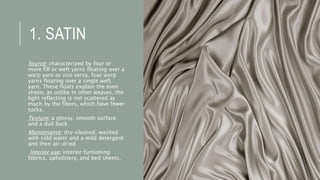
1. SATIN
Source: characterized by four or
more fill or weft yarns floating over a
warp yarn or vice versa, four warp
yarns floating over a single weft
yarn. These floats explain the even
sheen, as unlike in other weaves, the
light reflecting is not scattered as
much by the fibers, which have fewer
tucks.
Texture: a glossy, smooth surface
and a dull back
Maintenance: dry-cleaned, washed
with cold water and a mild detergent
and then air-dried
Interior use: interior furnishing
fabrics, upholstery, and bed sheets.
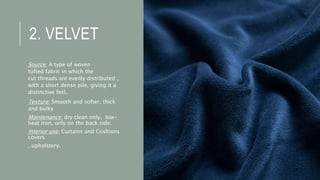
2. VELVET
Source: A type of woven
tufted fabric in which the
cut threads are evenly distributed ,
with a short dense pile, giving it a
distinctive feel.
Texture: Smooth and softer, thick
and bulky
Maintenance: dry clean only, low-
heat iron, only on the back side.
Interior use: Curtains and Cushions
covers
, upholstery.
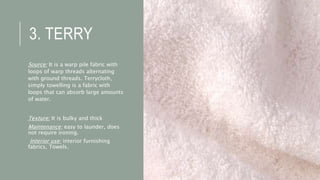
3. TERRY
Source: It is a warp pile fabric with
loops of warp threads alternating
with ground threads. Terrycloth,
simply towelling is a fabric with
loops that can absorb large amounts
of water.
Texture: It is bulky and thick
Maintenance: easy to launder, does
not require ironing.
Interior use: interior furnishing
fabrics, Towels.
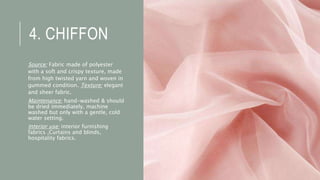
4. CHIFFON
Source: Fabric made of polyester
with a soft and crispy texture, made
from high twisted yarn and woven in
gummed condition. Texture: elegant
and sheer fabric.
Maintenance: hand-washed & should
be dried immediately, machine
washed but only with a gentle, cold
water setting.
Interior use: interior furnishing
fabrics ,Curtains and blinds,
hospitality fabrics.
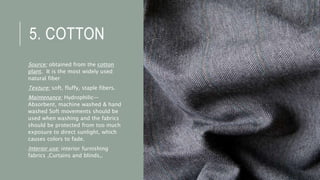
5. COTTON
Source: obtained from the cotton
plant. It is the most widely used
natural fiber
Texture: soft, fluffy, staple fibers.
Maintenance: Hydrophilic—
Absorbent, machine washed & hand
washed Soft movements should be
used when washing and the fabrics
should be protected from too much
exposure to direct sunlight, which
causes colors to fade.
Interior use: interior furnishing
fabrics ,Curtains and blinds,.
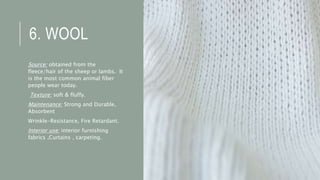
6. WOOL
Source: obtained from the
fleece/hair of the sheep or lambs. It
is the most common animal fiber
people wear today.
Texture: soft & fluffy.
Maintenance: Strong and Durable,
Absorbent
Wrinkle-Resistance, Fire Retardant.
Interior use: interior furnishing
fabrics ,Curtains , carpeting.
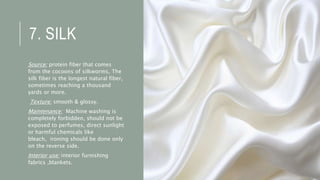
7. SILK
Source: protein fiber that comes
from the cocoons of silkworms, The
silk fiber is the longest natural fiber,
sometimes reaching a thousand
yards or more.
Texture: smooth & glossy.
Maintenance: Machine washing is
completely forbidden, should not be
exposed to perfumes, direct sunlight
or harmful chemicals like
bleach, ironing should be done only
on the reverse side.
Interior use: interior furnishing
fabrics ,blankets.
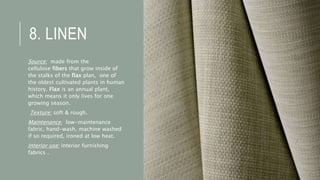
8. LINEN
Source: made from the
cellulose fibers that grow inside of
the stalks of the flax plan, one of
the oldest cultivated plants in human
history. Flax is an annual plant,
which means it only lives for one
growing season.
Texture: soft & rough.
Maintenance: low-maintenance
fabric, hand-wash, machine washed
if so required, ironed at low heat.
Interior use: interior furnishing
fabrics .
REFERENCES
ohttp://www.apparelsearch.com/definitions/fiber/acetate_definition.htm
ohttp://www.ehow.com/info_8480974_acetate-fabric.html
ohttp://www.typesofclothingfabrics.com/acetate-fabric.shtml
ohttp://www.typesofclothingfabrics.com/organza-fabrics.shtml
ohttp://essenziale-hd.com/2013/04/24/textiles-glossary-home-decorating-fabrics-from-a-to-z/
ohttps://en.wikipedia.org/wiki/Nylon
ohttp://www.streetdirectory.com/travel_guide/31155/home_accessories/proper_way_to_maintain_nylon_fabrics.html
ohttps://en.wikipedia.org/wiki/Polyester

Artificial fibers

  • 1.
  • 2.
    INDEX 1. Nylon 2. Polyester 3.Acrylic 4. Lyocell 5. Acetate 6. Metallic fiber 7. Olefin 8. Synthetic organza
  • 3.
    1. NYLON Source: Nylonsare condensation copolymers, formed by reacting difunctional monomers containing equal parts of amine and carboxylic acid, so that amides are formed at both ends of each monomer in a process analogous to polypeptide biopolymers. Texture: soft, lustrous feel Maintenance: machine washable, no temperature – tumble dry at low temperature Interior use: Furniture, used mostly often in carpets
  • 4.
    2. POLYESTER Source: Polyester isa term often defined as “long-chain polymers chemically composed of at least 85% by weight of an ester and a dihydric alcohol and a terephthalic acid”. Texture: be soft like cotton or satiny like silk Maintenance: Machine washable warm water Interior use: upholstery , used mostly often in carpets
  • 5.
    3. ACRYLIC Source: Acrylicplastic refers to a family of synthetic, or man-made, plastic materials containing one or more derivatives of acrylic acid. Texture: Acrylic is lightweight, soft, and warm, with a wool-like feel Maintenance: : wash in washing machine warm to cool water Interior use: home furnishing fabrics
  • 6.
    4. LYOCELL Source: Lyocellis a form of rayon which consists of cellulose fiber made from dissolving pulp (bleached wood pulp) using dry jet-wet spinning. Texture: Similar to rayon in feel. Soft, breathable, lightweight and comfortable Maintenance: : If line dried, be sure to toss in the dryer with a damp towel to soften the fabric after it is dry or nearly dry. Remember, lyocell is a cellulosic fiber and, as a result, will wrinkle. It may need a slight touch up with a warm iron. Because lyocell is similar to cotton, it can take medium to high temperature settings Interior use: upholstery, curtains
  • 7.
    5. ACETATE Source: Acetatefabrics are made with spun filaments of cellulose taken from wood pulp. Classified as a chemical fiber textile or semi-synthetic, acetate is sometimes mixed with silk, wool or cotton to make it stronger. Acetate flakes are generated by a reaction of the wood pulp to a variety of acetic acids. Texture: feels soft or crisp, with a very silk-like appearance Maintenance: hand wash, machine wash on gentle cycle, low heat ironing, natural drying Interior use: Furniture, drapery, curtains
  • 8.
    6. ACETATE Source: Metallicfibers are manufactured fibers composed of metal, plastic-coated metal, metal-coated plastic, or a core completely covered by metal. Coated metallic filaments helps to minimize tarnishing. Texture: Smooth, shiny and semi sheer Maintenance: dry clean only, no ironing Interior use: upholstery and curtains
  • 9.
    7. OLEFIN Source: Olefinfiber is a synthetic fiber made from a polyolefin, such as polypropylene or polyethylene. Polymerization of propylene and ethylene gases, controlled with special catalysts, creates olefin fibers. Dye is added directly to the polymer before melt spinning is applied. Additives, polymer variations and different process conditions can create a range of characteristics Texture: wool-like feel Maintenance: dry clean only, no ironing Interior use: wallpaper and carpeting
  • 10.
    8. SYNTHETIC ORGANZA Source: Originally thesefabrics were made exclusively of silk. However, they are now more commonly made of synthetic fibers such as rayon, polyester and acetate. In some instances, silk is mixed with any one of the synthetic fibers to make semi- synthetic organza fabric. ilaments used to make organza fabric are weaved loosely in plain weave. Texture: crisp, it is quite smooth and is not abrasive on the skin Maintenance: easy to wash and dry, better not to do it very frequently. Interior use: curtains and blinds.
  • 11.
  • 12.
    INDEX 1. Satin 2. Velvet 3.Terry 4. Chiffon 5. Cotton 6. Wool 7. Silk 8. linen
  • 13.
    1. SATIN Source: characterizedby four or more fill or weft yarns floating over a warp yarn or vice versa, four warp yarns floating over a single weft yarn. These floats explain the even sheen, as unlike in other weaves, the light reflecting is not scattered as much by the fibers, which have fewer tucks. Texture: a glossy, smooth surface and a dull back Maintenance: dry-cleaned, washed with cold water and a mild detergent and then air-dried Interior use: interior furnishing fabrics, upholstery, and bed sheets.
  • 14.
    2. VELVET Source: Atype of woven tufted fabric in which the cut threads are evenly distributed , with a short dense pile, giving it a distinctive feel. Texture: Smooth and softer, thick and bulky Maintenance: dry clean only, low- heat iron, only on the back side. Interior use: Curtains and Cushions covers , upholstery.
  • 15.
    3. TERRY Source: Itis a warp pile fabric with loops of warp threads alternating with ground threads. Terrycloth, simply towelling is a fabric with loops that can absorb large amounts of water. Texture: It is bulky and thick Maintenance: easy to launder, does not require ironing. Interior use: interior furnishing fabrics, Towels.
  • 16.
    4. CHIFFON Source: Fabricmade of polyester with a soft and crispy texture, made from high twisted yarn and woven in gummed condition. Texture: elegant and sheer fabric. Maintenance: hand-washed & should be dried immediately, machine washed but only with a gentle, cold water setting. Interior use: interior furnishing fabrics ,Curtains and blinds, hospitality fabrics.
  • 17.
    5. COTTON Source: obtainedfrom the cotton plant. It is the most widely used natural fiber Texture: soft, fluffy, staple fibers. Maintenance: Hydrophilic— Absorbent, machine washed & hand washed Soft movements should be used when washing and the fabrics should be protected from too much exposure to direct sunlight, which causes colors to fade. Interior use: interior furnishing fabrics ,Curtains and blinds,.
  • 18.
    6. WOOL Source: obtainedfrom the fleece/hair of the sheep or lambs. It is the most common animal fiber people wear today. Texture: soft & fluffy. Maintenance: Strong and Durable, Absorbent Wrinkle-Resistance, Fire Retardant. Interior use: interior furnishing fabrics ,Curtains , carpeting.
  • 19.
    7. SILK Source: proteinfiber that comes from the cocoons of silkworms, The silk fiber is the longest natural fiber, sometimes reaching a thousand yards or more. Texture: smooth & glossy. Maintenance: Machine washing is completely forbidden, should not be exposed to perfumes, direct sunlight or harmful chemicals like bleach, ironing should be done only on the reverse side. Interior use: interior furnishing fabrics ,blankets.
  • 20.
    8. LINEN Source: madefrom the cellulose fibers that grow inside of the stalks of the flax plan, one of the oldest cultivated plants in human history. Flax is an annual plant, which means it only lives for one growing season. Texture: soft & rough. Maintenance: low-maintenance fabric, hand-wash, machine washed if so required, ironed at low heat. Interior use: interior furnishing fabrics .
  • 21.