Under the supervision of
Dr. Jaiprakash Bhamu
Associate Professor,
DME
Presented by
Garima Sharma
Introduction to Passive Solar
System
 What is the meaning of this word “Passive” ?
 What is “Passive solar design”?
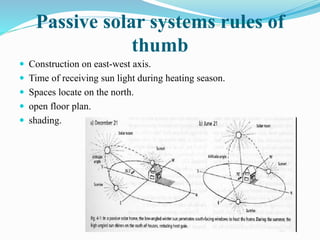
Passive solar systems rules of
thumb
 Construction on east-west axis.
 Time of receiving sun light during heating season.
 Spaces locate on the north.
 open floor plan.
 shading.
Basic Principles of Passive Solar
Design
 Passive solar design uses the elements of a building such as
orientation, windows, walls, roof and floors as well as the localized
environment to collect, store and distribute solar energy to heat a
home in winter, and block the sun’s heat in summer.
Generally, passive solar design makes use of the following elements:
 Orientation
 The local environment
 Insulation
 Energy efficient windows
 An absorber
Passive Solar Heating
 The goal of all passive solar heating systems is to capture the sun's
heat within the building's material and release that heat during
periods when the sun is not shining.
Primary elements of passive solar heating are :
 Thermal mass to absorb, store, and distribute heat.
 South-facing windows are designed to let the sun's heat in while
insulating against the cold.
 Open floor plans allow more sun inside.
There are 3 main methods of passive solar heating:
 Direct gain
 Indirect gain
 Isolated gain
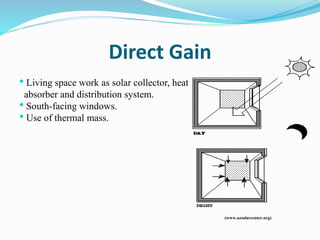
Direct Gain
• Living space work as solar collector, heat
absorber and distribution system.
• South-facing windows.
• Use of thermal mass.
(www.azsolarcenter.org)
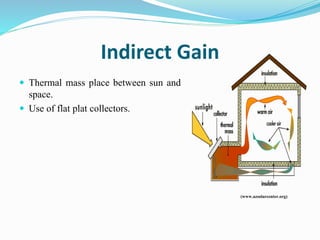
Indirect Gain
 Thermal mass place between sun and
space.
 Use of flat plat collectors.
(www.azsolarcenter.org)
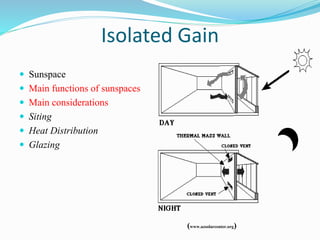
Isolated Gain
 Sunspace
 Main functions of sunspaces
 Main considerations
 Siting
 Heat Distribution
 Glazing
(www.azsolarcenter.org)
Passive solar cooling
 Passive cooling systems are least expensive means of cooling a home
which maximizes the efficiency of the building envelope without
any use of mechanical devices.
The primary focus of passive cooling is:
 Slow heat transfer into the house.
 Remove unwanted heat from the building.
Various passive technologies that can be adopted in the various
climatic zones in India are as follow:
 Shading system
 Ventilation
 Solar chimney
 Thermal mass
 Wind towers
 Evaporative cooling system
2.6.1
Shading system
 The most effective method of cooling a building is to shade
windows, walls and roof of building from direct solar radiation.
 There are two types of shading system:
 External Shading
 Internal Shading
External shading
These method used in external shading:
 Eaves
 Awnings
 Screens and shutters
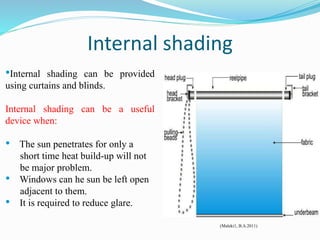
 Louvers
 Verandahs
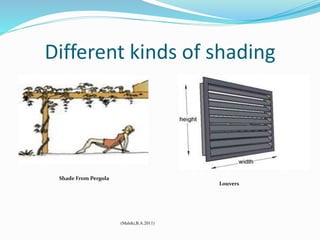
 Pergolas
 Trees and shrubs
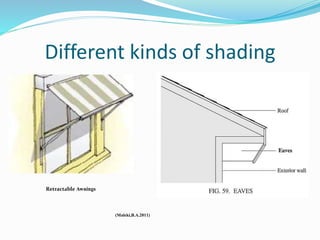
Different kinds of shading
Retractable Awnings
(Maleki,B.A.2011)
Different kinds of shading
(Maleki,B.A.2011)
Louvers
Shade From Pergola
Internal shading
•Internal shading can be provided
using curtains and blinds.
Internal shading can be a useful
device when:
• The sun penetrates for only a
short time heat build-up will not
be major problem.
• Windows can he sun be left open
adjacent to them.
• It is required to reduce glare.
(Maleki1, B.A.2011)
Passive solar ventilation
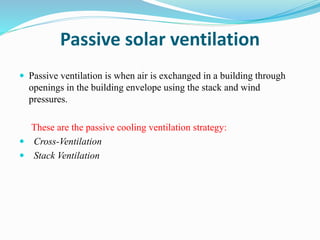
 Passive ventilation is when air is exchanged in a building through
openings in the building envelope using the stack and wind
pressures.
These are the passive cooling ventilation strategy:
 Cross-Ventilation
 Stack Ventilation
Cross-Ventilation
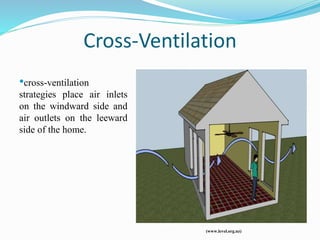
•cross-ventilation
strategies place air inlets
on the windward side and
air outlets on the leeward
side of the home.
(www.level.org.nz)
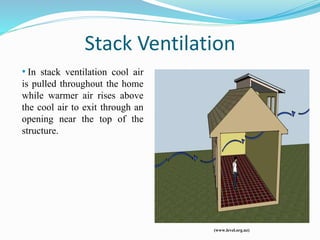
Stack Ventilation
• In stack ventilation cool air
is pulled throughout the home
while warmer air rises above
the cool air to exit through an
opening near the top of the
structure.
(www.level.org.nz)
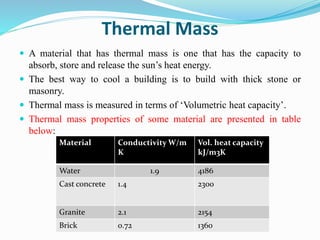
Thermal Mass
 A material that has thermal mass is one that has the capacity to
absorb, store and release the sun’s heat energy.
 The best way to cool a building is to build with thick stone or
masonry.
 Thermal mass is measured in terms of ‘Volumetric heat capacity’.
 Thermal mass properties of some material are presented in table
below:
Material Conductivity W/m
K
Vol. heat capacity
kJ/m3K
Water 1.9 4186
Cast concrete 1.4 2300
Granite 2.1 2154
Brick 0.72 1360
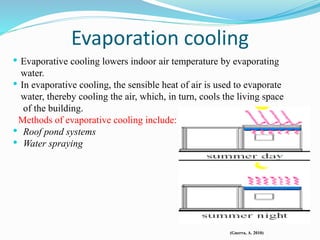
Evaporation cooling
• Evaporative cooling lowers indoor air temperature by evaporating
water.
• In evaporative cooling, the sensible heat of air is used to evaporate
water, thereby cooling the air, which, in turn, cools the living space
of the building.
Methods of evaporative cooling include:
• Roof pond systems
• Water spraying
(Guerra, A. 2010)
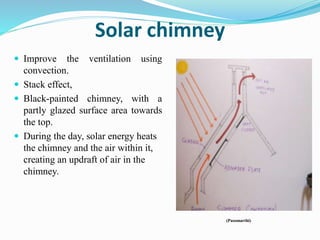
Solar chimney
 Improve the ventilation using
convection.
 Stack effect,
 Black-painted chimney, with a
partly glazed surface area towards
the top.
 During the day, solar energy heats
the chimney and the air within it,
creating an updraft of air in the
chimney.
(Pasomarthi)
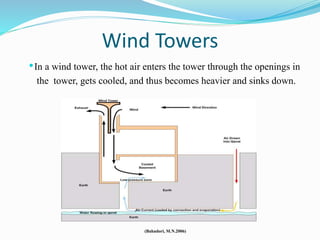
Wind Towers
•In a wind tower, the hot air enters the tower through the openings in
the tower, gets cooled, and thus becomes heavier and sinks down.
(Bahadori, M.N.2006)
Advantage of Passive Solar Design
 Eliminate heating and cooling costs
 Reduce greenhouse gas emissions
 Clean process
 Eco-friendly
 Cost
 Attractive living environment
 Low maintenance
 Unwavering comfort
Disadvantage of Passive Solar
Design:-
 Great deal of work for the engineers to arrange this system.
 All systems are not same.
 Careful construction required
 Improperly designed not work well
 Sunshine not available all day
 Extra heat and the higher temperatures
 Thermal wall loses heat back to the out-of-doors through the glass
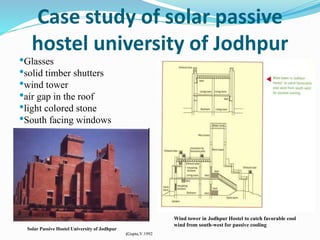
Case study of solar passive
hostel university of Jodhpur
Wind tower in Jodhpur Hostel to catch favorable cool
wind from south-west for passive cooling
•Glasses
•solid timber shutters
•wind tower
•air gap in the roof
•light colored stone
•South facing windows
Solar Passive Hostel University of Jodhpur
(Gupta,V.1992
References
 Kamal, M.A. (2012), “An Overview of Passive Cooling Techniques in
Buildings: Design Concepts and Architectural Interventions”, Acta
Technica Napocensis: Civil Engineering & Architecture, Vol. 55, No. 1,
pp. 84-97.
 Maleki, B.A (2011), “Shading: Passive Cooling And Energy
Conservation In Buildings”, International Journal on “Technical and
Physical Problems of Engineering”(IJTPE), Vol. 3, No. 4,pp, 72-79.
 Guerra, A. (2010), “The Roof-Pond or Roof Water A Solar System To
Gain Indirect”.
 Bahadori, M.N. (1978); “Passive Cooling System in Iranian
Architecture”, Scientific American, pp.144-154.
 Pasumarthi, N., and Sherif, S.A. (2008), “ Experimental And
Theoretical Performance Of A Demonstration Solar Chimney”.
 http://www.passivesolar.sustainablesources.com, cited on 12th Jan. 2014.
 http://www.azsolarcenter.org, cited on 16th Jan. 2014.
 Gupta, V.(1992),“ Solar Passive Hostel University of Jodhpur”,
ARCHITECTURE+DESIGN May-June 1992,pp. 34-35.
Thank You
Questions are Welcome

solar passive system for buildings

  • 1.
    Under the supervisionof Dr. Jaiprakash Bhamu Associate Professor, DME Presented by Garima Sharma
  • 2.
    Introduction to PassiveSolar System  What is the meaning of this word “Passive” ?  What is “Passive solar design”?
  • 3.
    Passive solar systemsrules of thumb  Construction on east-west axis.  Time of receiving sun light during heating season.  Spaces locate on the north.  open floor plan.  shading.
  • 4.
    Basic Principles ofPassive Solar Design  Passive solar design uses the elements of a building such as orientation, windows, walls, roof and floors as well as the localized environment to collect, store and distribute solar energy to heat a home in winter, and block the sun’s heat in summer. Generally, passive solar design makes use of the following elements:  Orientation  The local environment  Insulation  Energy efficient windows  An absorber
  • 5.
    Passive Solar Heating The goal of all passive solar heating systems is to capture the sun's heat within the building's material and release that heat during periods when the sun is not shining. Primary elements of passive solar heating are :  Thermal mass to absorb, store, and distribute heat.  South-facing windows are designed to let the sun's heat in while insulating against the cold.  Open floor plans allow more sun inside. There are 3 main methods of passive solar heating:  Direct gain  Indirect gain  Isolated gain
  • 6.
    Direct Gain • Livingspace work as solar collector, heat absorber and distribution system. • South-facing windows. • Use of thermal mass. (www.azsolarcenter.org)
  • 7.
    Indirect Gain  Thermalmass place between sun and space.  Use of flat plat collectors. (www.azsolarcenter.org)
  • 8.
    Isolated Gain  Sunspace Main functions of sunspaces  Main considerations  Siting  Heat Distribution  Glazing (www.azsolarcenter.org)
  • 9.
    Passive solar cooling Passive cooling systems are least expensive means of cooling a home which maximizes the efficiency of the building envelope without any use of mechanical devices. The primary focus of passive cooling is:  Slow heat transfer into the house.  Remove unwanted heat from the building. Various passive technologies that can be adopted in the various climatic zones in India are as follow:  Shading system  Ventilation  Solar chimney  Thermal mass  Wind towers  Evaporative cooling system 2.6.1
  • 10.
    Shading system  Themost effective method of cooling a building is to shade windows, walls and roof of building from direct solar radiation.  There are two types of shading system:  External Shading  Internal Shading
  • 11.
    External shading These methodused in external shading:  Eaves  Awnings  Screens and shutters  Louvers  Verandahs  Pergolas  Trees and shrubs
  • 12.
    Different kinds ofshading Retractable Awnings (Maleki,B.A.2011)
  • 13.
    Different kinds ofshading (Maleki,B.A.2011) Louvers Shade From Pergola
  • 14.
    Internal shading •Internal shadingcan be provided using curtains and blinds. Internal shading can be a useful device when: • The sun penetrates for only a short time heat build-up will not be major problem. • Windows can he sun be left open adjacent to them. • It is required to reduce glare. (Maleki1, B.A.2011)
  • 15.
    Passive solar ventilation Passive ventilation is when air is exchanged in a building through openings in the building envelope using the stack and wind pressures. These are the passive cooling ventilation strategy:  Cross-Ventilation  Stack Ventilation
  • 16.
    Cross-Ventilation •cross-ventilation strategies place airinlets on the windward side and air outlets on the leeward side of the home. (www.level.org.nz)
  • 17.
    Stack Ventilation • Instack ventilation cool air is pulled throughout the home while warmer air rises above the cool air to exit through an opening near the top of the structure. (www.level.org.nz)
  • 18.
    Thermal Mass  Amaterial that has thermal mass is one that has the capacity to absorb, store and release the sun’s heat energy.  The best way to cool a building is to build with thick stone or masonry.  Thermal mass is measured in terms of ‘Volumetric heat capacity’.  Thermal mass properties of some material are presented in table below: Material Conductivity W/m K Vol. heat capacity kJ/m3K Water 1.9 4186 Cast concrete 1.4 2300 Granite 2.1 2154 Brick 0.72 1360
  • 19.
    Evaporation cooling • Evaporativecooling lowers indoor air temperature by evaporating water. • In evaporative cooling, the sensible heat of air is used to evaporate water, thereby cooling the air, which, in turn, cools the living space of the building. Methods of evaporative cooling include: • Roof pond systems • Water spraying (Guerra, A. 2010)
  • 20.
    Solar chimney  Improvethe ventilation using convection.  Stack effect,  Black-painted chimney, with a partly glazed surface area towards the top.  During the day, solar energy heats the chimney and the air within it, creating an updraft of air in the chimney. (Pasomarthi)
  • 21.
    Wind Towers •In awind tower, the hot air enters the tower through the openings in the tower, gets cooled, and thus becomes heavier and sinks down. (Bahadori, M.N.2006)
  • 22.
    Advantage of PassiveSolar Design  Eliminate heating and cooling costs  Reduce greenhouse gas emissions  Clean process  Eco-friendly  Cost  Attractive living environment  Low maintenance  Unwavering comfort
  • 23.
    Disadvantage of PassiveSolar Design:-  Great deal of work for the engineers to arrange this system.  All systems are not same.  Careful construction required  Improperly designed not work well  Sunshine not available all day  Extra heat and the higher temperatures  Thermal wall loses heat back to the out-of-doors through the glass
  • 24.
    Case study ofsolar passive hostel university of Jodhpur Wind tower in Jodhpur Hostel to catch favorable cool wind from south-west for passive cooling •Glasses •solid timber shutters •wind tower •air gap in the roof •light colored stone •South facing windows Solar Passive Hostel University of Jodhpur (Gupta,V.1992
  • 25.
    References  Kamal, M.A.(2012), “An Overview of Passive Cooling Techniques in Buildings: Design Concepts and Architectural Interventions”, Acta Technica Napocensis: Civil Engineering & Architecture, Vol. 55, No. 1, pp. 84-97.  Maleki, B.A (2011), “Shading: Passive Cooling And Energy Conservation In Buildings”, International Journal on “Technical and Physical Problems of Engineering”(IJTPE), Vol. 3, No. 4,pp, 72-79.  Guerra, A. (2010), “The Roof-Pond or Roof Water A Solar System To Gain Indirect”.  Bahadori, M.N. (1978); “Passive Cooling System in Iranian Architecture”, Scientific American, pp.144-154.  Pasumarthi, N., and Sherif, S.A. (2008), “ Experimental And Theoretical Performance Of A Demonstration Solar Chimney”.  http://www.passivesolar.sustainablesources.com, cited on 12th Jan. 2014.  http://www.azsolarcenter.org, cited on 16th Jan. 2014.  Gupta, V.(1992),“ Solar Passive Hostel University of Jodhpur”, ARCHITECTURE+DESIGN May-June 1992,pp. 34-35.
  • 26.