Evolution Day 2
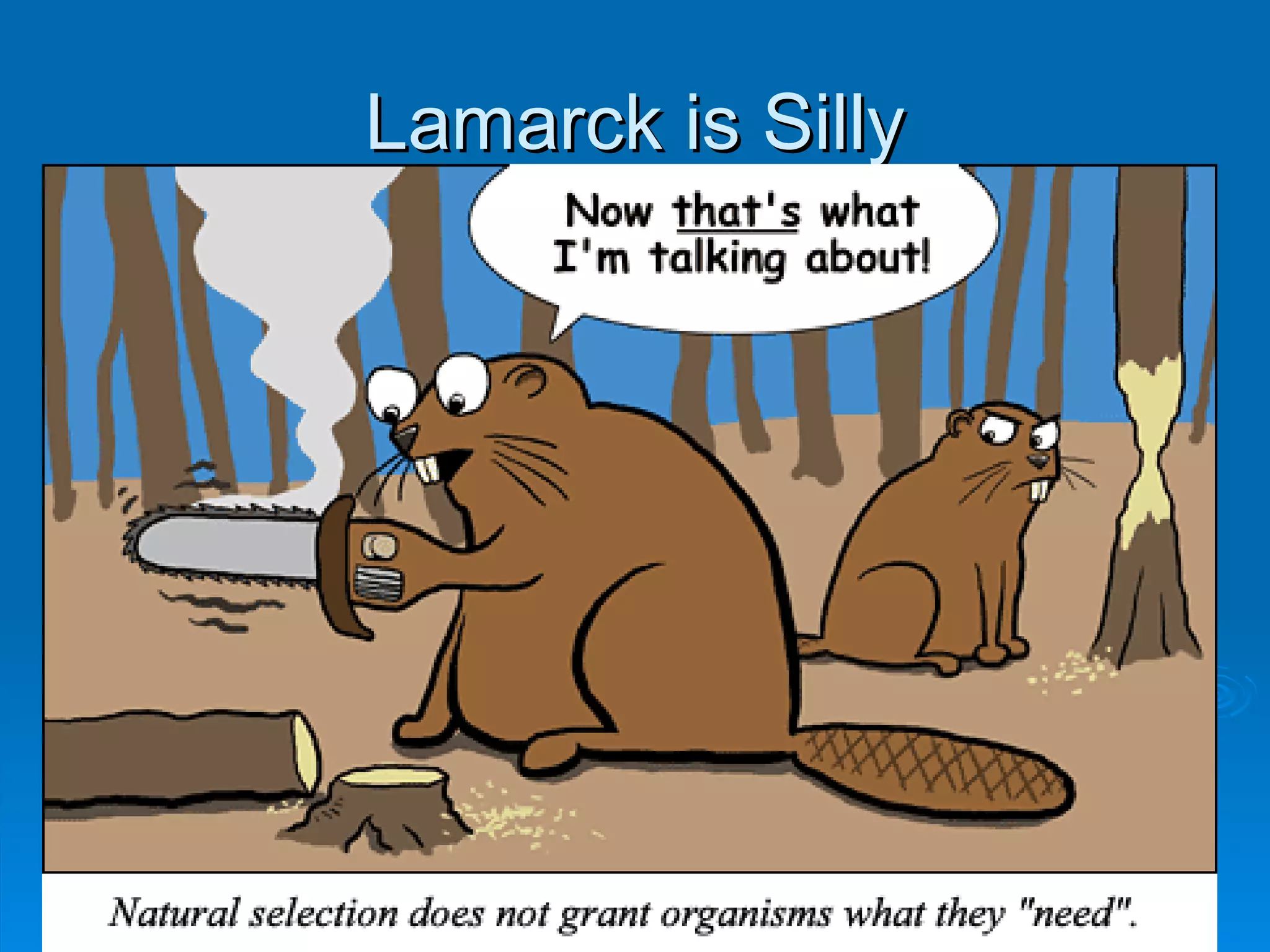
Lamarck is Silly
Key Terms Evolution :  Changes in a population of organisms over long periods of time. Natural Selection : process by which individuals that are better suited to their environment survive and reproduce successfully “AKA, Survival of the Fittest”  Remember: Individuals do not evolve,  populations do .
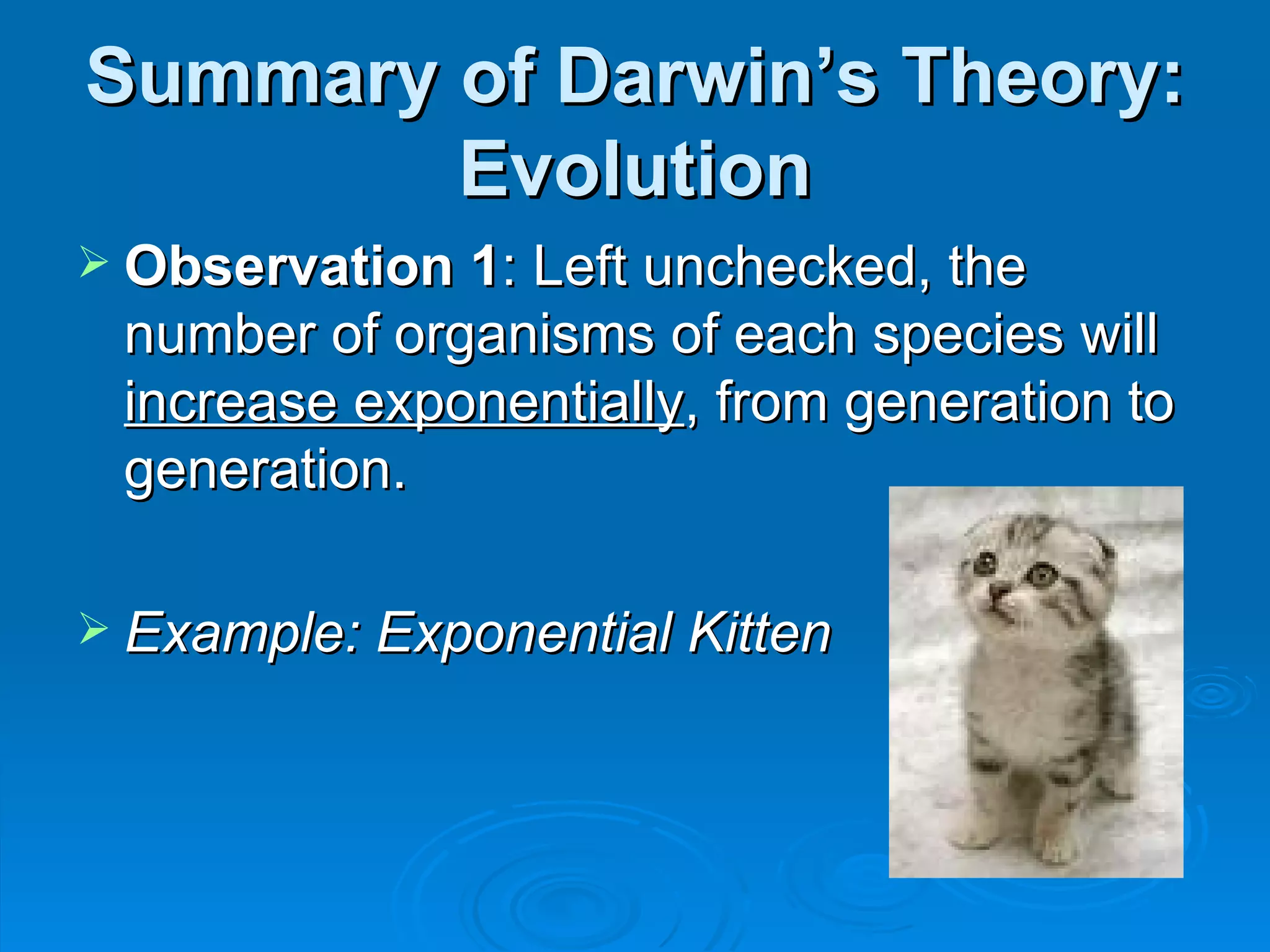
Summary of Darwin’s Theory: Evolution Observation 1 : Left unchecked, the number of organisms of each species will  increase exponentially , from generation to generation.  Example: Exponential Kitten
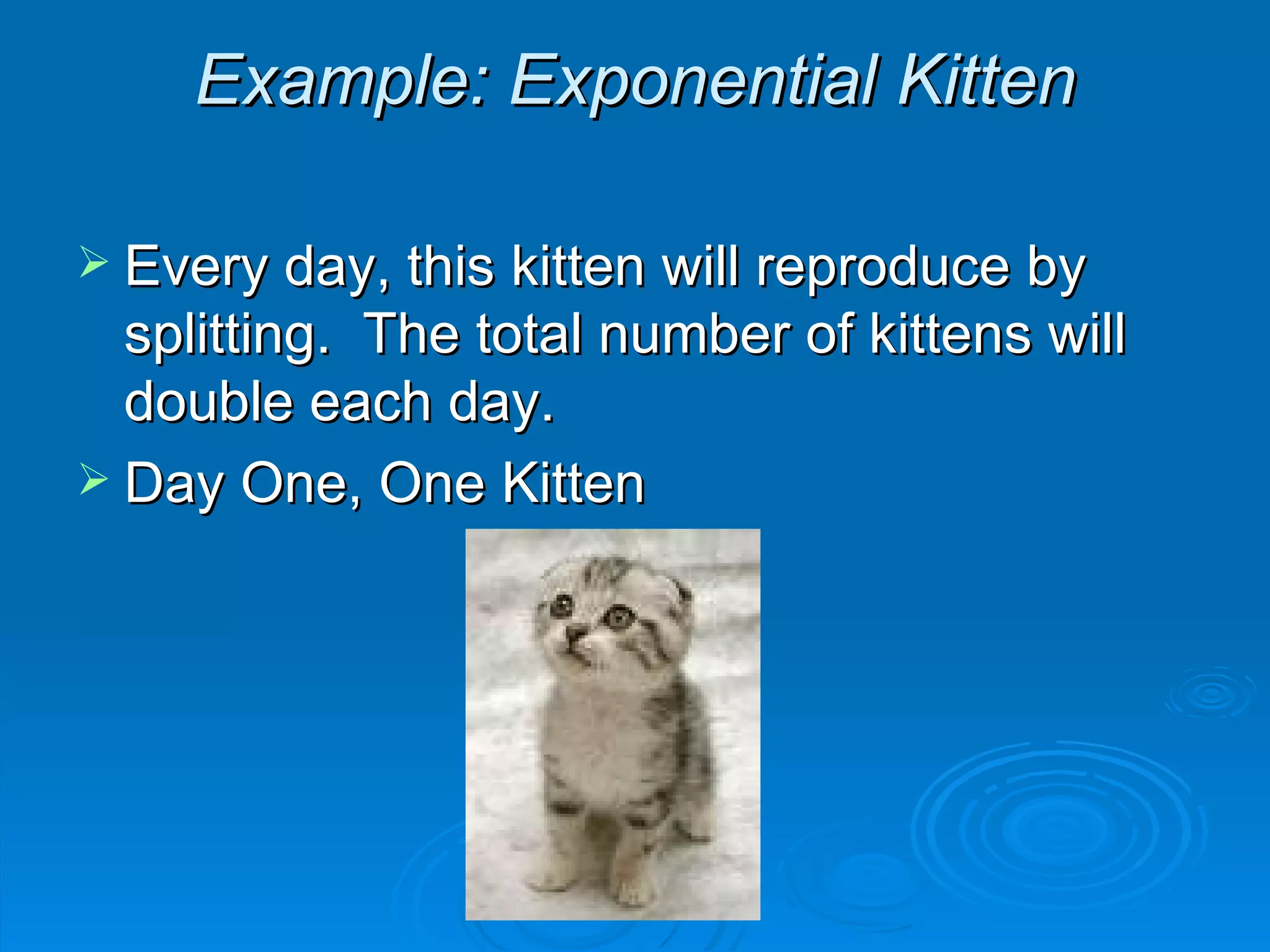
Example: Exponential Kitten Every day, this kitten will reproduce by splitting.  The total number of kittens will double each day. Day One, One Kitten
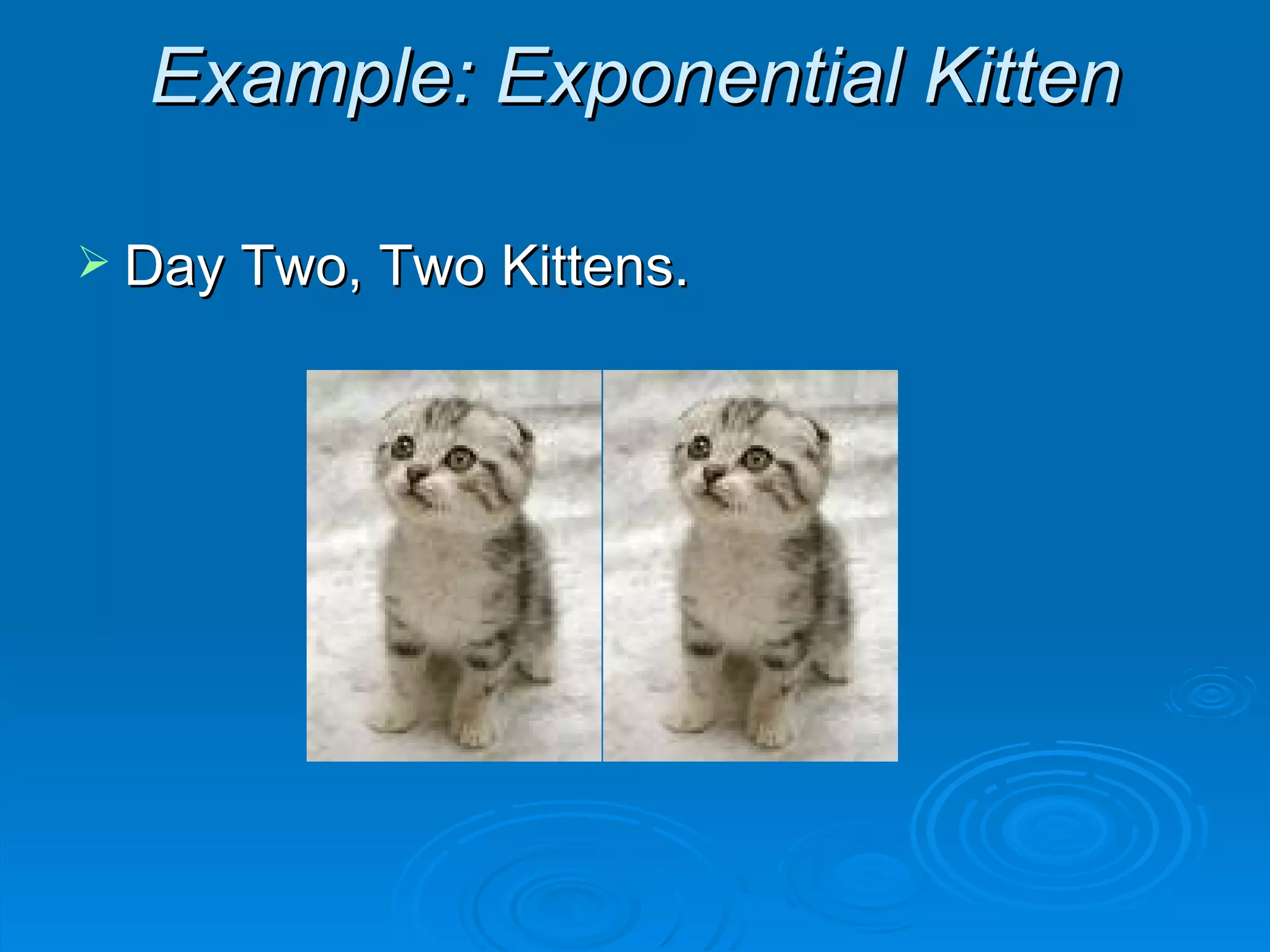
Example: Exponential Kitten Day Two, Two Kittens.
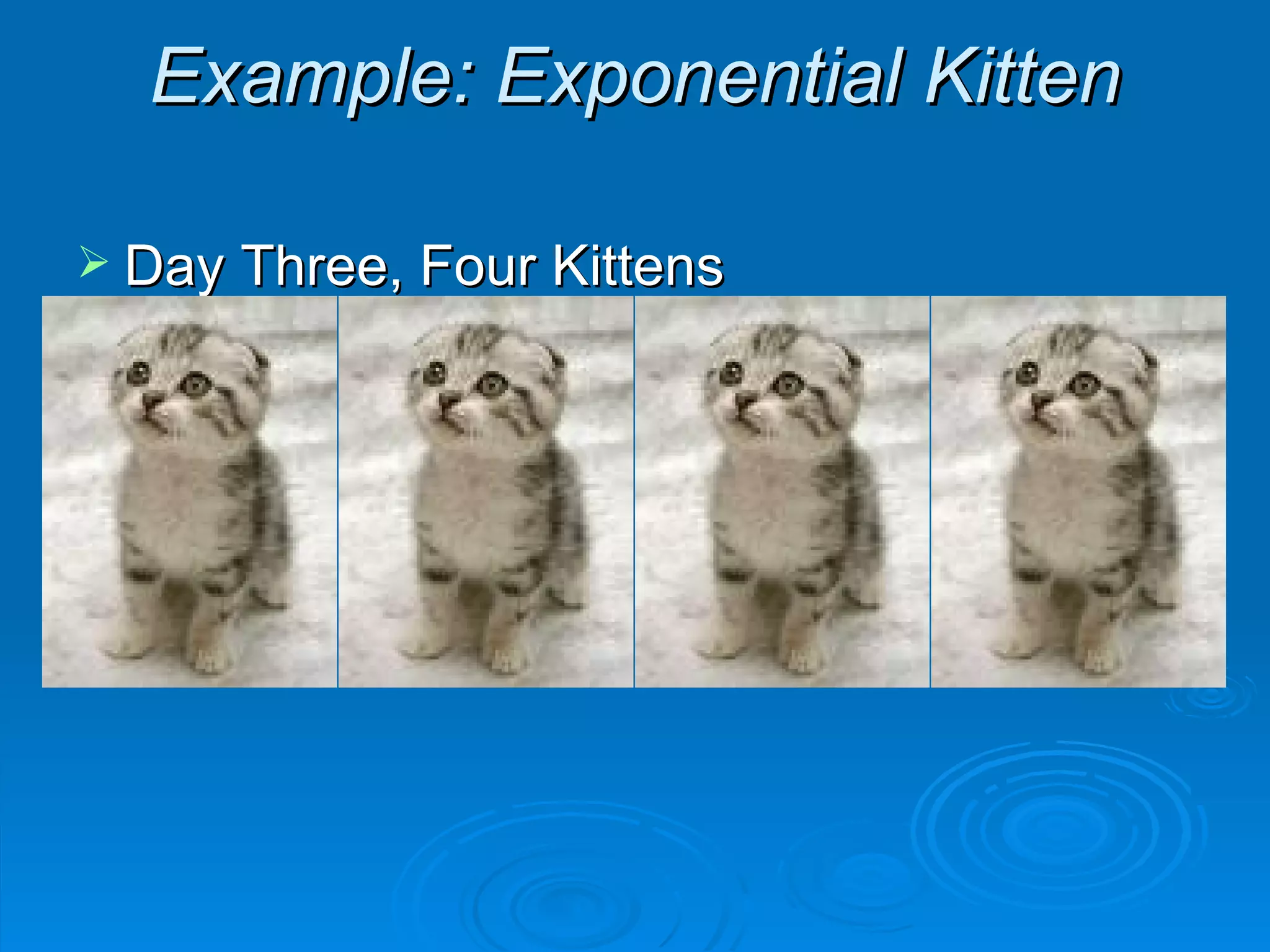
Example: Exponential Kitten Day Three, Four Kittens
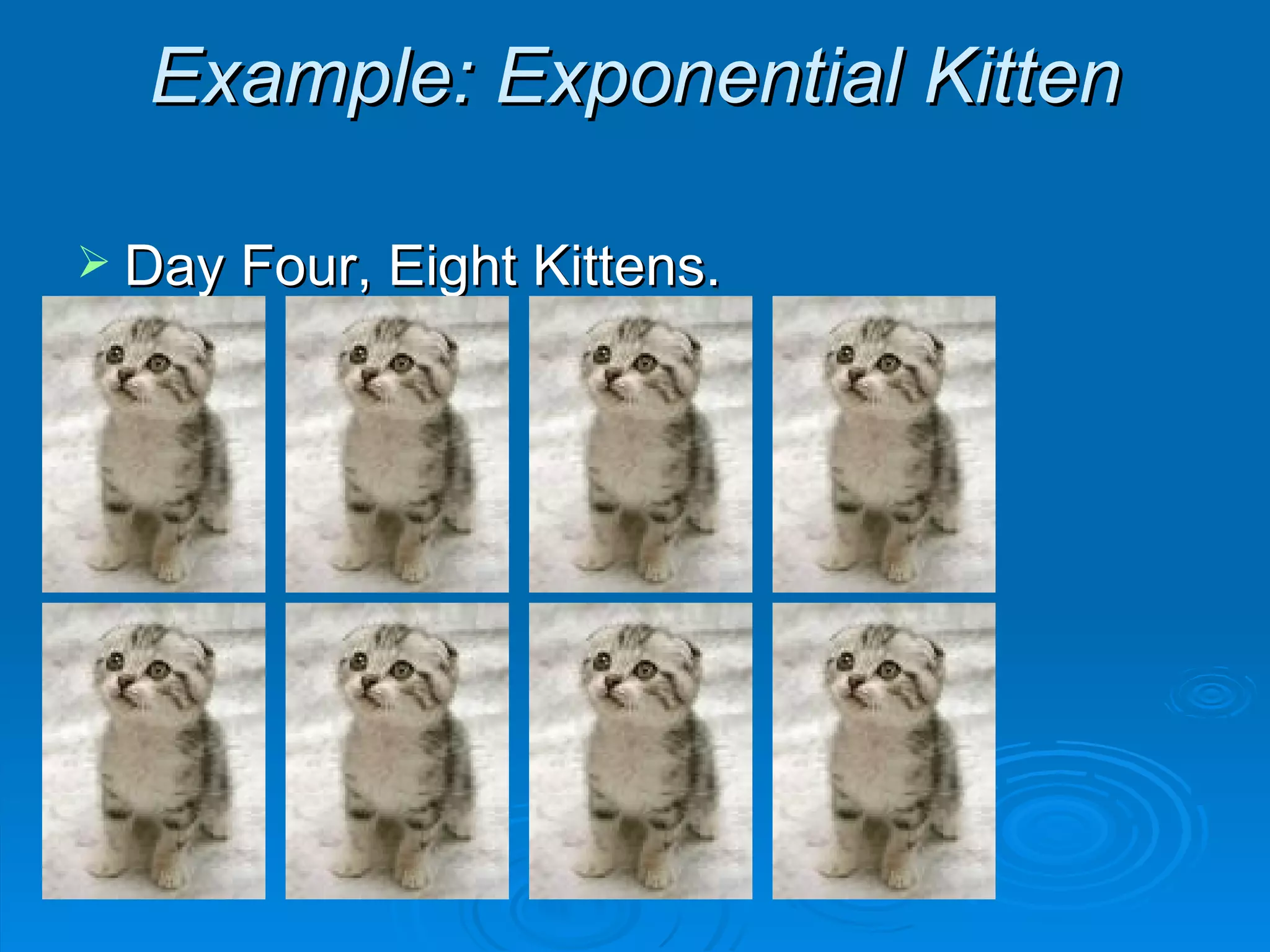
Example: Exponential Kitten Day Four, Eight Kittens.
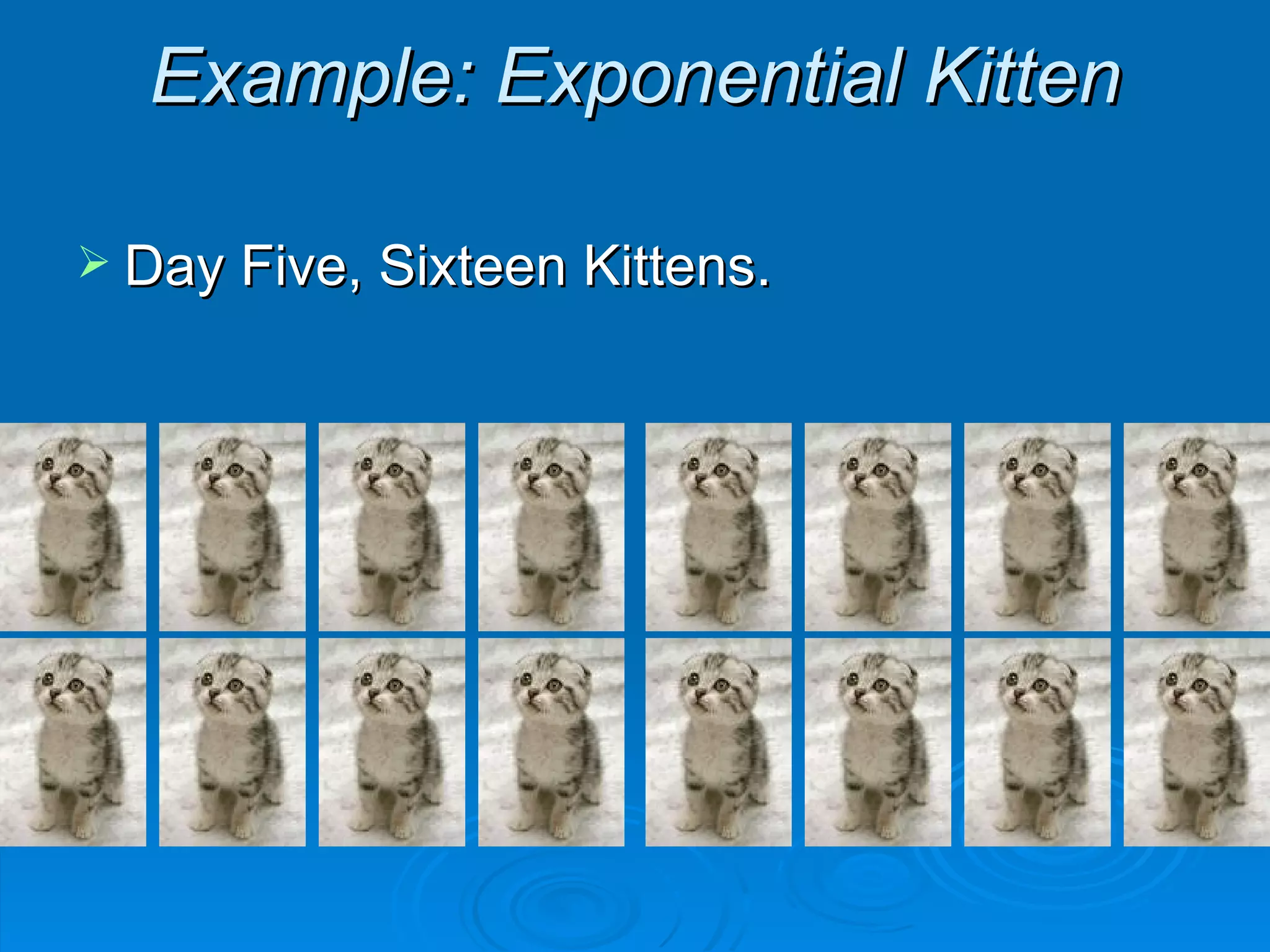
Example: Exponential Kitten Day Five, Sixteen Kittens.
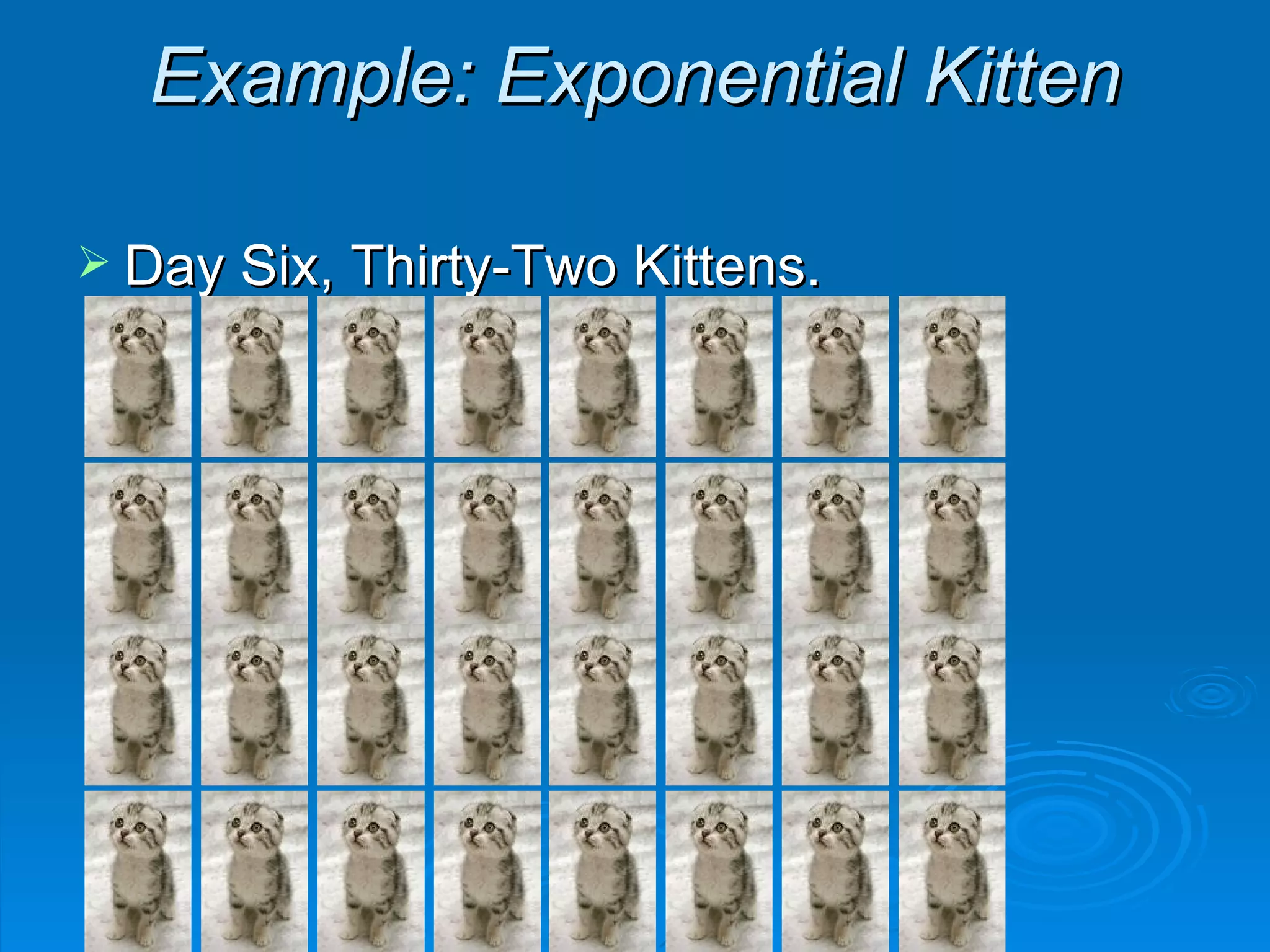
Example: Exponential Kitten Day Six, Thirty-Two Kittens.
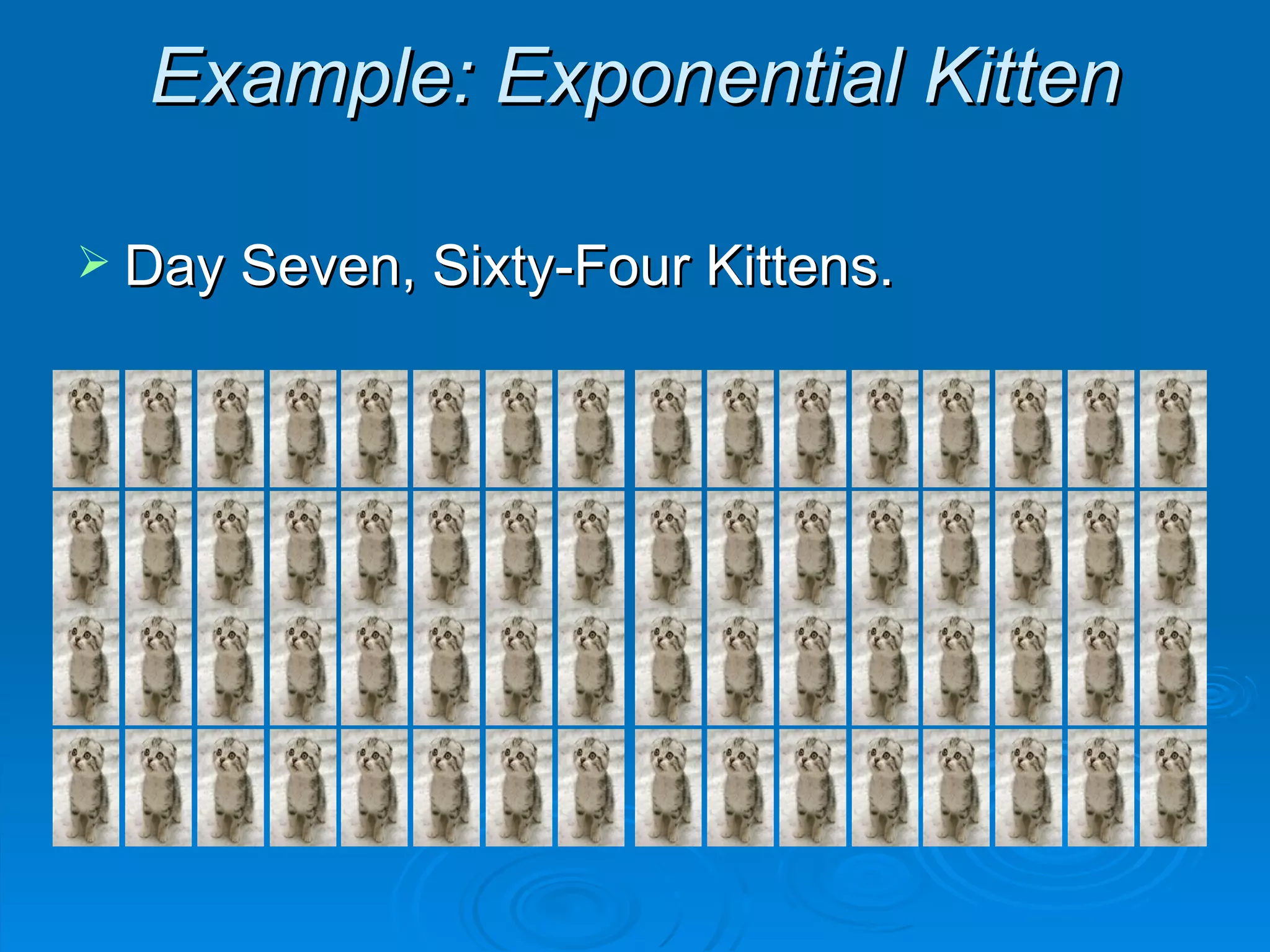
Example: Exponential Kitten Day Seven, Sixty-Four Kittens.
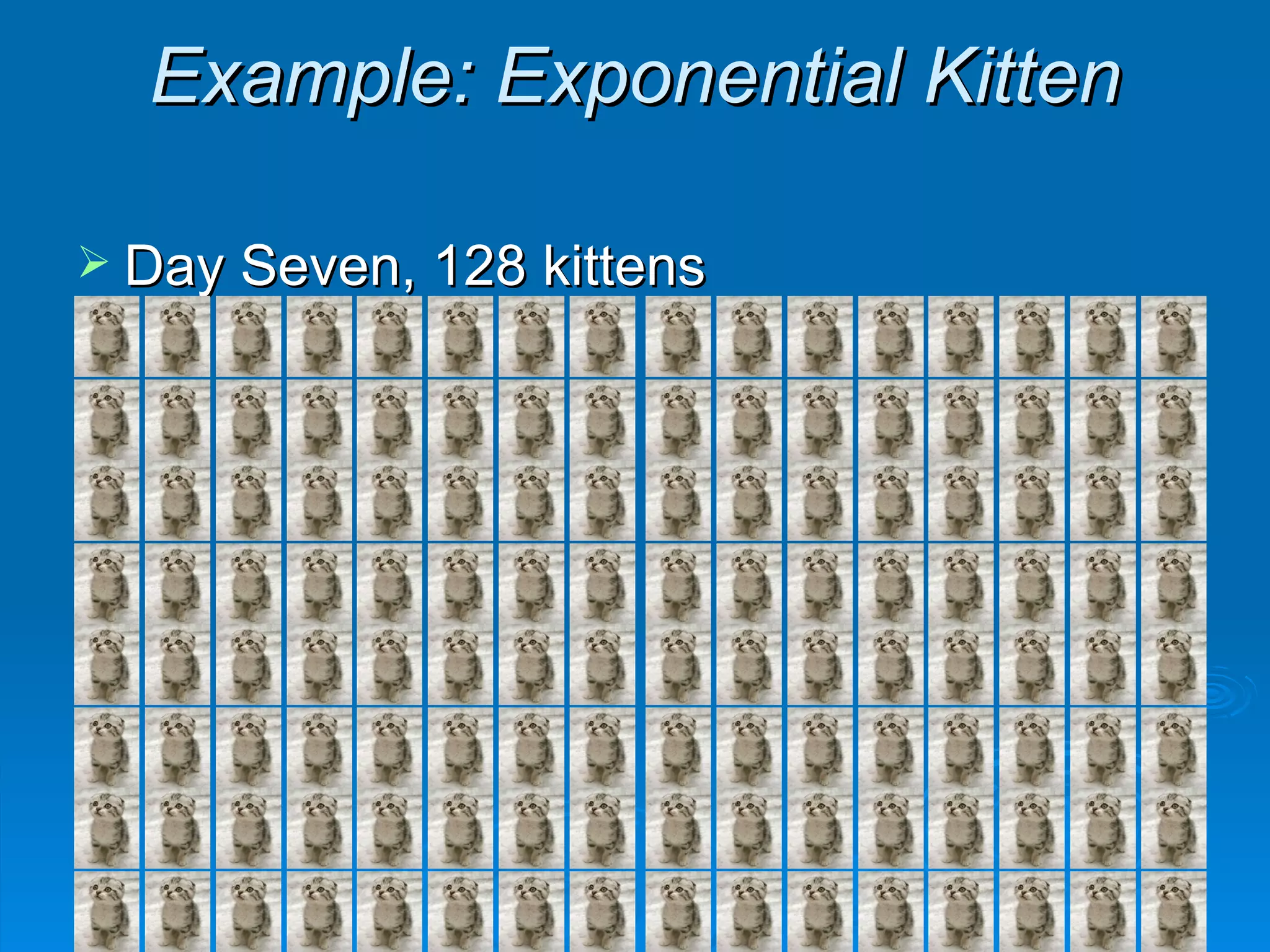
Example: Exponential Kitten Day Seven, 128 kittens
Summary of Darwin’s Theory: Evolution Observation 2 : In nature, populations tend to  remain stable in size .  Observation 3 : Environmental resources are limited.
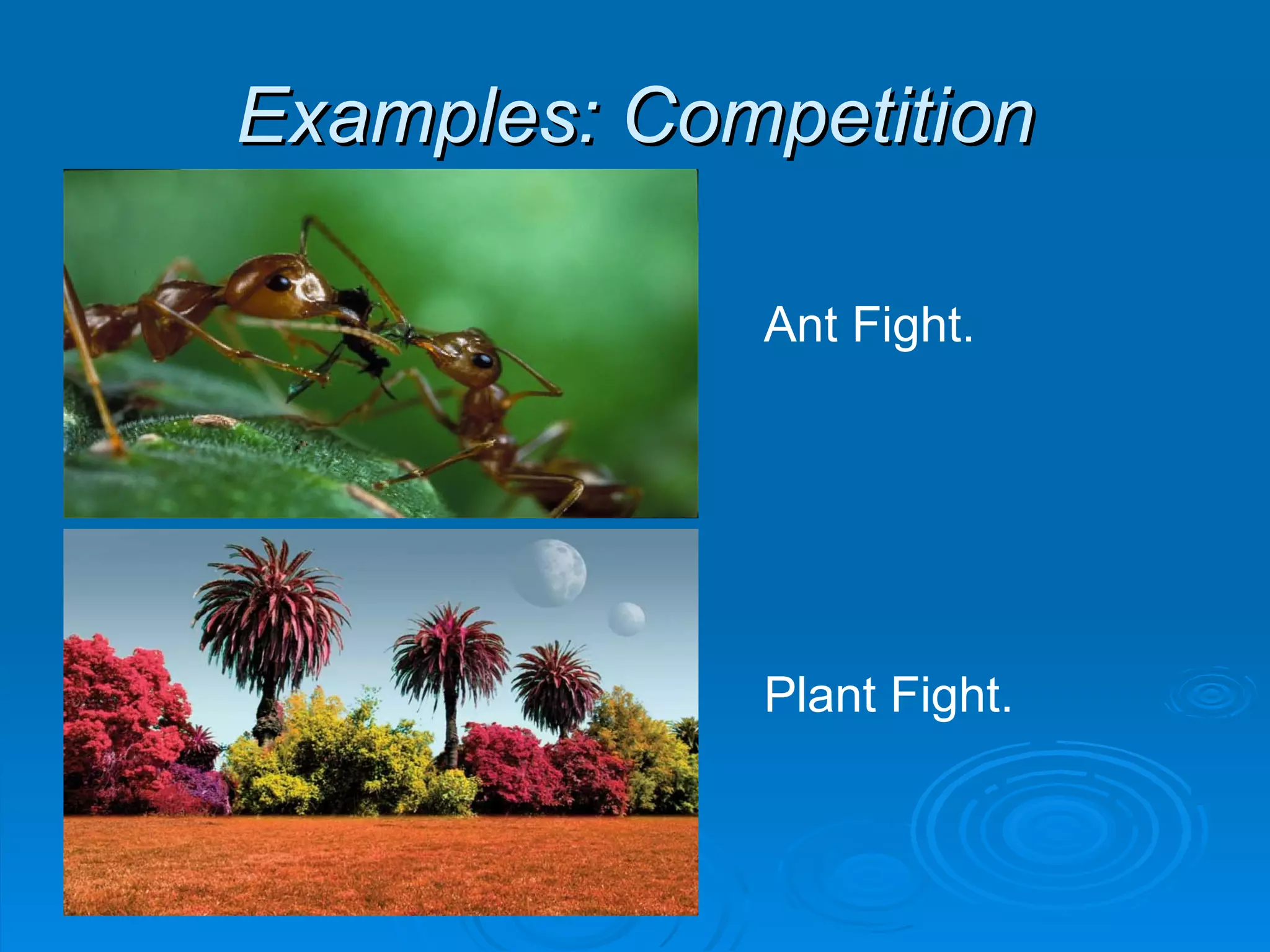
Summary of Darwin’s Theory: Evolution Inference 1:  Production of more individuals than can be supported by the environment leads to a  struggle for existence  among individuals, with only a fraction of offspring surviving in each generation. Examples: Plants competing for sunlight, Ants competing for space and food.
Examples: Competition Ant Fight. Plant Fight.
Summary of Darwin’s Theory: Evolution Observation 4:  Individuals of a population vary extensively in their characteristics with no two individuals being exactly alike. Observation 5 : Much of this variation between individuals  is heritable .
Variation and Heritability -Differences between individual organisms exist  due to differences in genetics. -These genetic differences arise from  genetic mutations.
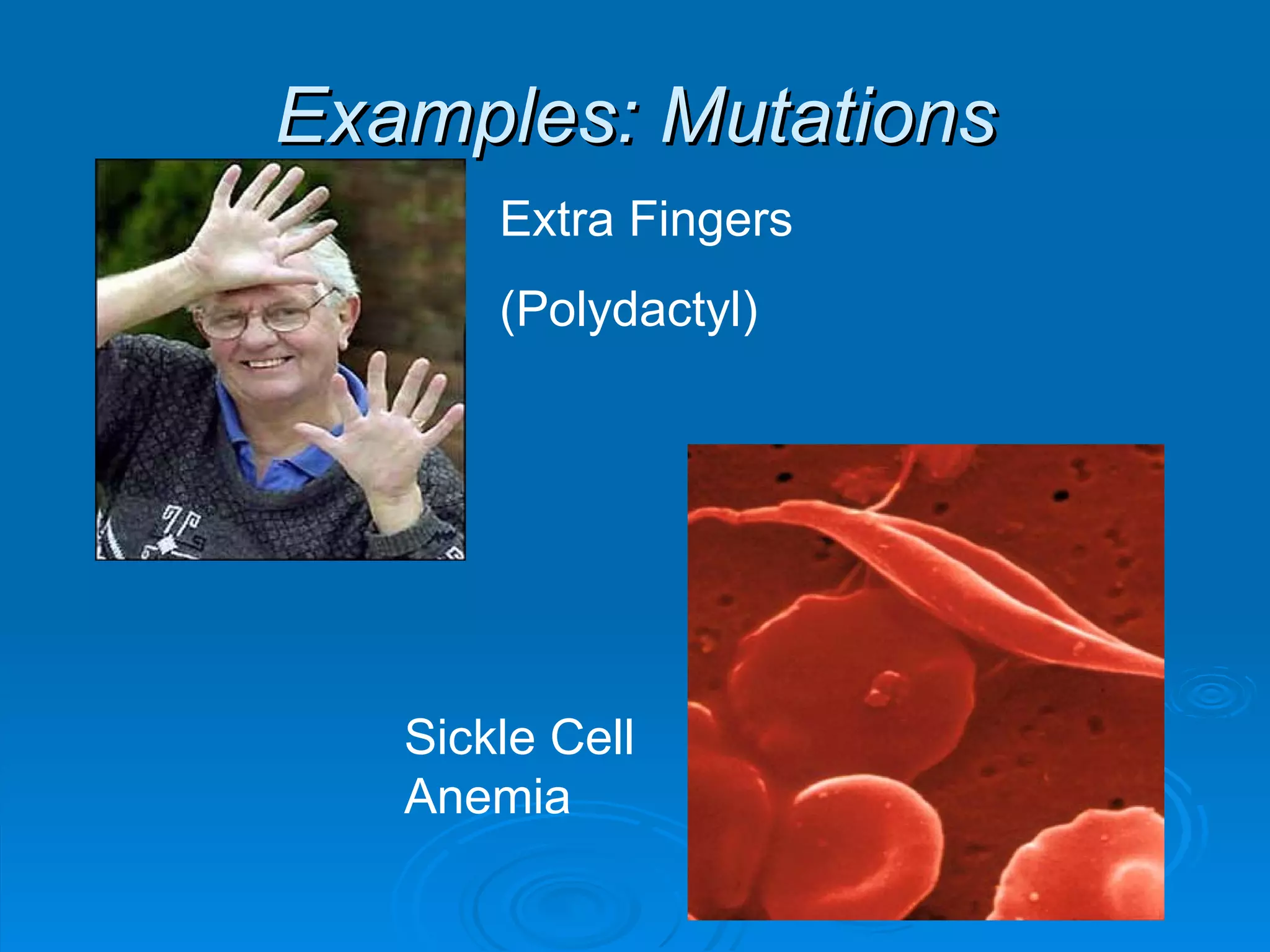
Variation and Heritability Mutations are not all good.  Many of them do nothing at all, while others are absolutely harmful.  Mutations occur randomly and have random effects. When a mutant breeds, these genetic mutations  are inherited by the offspring .  Examples: Extra Fingers, Sickle Cell Anemia
Examples: Mutations Extra Fingers (Polydactyl) Sickle Cell Anemia
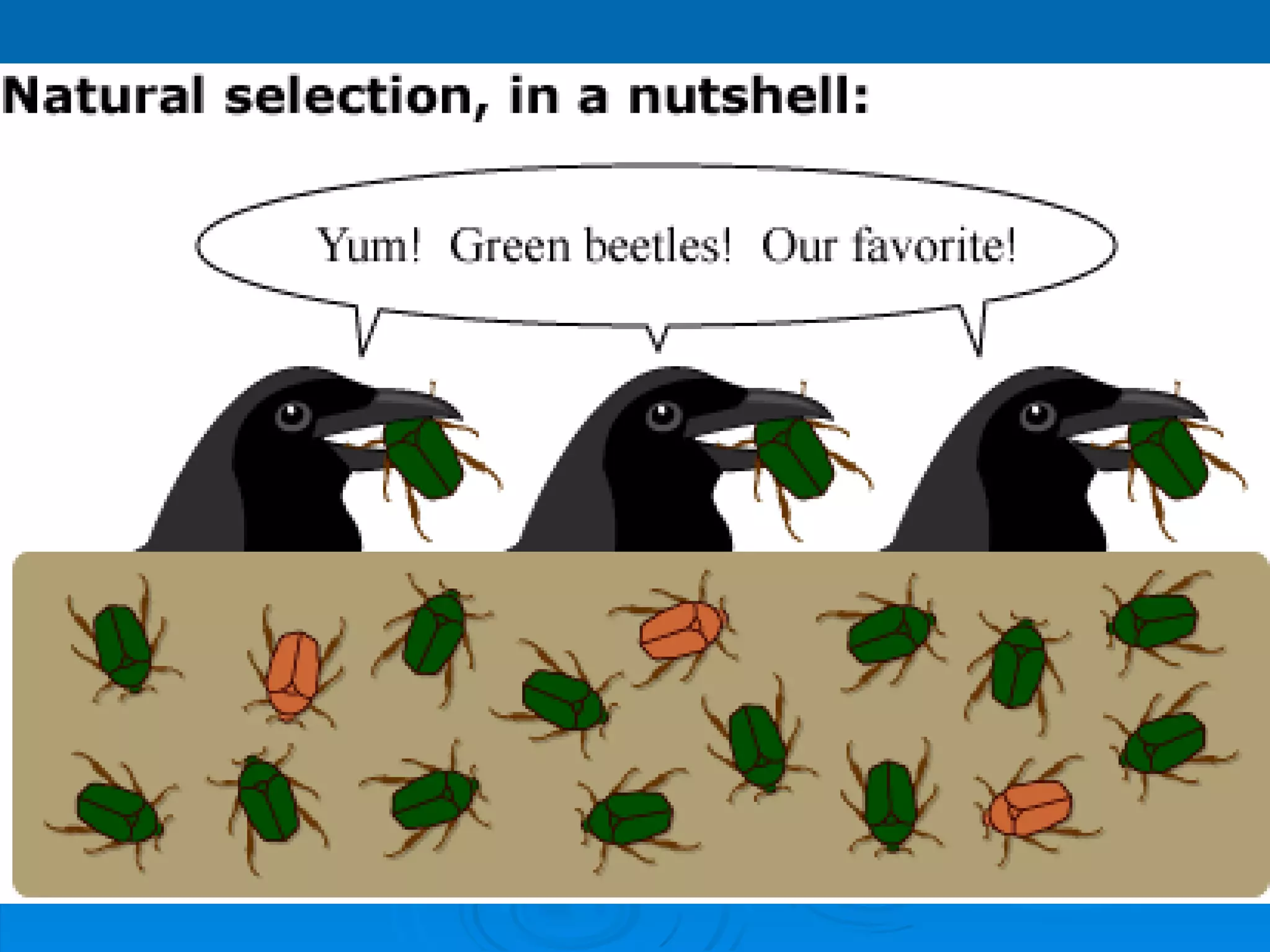
Summary of Darwin’s Theory: Evolution Inference 2: Survival in the struggle for existence is not random, but depends in part on the heritable characteristics of individuals. Individuals who inherit characteristics most fit for their environment are likely to  leave more offspring than less fit individuals .
Summary of Darwin’s Theory: Evolution Inference 3: The unequal ability of individuals to survive and reproduce leads to a gradual change in a population, with favorable characteristics  accumulating over generations  (natural selection).
Darwin’s Theory: The Short Version 1. Organisms differ; variation is inherited 2. Organisms produce more offspring than survive 3. Organisms compete for resources 4. Organisms with advantages survive to pass those advantages to their children 5. Species alive today are descended with modifications from common ancestors
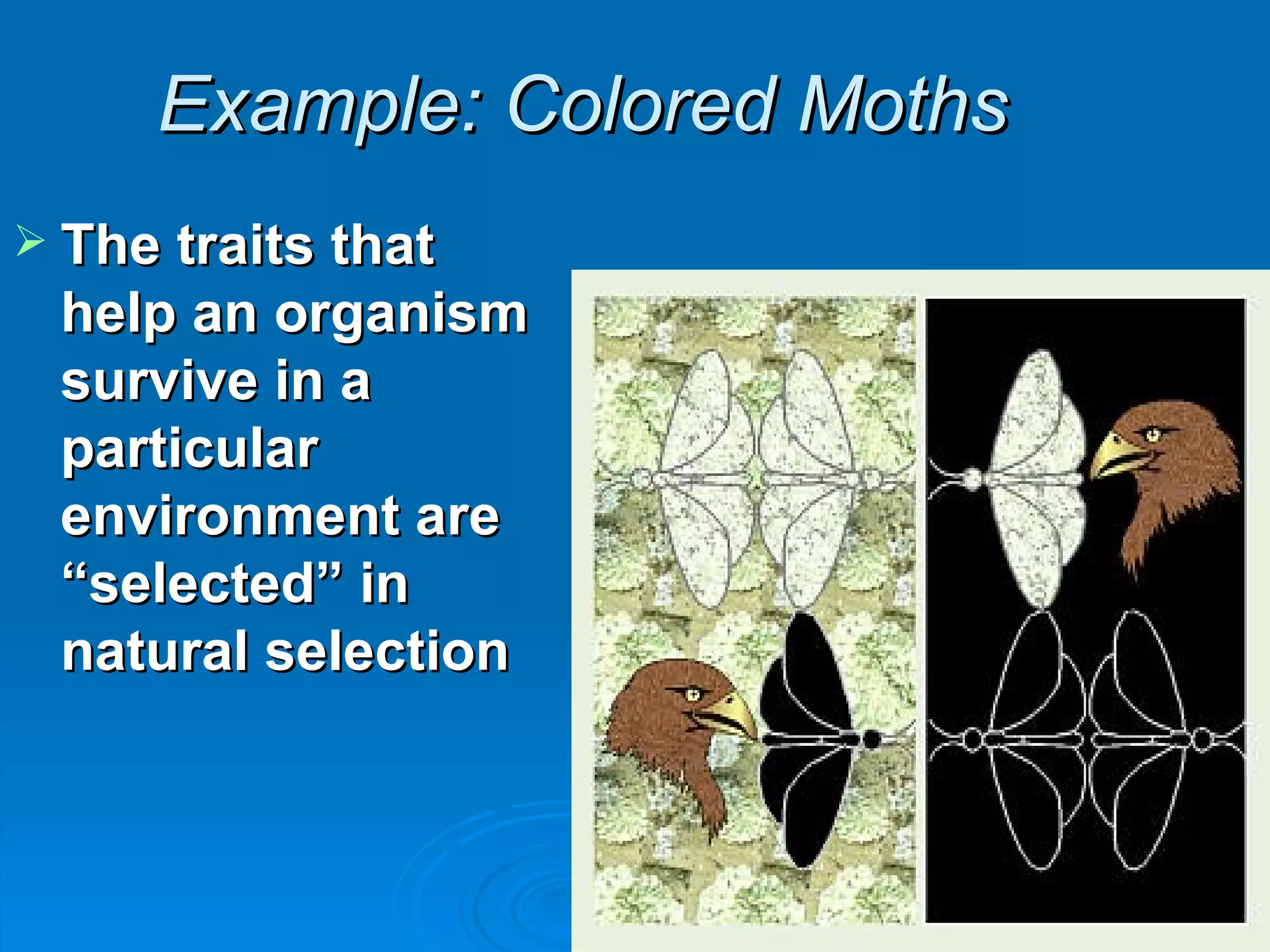
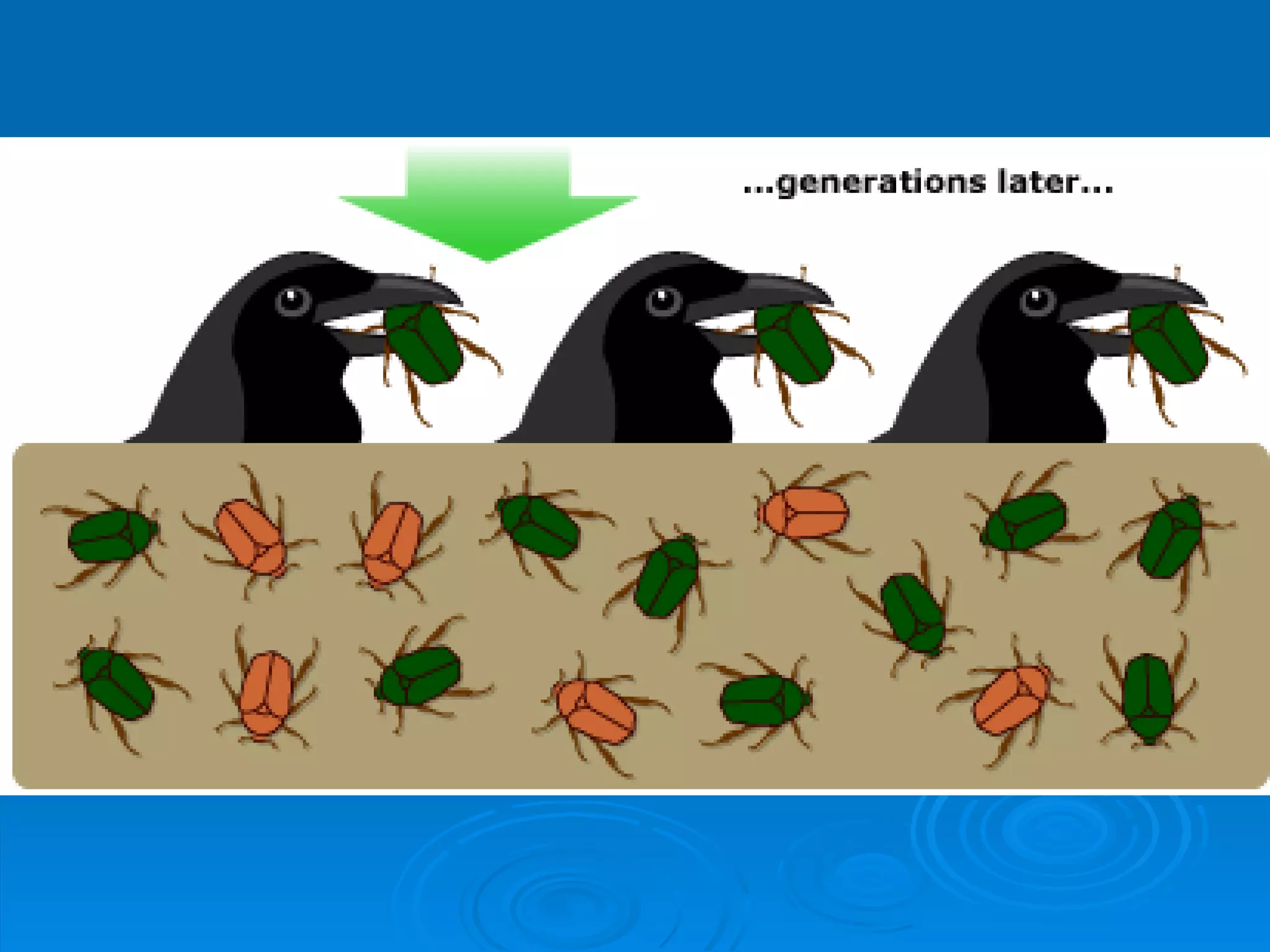
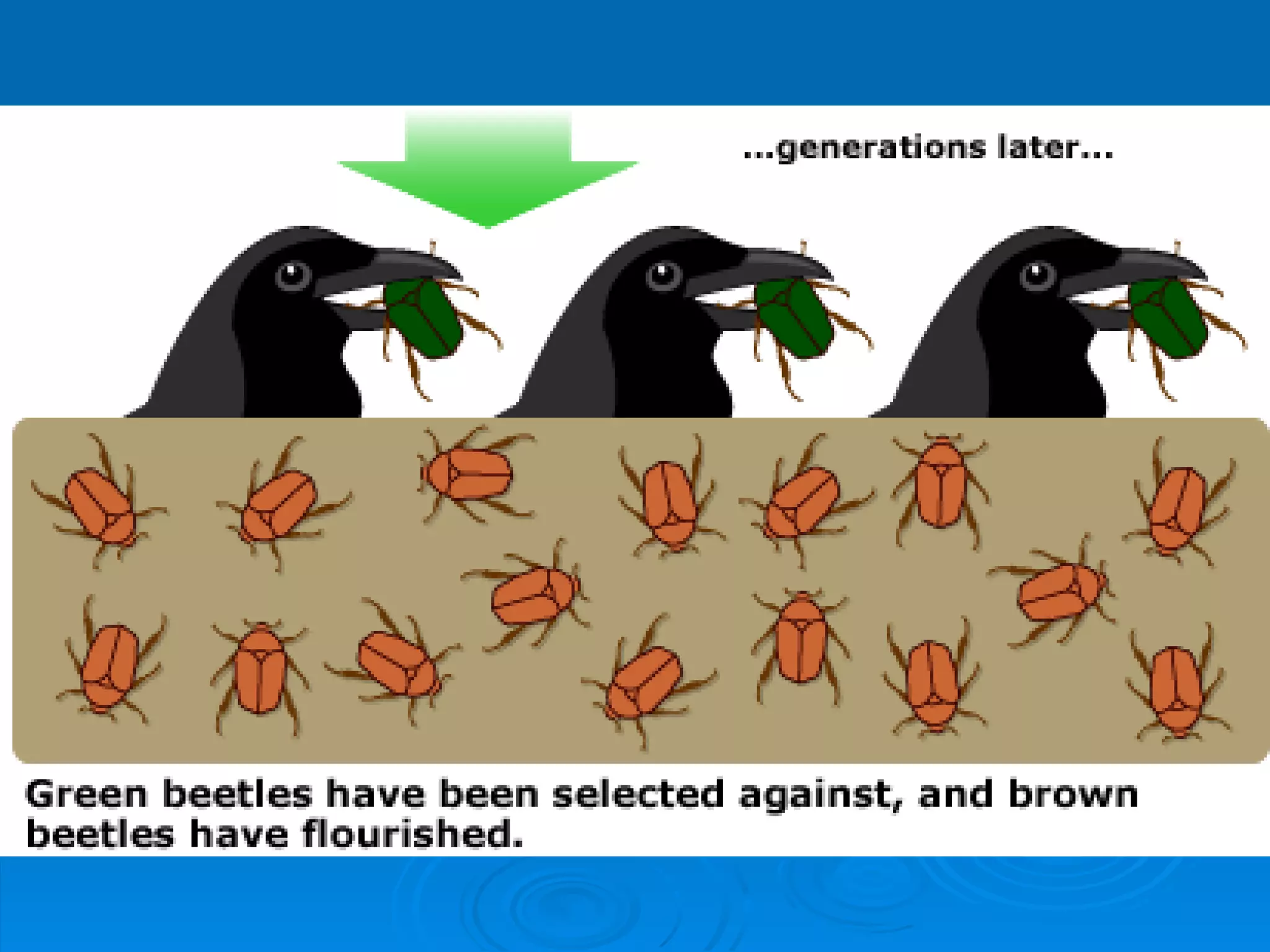
Example: Colored Moths The traits that help an organism survive in a particular environment are “selected” in natural selection


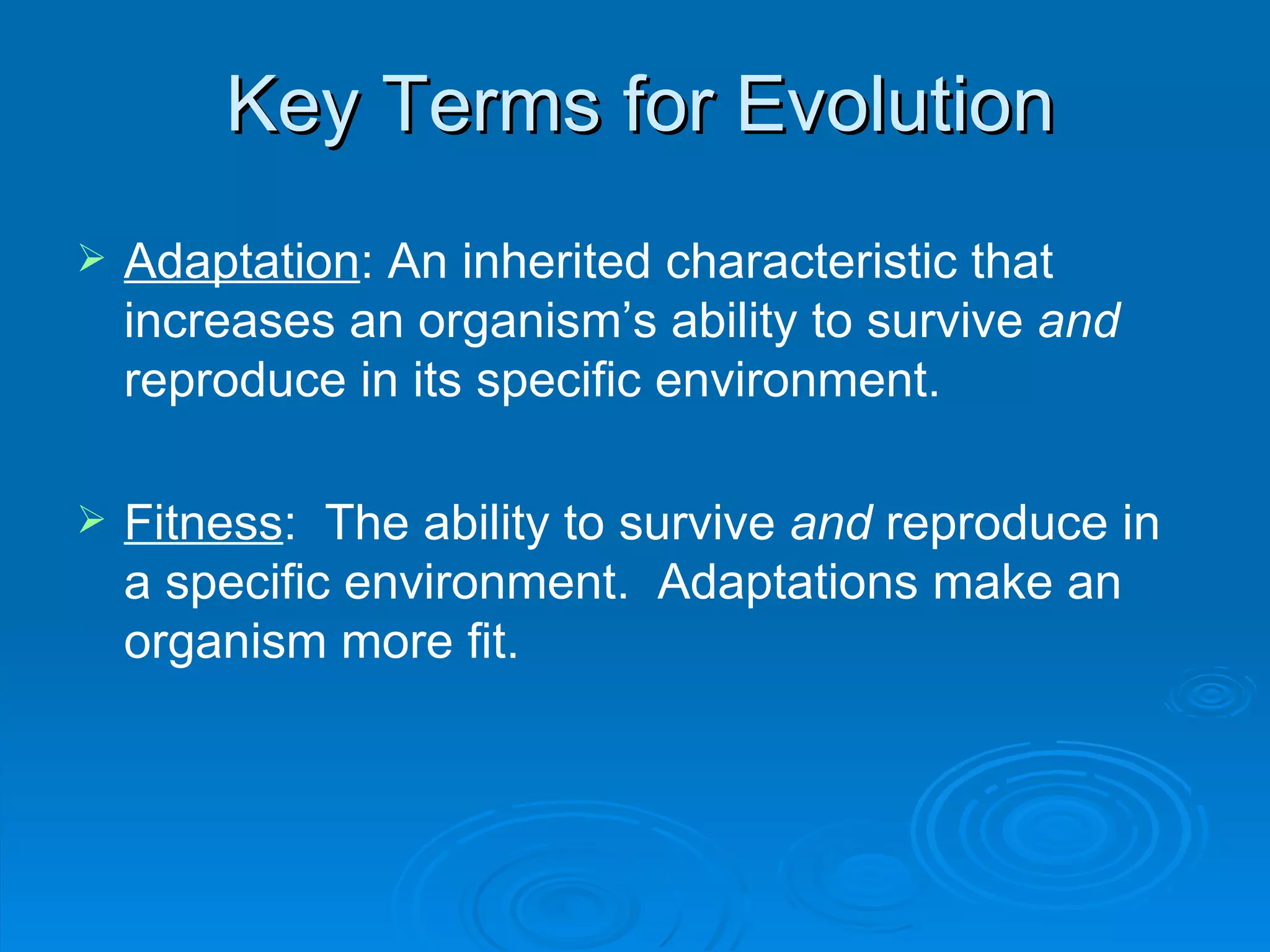
Key Terms for Evolution Adaptation : An inherited characteristic that increases an organism’s ability to survive  and  reproduce in its specific environment. Fitness :  The ability to survive  and  reproduce in a specific environment.  Adaptations make an organism more fit.
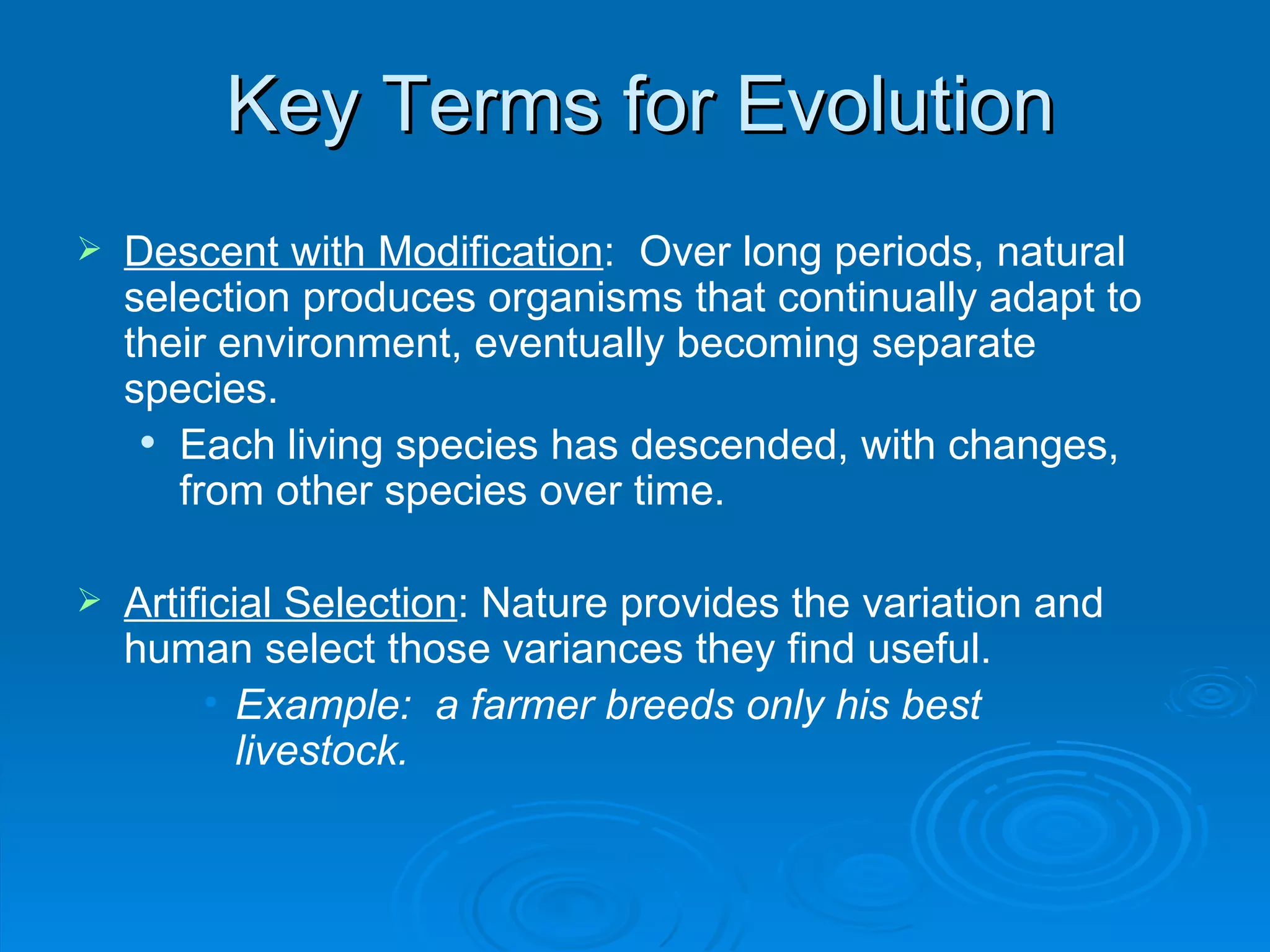
Key Terms for Evolution Descent with Modification :  Over long periods, natural selection produces organisms that continually adapt to their environment, eventually becoming separate species.  Each living species has descended, with changes, from other species over time. Artificial Selection : Nature provides the variation and human select those variances they find useful. Example:  a farmer breeds only his best livestock.
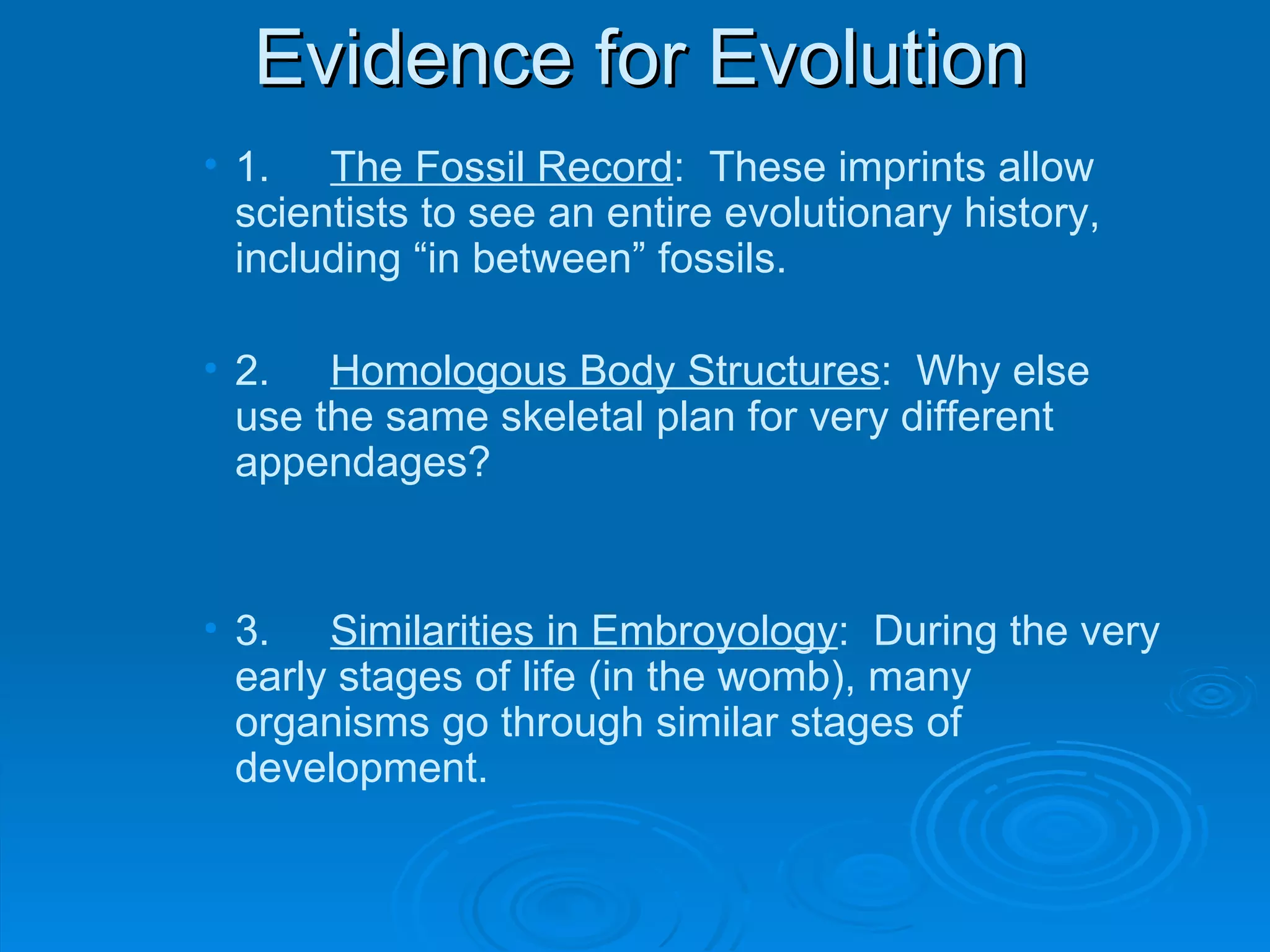
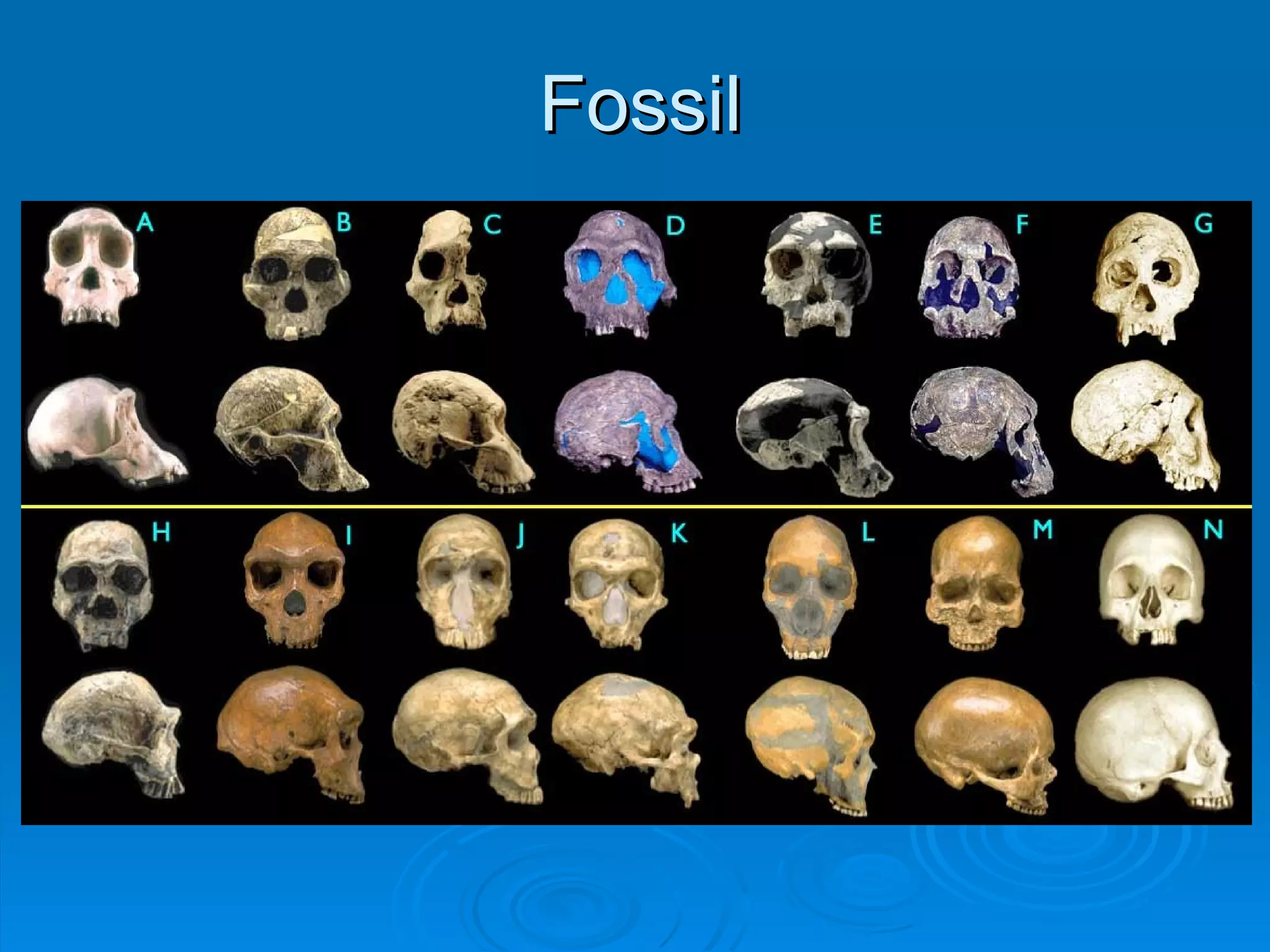
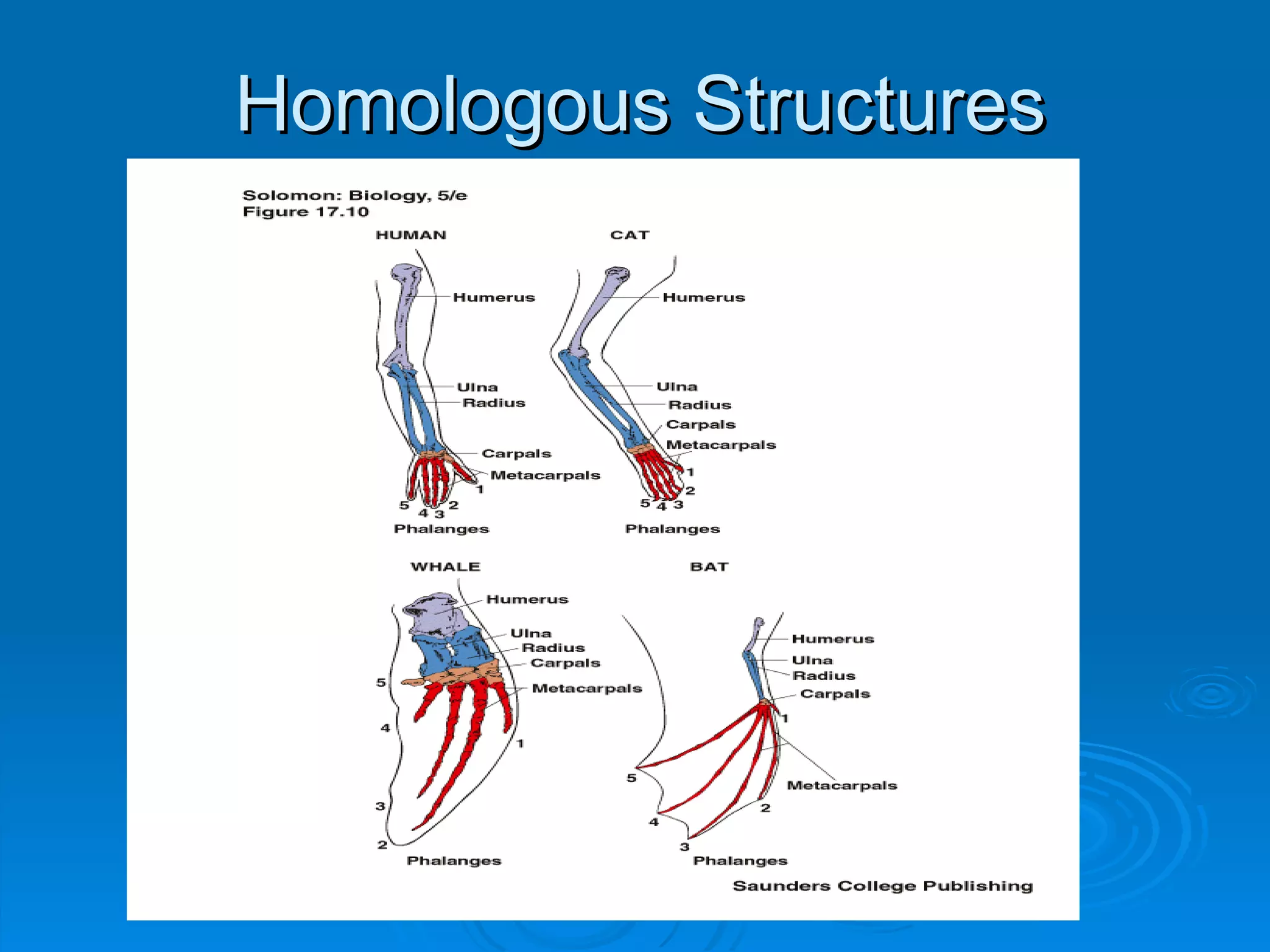
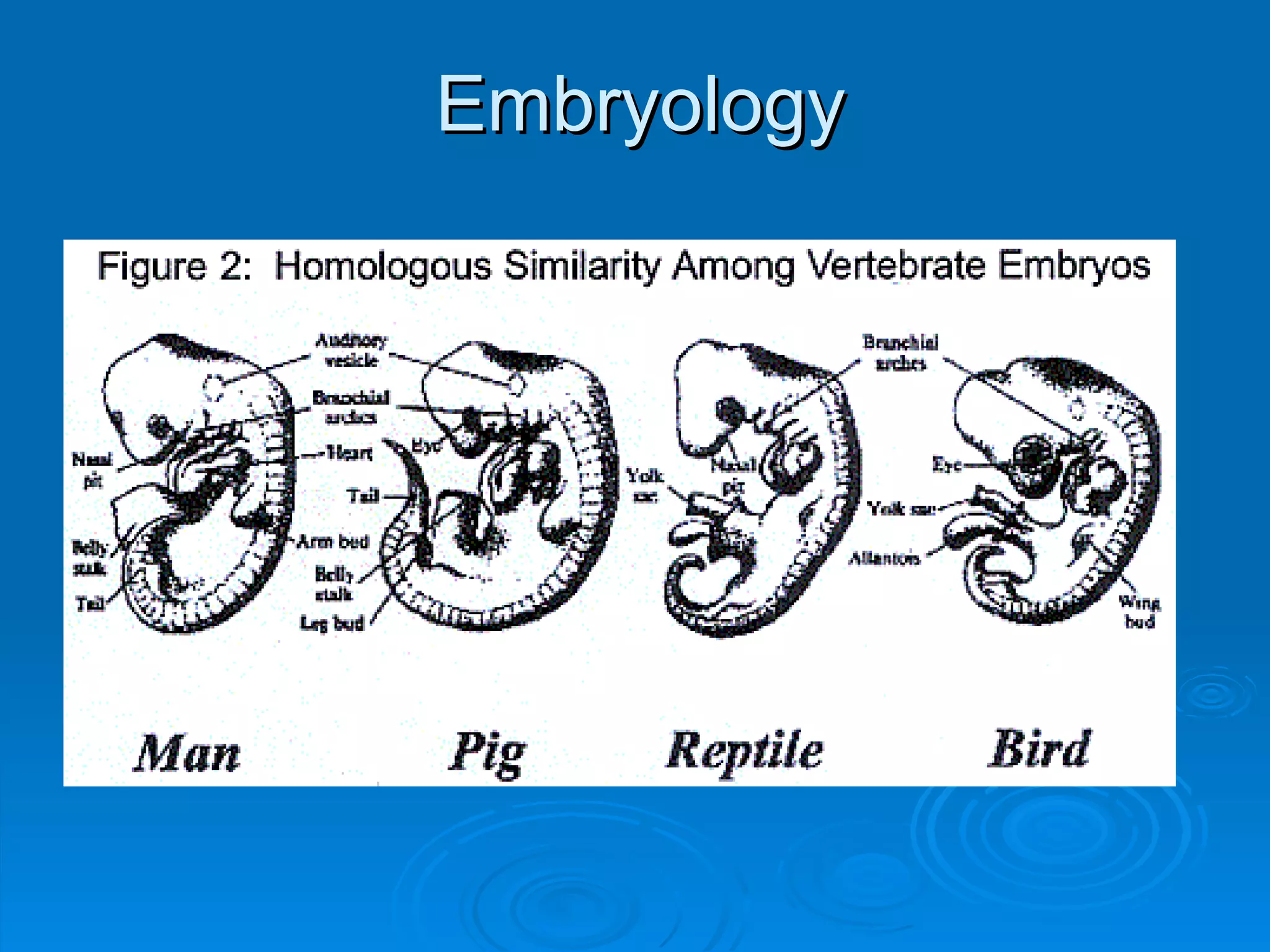
Evidence for Evolution 1. The Fossil Record :  These imprints allow scientists to see an entire evolutionary history, including “in between” fossils. 2. Homologous Body Structures :  Why else use the same skeletal plan for very different appendages?  3. Similarities in Embroyology :  During the very early stages of life (in the womb), many organisms go through similar stages of development.
Fossil
Homologous Structures
Embryology

Evolution two-

  • 1.
  • 2.
  • 3.
    Key Terms Evolution: Changes in a population of organisms over long periods of time. Natural Selection : process by which individuals that are better suited to their environment survive and reproduce successfully “AKA, Survival of the Fittest” Remember: Individuals do not evolve, populations do .
  • 4.
    Summary of Darwin’sTheory: Evolution Observation 1 : Left unchecked, the number of organisms of each species will increase exponentially , from generation to generation. Example: Exponential Kitten
  • 5.
    Example: Exponential KittenEvery day, this kitten will reproduce by splitting. The total number of kittens will double each day. Day One, One Kitten
  • 6.
    Example: Exponential KittenDay Two, Two Kittens.
  • 7.
    Example: Exponential KittenDay Three, Four Kittens
  • 8.
    Example: Exponential KittenDay Four, Eight Kittens.
  • 9.
    Example: Exponential KittenDay Five, Sixteen Kittens.
  • 10.
    Example: Exponential KittenDay Six, Thirty-Two Kittens.
  • 11.
    Example: Exponential KittenDay Seven, Sixty-Four Kittens.
  • 12.
    Example: Exponential KittenDay Seven, 128 kittens
  • 13.
    Summary of Darwin’sTheory: Evolution Observation 2 : In nature, populations tend to remain stable in size . Observation 3 : Environmental resources are limited.
  • 14.
    Summary of Darwin’sTheory: Evolution Inference 1: Production of more individuals than can be supported by the environment leads to a struggle for existence among individuals, with only a fraction of offspring surviving in each generation. Examples: Plants competing for sunlight, Ants competing for space and food.
  • 15.
    Examples: Competition AntFight. Plant Fight.
  • 16.
    Summary of Darwin’sTheory: Evolution Observation 4: Individuals of a population vary extensively in their characteristics with no two individuals being exactly alike. Observation 5 : Much of this variation between individuals is heritable .
  • 17.
    Variation and Heritability-Differences between individual organisms exist due to differences in genetics. -These genetic differences arise from genetic mutations.
  • 18.
    Variation and HeritabilityMutations are not all good. Many of them do nothing at all, while others are absolutely harmful. Mutations occur randomly and have random effects. When a mutant breeds, these genetic mutations are inherited by the offspring . Examples: Extra Fingers, Sickle Cell Anemia
  • 19.
    Examples: Mutations ExtraFingers (Polydactyl) Sickle Cell Anemia
  • 20.
    Summary of Darwin’sTheory: Evolution Inference 2: Survival in the struggle for existence is not random, but depends in part on the heritable characteristics of individuals. Individuals who inherit characteristics most fit for their environment are likely to leave more offspring than less fit individuals .
  • 21.
    Summary of Darwin’sTheory: Evolution Inference 3: The unequal ability of individuals to survive and reproduce leads to a gradual change in a population, with favorable characteristics accumulating over generations (natural selection).
  • 22.
    Darwin’s Theory: TheShort Version 1. Organisms differ; variation is inherited 2. Organisms produce more offspring than survive 3. Organisms compete for resources 4. Organisms with advantages survive to pass those advantages to their children 5. Species alive today are descended with modifications from common ancestors
  • 23.
    Example: Colored MothsThe traits that help an organism survive in a particular environment are “selected” in natural selection
  • 24.
  • 25.
  • 26.
  • 27.
    Key Terms forEvolution Adaptation : An inherited characteristic that increases an organism’s ability to survive and reproduce in its specific environment. Fitness : The ability to survive and reproduce in a specific environment. Adaptations make an organism more fit.
  • 28.
    Key Terms forEvolution Descent with Modification : Over long periods, natural selection produces organisms that continually adapt to their environment, eventually becoming separate species. Each living species has descended, with changes, from other species over time. Artificial Selection : Nature provides the variation and human select those variances they find useful. Example: a farmer breeds only his best livestock.
  • 29.
    Evidence for Evolution1. The Fossil Record : These imprints allow scientists to see an entire evolutionary history, including “in between” fossils. 2. Homologous Body Structures : Why else use the same skeletal plan for very different appendages? 3. Similarities in Embroyology : During the very early stages of life (in the womb), many organisms go through similar stages of development.
  • 30.
  • 31.
  • 32.