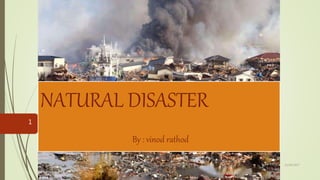
NATURAL DISASTER
By : vinod rathod
11/30/2017NATURAL DISASTER
1
INDEX
 WHAT IS DISASTER
 PHASES OF DISASTER
 TYPES OF DISASTER
 NATURAL DISASTER
 VOLCANO
 CYCLONE
 TORANDO
 Floods
 drought
 EARTHQUAKE
 TSUNAMI
 Landslides
 IMPACT OF NATURAL DISASTERS
 Individual Impact
 COMMUNITY IMPACT
 ECONOMIC IMPACT
 ENVIRONMENT IMPACT
 Conculsion
11/30/2017NATURAL DISASTER
2
SOURCE
 https://www.sms-tsunami-warning.com
 http://geology.com/articles/tsunami-geology.shtml
 https://www.conserve-energy-future.com
 http://www.water-quality-management.us/
11/30/2017NATURAL DISASTER
3
WHAT IS DISASTER ???
“A disaster can be defined as any occurrence that cause
damage, ecological disruption, loss of human life,
deterioration of health and health services on a scale,
sufficient to warrant an extraordinary response from
outside the affected community or area”.(W.H.O.)
“A disaster can be defined as an occurrence either nature
or manmade that causes human suffering and creates
human needs that victims cannot alleviate without
assistance”.American Red Cross (ARC)
11/30/2017NATURAL DISASTER
4
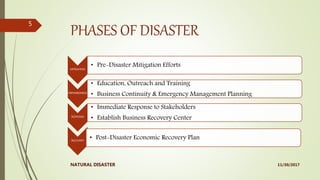
PHASES OF DISASTER
MITIGATION
• Pre-Disaster Mitigation Efforts
PREPAREDNESS
• Education, Outreach and Training
• Business Continuity & Emergency Management Planning
RESPONSE
• Immediate Response to Stakeholders
• Establish Business Recovery Center
RECOVERY
• Post-Disaster Economic Recovery Plan
11/30/2017NATURAL DISASTER
5
TYPES OF DISASTER
NATURAL DISASTER
A sudden and terrible event in nature (such as a hurricane, tornado, or
flood) that usually results in serious damage and many deaths.
MAN-MADE DISASTER
Man-made disasters are usually the result of things going wrong in our
complex technological society. They include: blackouts, hazardous material
spills, air pollution, house fires, radiation leaks, food or water
contamination, and industrial chemical releases.
11/30/2017NATURAL DISASTER
6
NATURAL DISASTER
 VOLCANO
 CYCLONE
 EARTHQUARKE
 FLOODS
 DROUGHT
 TSUNAMI
11/30/2017NATURAL DISASTER
7
VOLCANO
 A volcano is an opening in a
planet’s surface which allows hot
magma to escape from below
the surface.
 The largest volcano known to humans
is Olympus Mons on Mars. Olympus
Mons means Mount Olympus and is
bigger than Mount Everest.
11/30/2017NATURAL DISASTER
8
Volcano ejection
 When thick magma and large amounts of gas build up
under the surface, eruptions can be explosive, expelling
lava, rocks and ash into the air. Less gas and more
viscous magma usually mean a less dramatic eruption,
often causing streams of lava to ooze from the vent.
 The mountain-like mounds that we associate with
volcanoes are what remain after the material spewed
during eruptions has collected and hardened around the
vent. This can happen over a period of weeks or many
millions of years.
 A large eruption can be dangerous for people living near
a volcano. Flows of searing lava, which can reach 2,000
degrees Fahrenheit (1,250 degrees Celsius) or more, can
be released, burning everything in their path. Boulders
of hardening lava can rain down on villages. Mud flows
from rapidly melting snow can strip mountains and
valleys bare and bury towns.
11/30/2017NATURAL DISASTER
9
CYCLONE
11/30/2017NATURAL DISASTER
10
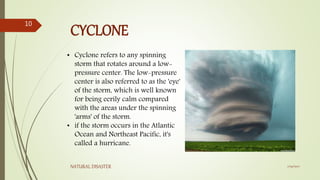
• Cyclone refers to any spinning
storm that rotates around a low-
pressure center. The low-pressure
center is also referred to as the 'eye'
of the storm, which is well known
for being eerily calm compared
with the areas under the spinning
'arms' of the storm.
• if the storm occurs in the Atlantic
Ocean and Northeast Pacific, it's
called a hurricane.
Formation of cyclones
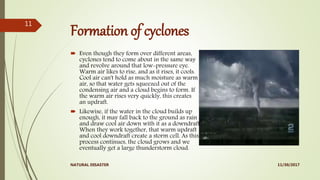
 Even though they form over different areas,
cyclones tend to come about in the same way
and revolve around that low-pressure eye.
Warm air likes to rise, and as it rises, it cools.
Cool air can't hold as much moisture as warm
air, so that water gets squeezed out of the
condensing air and a cloud begins to form. If
the warm air rises very quickly, this creates
an updraft.
 Likewise, if the water in the cloud builds up
enough, it may fall back to the ground as rain
and draw cool air down with it as a downdraft.
When they work together, that warm updraft
and cool downdraft create a storm cell. As this
process continues, the cloud grows and we
eventually get a large thunderstorm cloud.
11/30/2017NATURAL DISASTER
11
EARTHQUAKE
11/30/2017NATURAL DISASTER
12
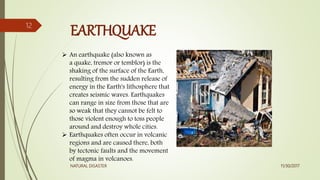
 An earthquake (also known as
a quake, tremor or temblor) is the
shaking of the surface of the Earth,
resulting from the sudden release of
energy in the Earth's lithosphere that
creates seismic waves. Earthquakes
can range in size from those that are
so weak that they cannot be felt to
those violent enough to toss people
around and destroy whole cities.
 Earthquakes often occur in volcanic
regions and are caused there, both
by tectonic faults and the movement
of magma in volcanoes.
TORANDO
11/30/2017NATURAL DISASTER
13
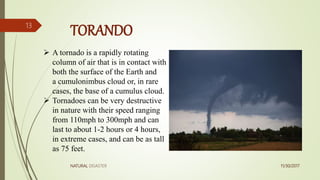
 A tornado is a rapidly rotating
column of air that is in contact with
both the surface of the Earth and
a cumulonimbus cloud or, in rare
cases, the base of a cumulus cloud.
 Tornadoes can be very destructive
in nature with their speed ranging
from 110mph to 300mph and can
last to about 1-2 hours or 4 hours,
in extreme cases, and can be as tall
as 75 feet.
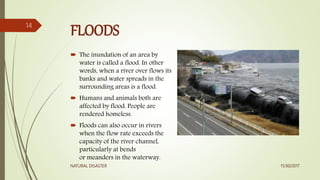
FLOODS
 The inundation of an area by
water is called a flood. In other
words, when a river over flows its
banks and water spreads in the
surrounding areas is a flood.
 Humans and animals both are
affected by flood. People are
rendered homeless.
 Floods can also occur in rivers
when the flow rate exceeds the
capacity of the river channel,
particularly at bends
or meanders in the waterway.
11/30/2017NATURAL DISASTER
14
DROUGHT
11/30/2017NATURAL DISASTER
15
A drought can be defined as a
prolonged period of unusually dry
weather in an area where some rain
might normally be expected.
Droughts involve water shortages,
crop damage, steam flow reduction
and depletion of groundwater and
soil moisture.
Drought is caused by not only lack
of precipitation and high
temperatures but by overuse and
overpopulation
TSUNAMI
 A tsunami or tidal wave, also known as a seismic
sea wave, is a series of waves in a water body
caused by the displacement of a large volume
of water, generally in an ocean or a large lake.
 Tsunami waves do not resemble normal
undersea currents or sea waves, because
their wavelength is far longer.
 Tsunamis generally consist of a series of
waves with periods ranging from minutes
to hours, arriving in a so-called "internal wave train".
11/30/2017NATURAL DISASTER
16
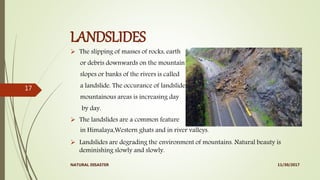
LANDSLIDES
 The slipping of masses of rocks, earth
or debris downwards on the mountain
slopes or banks of the rivers is called
a landslide. The occurance of landslides in
mountainous areas is increasing day
by day.
 The landslides are a common feature
in Himalaya,Western ghats and in river valleys.
 Landslides are degrading the environment of mountains. Natural beauty is
deminishing slowly and slowly.
11/30/2017NATURAL DISASTER
17
Formation of Landslides
 Landslides occur when the downward force of gravity acting on the slope
is greater than the force holding the soil particles together. The downward
force can occur in many different ways. The factors that contribute
whether landslides will occur are the steepness of the slope, the shape of
the slope and the properties of the materials in the slope.
The main way landslides occur is through erosion. Erosion is the process
of rock corroding or being eroded by wind, water, or other natural agents.
Additional moisture is another main cause of landslides. The moisture,
caused by heavy rainfall, adds additional weight to the slope therefore
creating a downward force, which the slope can’t handle. Shocks and
vibrations are also factors that can cause landslides. Earthquakes and
volcanoes are the main causes of shocks and vibration.
 Humans are large contributors to the trigger of landslides. Deforestation is
an example of this. As humans are in demand for clear land, deforestation
occurs. When forests on a slope are logged the soil they hold in place is
dismantled. Therefore weakening the cohesive force of the materials on
the slope. This makes the slope more susceptible to a landslide when
additional water and shock is added
11/30/2017NATURAL DISASTER
18
IMPACT OF NATURAL DISASTERS
 Individual Impact
 Community Impact
 Economic Impact
 Environmental Impact
11/30/2017NATURAL DISASTER
19
Individual Impact
Can be felt physically, mentally and emotionally
 Destruction of property, loss of financial resources
and personal injury or illness
Develop severe post-traumatic stress disorders or
withdraw into states of depression Lead to significant
population migrations
11/30/2017NATURAL DISASTER
20
COMMUNITY IMPACT
Loss of economic resources that recovery becomes
difficult, if not almost impossible
Opportunity in the aftermath of a disaster to
rebuild better and stronger communities than
before
Population, demographic and cultural shifts are
also result of the impact
11/30/2017NATURAL DISASTER
21
ECONOMIC IMPACT
Reduced tax revenue
Loss of infrastructure
Expense of reclamation efforts
Loss of normal revenue
Huge sums of federal assistance were necessary to
held jump start recovery efforts
11/30/2017NATURAL DISASTER
22
ENVIRONMENT IMPACT
Our ecosystems can be dramatically damaged
Global climate changes
Sea level increases that will completely swamp
some island nations
Edible fish supply decreases
Loss of coral reefs
11/30/2017NATURAL DISASTER
23
CONCULSION
NOT ALL NATURAL DISASTERS CAN BE PREVENTED.
EACH NATURAL DISASTER HAS ITS OWN FACTORS
AND COMPLICATIONS. UNDERSTANDING THE
BASIC PRINCIPLES OF ECOLOGY CAN PROVIDE KEYS
TO LESSENING THEIR EFFECTS. NATURE EVOLVED
WITH NATURAL DISASTERS AND DISTURBANCE. THE
BEST PREVENTION IS LOOKING AT STRATEGIES
FOUND IN NATURE.
11/30/2017NATURAL DISASTER
24
THANK YOU
11/30/2017NATURAL DISASTER
25

Natural Disaster project .

  • 1.
    NATURAL DISASTER By :vinod rathod 11/30/2017NATURAL DISASTER 1
  • 2.
    INDEX  WHAT ISDISASTER  PHASES OF DISASTER  TYPES OF DISASTER  NATURAL DISASTER  VOLCANO  CYCLONE  TORANDO  Floods  drought  EARTHQUAKE  TSUNAMI  Landslides  IMPACT OF NATURAL DISASTERS  Individual Impact  COMMUNITY IMPACT  ECONOMIC IMPACT  ENVIRONMENT IMPACT  Conculsion 11/30/2017NATURAL DISASTER 2
  • 3.
    SOURCE  https://www.sms-tsunami-warning.com  http://geology.com/articles/tsunami-geology.shtml https://www.conserve-energy-future.com  https://www.conserve-energy-future.com  http://www.water-quality-management.us/ 11/30/2017NATURAL DISASTER 3
  • 4.
    WHAT IS DISASTER??? “A disaster can be defined as any occurrence that cause damage, ecological disruption, loss of human life, deterioration of health and health services on a scale, sufficient to warrant an extraordinary response from outside the affected community or area”.(W.H.O.) “A disaster can be defined as an occurrence either nature or manmade that causes human suffering and creates human needs that victims cannot alleviate without assistance”.American Red Cross (ARC) 11/30/2017NATURAL DISASTER 4
  • 5.
    PHASES OF DISASTER MITIGATION •Pre-Disaster Mitigation Efforts PREPAREDNESS • Education, Outreach and Training • Business Continuity & Emergency Management Planning RESPONSE • Immediate Response to Stakeholders • Establish Business Recovery Center RECOVERY • Post-Disaster Economic Recovery Plan 11/30/2017NATURAL DISASTER 5
  • 6.
    TYPES OF DISASTER NATURALDISASTER A sudden and terrible event in nature (such as a hurricane, tornado, or flood) that usually results in serious damage and many deaths. MAN-MADE DISASTER Man-made disasters are usually the result of things going wrong in our complex technological society. They include: blackouts, hazardous material spills, air pollution, house fires, radiation leaks, food or water contamination, and industrial chemical releases. 11/30/2017NATURAL DISASTER 6
  • 7.
    NATURAL DISASTER  VOLCANO CYCLONE  EARTHQUARKE  FLOODS  DROUGHT  TSUNAMI 11/30/2017NATURAL DISASTER 7
  • 8.
    VOLCANO  A volcanois an opening in a planet’s surface which allows hot magma to escape from below the surface.  The largest volcano known to humans is Olympus Mons on Mars. Olympus Mons means Mount Olympus and is bigger than Mount Everest. 11/30/2017NATURAL DISASTER 8
  • 9.
    Volcano ejection  Whenthick magma and large amounts of gas build up under the surface, eruptions can be explosive, expelling lava, rocks and ash into the air. Less gas and more viscous magma usually mean a less dramatic eruption, often causing streams of lava to ooze from the vent.  The mountain-like mounds that we associate with volcanoes are what remain after the material spewed during eruptions has collected and hardened around the vent. This can happen over a period of weeks or many millions of years.  A large eruption can be dangerous for people living near a volcano. Flows of searing lava, which can reach 2,000 degrees Fahrenheit (1,250 degrees Celsius) or more, can be released, burning everything in their path. Boulders of hardening lava can rain down on villages. Mud flows from rapidly melting snow can strip mountains and valleys bare and bury towns. 11/30/2017NATURAL DISASTER 9
  • 10.
    CYCLONE 11/30/2017NATURAL DISASTER 10 • Cyclonerefers to any spinning storm that rotates around a low- pressure center. The low-pressure center is also referred to as the 'eye' of the storm, which is well known for being eerily calm compared with the areas under the spinning 'arms' of the storm. • if the storm occurs in the Atlantic Ocean and Northeast Pacific, it's called a hurricane.
  • 11.
    Formation of cyclones Even though they form over different areas, cyclones tend to come about in the same way and revolve around that low-pressure eye. Warm air likes to rise, and as it rises, it cools. Cool air can't hold as much moisture as warm air, so that water gets squeezed out of the condensing air and a cloud begins to form. If the warm air rises very quickly, this creates an updraft.  Likewise, if the water in the cloud builds up enough, it may fall back to the ground as rain and draw cool air down with it as a downdraft. When they work together, that warm updraft and cool downdraft create a storm cell. As this process continues, the cloud grows and we eventually get a large thunderstorm cloud. 11/30/2017NATURAL DISASTER 11
  • 12.
    EARTHQUAKE 11/30/2017NATURAL DISASTER 12  Anearthquake (also known as a quake, tremor or temblor) is the shaking of the surface of the Earth, resulting from the sudden release of energy in the Earth's lithosphere that creates seismic waves. Earthquakes can range in size from those that are so weak that they cannot be felt to those violent enough to toss people around and destroy whole cities.  Earthquakes often occur in volcanic regions and are caused there, both by tectonic faults and the movement of magma in volcanoes.
  • 13.
    TORANDO 11/30/2017NATURAL DISASTER 13  Atornado is a rapidly rotating column of air that is in contact with both the surface of the Earth and a cumulonimbus cloud or, in rare cases, the base of a cumulus cloud.  Tornadoes can be very destructive in nature with their speed ranging from 110mph to 300mph and can last to about 1-2 hours or 4 hours, in extreme cases, and can be as tall as 75 feet.
  • 14.
    FLOODS  The inundationof an area by water is called a flood. In other words, when a river over flows its banks and water spreads in the surrounding areas is a flood.  Humans and animals both are affected by flood. People are rendered homeless.  Floods can also occur in rivers when the flow rate exceeds the capacity of the river channel, particularly at bends or meanders in the waterway. 11/30/2017NATURAL DISASTER 14
  • 15.
    DROUGHT 11/30/2017NATURAL DISASTER 15 A droughtcan be defined as a prolonged period of unusually dry weather in an area where some rain might normally be expected. Droughts involve water shortages, crop damage, steam flow reduction and depletion of groundwater and soil moisture. Drought is caused by not only lack of precipitation and high temperatures but by overuse and overpopulation
  • 16.
    TSUNAMI  A tsunamior tidal wave, also known as a seismic sea wave, is a series of waves in a water body caused by the displacement of a large volume of water, generally in an ocean or a large lake.  Tsunami waves do not resemble normal undersea currents or sea waves, because their wavelength is far longer.  Tsunamis generally consist of a series of waves with periods ranging from minutes to hours, arriving in a so-called "internal wave train". 11/30/2017NATURAL DISASTER 16
  • 17.
    LANDSLIDES  The slippingof masses of rocks, earth or debris downwards on the mountain slopes or banks of the rivers is called a landslide. The occurance of landslides in mountainous areas is increasing day by day.  The landslides are a common feature in Himalaya,Western ghats and in river valleys.  Landslides are degrading the environment of mountains. Natural beauty is deminishing slowly and slowly. 11/30/2017NATURAL DISASTER 17
  • 18.
    Formation of Landslides Landslides occur when the downward force of gravity acting on the slope is greater than the force holding the soil particles together. The downward force can occur in many different ways. The factors that contribute whether landslides will occur are the steepness of the slope, the shape of the slope and the properties of the materials in the slope. The main way landslides occur is through erosion. Erosion is the process of rock corroding or being eroded by wind, water, or other natural agents. Additional moisture is another main cause of landslides. The moisture, caused by heavy rainfall, adds additional weight to the slope therefore creating a downward force, which the slope can’t handle. Shocks and vibrations are also factors that can cause landslides. Earthquakes and volcanoes are the main causes of shocks and vibration.  Humans are large contributors to the trigger of landslides. Deforestation is an example of this. As humans are in demand for clear land, deforestation occurs. When forests on a slope are logged the soil they hold in place is dismantled. Therefore weakening the cohesive force of the materials on the slope. This makes the slope more susceptible to a landslide when additional water and shock is added 11/30/2017NATURAL DISASTER 18
  • 19.
    IMPACT OF NATURALDISASTERS  Individual Impact  Community Impact  Economic Impact  Environmental Impact 11/30/2017NATURAL DISASTER 19
  • 20.
    Individual Impact Can befelt physically, mentally and emotionally  Destruction of property, loss of financial resources and personal injury or illness Develop severe post-traumatic stress disorders or withdraw into states of depression Lead to significant population migrations 11/30/2017NATURAL DISASTER 20
  • 21.
    COMMUNITY IMPACT Loss ofeconomic resources that recovery becomes difficult, if not almost impossible Opportunity in the aftermath of a disaster to rebuild better and stronger communities than before Population, demographic and cultural shifts are also result of the impact 11/30/2017NATURAL DISASTER 21
  • 22.
    ECONOMIC IMPACT Reduced taxrevenue Loss of infrastructure Expense of reclamation efforts Loss of normal revenue Huge sums of federal assistance were necessary to held jump start recovery efforts 11/30/2017NATURAL DISASTER 22
  • 23.
    ENVIRONMENT IMPACT Our ecosystemscan be dramatically damaged Global climate changes Sea level increases that will completely swamp some island nations Edible fish supply decreases Loss of coral reefs 11/30/2017NATURAL DISASTER 23
  • 24.
    CONCULSION NOT ALL NATURALDISASTERS CAN BE PREVENTED. EACH NATURAL DISASTER HAS ITS OWN FACTORS AND COMPLICATIONS. UNDERSTANDING THE BASIC PRINCIPLES OF ECOLOGY CAN PROVIDE KEYS TO LESSENING THEIR EFFECTS. NATURE EVOLVED WITH NATURAL DISASTERS AND DISTURBANCE. THE BEST PREVENTION IS LOOKING AT STRATEGIES FOUND IN NATURE. 11/30/2017NATURAL DISASTER 24
  • 25.