WHAT IS
NATIONALISM?
Grade: 11
Term: 3
Topic: 4 – NATIONALISMS – SOUTH AFRICA, THE
MIDDLE EAST AND AFRICA
Sub-Topic: CHAPTER 1 – WHAT IS NATIONALISM
M.N.SPIES
M.N.SPIES
M.N.SPIES
1.1 WHAT IS NATIONALISM?
• A feeling that people have of being loyal to
and proud of their country often with the
belief that it is better and more important
than other countries
• A desire by a large group of people (such as
people who share the same culture, history,
language, etc.) to form a separate and
independent nation of their own (Political
Independence)
M.N.SPIES
So does
South Africa have a
healthy form of
Nationalism?
M.N.SPIES
UNITE OR OPPRESS?
• How has it been used to unite people in
a struggle to throw off oppression?
• Think about African Nationalism.
• How has it also been used to oppress
people of a different 'nation' or ethnic
group?
• Think about Afrikaner Nationalism.
M.N.SPIES
“Nationalism is not the
awakening of nations to
self-consciousness: it
invents nations where they
do not exist”.
- Ernest Gellner, Nations and
Nationalism, 1983.
M.N.SPIES
Terminology
• What is a:
• Nation: A group of people sharing the same
culture, language, traditions and history.
• Ethnic group: People sharing a common
ancestry and distinctive culture and usually
belonging to a tribe or clan.
• Nation State: A state established on a defined
geographical territory and inhabited by a
nation that is politically independent.
M.N.SPIES
History of Nationalism
• Before the emergence of
nation states in Europe in the
19th century, most ordinary
people were loyal to their
immediate community, ruler
or church.
M.N.SPIES
History of Nationalism
• After larger and centralized states or
nation states were created in the
19th century, people's loyalty shifted
to the newly formed state, or to
nationalist movements inspired by
progressive thinkers of the time who
wanted to free people from the
chains of oppressive rulers.
M.N.SPIES
History of Nationalism
• In the 20th century, some nationalist
leaders in Europe, the Middle East,
and West Africa became increasingly
conservative and self-serving. They
used nationalism to promote their
personal power and to protect the
interests and needs of one national
group over another.
M.N.SPIES
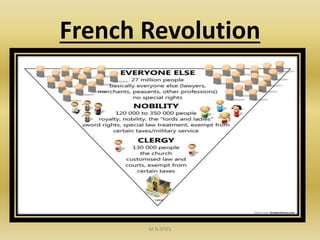
French Revolution
M.N.SPIES
Industrial Revolution
M.N.SPIES
1.2 The origins of nationalism in
Europe
• In Europe in the late 18th and 19th centuries,
events like the French Revolution, the
Industrial Revolution, and the unification of
Germany and Italy challenged the old political
and economic power institutions of the
monarchy and the church.
• In their place emerged newly constructed
societies in which power had shifted to the
people and the nation was all important.
M.N.SPIES
1.3 The Industrial Revolution and the
rise of the middle-class
• The Industrial Revolution dramatically changed
social and economic structures in Europe.
• With the invention of new technology and the
development of the factory system of production,
large sections of the population left the rural
areas and villages to seek work in the towns and
cities.
• As they did so, society was changing, stimulated
by improved access to newspapers and books,
which increased the circulation of ideas and
information.
M.N.SPIES
1.4 The rise of the middle class which
often initiated nationalist movements
• By 1850, social divisions in European
society had come to be based on wealth,
rather than on the possession of land.
• Despite the in the French Revolution,
most European countries were still ruled
by monarchs who denied ordinary
people any part in government.
M.N.SPIES
The rise of the middle class which
often initiated nationalist movements
• In addition, the new wealth resulting
from the Industrial Revolution
remained in the hands of a few rich
industrialists.
• These newly rich capitalists, together
with other members of the growing
middle-class, demanded more
political rights.
M.N.SPIES
The rise of the middle class which
often initiated nationalist movements
• During 1848 and 1849, there
were several worker uprisings in
France and the German states to
demand political rights.
• Political and economic instability
after 1850 stimulated increased
nationalism in Europe.
M.N.SPIES
The rise of the middle class which
often initiated nationalist movements
• Nationalist movements had achieved the
unification of Germany and Italy by 1871.
Before unification, Germany and Italy had
consisted of many small states, each under its
own ruler.
• The formation of a united Germany and a
united Italy led to new developments. The two
new states, especially Germany, looked to
develop their economies and to find more
wealth and power through colonial expansion.
M.N.SPIES
1.5 The theory of nationalism as an
imagined community
• Modern nationalism has been responsible for
shaping new identities and dreams for
nations.
• In a new nation, people are encouraged to
participate in and be loyal to their nation,
even though they might not know everyone in
it.
• This leads to an ‘imagined community’,
sustained by a commitment to serve and
defend one’s people.
M.N.SPIES

Nationalism

  • 1.
    WHAT IS NATIONALISM? Grade: 11 Term:3 Topic: 4 – NATIONALISMS – SOUTH AFRICA, THE MIDDLE EAST AND AFRICA Sub-Topic: CHAPTER 1 – WHAT IS NATIONALISM M.N.SPIES
  • 2.
  • 3.
  • 4.
    1.1 WHAT ISNATIONALISM? • A feeling that people have of being loyal to and proud of their country often with the belief that it is better and more important than other countries • A desire by a large group of people (such as people who share the same culture, history, language, etc.) to form a separate and independent nation of their own (Political Independence) M.N.SPIES
  • 5.
    So does South Africahave a healthy form of Nationalism? M.N.SPIES
  • 6.
    UNITE OR OPPRESS? •How has it been used to unite people in a struggle to throw off oppression? • Think about African Nationalism. • How has it also been used to oppress people of a different 'nation' or ethnic group? • Think about Afrikaner Nationalism. M.N.SPIES
  • 7.
    “Nationalism is notthe awakening of nations to self-consciousness: it invents nations where they do not exist”. - Ernest Gellner, Nations and Nationalism, 1983. M.N.SPIES
  • 8.
    Terminology • What isa: • Nation: A group of people sharing the same culture, language, traditions and history. • Ethnic group: People sharing a common ancestry and distinctive culture and usually belonging to a tribe or clan. • Nation State: A state established on a defined geographical territory and inhabited by a nation that is politically independent. M.N.SPIES
  • 9.
    History of Nationalism •Before the emergence of nation states in Europe in the 19th century, most ordinary people were loyal to their immediate community, ruler or church. M.N.SPIES
  • 10.
    History of Nationalism •After larger and centralized states or nation states were created in the 19th century, people's loyalty shifted to the newly formed state, or to nationalist movements inspired by progressive thinkers of the time who wanted to free people from the chains of oppressive rulers. M.N.SPIES
  • 11.
    History of Nationalism •In the 20th century, some nationalist leaders in Europe, the Middle East, and West Africa became increasingly conservative and self-serving. They used nationalism to promote their personal power and to protect the interests and needs of one national group over another. M.N.SPIES
  • 12.
  • 13.
  • 14.
    1.2 The originsof nationalism in Europe • In Europe in the late 18th and 19th centuries, events like the French Revolution, the Industrial Revolution, and the unification of Germany and Italy challenged the old political and economic power institutions of the monarchy and the church. • In their place emerged newly constructed societies in which power had shifted to the people and the nation was all important. M.N.SPIES
  • 15.
    1.3 The IndustrialRevolution and the rise of the middle-class • The Industrial Revolution dramatically changed social and economic structures in Europe. • With the invention of new technology and the development of the factory system of production, large sections of the population left the rural areas and villages to seek work in the towns and cities. • As they did so, society was changing, stimulated by improved access to newspapers and books, which increased the circulation of ideas and information. M.N.SPIES
  • 16.
    1.4 The riseof the middle class which often initiated nationalist movements • By 1850, social divisions in European society had come to be based on wealth, rather than on the possession of land. • Despite the in the French Revolution, most European countries were still ruled by monarchs who denied ordinary people any part in government. M.N.SPIES
  • 17.
    The rise ofthe middle class which often initiated nationalist movements • In addition, the new wealth resulting from the Industrial Revolution remained in the hands of a few rich industrialists. • These newly rich capitalists, together with other members of the growing middle-class, demanded more political rights. M.N.SPIES
  • 18.
    The rise ofthe middle class which often initiated nationalist movements • During 1848 and 1849, there were several worker uprisings in France and the German states to demand political rights. • Political and economic instability after 1850 stimulated increased nationalism in Europe. M.N.SPIES
  • 19.
    The rise ofthe middle class which often initiated nationalist movements • Nationalist movements had achieved the unification of Germany and Italy by 1871. Before unification, Germany and Italy had consisted of many small states, each under its own ruler. • The formation of a united Germany and a united Italy led to new developments. The two new states, especially Germany, looked to develop their economies and to find more wealth and power through colonial expansion. M.N.SPIES
  • 20.
    1.5 The theoryof nationalism as an imagined community • Modern nationalism has been responsible for shaping new identities and dreams for nations. • In a new nation, people are encouraged to participate in and be loyal to their nation, even though they might not know everyone in it. • This leads to an ‘imagined community’, sustained by a commitment to serve and defend one’s people. M.N.SPIES