BACKGROUND- RISE OF NATIONALISM

 During the French Revolution , the people
  in France expressed a great deal of pride
 in their nation. This pride has been called
   NATIONALISM. Nationalism will spread
    throughout the world and cause many
revolutions. Some of these revolutions will
   unite people and create nations. Others,
     while still acting to unite people, will
     ultimately lead to the end of some of
           histories great empires.
BIG IDEAS- KEY THEMES & CONCEPTS
At the end of this PowerPoint you should be able to:
1. Describe specific ways in which nationalism
   caused revolutions.
2. Described how nationalism led to the unification
   of both Italy and Germany.
3. Explain how nationalism impacted specific ethnic
   groups- Indians, Turks, and Jews.
4. Explain how nationalism will lead to the end of the
   Ottoman Empire.
IN THE BEGINNING… FRENCH REVOLUTION
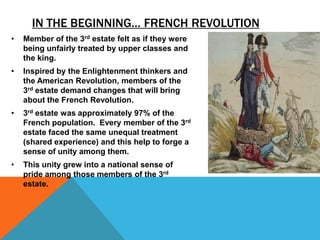
•   Member of the 3rd estate felt as if they were
    being unfairly treated by upper classes and
    the king.
•   Inspired by the Enlightenment thinkers and
    the American Revolution, members of the
    3rd estate demand changes that will bring
    about the French Revolution.
•   3rd estate was approximately 97% of the
    French population. Every member of the 3rd
    estate faced the same unequal treatment
    (shared experience) and this help to forge a
    sense of unity among them.
•   This unity grew into a national sense of
    pride among those members of the 3rd
    estate.
IN THE BEGINNING… NAPOLEON
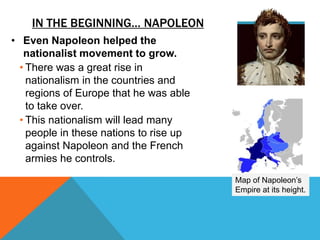
• Even Napoleon helped the
   nationalist movement to grow.
  • There was a great rise in
    nationalism in the countries and
    regions of Europe that he was able
    to take over.
  • This nationalism will lead many
    people in these nations to rise up
    against Napoleon and the French
    armies he controls.
                                         Map of Napoleon’s
                                         Empire at its height.
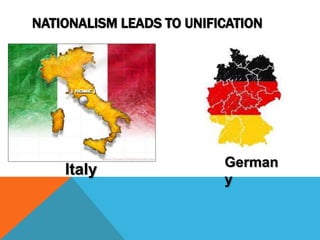
NATIONALISM LEADS TO UNIFICATION


                          German
    Italy
                          y
UNIFICATION OF ITALY
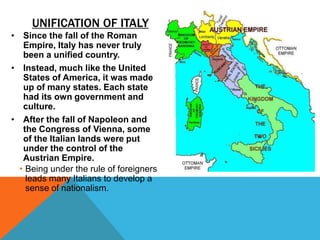
• Since the fall of the Roman
   Empire, Italy has never truly
   been a unified country.
• Instead, much like the United
   States of America, it was made
   up of many states. Each state
   had its own government and
   culture.
• After the fall of Napoleon and
   the Congress of Vienna, some
   of the Italian lands were put
   under the control of the
   Austrian Empire.
  • Being under the rule of foreigners
    leads many Italians to develop a
    sense of nationalism.
LEADERS OF THE ITALIAN NATIONALIST MOVEMENT
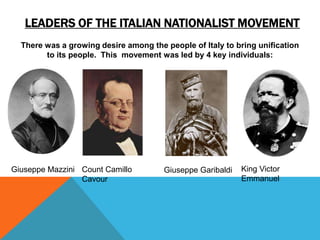
  There was a growing desire among the people of Italy to bring unification
        to its people. This movement was led by 4 key individuals:


Giuseppe Mazzini Count Camillo         Giuseppe Garibaldi   King Victor
                 Cavour                                     Emmanuel
LEADERS OF THE ITALIAN NATIONALIST MOVEMENT
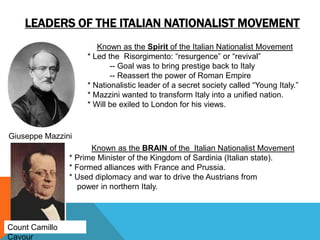
                       Known as the Spirit of the Italian Nationalist Movement
                    * Led the Risorgimento: “resurgence” or “revival”
                           -- Goal was to bring prestige back to Italy
                           -- Reassert the power of Roman Empire
                    * Nationalistic leader of a secret society called “Young Italy.”
                    * Mazzini wanted to transform Italy into a unified nation.
                    * Will be exiled to London for his views.


Giuseppe Mazzini
                      Known as the BRAIN of the Italian Nationalist Movement
                * Prime Minister of the Kingdom of Sardinia (Italian state).
                * Formed alliances with France and Prussia.
                * Used diplomacy and war to drive the Austrians from
                   power in northern Italy.


Count Camillo
Cavour
LEADERS OF THE ITALIAN NATIONALIST MOVEMENT
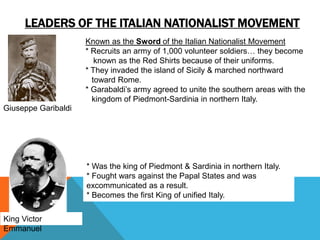
                     Known as the Sword of the Italian Nationalist Movement
                     * Recruits an army of 1,000 volunteer soldiers… they become
                        known as the Red Shirts because of their uniforms.
                     * They invaded the island of Sicily & marched northward
                       toward Rome.
                     * Garabaldi’s army agreed to unite the southern areas with the
                       kingdom of Piedmont-Sardinia in northern Italy.
Giuseppe Garibaldi


                     * Was the king of Piedmont & Sardinia in northern Italy.
                     * Fought wars against the Papal States and was
                     excommunicated as a result.
                     * Becomes the first King of unified Italy.

King Victor
Emmanuel
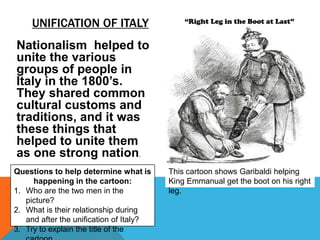
UNIFICATION OF ITALY                    “Right Leg in the Boot at Last”


Nationalism helped to
unite the various
groups of people in
Italy in the 1800’s.
They shared common
cultural customs and
traditions, and it was
these things that
helped to unite them
as one strong nation.
Questions to help determine what is      This cartoon shows Garibaldi helping
     happening in the cartoon:           King Emmanual get the boot on his right
1. Who are the two men in the            leg.
   picture?
2. What is their relationship during
   and after the unification of Italy?
3. Try to explain the title of the
UNIFICATION OF GERMANY
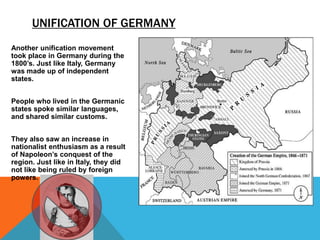
Another unification movement
took place in Germany during the
1800’s. Just like Italy, Germany
was made up of independent
states.


People who lived in the Germanic
states spoke similar languages,
and shared similar customs.


They also saw an increase in
nationalist enthusiasm as a result
of Napoleon’s conquest of the
region. Just like in Italy, they did
not like being ruled by foreign
powers.
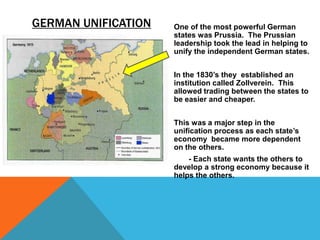
GERMAN UNIFICATION   One of the most powerful German
                     states was Prussia. The Prussian
                     leadership took the lead in helping to
                     unify the independent German states.


                     In the 1830’s they established an
                     institution called Zollverein. This
                     allowed trading between the states to
                     be easier and cheaper.


                     This was a major step in the
                     unification process as each state’s
                     economy became more dependent
                     on the others.
                         - Each state wants the others to
                     develop a strong economy because it
                     helps the others.
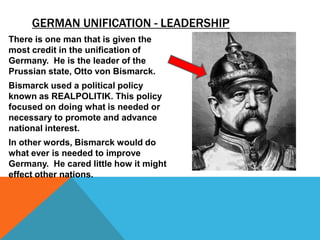
GERMAN UNIFICATION - LEADERSHIP
There is one man that is given the
most credit in the unification of
Germany. He is the leader of the
Prussian state, Otto von Bismarck.
Bismarck used a political policy
known as REALPOLITIK. This policy
focused on doing what is needed or
necessary to promote and advance
national interest.
In other words, Bismarck would do
what ever is needed to improve
Germany. He cared little how it might
effect other nations.
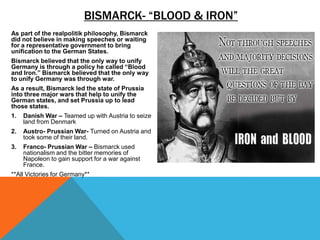
BISMARCK- “BLOOD & IRON”
As part of the realpolitik philosophy, Bismarck
did not believe in making speeches or waiting
for a representative government to bring
unification to the German States.
Bismarck believed that the only way to unify
Germany is through a policy he called “Blood
and Iron.” Bismarck believed that the only way
to unify Germany was through war.
As a result, Bismarck led the state of Prussia
into three major wars that help to unify the
German states, and set Prussia up to lead
those states.
1.   Danish War – Teamed up with Austria to seize
     land from Denmark
2.   Austro- Prussian War- Turned on Austria and
     took some of their land.
3.   Franco- Prussian War – Bismarck used
     nationalism and the bitter memories of
     Napoleon to gain support for a war against
     France.
**All Victories for Germany**
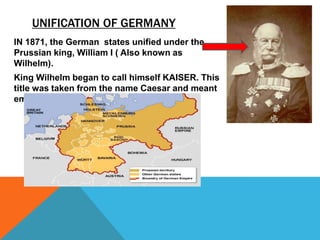
UNIFICATION OF GERMANY
IN 1871, the German states unified under the
Prussian king, William I ( Also known as
Wilhelm).
King Wilhelm began to call himself KAISER. This
title was taken from the name Caesar and meant
emperor.
POSITIVE & NEGATIVES OF NATIONALISM ON
              PEOPLE OF THE JEWISH FAITH
   Anti-Semitism: Discrimination against Jews, simply because they are
   Jewish. Negatives
As nationalism grew in nations and
regions throughout Europe, the
intensification of anti-Semitism also
grew.
As citizens grew more patriotic and
proud of their own nations, they
often grew less tolerant of those they
viewed as outsiders, including Jews.
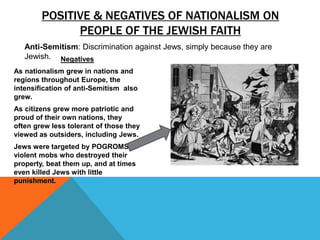
Jews were targeted by POGROMS or
violent mobs who destroyed their
property, beat them up, and at times
even killed Jews with little
punishment.
POSITIVE & NEGATIVES OF NATIONALISM ON
      PEOPLE OF THE JEWISH FAITH
                                   Positives

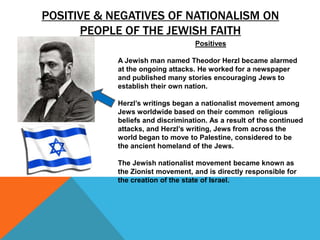
            A Jewish man named Theodor Herzl became alarmed
            at the ongoing attacks. He worked for a newspaper
            and published many stories encouraging Jews to
            establish their own nation.

            Herzl’s writings began a nationalist movement among
            Jews worldwide based on their common religious
            beliefs and discrimination. As a result of the continued
            attacks, and Herzl’s writing, Jews from across the
            world began to move to Palestine, considered to be
            the ancient homeland of the Jews.

            The Jewish nationalist movement became known as
            the Zionist movement, and is directly responsible for
            the creation of the state of Israel.
NATIONALISM IN INDIA
                       India’s nationalism movement is going
                       to grow out of the distrust of foreigners
                       in their land. Just like many of the
                       European nations you have already
                       learned about, the people were unhappy
                       when they were being controlled by
                       outsiders.
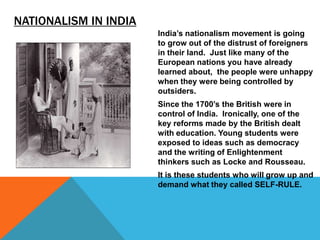
                       Since the 1700’s the British were in
                       control of India. Ironically, one of the
                       key reforms made by the British dealt
                       with education. Young students were
                       exposed to ideas such as democracy
                       and the writing of Enlightenment
                       thinkers such as Locke and Rousseau.
                       It is these students who will grow up and
                       demand what they called SELF-RULE.
DIVISIONS AMONG INDIAN NATIONALISTS
Indian National Congress
•   Made up of mainly Hindu
    professionals and business
    men.
•   Demanded more say in Indian     Muslim League
    political affairs that were     •   Indian Muslims began to grow
    dominated by the British.           distrustful of the Indian National
                                        Congress leadership because it was
•   Ultimately, they wanted to          primarily Hindu.
    put an end to the Imperialist   •   Muslims in India worried that they
    rule of Britain in India            were not being equally represented.
                                    •   They were also concerned about the
                                        growth of Hindu nationalism.
                                    •   In response they formed the Muslim
                                        League .
                                    •   One of their goals was to establish an
                                        independent Muslim state.
INDIAN NATIONALISM
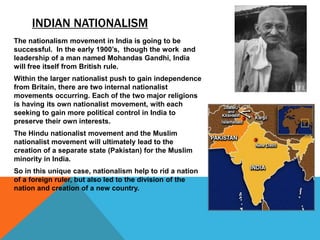
The nationalism movement in India is going to be
successful. In the early 1900’s, though the work and
leadership of a man named Mohandas Gandhi, India
will free itself from British rule.
Within the larger nationalist push to gain independence
from Britain, there are two internal nationalist
movements occurring. Each of the two major religions
is having its own nationalist movement, with each
seeking to gain more political control in India to
preserve their own interests.
The Hindu nationalist movement and the Muslim
nationalist movement will ultimately lead to the
creation of a separate state (Pakistan) for the Muslim
minority in India.
So in this unique case, nationalism help to rid a nation
of a foreign ruler, but also led to the division of the
nation and creation of a new country.
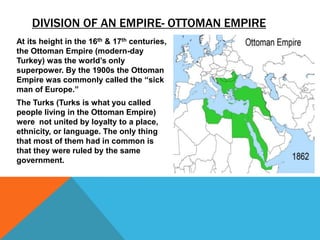
DIVISION OF AN EMPIRE- OTTOMAN EMPIRE
At its height in the 16th & 17th centuries,
the Ottoman Empire (modern-day
Turkey) was the world’s only
superpower. By the 1900s the Ottoman
Empire was commonly called the “sick
man of Europe.”
The Turks (Turks is what you called
people living in the Ottoman Empire)
were not united by loyalty to a place,
ethnicity, or language. The only thing
that most of them had in common is
that they were ruled by the same
government.
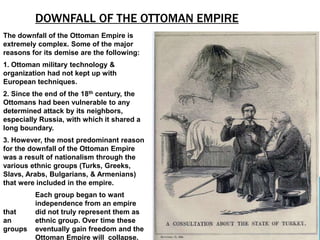
DOWNFALL OF THE OTTOMAN EMPIRE
The downfall of the Ottoman Empire is
extremely complex. Some of the major
reasons for its demise are the following:
1. Ottoman military technology &
organization had not kept up with
European techniques.
2. Since the end of the 18th century, the
Ottomans had been vulnerable to any
determined attack by its neighbors,
especially Russia, with which it shared a
long boundary.
3. However, the most predominant reason
for the downfall of the Ottoman Empire
was a result of nationalism through the
various ethnic groups (Turks, Greeks,
Slavs, Arabs, Bulgarians, & Armenians)
that were included in the empire.
         Each group began to want
         independence from an empire
that     did not truly represent them as
an       ethnic group. Over time these
groups   eventually gain freedom and the
         Ottoman Empire will collapse.
BIG IDEAS- KEY THEMES & CONCEPTS
Now, answer the following questions on the sheet
  provided.
1. Describe specific ways in which nationalism
   caused revolutions.
2. Described how nationalism led to the unification
   of both Italy and Germany.
3. Explain how nationalism impacted specific ethnic
   groups- Indians, Turks, and Jews.
4. Explain how nationalism will lead to the end of the
   Ottoman Empire.

Nationalist Movements

  • 2.
    BACKGROUND- RISE OFNATIONALISM During the French Revolution , the people in France expressed a great deal of pride in their nation. This pride has been called NATIONALISM. Nationalism will spread throughout the world and cause many revolutions. Some of these revolutions will unite people and create nations. Others, while still acting to unite people, will ultimately lead to the end of some of histories great empires.
  • 3.
    BIG IDEAS- KEYTHEMES & CONCEPTS At the end of this PowerPoint you should be able to: 1. Describe specific ways in which nationalism caused revolutions. 2. Described how nationalism led to the unification of both Italy and Germany. 3. Explain how nationalism impacted specific ethnic groups- Indians, Turks, and Jews. 4. Explain how nationalism will lead to the end of the Ottoman Empire.
  • 4.
    IN THE BEGINNING…FRENCH REVOLUTION • Member of the 3rd estate felt as if they were being unfairly treated by upper classes and the king. • Inspired by the Enlightenment thinkers and the American Revolution, members of the 3rd estate demand changes that will bring about the French Revolution. • 3rd estate was approximately 97% of the French population. Every member of the 3rd estate faced the same unequal treatment (shared experience) and this help to forge a sense of unity among them. • This unity grew into a national sense of pride among those members of the 3rd estate.
  • 5.
    IN THE BEGINNING…NAPOLEON • Even Napoleon helped the nationalist movement to grow. • There was a great rise in nationalism in the countries and regions of Europe that he was able to take over. • This nationalism will lead many people in these nations to rise up against Napoleon and the French armies he controls. Map of Napoleon’s Empire at its height.
  • 6.
    NATIONALISM LEADS TOUNIFICATION German Italy y
  • 7.
    UNIFICATION OF ITALY •Since the fall of the Roman Empire, Italy has never truly been a unified country. • Instead, much like the United States of America, it was made up of many states. Each state had its own government and culture. • After the fall of Napoleon and the Congress of Vienna, some of the Italian lands were put under the control of the Austrian Empire. • Being under the rule of foreigners leads many Italians to develop a sense of nationalism.
  • 8.
    LEADERS OF THEITALIAN NATIONALIST MOVEMENT There was a growing desire among the people of Italy to bring unification to its people. This movement was led by 4 key individuals: Giuseppe Mazzini Count Camillo Giuseppe Garibaldi King Victor Cavour Emmanuel
  • 9.
    LEADERS OF THEITALIAN NATIONALIST MOVEMENT Known as the Spirit of the Italian Nationalist Movement * Led the Risorgimento: “resurgence” or “revival” -- Goal was to bring prestige back to Italy -- Reassert the power of Roman Empire * Nationalistic leader of a secret society called “Young Italy.” * Mazzini wanted to transform Italy into a unified nation. * Will be exiled to London for his views. Giuseppe Mazzini Known as the BRAIN of the Italian Nationalist Movement * Prime Minister of the Kingdom of Sardinia (Italian state). * Formed alliances with France and Prussia. * Used diplomacy and war to drive the Austrians from power in northern Italy. Count Camillo Cavour
  • 10.
    LEADERS OF THEITALIAN NATIONALIST MOVEMENT Known as the Sword of the Italian Nationalist Movement * Recruits an army of 1,000 volunteer soldiers… they become known as the Red Shirts because of their uniforms. * They invaded the island of Sicily & marched northward toward Rome. * Garabaldi’s army agreed to unite the southern areas with the kingdom of Piedmont-Sardinia in northern Italy. Giuseppe Garibaldi * Was the king of Piedmont & Sardinia in northern Italy. * Fought wars against the Papal States and was excommunicated as a result. * Becomes the first King of unified Italy. King Victor Emmanuel
  • 11.
    UNIFICATION OF ITALY “Right Leg in the Boot at Last” Nationalism helped to unite the various groups of people in Italy in the 1800’s. They shared common cultural customs and traditions, and it was these things that helped to unite them as one strong nation. Questions to help determine what is This cartoon shows Garibaldi helping happening in the cartoon: King Emmanual get the boot on his right 1. Who are the two men in the leg. picture? 2. What is their relationship during and after the unification of Italy? 3. Try to explain the title of the
  • 12.
    UNIFICATION OF GERMANY Anotherunification movement took place in Germany during the 1800’s. Just like Italy, Germany was made up of independent states. People who lived in the Germanic states spoke similar languages, and shared similar customs. They also saw an increase in nationalist enthusiasm as a result of Napoleon’s conquest of the region. Just like in Italy, they did not like being ruled by foreign powers.
  • 13.
    GERMAN UNIFICATION One of the most powerful German states was Prussia. The Prussian leadership took the lead in helping to unify the independent German states. In the 1830’s they established an institution called Zollverein. This allowed trading between the states to be easier and cheaper. This was a major step in the unification process as each state’s economy became more dependent on the others. - Each state wants the others to develop a strong economy because it helps the others.
  • 14.
    GERMAN UNIFICATION -LEADERSHIP There is one man that is given the most credit in the unification of Germany. He is the leader of the Prussian state, Otto von Bismarck. Bismarck used a political policy known as REALPOLITIK. This policy focused on doing what is needed or necessary to promote and advance national interest. In other words, Bismarck would do what ever is needed to improve Germany. He cared little how it might effect other nations.
  • 15.
    BISMARCK- “BLOOD &IRON” As part of the realpolitik philosophy, Bismarck did not believe in making speeches or waiting for a representative government to bring unification to the German States. Bismarck believed that the only way to unify Germany is through a policy he called “Blood and Iron.” Bismarck believed that the only way to unify Germany was through war. As a result, Bismarck led the state of Prussia into three major wars that help to unify the German states, and set Prussia up to lead those states. 1. Danish War – Teamed up with Austria to seize land from Denmark 2. Austro- Prussian War- Turned on Austria and took some of their land. 3. Franco- Prussian War – Bismarck used nationalism and the bitter memories of Napoleon to gain support for a war against France. **All Victories for Germany**
  • 16.
    UNIFICATION OF GERMANY IN1871, the German states unified under the Prussian king, William I ( Also known as Wilhelm). King Wilhelm began to call himself KAISER. This title was taken from the name Caesar and meant emperor.
  • 17.
    POSITIVE & NEGATIVESOF NATIONALISM ON PEOPLE OF THE JEWISH FAITH Anti-Semitism: Discrimination against Jews, simply because they are Jewish. Negatives As nationalism grew in nations and regions throughout Europe, the intensification of anti-Semitism also grew. As citizens grew more patriotic and proud of their own nations, they often grew less tolerant of those they viewed as outsiders, including Jews. Jews were targeted by POGROMS or violent mobs who destroyed their property, beat them up, and at times even killed Jews with little punishment.
  • 18.
    POSITIVE & NEGATIVESOF NATIONALISM ON PEOPLE OF THE JEWISH FAITH Positives A Jewish man named Theodor Herzl became alarmed at the ongoing attacks. He worked for a newspaper and published many stories encouraging Jews to establish their own nation. Herzl’s writings began a nationalist movement among Jews worldwide based on their common religious beliefs and discrimination. As a result of the continued attacks, and Herzl’s writing, Jews from across the world began to move to Palestine, considered to be the ancient homeland of the Jews. The Jewish nationalist movement became known as the Zionist movement, and is directly responsible for the creation of the state of Israel.
  • 19.
    NATIONALISM IN INDIA India’s nationalism movement is going to grow out of the distrust of foreigners in their land. Just like many of the European nations you have already learned about, the people were unhappy when they were being controlled by outsiders. Since the 1700’s the British were in control of India. Ironically, one of the key reforms made by the British dealt with education. Young students were exposed to ideas such as democracy and the writing of Enlightenment thinkers such as Locke and Rousseau. It is these students who will grow up and demand what they called SELF-RULE.
  • 20.
    DIVISIONS AMONG INDIANNATIONALISTS Indian National Congress • Made up of mainly Hindu professionals and business men. • Demanded more say in Indian Muslim League political affairs that were • Indian Muslims began to grow dominated by the British. distrustful of the Indian National Congress leadership because it was • Ultimately, they wanted to primarily Hindu. put an end to the Imperialist • Muslims in India worried that they rule of Britain in India were not being equally represented. • They were also concerned about the growth of Hindu nationalism. • In response they formed the Muslim League . • One of their goals was to establish an independent Muslim state.
  • 21.
    INDIAN NATIONALISM The nationalismmovement in India is going to be successful. In the early 1900’s, though the work and leadership of a man named Mohandas Gandhi, India will free itself from British rule. Within the larger nationalist push to gain independence from Britain, there are two internal nationalist movements occurring. Each of the two major religions is having its own nationalist movement, with each seeking to gain more political control in India to preserve their own interests. The Hindu nationalist movement and the Muslim nationalist movement will ultimately lead to the creation of a separate state (Pakistan) for the Muslim minority in India. So in this unique case, nationalism help to rid a nation of a foreign ruler, but also led to the division of the nation and creation of a new country.
  • 22.
    DIVISION OF ANEMPIRE- OTTOMAN EMPIRE At its height in the 16th & 17th centuries, the Ottoman Empire (modern-day Turkey) was the world’s only superpower. By the 1900s the Ottoman Empire was commonly called the “sick man of Europe.” The Turks (Turks is what you called people living in the Ottoman Empire) were not united by loyalty to a place, ethnicity, or language. The only thing that most of them had in common is that they were ruled by the same government.
  • 23.
    DOWNFALL OF THEOTTOMAN EMPIRE The downfall of the Ottoman Empire is extremely complex. Some of the major reasons for its demise are the following: 1. Ottoman military technology & organization had not kept up with European techniques. 2. Since the end of the 18th century, the Ottomans had been vulnerable to any determined attack by its neighbors, especially Russia, with which it shared a long boundary. 3. However, the most predominant reason for the downfall of the Ottoman Empire was a result of nationalism through the various ethnic groups (Turks, Greeks, Slavs, Arabs, Bulgarians, & Armenians) that were included in the empire. Each group began to want independence from an empire that did not truly represent them as an ethnic group. Over time these groups eventually gain freedom and the Ottoman Empire will collapse.
  • 24.
    BIG IDEAS- KEYTHEMES & CONCEPTS Now, answer the following questions on the sheet provided. 1. Describe specific ways in which nationalism caused revolutions. 2. Described how nationalism led to the unification of both Italy and Germany. 3. Explain how nationalism impacted specific ethnic groups- Indians, Turks, and Jews. 4. Explain how nationalism will lead to the end of the Ottoman Empire.