NATIONAL AIDS CONTROL
PROGRAMME(NACP)
MOHAMMED YOUSUF
MOHAMMED SAAD ZAKI
11/8/2019 1
NATIONAL AIDS CONTROL PROGRAMME
• National AIDS control programme was launched in india in 1987.
• The aim of the programme is
1. To prevent further transmission of HIV
2. To decrease morbidity & mortality associated with HIV infection
3. To minimze the socio-economic impact resulting from HIV
infection
11/8/2019 2
MILESTONES OF PROGRAMME
• 1986 - First case of HIV detected
- AIDS task force was set up by ICMR
- National AIDS committe established under the Ministry of Health
• 1990 - Medium term plan launched for 4 states & 4 metros.
• 1992 - NACP-1 launched to slow down the spread of HIV infection.
- National AIDS control Board constituted.
- National AIDS Control Organization was set-up
11/8/2019 3
• 1999 - NACP-2 begins, focussing on behaviour change, increased
decentralizaton & NGO involvement.
- State AIDS Control Societies established.
• 2002 - National AIDS Control Policy Adopted.
- National Blood Policy adopted
• 2004 - Anti-Retroviral Treatment(ART) initiated
• 2006 - National Council on AIDS constituted under charmanship of the
prime minister.
- National Policy on Paediatric ART formulated.
11/8/2019 4
• 2007 - NACP-3 launched for 5 years (2007-2012)
• 2012 - NACP-4 launched for 5 years (2012-2017)
• 2017 - National Strategic plan for HIV/AIDS and STIs 2017-2024
launched
11/8/2019 5
The national strategy has following components:
1. Establishment of surveillance centres to cover the whole country.
2. Identification of High-Risk group & their screening.
3. Issuing specific guidelines for management of detected cases & their
follow up.
4. Formulating guidelines for blood bank, blood product manufacturers,
blood donors & dialysis units.
5. Information, education & communication activities by involving mass
media & research for reduction of personel & social impact of the
disease.
6. Control of Sexully Trasmitted Diseases(STD)
7. Condom programme.
11/8/2019 6
• The government of India initiated programmes of prevention & raising
awareness under the MEDIUM TERM PLAN (1990-92)
• NACP-1 (1992 - 99)
• NACP -2 (1999 - 2006)
• NACP - 3 (2007 - 2012)
• Based on the lessons learnt & achievement made in Phase 1,2 & 3
NACP- 4 was launched (2012 - 2017)
11/8/2019 7
11/8/2019 8
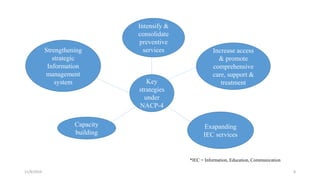
Key
strategies
under
NACP-4
Intensify &
consolidate
preventive
services Increase access
& promote
comprehensive
care, support &
treatment
Exapanding
IEC services
Capacity
building
Strengthening
strategic
Information
management
system
*IEC = Information, Education, Communication
SERVICES UNDER NACP-4
11/8/2019 9
1.Prevention services
2.Care, support & treatment services
1. Prevention services
• Targeted interventions for high-risk group (female sex workers, transgenders,
injecting drug users) & bridge population ( truckers & migrants)
• Needle-syringe exchange programme & opioid substitution therapy for IUD
(Intravenous Drug Users)
• Prevention intervention for migrant population
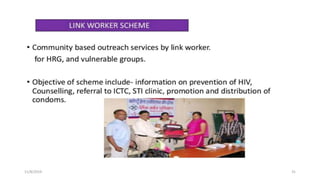
• Link worker scheme for HRG's & vulnerable population
• Prevention of STI/RTI
*STI= sexually transmitted infections, RTI = reproductive tract infection, HRG= high risk groups
11/8/2019 10
• Blood safety.
• HIV counselling & testing centre
• Prevention of Parent To Child Transmission(PPTCT)
• condom promotion
• Information, education & communication
• social mobilization, youth intervention & adolescence education
programme
• mainstreaming HIV/AIDS response
• work place interventions
11/8/2019 11
2. Care, support & treatment services
• Laboratory services for CD4 testing & other investigations
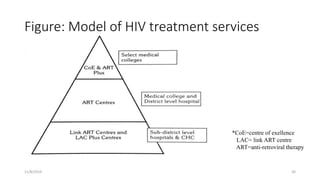
• Free 1st line & 2nd line Anti-Retroviral Therapy (ART) through ART centres & Link ART Centres
(LACs), Centre of Excellence (CoE) & ART plus centres
• Paediatric ART for children
• Early infant diagnosis for HIV exposed infants & children below 18 months.
• Nutritional & psycho-social support through Care & Support Centres (CSC)
• HIV/TB coordination
• Treatment of opportunistic infection
• Drop-in centres for PLHIV
11/8/2019 12
HIV SURVEILLANCE
• Different types of surveillance activites are being carried out in the
country such as
1. HIV Sentinel Surveillance
2. HIV sero-surveillance
3. AIDS case surveillance
4. STD surveillance
5. Behavioural surveillance
6. Integration with surveillance of other diseases like TB etc
11/8/2019 13
HIV SENTINEL SURVEILLIANCE
• The objectives of the surveillance are
1. To determine the level of HIV infection among general population as well
as high risk group in different states
2. To understand the trends of HIV epidemic among general population as
well as high risk group in different states
3. To understand the geographical spread of HIV infection & to identify
emerging pockets
4. To provide information for prioritization of programme resources &
evaluation of programme impact
5. To estimate HIV prevalence & HIV burden in the country.
11/8/2019 14
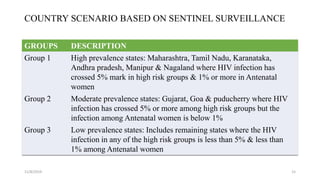
COUNTRY SCENARIO BASED ON SENTINEL SURVEILLANCE
GROUPS DESCRIPTION
Group 1 High prevalence states: Maharashtra, Tamil Nadu, Karanataka,
Andhra pradesh, Manipur & Nagaland where HIV infection has
crossed 5% mark in high risk groups & 1% or more in Antenatal
women
Group 2 Moderate prevalence states: Gujarat, Goa & puducherry where HIV
infection has crossed 5% or more among high risk groups but the
infection among Antenatal women is below 1%
Group 3 Low prevalence states: Includes remaining states where the HIV
infection in any of the high risk groups is less than 5% & less than
1% among Antenatal women
11/8/2019 15
NATIONAL AIDS CONTROL
ORGANIZATION (NACO)
• The ministry of health & family welfare launched
NACO in 1992.
• It works as a separate wing to implement & closely
monitor the various components of the programme.
• It is headed by the Additional Secretary, Ministry of
Health & Director General, NACO Govt. of India
11/8/2019 16
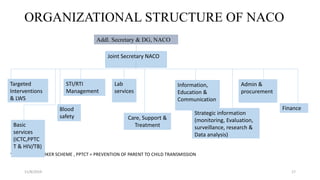
ORGANIZATIONAL STRUCTURE OF NACO
*LWS = LINE WORKER SCHEME , PPTCT = PREVENTION OF PARENT TO CHILD TRANSMISSION
11/8/2019 17
Addl. Secretary & DG, NACO
Joint Secretary NACO
Targeted
Interventions
& LWS
Basic
services
(ICTC,PPTC
T & HIV/TB)
STI/RTI
Management
Blood
safety
Lab
services
Care, Support &
Treatment
Information,
Education &
Communication
Strategic information
(monitoring, Evaluation,
surveillance, research &
Data analysis)
Admin &
procurement
Finance
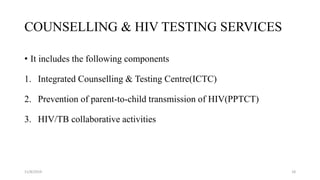
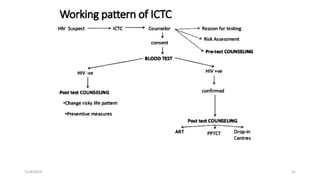
COUNSELLING & HIV TESTING SERVICES
• It includes the following components
1. Integrated Counselling & Testing Centre(ICTC)
2. Prevention of parent-to-child transmission of HIV(PPTCT)
3. HIV/TB collaborative activities
11/8/2019 18
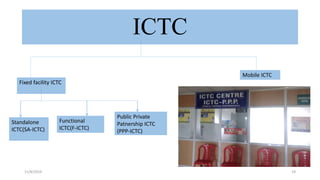
ICTC
11/8/2019 19
Fixed facility ICTC
Mobile ICTC
Standalone
ICTC(SA-ICTC)
Functional
ICTC(F-ICTC)
Public Private
Patnership ICTC
(PPP-ICTC)
11/8/2019 20
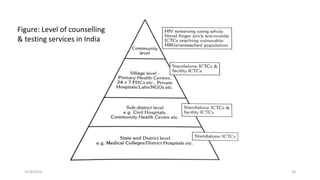
Figure: Level of counselling
& testing services in India
11/8/2019 21
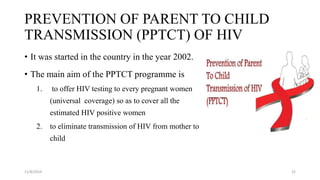
PREVENTION OF PARENT TO CHILD
TRANSMISSION (PPTCT) OF HIV
• It was started in the country in the year 2002.
• The main aim of the PPTCT programme is
1. to offer HIV testing to every pregnant women
(universal coverage) so as to cover all the
estimated HIV positive women
2. to eliminate transmission of HIV from mother to
child
11/8/2019 22
11/8/2019 23
• In india PPTCT was started with single dose Nevirapine prophylaxis
for HIV positive pregnant women during labour & also for her new
born child.
• But in 2010 WHO adopted with the department of AIDS control
adopting ''option B'' were it directed for the use of multi-drug ARV
prophylaxis instead single dose Nevirapine.
• In september 2012 India transitioned from single dose Nevirapine to
multi-drug ARV prophylaxis.
*ARV=Anti-retroviral
11/8/2019 24
• Without any intervention risk of transmission of HIV from infected mother
to her child is between 20-45%.
• Single dose Nevirapine is highly effective in reducing risk of transmission
from about 45% to less than 10%.
• Multiple drugs for PPTCT can reduce transmission to less than 5% if
started early in pregnancy & continued throughout period of delivery &
breast feeding.
Essential package of PPTCT services
• Offer HIV counselling & testing
• Moving from ANC centric to Family centric
• ART to all HIV pregnant women regardless of CD4 count & clinical
stages of HIV progression. Preferred regimen is TDF+3TC+EFV.
• Promoting institutional delivery
• Provision of care for associated conditions
• Counselling for exclusive breastfeeding upto 6 months
• Provision of ART prophylaxis to infants upto 6 months
• Ensuring initiation of Co-trimoxazole prophylactic Therapy(CPT) &
Early Infant Diagnosis (EID) using HIV-DNA PCR at 6 weeks of age
onwards, as per the EID guidelines
11/8/2019 25
*TDF=TENOFOVIR, 3TC=LAMIVUDINE, EFV=EFAVIRENZ
HIV TESTING OF TB PATIENTS
• Detection of HIV by offering HIV test to diagnosed TB patient is being
implemented by NACP & RNTCP jointly since 2007-08.
• States with high HIV prevalence cover about 90% TB patients for HIV testing, but
case fatality rate among HIV infected cases remain 13-14%,as compared to less
than 4% in HIV negative cases, indicating delayed detection of HIV/TB inspite of
good coverage.
• HIV testing in presumptive cases of TB rolled out in india in OCT 2012 in
karnataka followed by maharashtra, Andhra Pradesh & Tamil Nadu.
11/8/2019 26
Figure: Pronged strategy for HIV/TB
coordination
11/8/2019 27
CARE, SUPPORT & TREATMENT(CST)
• The CST component of NACP aims to provide comprehensive services to
people living with HIV(PLHIV) to improve the quality of life.
• The policy package include the following
1. Free universal access to life long standardized ART
2. Free laboratory diagnostic & monitoring services
3. Facilitating long term retention in care
4. Prevention, diagnosis & management of opportunistic infection
5. Linkage to care & support services & linkage to social protection scheme
11/8/2019 28
• The country has adopted fast track target of 90-90-90 which aims at
ending AIDS as public health treat by 2030 by achieving fast track
targets by 2020.
• They are as follows
1. 90 per cent of PLHIV know their status of which
2. 90 per cent of PLHIV are on ART, of which
3. 90 per cent of PLHIV have viral suppression
• A significant step of rolling out ''test & treat'' policy has been taken
towards achieving this target.
11/8/2019 29
*PLHIV=PEOPLE LIVING WITH HIV
Figure: Model of HIV treatment services
11/8/2019 30
*CoE=centre of exellence
LAC= link ART centre
ART=anti-retroviral therapy
11/8/2019 31
11/8/2019 32
11/8/2019 33
Condom promotion
• It is a strategy that will be strengthened through free distribution & social
marketing channels, non-traditional outlets, females condoms etc
• It is aided by an effective communication strategy.
• The programme will continue to link prevention with care, support &
treatment.
• This will promote positive prevention.
11/8/2019 34
SURAKSHA CLINIC
• It is branded by NACO
• It has been developed for the better health services &
prevention of HIV/AIDS & other STI/RTI diseases
• These clinics are associated with dermatology department
so the patient do not feel hesitated in explaining their
problems
11/8/2019 35
NATIONAL STRATEGIC PLAN(NSP) FOR
HIV/AIDS & STI 2017-2024
• It is developed with a vision of an AIDS free India.
• The mission is to attain universal coverage of HIV prevention,
testing, treatment to care continuum that is effective, inclusive,
equitable & adapted to population & local needs.
11/8/2019 36
GOAL
•The goal is to achieve zero new infection, zero AIDS-
related deaths & zero AIDS related stigma &
discrimination.
11/8/2019 37
STRATEGIC FRAMEWORK
• NSP is designed around a result-based framework that reflects the fast-track targets
and the ''ending of AIDS'' commitment.
• Based on this strategic framework, a specific planning approach is required which
helps differentiate States and Union Territories (UT) according to 3 predominant
epidemiological contexts.
I. States / Union Territories with a “ mature ” epidemic where HIV incidence and
prevalence are high in key,bridge and other at risk population and in some cases
other segments of the general populations .
11/8/2019 38
II. Those States/ UT where there are emerging epidemics with
relatively new and rising rates of infection among key bridge and
other at risk population .
III. States /UT with low or stable epidemics where there is still a need to
focus on potential risks among key bridge and other at risk
populations to maintain the low infection rates and eliminate HIV
transmission.
11/8/2019 39
OBJECTIVES
• NSP proposes six objectives towards fulfilling its vision of an AIDS free INDIA, these are;
1. Reduce 80% new infections by 2024 (baseline 2010)
2. Ensure 95% of estimated PLHIV (people living with HIV / AIDS) know there status by
2020
3. Ensure 95% PLHIV have ART( Anti retroviral treatment) initiation and retention by 2024,
for sustained viral suppression
4. Eliminate mother to child transmission of HIV and syphilis by 2020
5. Eliminate HIV/AIDS related stigma and discrimination by 2020
6. Facilitate systainable NACP ( National AIDS control programme ) service delivery by 2024
11/8/2019 40
Achievement of these objectives by 2024 would
result in
• Estimated new infections will reduce from 102,226 (2010) to < 21,000 per year
• 2.14 million PLHIV of the total estimated PLHIV (2.25 million) would know their status
• 2.03 million PLHIV would be put on ART
• 1.93 million PLHIV would be retained on treatment and have HIV VL <1000 copies/ml
• Attainment of < 50 cases of new pediaetric HIV infections per 1,00,000 live births with a
mother to child transmission rate < 5% by 2020 and maintainence of same thereof
11/8/2019 41
• Attainment of < 50 cases of congenital syphilis per 1,00,000 live births
and maintainance of same thereof
• HIV /AIDS will be percieved as chronic manageable disease with no
stigma and discrimination attached to it
• Key components of NACP such as prevention outreach , testing ,
treatment , prevention of mother to child transmission ,viral load
separation , care and support , as well as social protection scheme will
continue through 100% domestic funding
11/8/2019 42
INFORMATION, EDUCATION &
COMMUNICATION
• Communication in NACP-4 is directed at:
1. To increase knowledge among general population ( especially youth and
women) on save sexual behaviour
2. To sustain behaviour change in high risk groups and bridge populations
3. To generate demand for care , support,and treatment services
4. To make appropriate changes in social norms that reinforce positive attitude ,
beliefs and practices to reduce stigma and discrimination
11/8/2019 43
Adolescence Education Programme
• This programme runs in secondary and senior secondary schools to built up life skills
of adolescents to cope with the physical and physiological changes associated with
growing up.
• Under the programme 16 hour sessions are scheduled during the academic terms of
class 9th and 11th.
• State AIDS control society have further adapted the modules after state level
consultations with NGOs , academicians , psychologists and parent teacher bodies.
11/8/2019 44
• The purpose to establish red ribbon club in college is
to encourage peer-to-peer messaging on HIV
prevention and to provide a safe space for young
people to seek clearifications of their doubts and myths
surrounding HIV /AIDS .
• This also promotes blood donation among youths.
11/8/2019 45
RED RIBBON CLUB
RED RIBBON EXPRESS
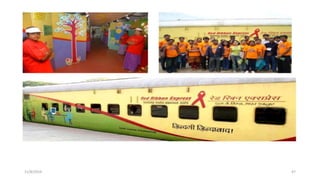
• Its an HIV/AIDS, other sexually transmitted infection awareness campaign train
by Indian railway.
• The motto of the red ribbon express is ''Embarking on the journey of life''
• Partners involved NACO, UNICEF, State AIDS control Societies(SACS),
National Rural Health Mission & Indian railways
11/8/2019 46
11/8/2019 47
SWOT ANALYSIS
11/8/2019 48
STRENGTHS
• Political commitment.
• Programme decentralized through state & district societies in order to
effective implementation & ensure local planning.
• Budget allocation is high.
• Surveillance component both sentinel & behavior.
11/8/2019 49
WEAKNESS
• Stigma
• Conflicting roles of national & international agency
• Under utilization of funds in many states
• More expenditure on ART.
11/8/2019 50
OPPORTUNITIES
• WHO & UNICEF should provide central leadership & uniform guidelines
worldwide.
• Indian pharmaceuticals are strong & prompted to produce drugs in India.
That will reduce cost.
• Social & religious groups involved in raising awareness.
• Awareness in rural areas can be increased.
• Strategy for rehablitation should aslo be made.
11/8/2019 51
THREATS
• Reduced budget can hamper the progress.
• Withdrawal of international agencies could hamper progress.
• Some states such has gujarat, Chhatisgarh, Goa, Rajasthan have
banned sex education due to religious & cultural sentiments which is a
serious setback to the programme.
11/8/2019 52
REFERENCES
• Textbook of Park 25th EDITION
• National AIDS control organization http://www.naco.gov.in/
• Textbook of suryakanth 4th edition
• WHO guidelines for ART
11/8/2019 53
QUESTIONS
• LONG ESSAY
1. National AIDS control programme explain in detail.
• SHORT ESSAY
1. Describe the strategies adopted by National AIDS control programme .
2. Clinical manifestation of HIV infection.
• SHORT ANSWER
1. Sentinel surveilance for HIV in India.
2. HAART ( Human AIDS Anti Retroviral Therapy) .
3. Window period.
4. Case definition used for diagnosis of AIDS.
11/8/2019 54
11/8/2019 55

National Aids Control Program

  • 1.
    NATIONAL AIDS CONTROL PROGRAMME(NACP) MOHAMMEDYOUSUF MOHAMMED SAAD ZAKI 11/8/2019 1
  • 2.
    NATIONAL AIDS CONTROLPROGRAMME • National AIDS control programme was launched in india in 1987. • The aim of the programme is 1. To prevent further transmission of HIV 2. To decrease morbidity & mortality associated with HIV infection 3. To minimze the socio-economic impact resulting from HIV infection 11/8/2019 2
  • 3.
    MILESTONES OF PROGRAMME •1986 - First case of HIV detected - AIDS task force was set up by ICMR - National AIDS committe established under the Ministry of Health • 1990 - Medium term plan launched for 4 states & 4 metros. • 1992 - NACP-1 launched to slow down the spread of HIV infection. - National AIDS control Board constituted. - National AIDS Control Organization was set-up 11/8/2019 3
  • 4.
    • 1999 -NACP-2 begins, focussing on behaviour change, increased decentralizaton & NGO involvement. - State AIDS Control Societies established. • 2002 - National AIDS Control Policy Adopted. - National Blood Policy adopted • 2004 - Anti-Retroviral Treatment(ART) initiated • 2006 - National Council on AIDS constituted under charmanship of the prime minister. - National Policy on Paediatric ART formulated. 11/8/2019 4
  • 5.
    • 2007 -NACP-3 launched for 5 years (2007-2012) • 2012 - NACP-4 launched for 5 years (2012-2017) • 2017 - National Strategic plan for HIV/AIDS and STIs 2017-2024 launched 11/8/2019 5
  • 6.
    The national strategyhas following components: 1. Establishment of surveillance centres to cover the whole country. 2. Identification of High-Risk group & their screening. 3. Issuing specific guidelines for management of detected cases & their follow up. 4. Formulating guidelines for blood bank, blood product manufacturers, blood donors & dialysis units. 5. Information, education & communication activities by involving mass media & research for reduction of personel & social impact of the disease. 6. Control of Sexully Trasmitted Diseases(STD) 7. Condom programme. 11/8/2019 6
  • 7.
    • The governmentof India initiated programmes of prevention & raising awareness under the MEDIUM TERM PLAN (1990-92) • NACP-1 (1992 - 99) • NACP -2 (1999 - 2006) • NACP - 3 (2007 - 2012) • Based on the lessons learnt & achievement made in Phase 1,2 & 3 NACP- 4 was launched (2012 - 2017) 11/8/2019 7
  • 8.
    11/8/2019 8 Key strategies under NACP-4 Intensify & consolidate preventive servicesIncrease access & promote comprehensive care, support & treatment Exapanding IEC services Capacity building Strengthening strategic Information management system *IEC = Information, Education, Communication
  • 9.
    SERVICES UNDER NACP-4 11/8/20199 1.Prevention services 2.Care, support & treatment services
  • 10.
    1. Prevention services •Targeted interventions for high-risk group (female sex workers, transgenders, injecting drug users) & bridge population ( truckers & migrants) • Needle-syringe exchange programme & opioid substitution therapy for IUD (Intravenous Drug Users) • Prevention intervention for migrant population • Link worker scheme for HRG's & vulnerable population • Prevention of STI/RTI *STI= sexually transmitted infections, RTI = reproductive tract infection, HRG= high risk groups 11/8/2019 10
  • 11.
    • Blood safety. •HIV counselling & testing centre • Prevention of Parent To Child Transmission(PPTCT) • condom promotion • Information, education & communication • social mobilization, youth intervention & adolescence education programme • mainstreaming HIV/AIDS response • work place interventions 11/8/2019 11
  • 12.
    2. Care, support& treatment services • Laboratory services for CD4 testing & other investigations • Free 1st line & 2nd line Anti-Retroviral Therapy (ART) through ART centres & Link ART Centres (LACs), Centre of Excellence (CoE) & ART plus centres • Paediatric ART for children • Early infant diagnosis for HIV exposed infants & children below 18 months. • Nutritional & psycho-social support through Care & Support Centres (CSC) • HIV/TB coordination • Treatment of opportunistic infection • Drop-in centres for PLHIV 11/8/2019 12
  • 13.
    HIV SURVEILLANCE • Differenttypes of surveillance activites are being carried out in the country such as 1. HIV Sentinel Surveillance 2. HIV sero-surveillance 3. AIDS case surveillance 4. STD surveillance 5. Behavioural surveillance 6. Integration with surveillance of other diseases like TB etc 11/8/2019 13
  • 14.
    HIV SENTINEL SURVEILLIANCE •The objectives of the surveillance are 1. To determine the level of HIV infection among general population as well as high risk group in different states 2. To understand the trends of HIV epidemic among general population as well as high risk group in different states 3. To understand the geographical spread of HIV infection & to identify emerging pockets 4. To provide information for prioritization of programme resources & evaluation of programme impact 5. To estimate HIV prevalence & HIV burden in the country. 11/8/2019 14
  • 15.
    COUNTRY SCENARIO BASEDON SENTINEL SURVEILLANCE GROUPS DESCRIPTION Group 1 High prevalence states: Maharashtra, Tamil Nadu, Karanataka, Andhra pradesh, Manipur & Nagaland where HIV infection has crossed 5% mark in high risk groups & 1% or more in Antenatal women Group 2 Moderate prevalence states: Gujarat, Goa & puducherry where HIV infection has crossed 5% or more among high risk groups but the infection among Antenatal women is below 1% Group 3 Low prevalence states: Includes remaining states where the HIV infection in any of the high risk groups is less than 5% & less than 1% among Antenatal women 11/8/2019 15
  • 16.
    NATIONAL AIDS CONTROL ORGANIZATION(NACO) • The ministry of health & family welfare launched NACO in 1992. • It works as a separate wing to implement & closely monitor the various components of the programme. • It is headed by the Additional Secretary, Ministry of Health & Director General, NACO Govt. of India 11/8/2019 16
  • 17.
    ORGANIZATIONAL STRUCTURE OFNACO *LWS = LINE WORKER SCHEME , PPTCT = PREVENTION OF PARENT TO CHILD TRANSMISSION 11/8/2019 17 Addl. Secretary & DG, NACO Joint Secretary NACO Targeted Interventions & LWS Basic services (ICTC,PPTC T & HIV/TB) STI/RTI Management Blood safety Lab services Care, Support & Treatment Information, Education & Communication Strategic information (monitoring, Evaluation, surveillance, research & Data analysis) Admin & procurement Finance
  • 18.
    COUNSELLING & HIVTESTING SERVICES • It includes the following components 1. Integrated Counselling & Testing Centre(ICTC) 2. Prevention of parent-to-child transmission of HIV(PPTCT) 3. HIV/TB collaborative activities 11/8/2019 18
  • 19.
    ICTC 11/8/2019 19 Fixed facilityICTC Mobile ICTC Standalone ICTC(SA-ICTC) Functional ICTC(F-ICTC) Public Private Patnership ICTC (PPP-ICTC)
  • 20.
    11/8/2019 20 Figure: Levelof counselling & testing services in India
  • 21.
  • 22.
    PREVENTION OF PARENTTO CHILD TRANSMISSION (PPTCT) OF HIV • It was started in the country in the year 2002. • The main aim of the PPTCT programme is 1. to offer HIV testing to every pregnant women (universal coverage) so as to cover all the estimated HIV positive women 2. to eliminate transmission of HIV from mother to child 11/8/2019 22
  • 23.
    11/8/2019 23 • Inindia PPTCT was started with single dose Nevirapine prophylaxis for HIV positive pregnant women during labour & also for her new born child. • But in 2010 WHO adopted with the department of AIDS control adopting ''option B'' were it directed for the use of multi-drug ARV prophylaxis instead single dose Nevirapine. • In september 2012 India transitioned from single dose Nevirapine to multi-drug ARV prophylaxis. *ARV=Anti-retroviral
  • 24.
    11/8/2019 24 • Withoutany intervention risk of transmission of HIV from infected mother to her child is between 20-45%. • Single dose Nevirapine is highly effective in reducing risk of transmission from about 45% to less than 10%. • Multiple drugs for PPTCT can reduce transmission to less than 5% if started early in pregnancy & continued throughout period of delivery & breast feeding.
  • 25.
    Essential package ofPPTCT services • Offer HIV counselling & testing • Moving from ANC centric to Family centric • ART to all HIV pregnant women regardless of CD4 count & clinical stages of HIV progression. Preferred regimen is TDF+3TC+EFV. • Promoting institutional delivery • Provision of care for associated conditions • Counselling for exclusive breastfeeding upto 6 months • Provision of ART prophylaxis to infants upto 6 months • Ensuring initiation of Co-trimoxazole prophylactic Therapy(CPT) & Early Infant Diagnosis (EID) using HIV-DNA PCR at 6 weeks of age onwards, as per the EID guidelines 11/8/2019 25 *TDF=TENOFOVIR, 3TC=LAMIVUDINE, EFV=EFAVIRENZ
  • 26.
    HIV TESTING OFTB PATIENTS • Detection of HIV by offering HIV test to diagnosed TB patient is being implemented by NACP & RNTCP jointly since 2007-08. • States with high HIV prevalence cover about 90% TB patients for HIV testing, but case fatality rate among HIV infected cases remain 13-14%,as compared to less than 4% in HIV negative cases, indicating delayed detection of HIV/TB inspite of good coverage. • HIV testing in presumptive cases of TB rolled out in india in OCT 2012 in karnataka followed by maharashtra, Andhra Pradesh & Tamil Nadu. 11/8/2019 26
  • 27.
    Figure: Pronged strategyfor HIV/TB coordination 11/8/2019 27
  • 28.
    CARE, SUPPORT &TREATMENT(CST) • The CST component of NACP aims to provide comprehensive services to people living with HIV(PLHIV) to improve the quality of life. • The policy package include the following 1. Free universal access to life long standardized ART 2. Free laboratory diagnostic & monitoring services 3. Facilitating long term retention in care 4. Prevention, diagnosis & management of opportunistic infection 5. Linkage to care & support services & linkage to social protection scheme 11/8/2019 28
  • 29.
    • The countryhas adopted fast track target of 90-90-90 which aims at ending AIDS as public health treat by 2030 by achieving fast track targets by 2020. • They are as follows 1. 90 per cent of PLHIV know their status of which 2. 90 per cent of PLHIV are on ART, of which 3. 90 per cent of PLHIV have viral suppression • A significant step of rolling out ''test & treat'' policy has been taken towards achieving this target. 11/8/2019 29 *PLHIV=PEOPLE LIVING WITH HIV
  • 30.
    Figure: Model ofHIV treatment services 11/8/2019 30 *CoE=centre of exellence LAC= link ART centre ART=anti-retroviral therapy
  • 31.
  • 32.
  • 33.
  • 34.
    Condom promotion • Itis a strategy that will be strengthened through free distribution & social marketing channels, non-traditional outlets, females condoms etc • It is aided by an effective communication strategy. • The programme will continue to link prevention with care, support & treatment. • This will promote positive prevention. 11/8/2019 34
  • 35.
    SURAKSHA CLINIC • Itis branded by NACO • It has been developed for the better health services & prevention of HIV/AIDS & other STI/RTI diseases • These clinics are associated with dermatology department so the patient do not feel hesitated in explaining their problems 11/8/2019 35
  • 36.
    NATIONAL STRATEGIC PLAN(NSP)FOR HIV/AIDS & STI 2017-2024 • It is developed with a vision of an AIDS free India. • The mission is to attain universal coverage of HIV prevention, testing, treatment to care continuum that is effective, inclusive, equitable & adapted to population & local needs. 11/8/2019 36
  • 37.
    GOAL •The goal isto achieve zero new infection, zero AIDS- related deaths & zero AIDS related stigma & discrimination. 11/8/2019 37
  • 38.
    STRATEGIC FRAMEWORK • NSPis designed around a result-based framework that reflects the fast-track targets and the ''ending of AIDS'' commitment. • Based on this strategic framework, a specific planning approach is required which helps differentiate States and Union Territories (UT) according to 3 predominant epidemiological contexts. I. States / Union Territories with a “ mature ” epidemic where HIV incidence and prevalence are high in key,bridge and other at risk population and in some cases other segments of the general populations . 11/8/2019 38
  • 39.
    II. Those States/UT where there are emerging epidemics with relatively new and rising rates of infection among key bridge and other at risk population . III. States /UT with low or stable epidemics where there is still a need to focus on potential risks among key bridge and other at risk populations to maintain the low infection rates and eliminate HIV transmission. 11/8/2019 39
  • 40.
    OBJECTIVES • NSP proposessix objectives towards fulfilling its vision of an AIDS free INDIA, these are; 1. Reduce 80% new infections by 2024 (baseline 2010) 2. Ensure 95% of estimated PLHIV (people living with HIV / AIDS) know there status by 2020 3. Ensure 95% PLHIV have ART( Anti retroviral treatment) initiation and retention by 2024, for sustained viral suppression 4. Eliminate mother to child transmission of HIV and syphilis by 2020 5. Eliminate HIV/AIDS related stigma and discrimination by 2020 6. Facilitate systainable NACP ( National AIDS control programme ) service delivery by 2024 11/8/2019 40
  • 41.
    Achievement of theseobjectives by 2024 would result in • Estimated new infections will reduce from 102,226 (2010) to < 21,000 per year • 2.14 million PLHIV of the total estimated PLHIV (2.25 million) would know their status • 2.03 million PLHIV would be put on ART • 1.93 million PLHIV would be retained on treatment and have HIV VL <1000 copies/ml • Attainment of < 50 cases of new pediaetric HIV infections per 1,00,000 live births with a mother to child transmission rate < 5% by 2020 and maintainence of same thereof 11/8/2019 41
  • 42.
    • Attainment of< 50 cases of congenital syphilis per 1,00,000 live births and maintainance of same thereof • HIV /AIDS will be percieved as chronic manageable disease with no stigma and discrimination attached to it • Key components of NACP such as prevention outreach , testing , treatment , prevention of mother to child transmission ,viral load separation , care and support , as well as social protection scheme will continue through 100% domestic funding 11/8/2019 42
  • 43.
    INFORMATION, EDUCATION & COMMUNICATION •Communication in NACP-4 is directed at: 1. To increase knowledge among general population ( especially youth and women) on save sexual behaviour 2. To sustain behaviour change in high risk groups and bridge populations 3. To generate demand for care , support,and treatment services 4. To make appropriate changes in social norms that reinforce positive attitude , beliefs and practices to reduce stigma and discrimination 11/8/2019 43
  • 44.
    Adolescence Education Programme •This programme runs in secondary and senior secondary schools to built up life skills of adolescents to cope with the physical and physiological changes associated with growing up. • Under the programme 16 hour sessions are scheduled during the academic terms of class 9th and 11th. • State AIDS control society have further adapted the modules after state level consultations with NGOs , academicians , psychologists and parent teacher bodies. 11/8/2019 44
  • 45.
    • The purposeto establish red ribbon club in college is to encourage peer-to-peer messaging on HIV prevention and to provide a safe space for young people to seek clearifications of their doubts and myths surrounding HIV /AIDS . • This also promotes blood donation among youths. 11/8/2019 45 RED RIBBON CLUB
  • 46.
    RED RIBBON EXPRESS •Its an HIV/AIDS, other sexually transmitted infection awareness campaign train by Indian railway. • The motto of the red ribbon express is ''Embarking on the journey of life'' • Partners involved NACO, UNICEF, State AIDS control Societies(SACS), National Rural Health Mission & Indian railways 11/8/2019 46
  • 47.
  • 48.
  • 49.
    STRENGTHS • Political commitment. •Programme decentralized through state & district societies in order to effective implementation & ensure local planning. • Budget allocation is high. • Surveillance component both sentinel & behavior. 11/8/2019 49
  • 50.
    WEAKNESS • Stigma • Conflictingroles of national & international agency • Under utilization of funds in many states • More expenditure on ART. 11/8/2019 50
  • 51.
    OPPORTUNITIES • WHO &UNICEF should provide central leadership & uniform guidelines worldwide. • Indian pharmaceuticals are strong & prompted to produce drugs in India. That will reduce cost. • Social & religious groups involved in raising awareness. • Awareness in rural areas can be increased. • Strategy for rehablitation should aslo be made. 11/8/2019 51
  • 52.
    THREATS • Reduced budgetcan hamper the progress. • Withdrawal of international agencies could hamper progress. • Some states such has gujarat, Chhatisgarh, Goa, Rajasthan have banned sex education due to religious & cultural sentiments which is a serious setback to the programme. 11/8/2019 52
  • 53.
    REFERENCES • Textbook ofPark 25th EDITION • National AIDS control organization http://www.naco.gov.in/ • Textbook of suryakanth 4th edition • WHO guidelines for ART 11/8/2019 53
  • 54.
    QUESTIONS • LONG ESSAY 1.National AIDS control programme explain in detail. • SHORT ESSAY 1. Describe the strategies adopted by National AIDS control programme . 2. Clinical manifestation of HIV infection. • SHORT ANSWER 1. Sentinel surveilance for HIV in India. 2. HAART ( Human AIDS Anti Retroviral Therapy) . 3. Window period. 4. Case definition used for diagnosis of AIDS. 11/8/2019 54
  • 55.