National Strategic Plan
For HIV/AIDS and STI
2017-2024
“Paving Way for an AIDS Free India”
Back ground
• First case of HIV in India -1986.
• NACP – 1987 ---Four phases.
• NACP IV- 2012-2017.
• NSP-2017-2024, frame work document.
• Designed for a period of Seven years.
• 66% reduction in new infections from 2000-
2015.
• 54% reduction in AIDS related deaths since
2007.
• 2.3 million PLHIV in India (2019).
• 28% of PLHIV do not know their HIV status.
• Around 6000 PLHIV in J&K.
Vision
• An AIDS Free India.
• It was framed in tune with SDG 3, That
encompasses:
• “Ending of AIDS by 2030”.
Mission
• Attain universal coverage of HIV prevention,
treatment to care continuum that are
effective, inclusive, equitable and adapted to
needs.
Goals
• Achieving Zero new infections
• Zero AIDS related death
• Zero discrimination
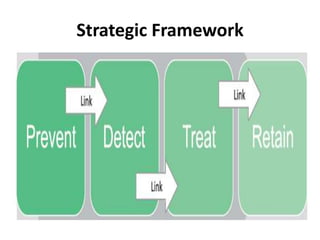
Strategic Framework
Prevent
• Increased coverage for improved prevention,
testing and care linkages.
• Systematic evidence generation to reach 'at
risk' population.
• Retain Key Population with adequate and
appropriate services.
TEST
• Geo-prioritise differential approach.
• Use graded approach to increase HIV testing.
• Pilot and scale up newer modalities of testing
(e.g. CBT, Self Testing, etc.).
• Active use of IEC to increase demand for HIV
testing
Treat
• Accelerate uptake of ART
• Improve ART retention by engaging
community/NGOs/ private sector.
• Ensure supportive environment for achieving
universal access to ART
• Address co-morbidities of HIV infection to lower
mortality and morbidity.
Objective
• Reduce new infection of HIV by 80% by 2024.
• Link 95% of PLHIV with services by 2024.
• Ensure ART initiation and retention of 95% of
PLHIV for sustained viral load suppression by
2024.
• Eliminate mother to child transmission of HIV
and Syphilis by 2024.
• Eliminate HIV related stigma and
discrimination by 2020.
• Facilitate sustainable NACP service delivery
by 2024.
By 2024
• Estimated new infections will reduce from
102,226 (2010) to < 21,000 per year.
• 2.14 million PLHIV of the total estimated PLHIV
(2.25 million) would know their status.
• 2.03 million PLHIV would be put on ART.
• 1.93 million PLHIV would be retained on
treatment and have HIV VL <1000 copies/Ml.
• Fulfilment of<50 cases of new paediatric HIV
infections per 100,000 live births with a
mother-to-child transmission rate of <5% by
2020 and maintenance of same thereof.
• Attainment of <50 cases of congenital syphilis
per 100,000 live births and maintenance of
same thereof.
• HIV/AIDS will be perceived as chronic
manageable disease with no stigma and
discrimination attached to it.
• Key components of the NACP such as
prevention outreach, testing, treatment,
prevention of mother-to-child transmission,
viral load suppression, care and support, as
well as social protection schemes will continue
through 100% domestic funding.
Major strategies
• Fast-Tracked Flexible Approach to HIV
Programming
• The HIV epidemic is not uniform in all States/
UTs of India, and even within the State/UTs,
there are vast differences in both situational
and epidemic trends.
• Leveraging integration of the AIDS
Programme with the National Health Mission
• Many components of the NACP require
support from general health systems and other
programmes.
• For example, PPTCT is heavily dependent on
the RMNCH+A programme to get pregnant
mother
under ANC care and hence tested for HIV.
• Active collaboration with private sector
• Engaging public and private sector companies
through their corporate social responsibility
(CSR)functions and funds.
• Developing an Advocacy, Communication and
Social Mobilisation (ACSM) approach.
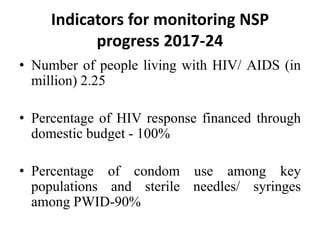
Indicators for monitoring NSP
progress 2017-24
• Number of people living with HIV/ AIDS (in
million) 2.25
• Percentage of HIV response financed through
domestic budget - 100%
• Percentage of condom use among key
populations and sterile needles/ syringes
among PWID-90%
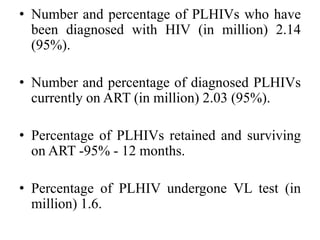
• Number and percentage of PLHIVs who have
been diagnosed with HIV (in million) 2.14
(95%).
• Number and percentage of diagnosed PLHIVs
currently on ART (in million) 2.03 (95%).
• Percentage of PLHIVs retained and surviving
on ART -95% - 12 months.
• Percentage of PLHIV undergone VL test (in
million) 1.6.
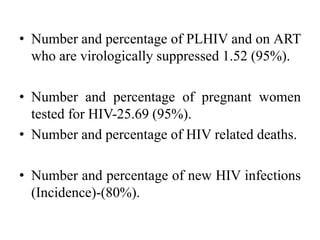
• Number and percentage of PLHIV and on ART
who are virologically suppressed 1.52 (95%).
• Number and percentage of pregnant women
tested for HIV-25.69 (95%).
• Number and percentage of HIV related deaths.

• Number and percentage of new HIV infections
(Incidence)-(80%).
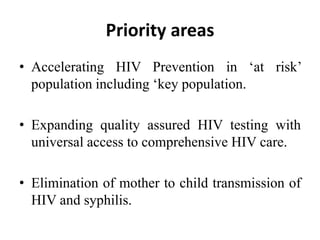
Priority areas
• Accelerating HIV Prevention in ‘at risk’
population including ‘key population.
• Expanding quality assured HIV testing with
universal access to comprehensive HIV care.
• Elimination of mother to child transmission of
HIV and syphilis.
• Addressing the critical enablers in HIV
programming.
• Restructuring the strategic information system
to be efficient and patient-centric.
Thanks

National strategic plan

  • 1.
    National Strategic Plan ForHIV/AIDS and STI 2017-2024 “Paving Way for an AIDS Free India”
  • 2.
    Back ground • Firstcase of HIV in India -1986. • NACP – 1987 ---Four phases. • NACP IV- 2012-2017. • NSP-2017-2024, frame work document. • Designed for a period of Seven years.
  • 3.
    • 66% reductionin new infections from 2000- 2015. • 54% reduction in AIDS related deaths since 2007. • 2.3 million PLHIV in India (2019). • 28% of PLHIV do not know their HIV status. • Around 6000 PLHIV in J&K.
  • 4.
    Vision • An AIDSFree India. • It was framed in tune with SDG 3, That encompasses: • “Ending of AIDS by 2030”.
  • 5.
    Mission • Attain universalcoverage of HIV prevention, treatment to care continuum that are effective, inclusive, equitable and adapted to needs.
  • 6.
    Goals • Achieving Zeronew infections • Zero AIDS related death • Zero discrimination
  • 7.
  • 8.
    Prevent • Increased coveragefor improved prevention, testing and care linkages. • Systematic evidence generation to reach 'at risk' population. • Retain Key Population with adequate and appropriate services.
  • 9.
    TEST • Geo-prioritise differentialapproach. • Use graded approach to increase HIV testing. • Pilot and scale up newer modalities of testing (e.g. CBT, Self Testing, etc.). • Active use of IEC to increase demand for HIV testing
  • 10.
    Treat • Accelerate uptakeof ART • Improve ART retention by engaging community/NGOs/ private sector. • Ensure supportive environment for achieving universal access to ART • Address co-morbidities of HIV infection to lower mortality and morbidity.
  • 11.
    Objective • Reduce newinfection of HIV by 80% by 2024. • Link 95% of PLHIV with services by 2024. • Ensure ART initiation and retention of 95% of PLHIV for sustained viral load suppression by 2024. • Eliminate mother to child transmission of HIV and Syphilis by 2024.
  • 12.
    • Eliminate HIVrelated stigma and discrimination by 2020. • Facilitate sustainable NACP service delivery by 2024.
  • 14.
    By 2024 • Estimatednew infections will reduce from 102,226 (2010) to < 21,000 per year. • 2.14 million PLHIV of the total estimated PLHIV (2.25 million) would know their status. • 2.03 million PLHIV would be put on ART. • 1.93 million PLHIV would be retained on treatment and have HIV VL <1000 copies/Ml.
  • 15.
    • Fulfilment of<50cases of new paediatric HIV infections per 100,000 live births with a mother-to-child transmission rate of <5% by 2020 and maintenance of same thereof. • Attainment of <50 cases of congenital syphilis per 100,000 live births and maintenance of same thereof. • HIV/AIDS will be perceived as chronic manageable disease with no stigma and discrimination attached to it.
  • 16.
    • Key componentsof the NACP such as prevention outreach, testing, treatment, prevention of mother-to-child transmission, viral load suppression, care and support, as well as social protection schemes will continue through 100% domestic funding.
  • 17.
    Major strategies • Fast-TrackedFlexible Approach to HIV Programming • The HIV epidemic is not uniform in all States/ UTs of India, and even within the State/UTs, there are vast differences in both situational and epidemic trends.
  • 18.
    • Leveraging integrationof the AIDS Programme with the National Health Mission • Many components of the NACP require support from general health systems and other programmes. • For example, PPTCT is heavily dependent on the RMNCH+A programme to get pregnant mother under ANC care and hence tested for HIV.
  • 19.
    • Active collaborationwith private sector • Engaging public and private sector companies through their corporate social responsibility (CSR)functions and funds. • Developing an Advocacy, Communication and Social Mobilisation (ACSM) approach.
  • 20.
    Indicators for monitoringNSP progress 2017-24 • Number of people living with HIV/ AIDS (in million) 2.25 • Percentage of HIV response financed through domestic budget - 100% • Percentage of condom use among key populations and sterile needles/ syringes among PWID-90%
  • 21.
    • Number andpercentage of PLHIVs who have been diagnosed with HIV (in million) 2.14 (95%). • Number and percentage of diagnosed PLHIVs currently on ART (in million) 2.03 (95%). • Percentage of PLHIVs retained and surviving on ART -95% - 12 months. • Percentage of PLHIV undergone VL test (in million) 1.6.
  • 22.
    • Number andpercentage of PLHIV and on ART who are virologically suppressed 1.52 (95%). • Number and percentage of pregnant women tested for HIV-25.69 (95%). • Number and percentage of HIV related deaths. • Number and percentage of new HIV infections (Incidence)-(80%).
  • 23.
    Priority areas • AcceleratingHIV Prevention in ‘at risk’ population including ‘key population. • Expanding quality assured HIV testing with universal access to comprehensive HIV care. • Elimination of mother to child transmission of HIV and syphilis.
  • 24.
    • Addressing thecritical enablers in HIV programming. • Restructuring the strategic information system to be efficient and patient-centric.
  • 25.