Point of View and Perspective
Dialogue and Narration Dialogue When the characters speak Narration When the narrator speaks “Quotation marks” separate narration from dialogue. “Help” my cousin Jack Said.
Point of View Five types of point of view: 1 st  Person 2 nd  Person 3 rd  Person Limited 3 rd  Person Omniscient 3 rd  Person Objective
Point of View 1 st  Person I, me, my, we, our… Story is told from a main character’s POV Benefits Readers see events from the perspective of an important character Readers often understand the main character better
Point of View 1 st  Person  Drawbacks Narrator may be unreliable-insane, naïve, deceptive, narrow minded Readers see only one perspective which makes the story very limited
Point of View 1 st  Person (Cont’d) “ True—nervous—very dreadfully nervous I had been and am; but why will you say that I am mad? The disease had sharpened my sense—not destroyed—not dulled them. Above all was the sense of hearing acute. I heard all things in the heaven and in the earth. Edgar Alle Poe, “The Tell-Tale Heart” (1850)
Point of View 2 nd  Person You, yours, your, yourself A second-person POV is rare Uses “you” and present command Often the narrator is speaking to him/herself
Point of View 3 rd  Person Omniscient Limited Objective
Point of View 3 rd  Person Omniscient All knowing The narrator can see into the minds of all characters Godlike narrator He/she can enter character's minds and know everything that is going, past, present, and future May be a narrator outside the text
Point of View 3 rd  Person Omniscient  Very natural technique Author is after all omniscient regarding his/her work Disadvantage Not lifelike Narrator knows and tells all Is truly a convention of literature
Point of View 3 rd  Person Omniscient  “It was the best of times, it was the worst of times, it was the age of wisdom, it was the age of foolishness, it was the epoch of belief, it was the epoch of incredulity, it was the season of Light, it was the season of darkness, it was the spring of hope, it was the winter of despair…”  Charles Dickens,  A Tale of Two Cities  (1859)
Point of View 3 rd  Person Limited Narrator can see into ONE character’s mind All characters have thought privacy except ONE Gives the impression that we are very close to the mind of that ONE character, though viewing it from a distance Sometimes this narrator can be too focused or may impose his/her own opinions with no grounds
Point of View 3 rd  Person Limited Omniscient “ The girl he loved was shy and quick with the smallest in the class, and usually she said noting, but one day she opened her mouth and roa, and when the teacher—it was French class—asked her what she was doing, she said, in French, I am a lion…” Elizabeth Graver, “The Boy who fell Forty Feet” (1993)
Point of View 3 rd  Person Objective Narrator only describes and does not enter the characters’ thoughts Like a video camera, the narrator reports what happens and what the characters are saying The narrator adds no comment about how the characters are feeling The narrator offers no comment on the mood of the setting-no mention of awkwardness, ease, tension, ect….
Point of View 3 rd  Person Objective “The morning of June 27 th  was clear and sunny, with fresh warmth of a full-summer day; the flowers were blossoming profusely and the grass was richly green. The people of the village began to gather in the square, between the post office and the bank, around ten o’clock…”  Shirley Jackson, “The Lottery” (1948)
Point of View Review: Point of view=Who is telling the story and how much they contribute 1 st  Person I, Me, My, We, Our 2 nd  Person You, Your Yours, Yourself
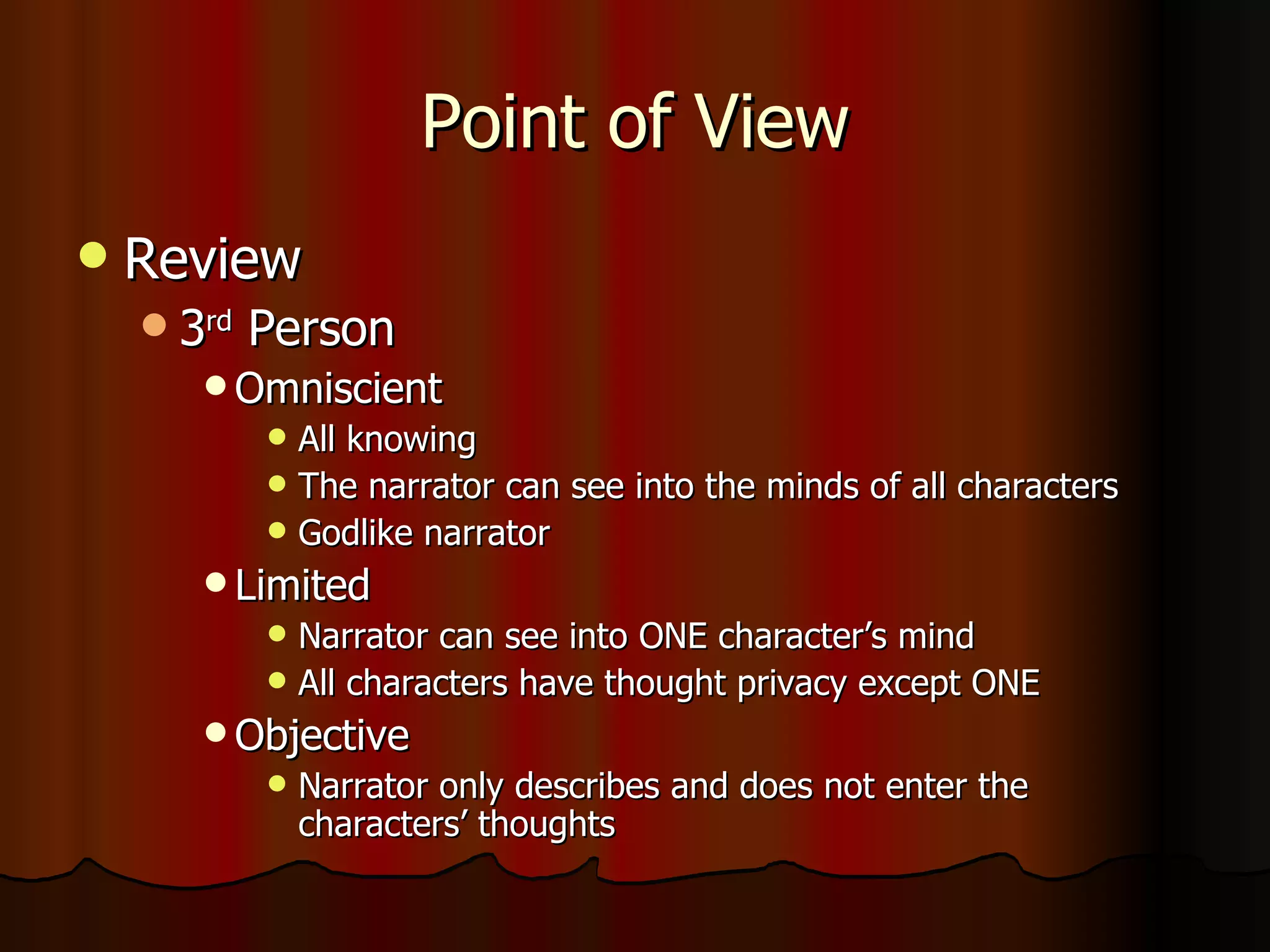
Point of View Review 3 rd  Person Omniscient All knowing The narrator can see into the minds of all characters Godlike narrator Limited Narrator can see into ONE character’s mind All characters have thought privacy except ONE Objective Narrator only describes and does not enter the characters’ thoughts

Point of view and perspective

  • 1.
    Point of Viewand Perspective
  • 2.
    Dialogue and NarrationDialogue When the characters speak Narration When the narrator speaks “Quotation marks” separate narration from dialogue. “Help” my cousin Jack Said.
  • 3.
    Point of ViewFive types of point of view: 1 st Person 2 nd Person 3 rd Person Limited 3 rd Person Omniscient 3 rd Person Objective
  • 4.
    Point of View1 st Person I, me, my, we, our… Story is told from a main character’s POV Benefits Readers see events from the perspective of an important character Readers often understand the main character better
  • 5.
    Point of View1 st Person Drawbacks Narrator may be unreliable-insane, naïve, deceptive, narrow minded Readers see only one perspective which makes the story very limited
  • 6.
    Point of View1 st Person (Cont’d) “ True—nervous—very dreadfully nervous I had been and am; but why will you say that I am mad? The disease had sharpened my sense—not destroyed—not dulled them. Above all was the sense of hearing acute. I heard all things in the heaven and in the earth. Edgar Alle Poe, “The Tell-Tale Heart” (1850)
  • 7.
    Point of View2 nd Person You, yours, your, yourself A second-person POV is rare Uses “you” and present command Often the narrator is speaking to him/herself
  • 8.
    Point of View3 rd Person Omniscient Limited Objective
  • 9.
    Point of View3 rd Person Omniscient All knowing The narrator can see into the minds of all characters Godlike narrator He/she can enter character's minds and know everything that is going, past, present, and future May be a narrator outside the text
  • 10.
    Point of View3 rd Person Omniscient Very natural technique Author is after all omniscient regarding his/her work Disadvantage Not lifelike Narrator knows and tells all Is truly a convention of literature
  • 11.
    Point of View3 rd Person Omniscient “It was the best of times, it was the worst of times, it was the age of wisdom, it was the age of foolishness, it was the epoch of belief, it was the epoch of incredulity, it was the season of Light, it was the season of darkness, it was the spring of hope, it was the winter of despair…” Charles Dickens, A Tale of Two Cities (1859)
  • 12.
    Point of View3 rd Person Limited Narrator can see into ONE character’s mind All characters have thought privacy except ONE Gives the impression that we are very close to the mind of that ONE character, though viewing it from a distance Sometimes this narrator can be too focused or may impose his/her own opinions with no grounds
  • 13.
    Point of View3 rd Person Limited Omniscient “ The girl he loved was shy and quick with the smallest in the class, and usually she said noting, but one day she opened her mouth and roa, and when the teacher—it was French class—asked her what she was doing, she said, in French, I am a lion…” Elizabeth Graver, “The Boy who fell Forty Feet” (1993)
  • 14.
    Point of View3 rd Person Objective Narrator only describes and does not enter the characters’ thoughts Like a video camera, the narrator reports what happens and what the characters are saying The narrator adds no comment about how the characters are feeling The narrator offers no comment on the mood of the setting-no mention of awkwardness, ease, tension, ect….
  • 15.
    Point of View3 rd Person Objective “The morning of June 27 th was clear and sunny, with fresh warmth of a full-summer day; the flowers were blossoming profusely and the grass was richly green. The people of the village began to gather in the square, between the post office and the bank, around ten o’clock…” Shirley Jackson, “The Lottery” (1948)
  • 16.
    Point of ViewReview: Point of view=Who is telling the story and how much they contribute 1 st Person I, Me, My, We, Our 2 nd Person You, Your Yours, Yourself
  • 17.
    Point of ViewReview 3 rd Person Omniscient All knowing The narrator can see into the minds of all characters Godlike narrator Limited Narrator can see into ONE character’s mind All characters have thought privacy except ONE Objective Narrator only describes and does not enter the characters’ thoughts