NARRATION
Pattern of Development in
Writing a Paragraph
-refers to the particular
strategy writers use to
develop ideas.
Psychological
Facts
Closing your eyes
helps you remember
things.
People tend to value memories
more than actual people.
Sometimes, you miss the
memories, not the actual
person.
Your nose is connected to
the memory center of your
brain that is why smells can
trigger powerful memories.
Scent is a powerful trigger for
memory. According to studies,
a memory paired or associated
to a scent can be recalled more
easily.
When a person dies, they have
7 minutes of brain activity left.
It’s the mind playing back the
person’s memories in a dream
sequences.
NARRATION
It tells a story
about a real or
imaginary
experience or
incident.
Characteristics:
- The details are
usually arranged in
chronological order
and are logical.
* Chronological –
arranged in the order of
occurrence
* Logical – acceptable by
reason (easily understood
by majority)
Transitional expressions
can help tie ideas
together and show
relationships. They also
reveal organization
patterns to help your
reader follow along.
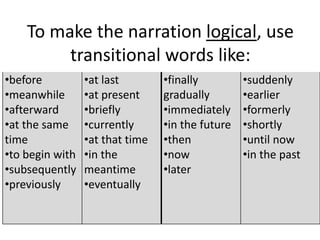
To make the narration logical, use
transitional words like:
•before
•meanwhile
•afterward
•at the same
time
•to begin with
•subsequently
•previously
•at last
•at present
•briefly
•currently
•at that time
•in the
meantime
•eventually
•finally
gradually
•immediately
•in the future
•then
•now
•later
•suddenly
•earlier
•formerly
•shortly
•until now
•in the past
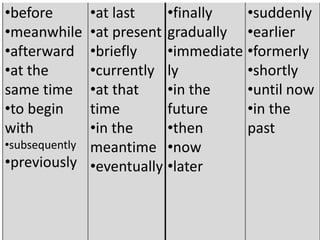
•before
•meanwhile
•afterward
•at the
same time
•to begin
with
•subsequently
•previously
•at last
•at present
•briefly
•currently
•at that
time
•in the
meantime
•eventually
•finally
gradually
•immediate
ly
•in the
future
•then
•now
•later
•suddenly
•earlier
•formerly
•shortly
•until now
•in the
past
Sample Narration
No.1
SURVIVING
POLICE ATTACK
Morillo recalled being brought to a
room along with Daa Jr. It was
connected to the house, but its two
walls were missing and one opening led
to a ravine about three meters away.
Without warning, the police shot
Morillo in the chest. He fell to the
ground bleeding, but did not lose
consciousness. The officer then shot
Daa twice, the second time on the head.
Lying beside Daa, Morillo
played dead. He crawled out
of the opening and onto the
edge of the ravine, and
found his way to the nearest
highway where he sought
medical help.
At the back of the house, the
police made Gabo, Comendo, and Cule
kneel on the ground and shot them to
death. Cule was the last of the three to
be killed. Hugging the legs of one of
the armed men, he begged to be
spared, but the police still shot him on
the nape, based on an eyewitness
accountofa14-year-old.
And, as if nothing happened, the
police officers stayed a few more
hours inside Daa’s home, and ate
at the billiard table using the
family’s plates and utensils,
helping themselves to food and
drinks from a sari-sari store
owned by the family of one of the
victims.
Morillo recuperated at the
East Avenue Medical Center.
But during the time he was
confined, QCPD police kept
him captive in the hospital
room. He is now under the
custody of the Commission
on Human Rights.
Sample Narration
No.2
It was already around 3 p.m. of that
fateful day of January 25 or more than
12 hours since we entered Barangay
Tukanalipao in Mamasapano,
Maguindanao, when SPO1 Inocencio
told us that he was wounded. We
were already cornered by their
enemies that time. The gun battle
started as early as 6 a.m.
We decided to lay silent for a while so
their enemies would think that we
were already dead. Our plan was to
fight it out with their enemies down
to their last bullet. Around 4pm, we
were already looking at each other as
if saying goodbye and preparing for
our last stand against at least 1,000
fully-armed enemies.
1. Objective Narration
(the narration of fact)
–events are actual
happenings in real life.

Examples:
1. Narration of the earthquake in Surigao
2. The Narration of Yolanda Victims
3. The Narration of a Shipwrecked
Titanic Survivor
4. Personal Experience
5. Others Experience
A Sudden Goodbye
The last time I saw my ex-
boyfriend was when he was
trying to open the gate of their
house. I never thought that it
would be the last. I glimpsed a
smile to him but his face was
naked that it just starred at me –
looking at me as he tried to bid
goodbye.
A Once In a
Life Time Experience
The one day I spent in Morocco,
Africa was an experience of a
lifetime. When I finally reached
Morocco and got off the bus, there
were four little girls standing
shoeless in the hot sun. After I
swallowed my tears, I could not even
try to picture this in America as it is
not something you often see in the
U.S.
Meanwhile my tourist guide
instructed me not to give them
money as it encouraged the
children to beg; however, I was
wearing four silver bracelets. As I
walked over to the girls, their eyes
watched my every move. Then I
kneeled down to their level while I
gave each girl a bracelet.
They stood there gleaming at
me, for they were pleased. I felt
completely in disbelief that this
tiny gesture could mean so
much. Though this experience
was upsetting, and a huge
culture shock, it will stay with
me forever.
© Kayla Marie Anfinson 2005
Subjective Narration
( purely imaginative)
– writer controls the
narration of events; that is
the whole story is the
product of author’s
imagination.
Examples:
Short stories
novels
myths
legends
fairy tales
Blood is Sweeter
than Love
There was once a Dracula who
lived in the forest by the kingdom
of Halcon. He was living for almost
one hundred years since his
parents left him in the tower
where he spent his life watching
television and playing yoyo. He
was alone and no friends to play
Every time he wanted to go to
centre town where people were
happily celebrating feasts of
different saints, he would cover
himself with black cloth and would
roam around the town while
observing how the townspeople
eating, drinking and mingling with
each other.
One night while he was
drinking in the Catacomb club
with a red blood champagne
floating with paired eyes and
dangling veins, a lady in red
with oozing brilliant eyes sat
beside him and asked his
name…(to be continued)
Setting Her
Husband Free
Once upon a time there was a fine
stag who ruled a herd of deer in a
forest and it had a beautiful wife. The
doe was very devoted to her husband
and helped him in all matters of life.
One day, the stag was caught in the
trap of a hunter and the doe was very
frightened as was the stag. All the
friends of the stag left him.
But the doe remained steadfast next
to him and waited for the hunter to
come. She was very devoted to her
husband. As soon as the hunter came,
she fell on his knees and begged, "Sir!
Please make a nice bed of leaves for
me and my husband and then kill me
first and then my husband and you
can have a nice feast."
The hunter was so amazed and
surprised by her love that he
went to first free the stag
before he prepared the bed of
leaves, and in a split second,
the stag and the doe ran after
being free.
TIME
MACHINE
Output No. 1
Choose from
Task A and
Task B.
(Task A): Objective
(past): Narrate a
story of an
important event
with your family,
friends, or special
someone.
(Task B):
Subjective
(future): Write a
short fantasy of
what you would
like to happen in
the future.
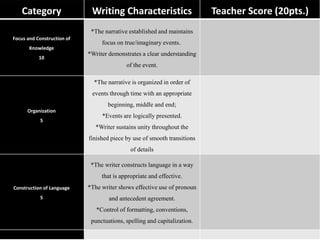
Category Writing Characteristics Teacher Score (20pts.)
Focus and Construction of
Knowledge
10
*The narrative established and maintains
focus on true/imaginary events.
*Writer demonstrates a clear understanding
of the event.
Organization
5
*The narrative is organized in order of
events through time with an appropriate
beginning, middle and end;
*Events are logically presented.
*Writer sustains unity throughout the
finished piece by use of smooth transitions
of details
Construction of Language
5
*The writer constructs language in a way
that is appropriate and effective.
*The writer shows effective use of pronoun
and antecedent agreement.
*Control of formatting, conventions,
punctuations, spelling and capitalization.
EVALUATION
A. Define narration.(2pt)
B. What are the two
characteristics of narration?
(2pts)
C. Enumerate classifications
of narration. (2pts)
D. Differentiate the
classifications (2pts)
E. Classify the following
narrated events whether
objective or subjective
narration. Then, write
what the narration is all
about. (2pts each)
E. Classify the following
narrated events whether
objective or subjective
narration.
The
Golden
Cage
I saw the caged songbird
had everything she needed;
food, water and shelter. Still
I saw a sad look upon her
face and she had not sung
for a very long time.
“Why do you not sing
anymore?”
You have quite a comfortable
life in your cage. She looked at
me with tearful eyes and said
“ A golden cage is still a
cage”
When I was in elementary school, I was a
very happy and outgoing kid and had lots of
friends. But when I started secondary
school, some older kids started to bully and
tease me. All my friends from elementary
school left me because they didn’t want to
be seen with me. At my school, everything
was all about money and clothes. I had huge
glasses and I was really ugly and everyone
laughed at me. Then a boy (he was in 8th
grade I think) started to follow me around.
He called me names, took my stuff and made up
rumors about me. One day he and his friends
beat me up on the bus. No one wanted to be
friends with me anymore. The n I became
friends with two girls in my class. They started
making up rumors about me. Everyone kept
telling me what a bad person I was. In 6th grade,
the bullying got even worse. Everyone said I was
ugly and I should just kill myself. In 7th grade my
mom made me attend afternoon classes (full-
time school was voluntary at my school). The
kids in afternoon class started bullying me, too.
They followed me around and took photos of
me in the bathroom to send them to the
whole school. When I got home from school, I
would go to my room and cry all evening. I
never talked to anyone. My grades dropped
and my teachers started to talk to my
parents. They told them I was lazy and
refused to participate. They knew I was
bullied but they never did anything to stop it.
Everyone hated me and I didn’t have a single
friend. I just want to tell everyone who is
going through the same: It gets better.
I know it’s really hard, and you might feel like
giving up sometimes, but you have to be
yourself and stay confident. Don’t let them
get to you. I know you’re suffering, but at
some point you’ll be proud of yourself for all
that you’ve been through. And if anyone
judges you, it is their own problem. Those
people have no idea what you’ve been
through. They probably couldn’t even take it.
But you had to take it. And you’re still here
going on with your life. And that’s why you
can be proud of yourself.
My father’s name is Robert
Ola, he died on Aug 28th
2003 of a heart attack. It
was about six in the morning
I was sleeping restlessly and
the phone rang and I missed
it then it rang again.
I saw it was my father’s house
calling to get me up for the first
day of school. To my surprise it
was my stepmother crying on
the other line. This was the
start of the worst day of my life
in the short seventeen years I
had been alive.
She proceeded to tell me that
my father has had a heart
attack and the ambulance had
came and got him. Then the
horror began I asked he’s ok
right he’s going to be ok . With
sorrow in her voice she said
Jace he’s dead.
I started crying and disbelief
and ran to my mom’s room
screaming and yelling. Later my
family gathered and
remembered the day that I
recall as the worst day of my
life.
Bring a picture that
depicts a special moment
of your life with special
person/people as in
family, friend,
classmates…
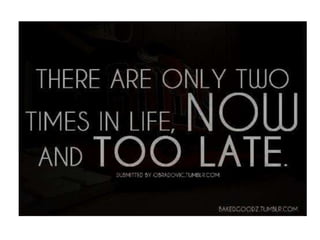
LIFE LESSON:
In life there is no turning back.
Though we would like to return on
time we are seizing today, we
cannot because soon this moment
we have right now will just become
part of a memory. A memory that
no matter how much you wish to
happen again, you cannot

Paragraph development -Narration

  • 1.
  • 2.
    Pattern of Developmentin Writing a Paragraph -refers to the particular strategy writers use to develop ideas.
  • 3.
  • 4.
    Closing your eyes helpsyou remember things.
  • 5.
    People tend tovalue memories more than actual people. Sometimes, you miss the memories, not the actual person.
  • 6.
    Your nose isconnected to the memory center of your brain that is why smells can trigger powerful memories.
  • 7.
    Scent is apowerful trigger for memory. According to studies, a memory paired or associated to a scent can be recalled more easily.
  • 8.
    When a persondies, they have 7 minutes of brain activity left. It’s the mind playing back the person’s memories in a dream sequences.
  • 11.
  • 12.
    It tells astory about a real or imaginary experience or incident.
  • 13.
    Characteristics: - The detailsare usually arranged in chronological order and are logical.
  • 14.
    * Chronological – arrangedin the order of occurrence * Logical – acceptable by reason (easily understood by majority)
  • 15.
    Transitional expressions can helptie ideas together and show relationships. They also reveal organization patterns to help your reader follow along.
  • 16.
    To make thenarration logical, use transitional words like: •before •meanwhile •afterward •at the same time •to begin with •subsequently •previously •at last •at present •briefly •currently •at that time •in the meantime •eventually •finally gradually •immediately •in the future •then •now •later •suddenly •earlier •formerly •shortly •until now •in the past
  • 17.
    •before •meanwhile •afterward •at the same time •tobegin with •subsequently •previously •at last •at present •briefly •currently •at that time •in the meantime •eventually •finally gradually •immediate ly •in the future •then •now •later •suddenly •earlier •formerly •shortly •until now •in the past
  • 18.
  • 19.
  • 20.
    Morillo recalled beingbrought to a room along with Daa Jr. It was connected to the house, but its two walls were missing and one opening led to a ravine about three meters away. Without warning, the police shot Morillo in the chest. He fell to the ground bleeding, but did not lose consciousness. The officer then shot Daa twice, the second time on the head.
  • 21.
    Lying beside Daa,Morillo played dead. He crawled out of the opening and onto the edge of the ravine, and found his way to the nearest highway where he sought medical help.
  • 22.
    At the backof the house, the police made Gabo, Comendo, and Cule kneel on the ground and shot them to death. Cule was the last of the three to be killed. Hugging the legs of one of the armed men, he begged to be spared, but the police still shot him on the nape, based on an eyewitness accountofa14-year-old.
  • 23.
    And, as ifnothing happened, the police officers stayed a few more hours inside Daa’s home, and ate at the billiard table using the family’s plates and utensils, helping themselves to food and drinks from a sari-sari store owned by the family of one of the victims.
  • 24.
    Morillo recuperated atthe East Avenue Medical Center. But during the time he was confined, QCPD police kept him captive in the hospital room. He is now under the custody of the Commission on Human Rights.
  • 25.
  • 26.
    It was alreadyaround 3 p.m. of that fateful day of January 25 or more than 12 hours since we entered Barangay Tukanalipao in Mamasapano, Maguindanao, when SPO1 Inocencio told us that he was wounded. We were already cornered by their enemies that time. The gun battle started as early as 6 a.m.
  • 27.
    We decided tolay silent for a while so their enemies would think that we were already dead. Our plan was to fight it out with their enemies down to their last bullet. Around 4pm, we were already looking at each other as if saying goodbye and preparing for our last stand against at least 1,000 fully-armed enemies.
  • 29.
    1. Objective Narration (thenarration of fact) –events are actual happenings in real life.
  • 30.
    Examples: 1. Narration ofthe earthquake in Surigao 2. The Narration of Yolanda Victims 3. The Narration of a Shipwrecked Titanic Survivor 4. Personal Experience 5. Others Experience
  • 31.
  • 32.
    The last timeI saw my ex- boyfriend was when he was trying to open the gate of their house. I never thought that it would be the last. I glimpsed a smile to him but his face was naked that it just starred at me – looking at me as he tried to bid goodbye.
  • 33.
    A Once Ina Life Time Experience
  • 34.
    The one dayI spent in Morocco, Africa was an experience of a lifetime. When I finally reached Morocco and got off the bus, there were four little girls standing shoeless in the hot sun. After I swallowed my tears, I could not even try to picture this in America as it is not something you often see in the U.S.
  • 35.
    Meanwhile my touristguide instructed me not to give them money as it encouraged the children to beg; however, I was wearing four silver bracelets. As I walked over to the girls, their eyes watched my every move. Then I kneeled down to their level while I gave each girl a bracelet.
  • 36.
    They stood theregleaming at me, for they were pleased. I felt completely in disbelief that this tiny gesture could mean so much. Though this experience was upsetting, and a huge culture shock, it will stay with me forever. © Kayla Marie Anfinson 2005
  • 37.
    Subjective Narration ( purelyimaginative) – writer controls the narration of events; that is the whole story is the product of author’s imagination.
  • 38.
  • 39.
  • 40.
    There was oncea Dracula who lived in the forest by the kingdom of Halcon. He was living for almost one hundred years since his parents left him in the tower where he spent his life watching television and playing yoyo. He was alone and no friends to play
  • 41.
    Every time hewanted to go to centre town where people were happily celebrating feasts of different saints, he would cover himself with black cloth and would roam around the town while observing how the townspeople eating, drinking and mingling with each other.
  • 42.
    One night whilehe was drinking in the Catacomb club with a red blood champagne floating with paired eyes and dangling veins, a lady in red with oozing brilliant eyes sat beside him and asked his name…(to be continued)
  • 43.
  • 44.
    Once upon atime there was a fine stag who ruled a herd of deer in a forest and it had a beautiful wife. The doe was very devoted to her husband and helped him in all matters of life. One day, the stag was caught in the trap of a hunter and the doe was very frightened as was the stag. All the friends of the stag left him.
  • 45.
    But the doeremained steadfast next to him and waited for the hunter to come. She was very devoted to her husband. As soon as the hunter came, she fell on his knees and begged, "Sir! Please make a nice bed of leaves for me and my husband and then kill me first and then my husband and you can have a nice feast."
  • 46.
    The hunter wasso amazed and surprised by her love that he went to first free the stag before he prepared the bed of leaves, and in a split second, the stag and the doe ran after being free.
  • 48.
  • 49.
    Choose from Task Aand Task B.
  • 50.
    (Task A): Objective (past):Narrate a story of an important event with your family, friends, or special someone.
  • 51.
    (Task B): Subjective (future): Writea short fantasy of what you would like to happen in the future.
  • 52.
    Category Writing CharacteristicsTeacher Score (20pts.) Focus and Construction of Knowledge 10 *The narrative established and maintains focus on true/imaginary events. *Writer demonstrates a clear understanding of the event. Organization 5 *The narrative is organized in order of events through time with an appropriate beginning, middle and end; *Events are logically presented. *Writer sustains unity throughout the finished piece by use of smooth transitions of details Construction of Language 5 *The writer constructs language in a way that is appropriate and effective. *The writer shows effective use of pronoun and antecedent agreement. *Control of formatting, conventions, punctuations, spelling and capitalization.
  • 54.
  • 55.
    A. Define narration.(2pt) B.What are the two characteristics of narration? (2pts) C. Enumerate classifications of narration. (2pts) D. Differentiate the classifications (2pts)
  • 56.
    E. Classify thefollowing narrated events whether objective or subjective narration. Then, write what the narration is all about. (2pts each)
  • 57.
    E. Classify thefollowing narrated events whether objective or subjective narration.
  • 59.
  • 60.
    I saw thecaged songbird had everything she needed; food, water and shelter. Still I saw a sad look upon her face and she had not sung for a very long time.
  • 61.
    “Why do younot sing anymore?” You have quite a comfortable life in your cage. She looked at me with tearful eyes and said “ A golden cage is still a cage”
  • 63.
    When I wasin elementary school, I was a very happy and outgoing kid and had lots of friends. But when I started secondary school, some older kids started to bully and tease me. All my friends from elementary school left me because they didn’t want to be seen with me. At my school, everything was all about money and clothes. I had huge glasses and I was really ugly and everyone laughed at me. Then a boy (he was in 8th grade I think) started to follow me around.
  • 64.
    He called menames, took my stuff and made up rumors about me. One day he and his friends beat me up on the bus. No one wanted to be friends with me anymore. The n I became friends with two girls in my class. They started making up rumors about me. Everyone kept telling me what a bad person I was. In 6th grade, the bullying got even worse. Everyone said I was ugly and I should just kill myself. In 7th grade my mom made me attend afternoon classes (full- time school was voluntary at my school). The kids in afternoon class started bullying me, too.
  • 65.
    They followed mearound and took photos of me in the bathroom to send them to the whole school. When I got home from school, I would go to my room and cry all evening. I never talked to anyone. My grades dropped and my teachers started to talk to my parents. They told them I was lazy and refused to participate. They knew I was bullied but they never did anything to stop it. Everyone hated me and I didn’t have a single friend. I just want to tell everyone who is going through the same: It gets better.
  • 66.
    I know it’sreally hard, and you might feel like giving up sometimes, but you have to be yourself and stay confident. Don’t let them get to you. I know you’re suffering, but at some point you’ll be proud of yourself for all that you’ve been through. And if anyone judges you, it is their own problem. Those people have no idea what you’ve been through. They probably couldn’t even take it. But you had to take it. And you’re still here going on with your life. And that’s why you can be proud of yourself.
  • 68.
    My father’s nameis Robert Ola, he died on Aug 28th 2003 of a heart attack. It was about six in the morning I was sleeping restlessly and the phone rang and I missed it then it rang again.
  • 69.
    I saw itwas my father’s house calling to get me up for the first day of school. To my surprise it was my stepmother crying on the other line. This was the start of the worst day of my life in the short seventeen years I had been alive.
  • 70.
    She proceeded totell me that my father has had a heart attack and the ambulance had came and got him. Then the horror began I asked he’s ok right he’s going to be ok . With sorrow in her voice she said Jace he’s dead.
  • 71.
    I started cryingand disbelief and ran to my mom’s room screaming and yelling. Later my family gathered and remembered the day that I recall as the worst day of my life.
  • 73.
    Bring a picturethat depicts a special moment of your life with special person/people as in family, friend, classmates…
  • 76.
    LIFE LESSON: In lifethere is no turning back. Though we would like to return on time we are seizing today, we cannot because soon this moment we have right now will just become part of a memory. A memory that no matter how much you wish to happen again, you cannot