English ~ 9
 A CHARACTER is the leading figure(s) of a story. In a short 
story or modern play, there are typically only a few characters. 
 Authors call upon several methods to help the reader get a 
better picture of that character, such as: 
 PHYSICAL DESCRIPTION 
 The CHARACTER’s WORDS 
 The CHARACTER’s ACTIONS 
 The CHARACTER’s THOUGHTS 
 OTHER CHARACTERS’ ACTIONS / SPEECH / THOUGHTS ABOUT 
the CHARACTER
 PROTAGONIST: The central character of a story. He 
or she is the hero, villain, or victim around which the 
story is based. 
 Ideally this is the character in the story with whom the reader 
sympathizes or identifies with. 
 ANTAGONIST: The character or force that acts 
against the protagonist and tries to prevent him or 
her from achieving his or her goals or objectives. 
 Again, this character or force may be good or bad, so long as 
he, she, or it opposes the main character.
 FLAT – Characterized by one or two traits. Usually the 
reader only sees one side of this character. He or she 
can be summed up in one sentence. 
 ROUND – A complex and many-sided character. 
Touches life in many aspects. A fully-developed 
character, set with often ironic or antagonistic 
internal values or conflicts.
 STATIC – A character who is the same sort of person at 
the end of the story as she was at the beginning. This 
character DOES NOT change. 
 DYNAMIC – A developing character. He or she undergoes 
a significant, lasting, permanent change in some aspect of 
his or her personality or outlook. 
 The change must be: 
1)Possible for the character; 
2)The result of sufficient motivation; and 
3)Given sufficient time.
 NOTE: a character may be FLAT or ROUND, and 
STATIC or DYNAMIC. Each pairing represents 
opposites on a continuum. 
STATIC 
FLAT 
ROUND 
DYNAMIC
 Writers present their characters in two ways: 
DIRECT PRESENTATION / “TELLING” – a direct statement 
as to what the character is like given by the author, the 
character him or herself, or another character. 
INDIRECT PRESENTATION / “SHOWING” – a statement 
about the character, his words or actions, from which we 
infer what he or she is like. 
 While a good writer will use both manners of presentation to 
develop a character, it is important to note that Indirect 
Presentation is a much for engaging and powerful way of 
presenting character, and should be more heavily relied on.
 We learn about characters in six ways: 
 By the author’s direct statement (DIRECT) 
 By what other characters say and think about him or her 
(DIRECT) 
 By what he or she says (INDIRECT) 
 By what he or she does (INDIRECT) 
 By what he or she thinks (INDIRECT) 
 By a character foil (a character who makes another 
character seem better or worse by contrast; INDIRECT).
ENGLISH ~ 9
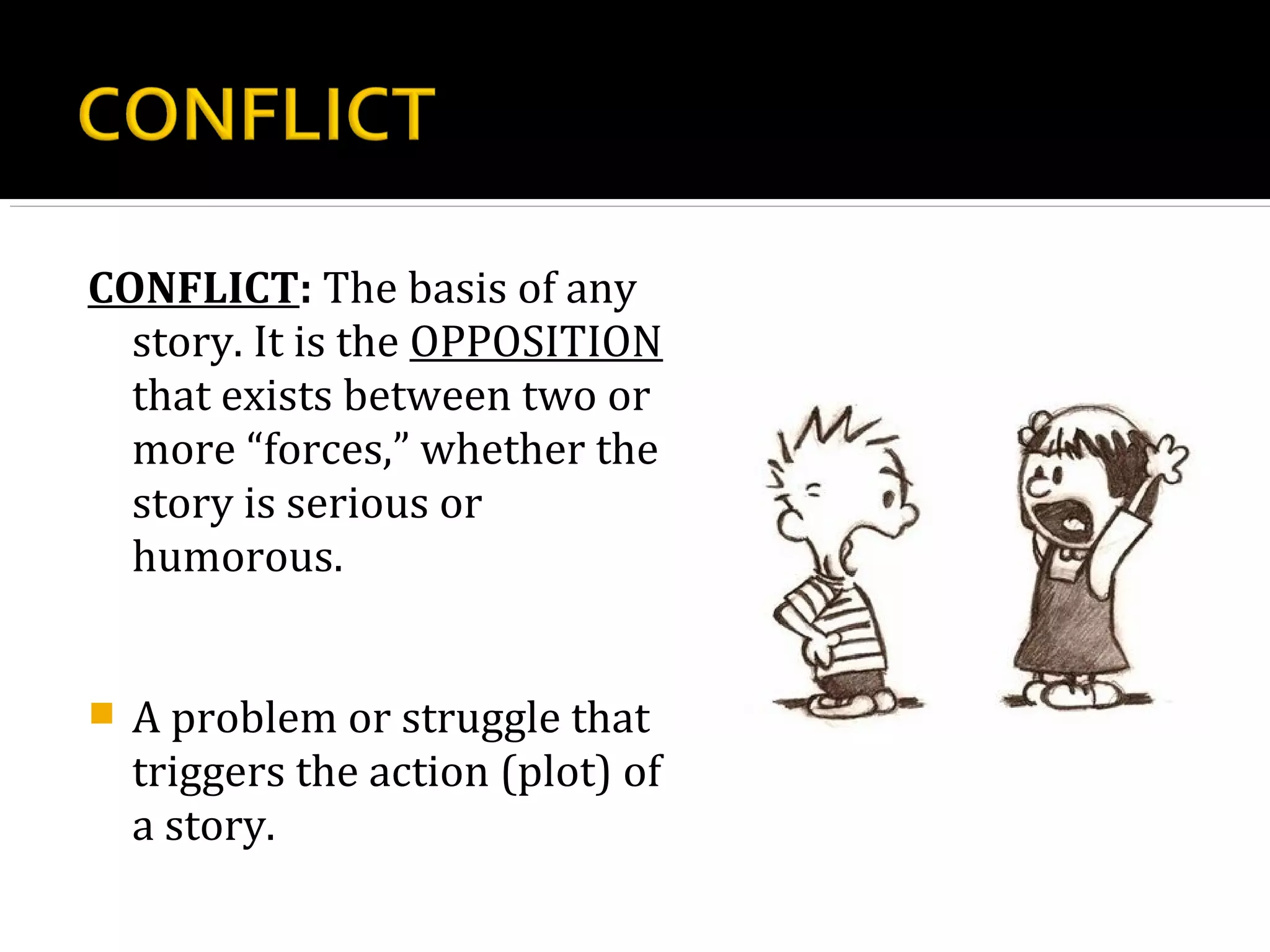
CONFLICT: The basis of any 
story. It is the OPPOSITION 
that exists between two or 
more “forces,” whether the 
story is serious or 
humorous. 
 A problem or struggle that 
triggers the action (plot) of 
a story.
There are two basic types of conflict. 
 EXTERNAL – conflict that generally can be seen 
as it is occurring; occurs between two or more 
individuals. 
 INTERNAL – conflict that cannot be seen; occurs 
within an individual.
There are three types of External Conflict: 
 CHARACTER VERSUS CHARACTER – the most 
common type of conflict. The conflict can be physical, 
psychological, or emotional.
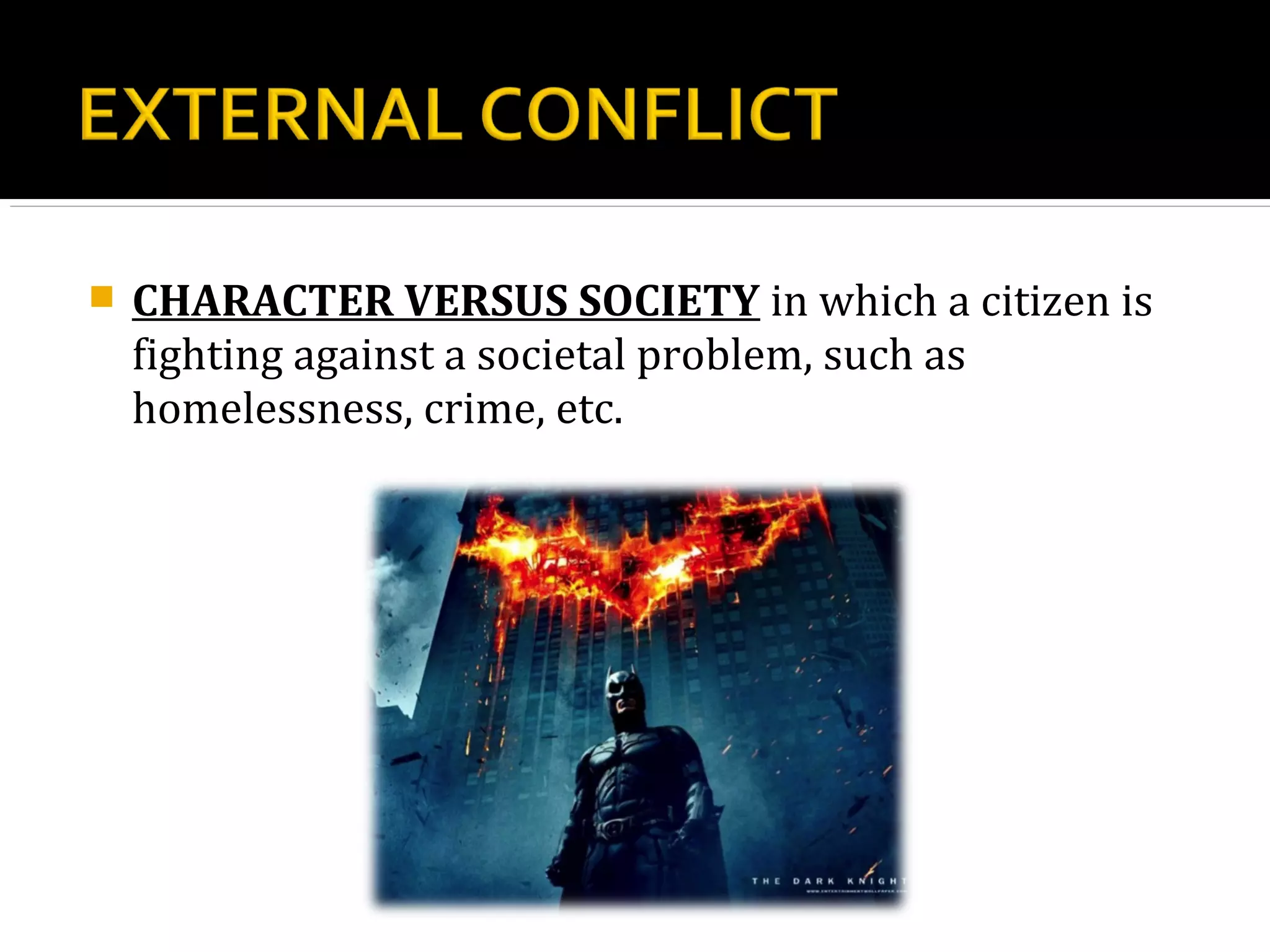
 CHARACTER VERSUS SOCIETY in which a citizen is 
fighting against a societal problem, such as 
homelessness, crime, etc.
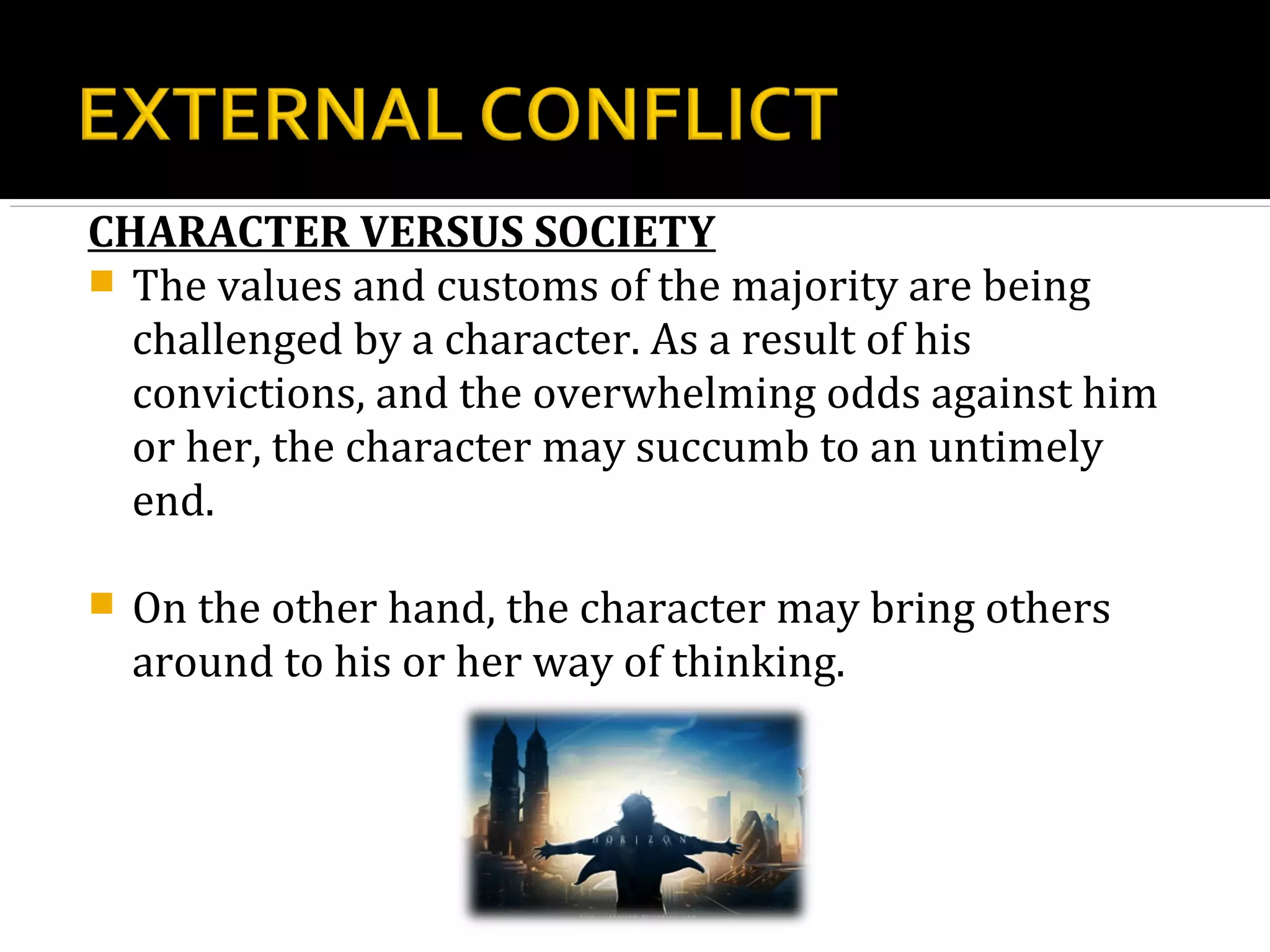
CHARACTER VERSUS SOCIETY 
 The values and customs of the majority are being 
challenged by a character. As a result of his 
convictions, and the overwhelming odds against him 
or her, the character may succumb to an untimely 
end. 
 On the other hand, the character may bring others 
around to his or her way of thinking.
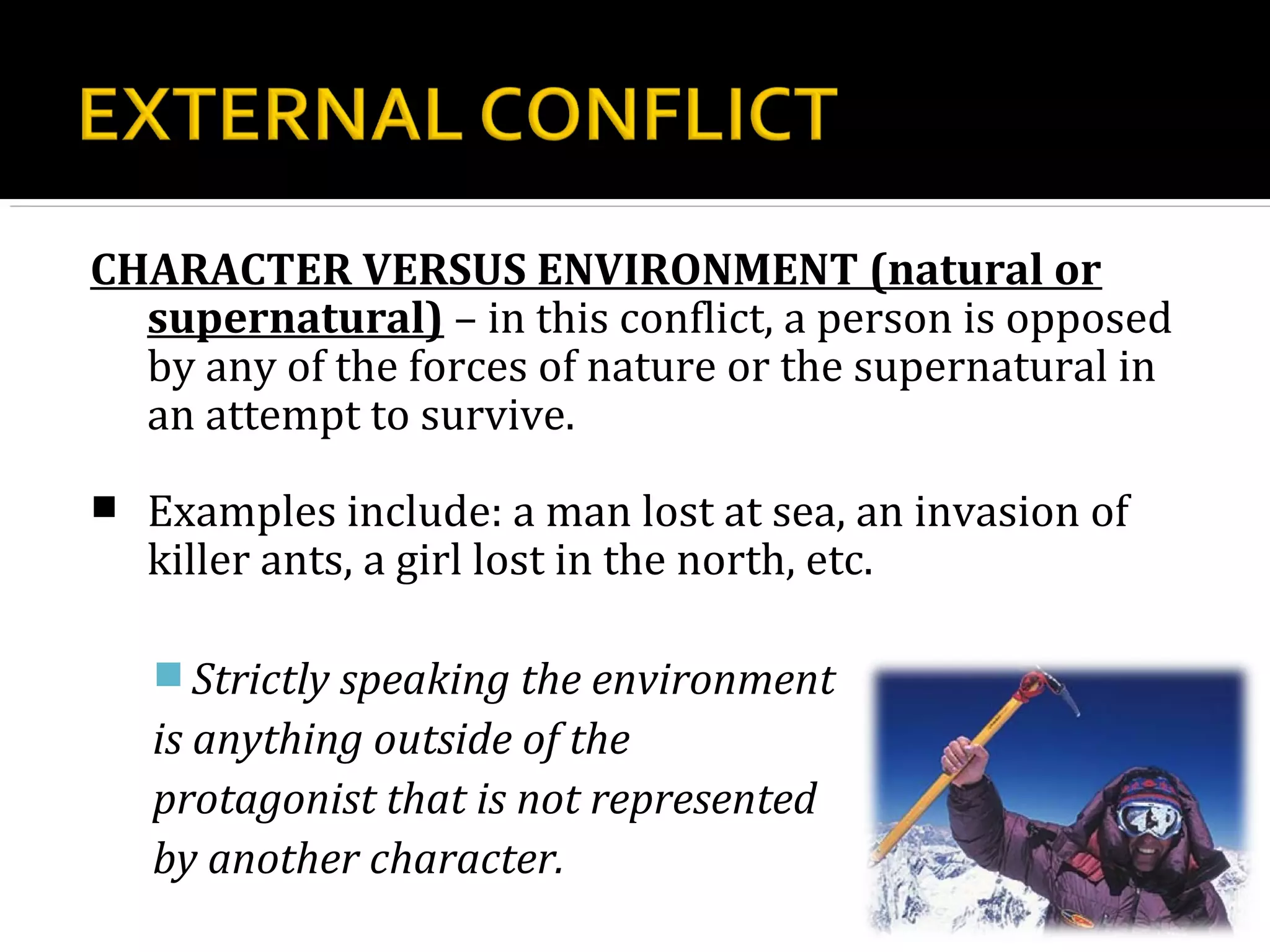
CHARACTER VERSUS ENVIRONMENT (natural or 
supernatural) – in this conflict, a person is opposed 
by any of the forces of nature or the supernatural in 
an attempt to survive. 
 Examples include: a man lost at sea, an invasion of 
killer ants, a girl lost in the north, etc. 
Strictly speaking the environment 
is anything outside of the 
protagonist that is not represented 
by another character.
On the one hand, Character versus Environment, can be 
used to express the insignificance of a single human 
being… 
 On the other hand, it tests the limits of a person’s 
strength and will to live, and may thus reveal the 
significance of a single human being
INTERNAL CONFLICT is restricted to a person struggling 
with him or herself, or his or her conscience. 
CHARACTER VERSUS SELF : 
 This conflict exists within the character’s mind; 
 Examples include: Should I steal from this store? Should I 
turn in my best friend who has committed a crime?
INTERNAL CONFLICT 
 This is a good test of a character’s values and will. 
 Does he or she give into temptation? Or rise above it? 
 Does he or she demand the most from him or herself? 
Or, does he or she settle for something less? 
 Does he even bother to struggle? 
 The internal conflicts of a character and how they are 
resolved are good clues to the character’s strength of 
will.
You thoughts…? 
“Did you know that the first Matrix was designed to be a perfect 
human world? Where none suffered, where everyone would 
be happy. 
It was a disaster. No one would accept the 
program. Entire crops were lost. Some 
believed we lacked the programming 
language to describe your perfect world. But 
I believe that, as a species, human beings 
define their reality through suffering and 
misery. The perfect world was a dream that 
your primitive cerebrum kept trying to wake 
up from. Which is why the Matrix was 
redesigned to this: the peak of your 
civilization.”
 Often, most, if not all types of conflict appear in a 
short story. 
 You will be asked to indentify what types of 
conflict are present in a story, as well as discuss 
what these conflicts reveal about various 
characters, plots, values and themes. 
 Further, being able to identify the MAIN 
conflict is often key.

Character and Conflict

  • 1.
  • 2.
     A CHARACTERis the leading figure(s) of a story. In a short story or modern play, there are typically only a few characters.  Authors call upon several methods to help the reader get a better picture of that character, such as:  PHYSICAL DESCRIPTION  The CHARACTER’s WORDS  The CHARACTER’s ACTIONS  The CHARACTER’s THOUGHTS  OTHER CHARACTERS’ ACTIONS / SPEECH / THOUGHTS ABOUT the CHARACTER
  • 3.
     PROTAGONIST: Thecentral character of a story. He or she is the hero, villain, or victim around which the story is based.  Ideally this is the character in the story with whom the reader sympathizes or identifies with.  ANTAGONIST: The character or force that acts against the protagonist and tries to prevent him or her from achieving his or her goals or objectives.  Again, this character or force may be good or bad, so long as he, she, or it opposes the main character.
  • 4.
     FLAT –Characterized by one or two traits. Usually the reader only sees one side of this character. He or she can be summed up in one sentence.  ROUND – A complex and many-sided character. Touches life in many aspects. A fully-developed character, set with often ironic or antagonistic internal values or conflicts.
  • 5.
     STATIC –A character who is the same sort of person at the end of the story as she was at the beginning. This character DOES NOT change.  DYNAMIC – A developing character. He or she undergoes a significant, lasting, permanent change in some aspect of his or her personality or outlook.  The change must be: 1)Possible for the character; 2)The result of sufficient motivation; and 3)Given sufficient time.
  • 6.
     NOTE: acharacter may be FLAT or ROUND, and STATIC or DYNAMIC. Each pairing represents opposites on a continuum. STATIC FLAT ROUND DYNAMIC
  • 7.
     Writers presenttheir characters in two ways: DIRECT PRESENTATION / “TELLING” – a direct statement as to what the character is like given by the author, the character him or herself, or another character. INDIRECT PRESENTATION / “SHOWING” – a statement about the character, his words or actions, from which we infer what he or she is like.  While a good writer will use both manners of presentation to develop a character, it is important to note that Indirect Presentation is a much for engaging and powerful way of presenting character, and should be more heavily relied on.
  • 8.
     We learnabout characters in six ways:  By the author’s direct statement (DIRECT)  By what other characters say and think about him or her (DIRECT)  By what he or she says (INDIRECT)  By what he or she does (INDIRECT)  By what he or she thinks (INDIRECT)  By a character foil (a character who makes another character seem better or worse by contrast; INDIRECT).
  • 9.
  • 10.
    CONFLICT: The basisof any story. It is the OPPOSITION that exists between two or more “forces,” whether the story is serious or humorous.  A problem or struggle that triggers the action (plot) of a story.
  • 11.
    There are twobasic types of conflict.  EXTERNAL – conflict that generally can be seen as it is occurring; occurs between two or more individuals.  INTERNAL – conflict that cannot be seen; occurs within an individual.
  • 12.
    There are threetypes of External Conflict:  CHARACTER VERSUS CHARACTER – the most common type of conflict. The conflict can be physical, psychological, or emotional.
  • 13.
     CHARACTER VERSUSSOCIETY in which a citizen is fighting against a societal problem, such as homelessness, crime, etc.
  • 14.
    CHARACTER VERSUS SOCIETY  The values and customs of the majority are being challenged by a character. As a result of his convictions, and the overwhelming odds against him or her, the character may succumb to an untimely end.  On the other hand, the character may bring others around to his or her way of thinking.
  • 15.
    CHARACTER VERSUS ENVIRONMENT(natural or supernatural) – in this conflict, a person is opposed by any of the forces of nature or the supernatural in an attempt to survive.  Examples include: a man lost at sea, an invasion of killer ants, a girl lost in the north, etc. Strictly speaking the environment is anything outside of the protagonist that is not represented by another character.
  • 16.
    On the onehand, Character versus Environment, can be used to express the insignificance of a single human being…  On the other hand, it tests the limits of a person’s strength and will to live, and may thus reveal the significance of a single human being
  • 17.
    INTERNAL CONFLICT isrestricted to a person struggling with him or herself, or his or her conscience. CHARACTER VERSUS SELF :  This conflict exists within the character’s mind;  Examples include: Should I steal from this store? Should I turn in my best friend who has committed a crime?
  • 18.
    INTERNAL CONFLICT This is a good test of a character’s values and will.  Does he or she give into temptation? Or rise above it?  Does he or she demand the most from him or herself? Or, does he or she settle for something less?  Does he even bother to struggle?  The internal conflicts of a character and how they are resolved are good clues to the character’s strength of will.
  • 19.
    You thoughts…? “Didyou know that the first Matrix was designed to be a perfect human world? Where none suffered, where everyone would be happy. It was a disaster. No one would accept the program. Entire crops were lost. Some believed we lacked the programming language to describe your perfect world. But I believe that, as a species, human beings define their reality through suffering and misery. The perfect world was a dream that your primitive cerebrum kept trying to wake up from. Which is why the Matrix was redesigned to this: the peak of your civilization.”
  • 20.
     Often, most,if not all types of conflict appear in a short story.  You will be asked to indentify what types of conflict are present in a story, as well as discuss what these conflicts reveal about various characters, plots, values and themes.  Further, being able to identify the MAIN conflict is often key.