Success For All Writers
    with Mentor Texts
2012 PSU York Summer Institute
LYNNE R. DORFMAN
      AND
  ROSE CAPPELLI
from Mentor Texts: Teaching Writing Through Children’s
                      Literature


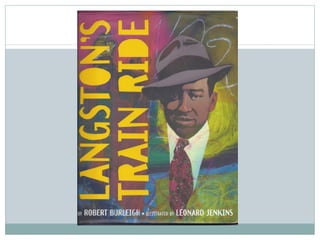
 Mentor texts become our coaches and our partners
 as we bring the joy of writing to our students. They
 help students envision the kind of writer they can
 become; they help teachers move the whole writer,
 rather than each individual piece of writing,
 forward. Writers can imitate the mentor text and
 continue to find new ways to grow.
Authority Lists

Lynne’s List:            Rose’s List:
 Horses                  Playing the violin
 Dogs                    Golf
 Humpback Whales         Motherhood
 Poetry                  Gardening
 Care of house plants    Birds
 Letter writing          Teaching children how
                           to read
Redefining a list for specificity: Horses
 Grooming a horse
 Caring for the equipment
 Dressage moves
 Jumps for a hunter course
 Divisions of a horse show
 Open jumping
 Olympic competitions
 English vs. Western
 Judging a horse show
 Thoroughbred racing
Turn and Talk
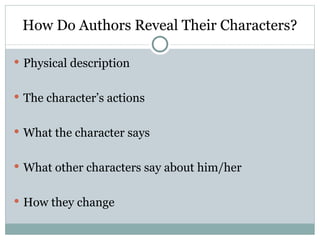
How Do Authors Reveal Their Characters?

 Physical description


 The character’s actions


 What the character says


 What other characters say about him/her


 How they change
Gestures to Enhance Memoir, Realistic Fiction, Personal
                Narratives, and Vignettes

From “Mrs. Buell” in Hey World, Here I Am! By Jean Little

  In winter she wore the same sweater every day, a man’s gray one, too
  big, with the sleeves pushed up. They kept slipping down and she’d
  shove them back a million times a day. Yet she never rolled up the cuffs
  to make them shorter. (p. 44)

  Her going had left a hole in my life. Because I knew, for the first time,
  that nothing was safe – not even the everyday, taken-for-granted
  background of my being. Like Mrs. Buell, pushing up her sweater
  sleeves and giving me my change. (p. 46)
From The Watsons Go to Birmingham – 1963 by
              Christopher Paul Curtis

Me and Joey cracked up. Byron kind of chuckled and Momma put her
hand over her mouth. She did this whenever she was going to give a
smile because she had a great big gap between her front teeth. If
Momma thought something was funny, first you’d see her trying to hide
the gap, then, if the smile got to be too strong, you’d see the gap for a
hot second before momma’s hand would come up to cover it, then she’d
crack up, too. (p. 4)

“And Mrs. Watson,” said Dad, “you can’t possibly deny that this is your
child. You can tell this boy has got a ton of Sands blood in him, look at
those ears!”
Poor Byron. If he’d have known how far his ears stuck out to the side I
bet he never would have gotten that butter!
Momma put her hand over her mouth and said, “Lord, don’t blame that
on my side of the family, someone switched this child at the hospital!”
(p. 98)
Notebook Entries: Gesture Use

He touched his chin as thinking.

Little Johnny threw his hands in the air. “Daddy.”

He pressed his hair back with both hands. “My dad is going to kill me.”

She shoved her hands deep into her pockets and slouched, as if trying to
  hide.

She held her palm out to him. “Whatever.”

She stared at her feet. As if her fingers had a mind of their own, they
  played with her coat zipper.
In “The Irishman” by L. Dorfman


     “What’s a tea cozy?” I whispered to April. I stole
a quick glance. She was leaning slightly forward, her
thin hair - the color of winter wheat - hanging limp
and damp around her shoulders. She shrugged her
shoulders – one small movement – and continued to
sit still and silent on the crooked wooden chair.
Perhaps she didn’t want to shift her weight on a
fragile chair that was destined to be broken and
discarded. But everything about April was
understated. She was definitely my polar opposite,
and I loved hanging out with her.
Reflection Questions

How did the description of character help your readers (peer
 response group/teacher) to visualize him or her?

How did your snapshot of the character help create a certain
 mood for the story or essay?

What strategies did you use to create a strong, clear
 description of the character?

How can you use “show, not tell” strategy here?

Where would you use this strategy again?
The Importance of Introductions

When I introduce leads to young writers, I ask them to
think about fishing, to imagine the writer as an angler
and the reader as a fish. Writers cast out their first line
of words in hopes of hooking the reader and reeling
him into the text.
           Stephanie Harvey, Nonfiction Matters: Reading,
                   Writing, and Research in Grades 3-8


It’s important that they [students] get a sense of the
range of options available for writing an introduction.
           Portalupi and Fletcher, Nonfiction Craft Lessons
The Importance of Endings

…the ending is as important as the beginning.
The ending is the part that will echo in the ear of
the reader when he or she is finished.
          Portalupi and Fletcher, Nonfiction Craft Lessons


Your ending should be made to stick! Etched in
their minds and hearts. Unforgettable.
                      Frank Murphy, children’s author
An anecdote from Rose’s Notebook…

     It was a hot summer afternoon that was
perfect for relaxing in the sun. So I spread out a
blanket in my backyard and lay down to catch
some rays. I removed my shiny silver watch but
carefully placed it on the blanket next to my head
(I wanted to be sure not to stay out in the sun too
long). Suddenly, I felt something dive-bomb my
head while a flurry of feathers brushed my face.
It was gone in a second, but so was my watch.
What would a bird want with a watch, I
wondered?
Possible nonfiction topics:

        How Birds Build Nests
        How to Attract Birds
        Nesting Materials
Once I went to my uncle’s house. All my
cousins were there. They were lifting a canoe
and there was a snake. It was black and had a
yellow stripe down its back. Charlie got bit. We
had fun except for Charlie.
                            Andrew, Grade 2


Possible topics:
   Snakes
   First aid for snake bites
Leads: A Great, First Sentence
                      Some Additional Examples
Foreshadowing:
If only Billy had known that he was tall enough to ride the “Rolling Thunder.” Why did he
 always talk before he thought things out?

Short, Choppy Statement:
No. No. I’ll never do that again!

Name Statement:
I, Lyddie Jones, will never, ever take my younger brother to an amusement park with my
best friends.

Thoughtshot:
“Why am I afraid to tell my sister how I feel?” Billy thought to himself.

Personification:
The old cars moaned and groaned as they were pulled up the wooden track by invisible
hands.
Creepy Statement:
The track rose up like a dark spirit across the blue sky, turning my insides to mush.

Weather:
A soft rain spattered against the car windows as we drove down the New Jersey Turnpike.
But there was a ray of hope – poking between dark clouds with golden spokes.

Quote (what people say):
My mother always said that Lyddie should have been born the boy. Lyddie, who was always
daring, courageous, and full of life.

Controversial Statement:
Amusement parks! They should really be called torture chambers!
a circus                         on a rocket ship to Mars

camping near a river             climbing a mountain

a ski vacation in Colorado       arriving at Ellis Island

at the seashore                  sailing on the Titanic

a deserted island                an apartment in Seattle

scuba diving near a coral reef   at a holiday party
From Lilly’s Purple Plastic Purse by Kevin Henkes

Lilly ran and skipped and hopped all the way home,


she was so happy. And she really did want to be a


teacher when she grew up…
From Shortcut by Donald Crews

We walked home without a word. We didn’t tell

Bigmama. We didn’t tell Mama. We didn’t tell

anyone. We didn’t talk about what had happened for

a very long time. And we didn’t take the shortcut

again.
From Crab Moon by Ruth Horowitz

Slowly and grandly the crab pulled herself forward.

Stepping and pausing, Daniel’s feet felt their way

into the bay. He followed until she disappeared.

Then he gave the water one last, long look and

whispered to the horseshoe crab, “See you next

summer.”
Similes from Owl Moon by Jane Yolen

 The trees stood still as giant statues.


 Somewhere behind us a train whistle blew, long and low, like
  a sad, sad song.

 And when their voices faded away it was as quiet as a dream.


 …and the snow below it was whiter than the milk in a cereal
  bowl.

 Then the owl pumped his great wings and lifted off the branch
  like a shadow without sound.
Blank, Blank, Blanking Craft

1. Invite writers to search their stories for sentences that have
     a verb in it.

2. Brainstorm a list such as run, write, love, sneeze, read,
    dance, swim, dream, ski, trudge

3. Ask students to rewrite the sentence using _____, _____,
    ____ing.

*Sometimes, your writers will choose to replace their verb for
   a stronger one first.
Verbs that have more than one syllable can be altered
 to make it sound more fun and more rhythmic.


For example the word “tackle” could be reconstructed
 to read: “I was tack, tack, tackling the running
 back all day long!”
Rationale for Use

 It adds song and poetry to any piece.


 It also adds emphasis.


 Think about a sentence that reads: “I was missing
 my mom while at camp.”

 Revise to read: “I was miss, miss, missing my
 mom while at camp.”
From Love That Dog by Sharon Creech

Some of the tiger sounds are still in my ears
like drums beat-beat-beating. p.9

My brain was pop-pop-popping
when I was looking at those poems. p. 35

We think maybe you did because you were
smile-smile-smiling all over the place. p. 82
Examples from Notebooks

I opened the huge box, and a yellow lab jumped out. All
Christmas day I was love, love, loving my new puppy.

We dash, dash, dashed across the yard on our new bikes.

I laugh, laugh, laughed until my face was wet with tears.

Mr. Smith was teach, teach, teaching us about subtraction
all week!
Grandfather by Lynne Dorfman

My grandfather remembers long ago
The coal mining town of Freeland, Pennsylvania.
He remembers the blackness of his father’s hands and face.
He remembers his mother waiting, waiting
for the husband who never returned,
buried with a dozen other miners…trapped.

He remembers waiting for the news.
No one would be coming home today, or the next day,
or the day after that – not ever.
He remembers his mothers sobs and then
it was finished.

He remembers selling supplies to miners
on Saturdays and even Sundays.
There would be food on the table
over prayer.
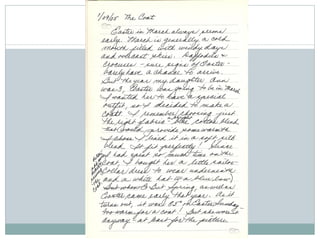
The Coat by Rose Cappelli
“Easter in March –
It will be cold!”
I think to myself
as I envision Annie’s Easter outfit
in my head.
A coat will be just right.

I find the perfect fabric –
a twill of royal blue
with a soft silk blend for the lining.
Slowly, the coat takes shape
as the fabric glides effortlessly
through my sewing machine.
The finished product fits her perfectly!
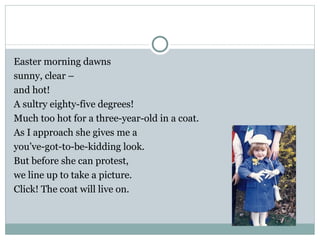
Easter morning dawns
sunny, clear –
and hot!
A sultry eighty-five degrees!
Much too hot for a three-year-old in a coat.
As I approach she gives me a
you’ve-got-to-be-kidding look.
But before she can protest,
we line up to take a picture.
Click! The coat will live on.
Why Poetry?

 A poem engages the reader in a whirlwind of sounds,
 emotions, and wonderings.

 Poetry blends emotions with appeal to the senses and an
 acquired wisdom about the world and how things work.

 Reading poems aloud helps students make
 reading/writing connections.

 Poetry improves vocabulary and fluency, deepens
 comprehension, and enhances thinking skills.
 Poetry helps students make personal connections to
 their lives.

 Poetry can be used effectively for both small and
 whole group instruction.

 Poetry can be used at any time of the day and across
 the curriculum.
From Don Murray…


When we write, we become
visible, we are players in the
game of life.
Some Ideas for List Poems

 things I don’t know
 things I don’t do
 noisy things
 quiet things
 scary things
 things that drive me crazy
 things I can’t understand
 spring things
 things that melt my heart
 things that are happening in the world at
  this very minute
 childhood games and/or toys
 things I like to eat
 things I don’t like to eat
Signs
     Possibilities for Reading Connections


 Fluency – phrasing
 Sight vocabulary development
 Phonemic awareness
 Decoding strategies – word families
 Vocabulary development
 Visualization and inferences
 Synthesis of ideas – drawing conclusions
Signs
      Possibilities for Writing Connections


 Scaffold (Noun-Verb, Main Idea)


 Conventions


 Word choice


 Alliteration
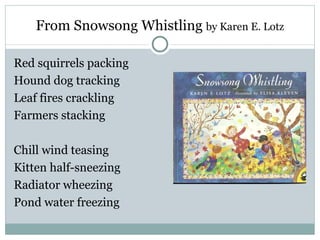
From Snowsong Whistling by Karen E. Lotz

Red squirrels packing
Hound dog tracking
Leaf fires crackling
Farmers stacking

Chill wind teasing
Kitten half-sneezing
Radiator wheezing
Pond water freezing
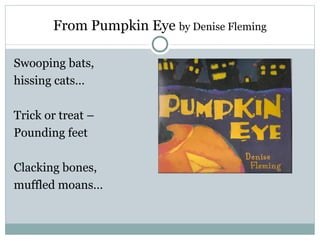
From Pumpkin Eye by Denise Fleming

Swooping bats,
hissing cats…

Trick or treat –
Pounding feet

Clacking bones,
muffled moans…
Some samples from Rose’s Notebook…


          Spring             My Busy Garden

Tulips blooming,       Nesting bluebirds,
Dogwoods budding,      Chirping chickadees,
Daffodils glowing -    Hovering
Spring is beautiful!       hummingbirds-
                       My busy garden!
Ice Skates
              by Mickeelah P., Grade 5


                         Ice skates
                 Sharp, sturdy, fleece-lined
        Relative of rollerblades and ballet slippers
  Who love children, leaps and twirls, and figure eights
  Who fear falling, getting dull, and growing too small
 Who need to be laced up tight, sharpened, and polished
        Who give fun on ice to both young and old
Who like to see children passing pucks, dancing, and racing
           Resident of snowy lands everywhere
                         Metal artist
Poetry will breathe life into all writing if
we honor it with our voices and time.

                  -Lester Laminack
from Mentor Texts: Teaching Writing Through Children’s
                      Literature


Mentor texts serve to show, not just tell,
students how to write well. They, along with
the teacher, provide wonderful examples
that help students grow into successful
writers through supportive partnerships.

Mentor Texts Break Out

  • 1.
    Success For AllWriters with Mentor Texts 2012 PSU York Summer Institute LYNNE R. DORFMAN AND ROSE CAPPELLI
  • 2.
    from Mentor Texts:Teaching Writing Through Children’s Literature Mentor texts become our coaches and our partners as we bring the joy of writing to our students. They help students envision the kind of writer they can become; they help teachers move the whole writer, rather than each individual piece of writing, forward. Writers can imitate the mentor text and continue to find new ways to grow.
  • 10.
    Authority Lists Lynne’s List: Rose’s List:  Horses  Playing the violin  Dogs  Golf  Humpback Whales  Motherhood  Poetry  Gardening  Care of house plants  Birds  Letter writing  Teaching children how to read
  • 11.
    Redefining a listfor specificity: Horses  Grooming a horse  Caring for the equipment  Dressage moves  Jumps for a hunter course  Divisions of a horse show  Open jumping  Olympic competitions  English vs. Western  Judging a horse show  Thoroughbred racing
  • 12.
  • 15.
    How Do AuthorsReveal Their Characters?  Physical description  The character’s actions  What the character says  What other characters say about him/her  How they change
  • 16.
    Gestures to EnhanceMemoir, Realistic Fiction, Personal Narratives, and Vignettes From “Mrs. Buell” in Hey World, Here I Am! By Jean Little In winter she wore the same sweater every day, a man’s gray one, too big, with the sleeves pushed up. They kept slipping down and she’d shove them back a million times a day. Yet she never rolled up the cuffs to make them shorter. (p. 44) Her going had left a hole in my life. Because I knew, for the first time, that nothing was safe – not even the everyday, taken-for-granted background of my being. Like Mrs. Buell, pushing up her sweater sleeves and giving me my change. (p. 46)
  • 17.
    From The WatsonsGo to Birmingham – 1963 by Christopher Paul Curtis Me and Joey cracked up. Byron kind of chuckled and Momma put her hand over her mouth. She did this whenever she was going to give a smile because she had a great big gap between her front teeth. If Momma thought something was funny, first you’d see her trying to hide the gap, then, if the smile got to be too strong, you’d see the gap for a hot second before momma’s hand would come up to cover it, then she’d crack up, too. (p. 4) “And Mrs. Watson,” said Dad, “you can’t possibly deny that this is your child. You can tell this boy has got a ton of Sands blood in him, look at those ears!” Poor Byron. If he’d have known how far his ears stuck out to the side I bet he never would have gotten that butter! Momma put her hand over her mouth and said, “Lord, don’t blame that on my side of the family, someone switched this child at the hospital!” (p. 98)
  • 18.
    Notebook Entries: GestureUse He touched his chin as thinking. Little Johnny threw his hands in the air. “Daddy.” He pressed his hair back with both hands. “My dad is going to kill me.” She shoved her hands deep into her pockets and slouched, as if trying to hide. She held her palm out to him. “Whatever.” She stared at her feet. As if her fingers had a mind of their own, they played with her coat zipper.
  • 19.
    In “The Irishman”by L. Dorfman “What’s a tea cozy?” I whispered to April. I stole a quick glance. She was leaning slightly forward, her thin hair - the color of winter wheat - hanging limp and damp around her shoulders. She shrugged her shoulders – one small movement – and continued to sit still and silent on the crooked wooden chair. Perhaps she didn’t want to shift her weight on a fragile chair that was destined to be broken and discarded. But everything about April was understated. She was definitely my polar opposite, and I loved hanging out with her.
  • 20.
    Reflection Questions How didthe description of character help your readers (peer response group/teacher) to visualize him or her? How did your snapshot of the character help create a certain mood for the story or essay? What strategies did you use to create a strong, clear description of the character? How can you use “show, not tell” strategy here? Where would you use this strategy again?
  • 27.
    The Importance ofIntroductions When I introduce leads to young writers, I ask them to think about fishing, to imagine the writer as an angler and the reader as a fish. Writers cast out their first line of words in hopes of hooking the reader and reeling him into the text. Stephanie Harvey, Nonfiction Matters: Reading, Writing, and Research in Grades 3-8 It’s important that they [students] get a sense of the range of options available for writing an introduction. Portalupi and Fletcher, Nonfiction Craft Lessons
  • 28.
    The Importance ofEndings …the ending is as important as the beginning. The ending is the part that will echo in the ear of the reader when he or she is finished. Portalupi and Fletcher, Nonfiction Craft Lessons Your ending should be made to stick! Etched in their minds and hearts. Unforgettable. Frank Murphy, children’s author
  • 29.
    An anecdote fromRose’s Notebook… It was a hot summer afternoon that was perfect for relaxing in the sun. So I spread out a blanket in my backyard and lay down to catch some rays. I removed my shiny silver watch but carefully placed it on the blanket next to my head (I wanted to be sure not to stay out in the sun too long). Suddenly, I felt something dive-bomb my head while a flurry of feathers brushed my face. It was gone in a second, but so was my watch. What would a bird want with a watch, I wondered?
  • 30.
    Possible nonfiction topics: How Birds Build Nests How to Attract Birds Nesting Materials
  • 31.
    Once I wentto my uncle’s house. All my cousins were there. They were lifting a canoe and there was a snake. It was black and had a yellow stripe down its back. Charlie got bit. We had fun except for Charlie. Andrew, Grade 2 Possible topics: Snakes First aid for snake bites
  • 32.
    Leads: A Great,First Sentence Some Additional Examples Foreshadowing: If only Billy had known that he was tall enough to ride the “Rolling Thunder.” Why did he always talk before he thought things out? Short, Choppy Statement: No. No. I’ll never do that again! Name Statement: I, Lyddie Jones, will never, ever take my younger brother to an amusement park with my best friends. Thoughtshot: “Why am I afraid to tell my sister how I feel?” Billy thought to himself. Personification: The old cars moaned and groaned as they were pulled up the wooden track by invisible hands.
  • 33.
    Creepy Statement: The trackrose up like a dark spirit across the blue sky, turning my insides to mush. Weather: A soft rain spattered against the car windows as we drove down the New Jersey Turnpike. But there was a ray of hope – poking between dark clouds with golden spokes. Quote (what people say): My mother always said that Lyddie should have been born the boy. Lyddie, who was always daring, courageous, and full of life. Controversial Statement: Amusement parks! They should really be called torture chambers!
  • 34.
    a circus on a rocket ship to Mars camping near a river climbing a mountain a ski vacation in Colorado arriving at Ellis Island at the seashore sailing on the Titanic a deserted island an apartment in Seattle scuba diving near a coral reef at a holiday party
  • 35.
    From Lilly’s PurplePlastic Purse by Kevin Henkes Lilly ran and skipped and hopped all the way home, she was so happy. And she really did want to be a teacher when she grew up…
  • 36.
    From Shortcut byDonald Crews We walked home without a word. We didn’t tell Bigmama. We didn’t tell Mama. We didn’t tell anyone. We didn’t talk about what had happened for a very long time. And we didn’t take the shortcut again.
  • 37.
    From Crab Moonby Ruth Horowitz Slowly and grandly the crab pulled herself forward. Stepping and pausing, Daniel’s feet felt their way into the bay. He followed until she disappeared. Then he gave the water one last, long look and whispered to the horseshoe crab, “See you next summer.”
  • 39.
    Similes from OwlMoon by Jane Yolen  The trees stood still as giant statues.  Somewhere behind us a train whistle blew, long and low, like a sad, sad song.  And when their voices faded away it was as quiet as a dream.  …and the snow below it was whiter than the milk in a cereal bowl.  Then the owl pumped his great wings and lifted off the branch like a shadow without sound.
  • 40.
    Blank, Blank, BlankingCraft 1. Invite writers to search their stories for sentences that have a verb in it. 2. Brainstorm a list such as run, write, love, sneeze, read, dance, swim, dream, ski, trudge 3. Ask students to rewrite the sentence using _____, _____, ____ing. *Sometimes, your writers will choose to replace their verb for a stronger one first.
  • 41.
    Verbs that havemore than one syllable can be altered to make it sound more fun and more rhythmic. For example the word “tackle” could be reconstructed to read: “I was tack, tack, tackling the running back all day long!”
  • 42.
    Rationale for Use It adds song and poetry to any piece.  It also adds emphasis.  Think about a sentence that reads: “I was missing my mom while at camp.”  Revise to read: “I was miss, miss, missing my mom while at camp.”
  • 43.
    From Love ThatDog by Sharon Creech Some of the tiger sounds are still in my ears like drums beat-beat-beating. p.9 My brain was pop-pop-popping when I was looking at those poems. p. 35 We think maybe you did because you were smile-smile-smiling all over the place. p. 82
  • 44.
    Examples from Notebooks Iopened the huge box, and a yellow lab jumped out. All Christmas day I was love, love, loving my new puppy. We dash, dash, dashed across the yard on our new bikes. I laugh, laugh, laughed until my face was wet with tears. Mr. Smith was teach, teach, teaching us about subtraction all week!
  • 45.
    Grandfather by LynneDorfman My grandfather remembers long ago The coal mining town of Freeland, Pennsylvania. He remembers the blackness of his father’s hands and face. He remembers his mother waiting, waiting for the husband who never returned, buried with a dozen other miners…trapped. He remembers waiting for the news. No one would be coming home today, or the next day, or the day after that – not ever. He remembers his mothers sobs and then it was finished. He remembers selling supplies to miners on Saturdays and even Sundays. There would be food on the table over prayer.
  • 48.
    The Coat byRose Cappelli “Easter in March – It will be cold!” I think to myself as I envision Annie’s Easter outfit in my head. A coat will be just right. I find the perfect fabric – a twill of royal blue with a soft silk blend for the lining. Slowly, the coat takes shape as the fabric glides effortlessly through my sewing machine. The finished product fits her perfectly!
  • 49.
    Easter morning dawns sunny,clear – and hot! A sultry eighty-five degrees! Much too hot for a three-year-old in a coat. As I approach she gives me a you’ve-got-to-be-kidding look. But before she can protest, we line up to take a picture. Click! The coat will live on.
  • 51.
    Why Poetry?  Apoem engages the reader in a whirlwind of sounds, emotions, and wonderings.  Poetry blends emotions with appeal to the senses and an acquired wisdom about the world and how things work.  Reading poems aloud helps students make reading/writing connections.  Poetry improves vocabulary and fluency, deepens comprehension, and enhances thinking skills.
  • 52.
     Poetry helpsstudents make personal connections to their lives.  Poetry can be used effectively for both small and whole group instruction.  Poetry can be used at any time of the day and across the curriculum.
  • 53.
    From Don Murray… Whenwe write, we become visible, we are players in the game of life.
  • 54.
    Some Ideas forList Poems  things I don’t know  things I don’t do  noisy things  quiet things  scary things  things that drive me crazy
  • 55.
     things Ican’t understand  spring things  things that melt my heart  things that are happening in the world at this very minute  childhood games and/or toys  things I like to eat  things I don’t like to eat
  • 56.
    Signs Possibilities for Reading Connections  Fluency – phrasing  Sight vocabulary development  Phonemic awareness  Decoding strategies – word families  Vocabulary development  Visualization and inferences  Synthesis of ideas – drawing conclusions
  • 57.
    Signs Possibilities for Writing Connections  Scaffold (Noun-Verb, Main Idea)  Conventions  Word choice  Alliteration
  • 58.
    From Snowsong Whistlingby Karen E. Lotz Red squirrels packing Hound dog tracking Leaf fires crackling Farmers stacking Chill wind teasing Kitten half-sneezing Radiator wheezing Pond water freezing
  • 59.
    From Pumpkin Eyeby Denise Fleming Swooping bats, hissing cats… Trick or treat – Pounding feet Clacking bones, muffled moans…
  • 60.
    Some samples fromRose’s Notebook… Spring My Busy Garden Tulips blooming, Nesting bluebirds, Dogwoods budding, Chirping chickadees, Daffodils glowing - Hovering Spring is beautiful! hummingbirds- My busy garden!
  • 61.
    Ice Skates by Mickeelah P., Grade 5 Ice skates Sharp, sturdy, fleece-lined Relative of rollerblades and ballet slippers Who love children, leaps and twirls, and figure eights Who fear falling, getting dull, and growing too small Who need to be laced up tight, sharpened, and polished Who give fun on ice to both young and old Who like to see children passing pucks, dancing, and racing Resident of snowy lands everywhere Metal artist
  • 62.
    Poetry will breathelife into all writing if we honor it with our voices and time. -Lester Laminack
  • 63.
    from Mentor Texts:Teaching Writing Through Children’s Literature Mentor texts serve to show, not just tell, students how to write well. They, along with the teacher, provide wonderful examples that help students grow into successful writers through supportive partnerships.