Introduction
Narrative Theory is the study of stories and how they work.
    Every media text has a narrative, even still images.
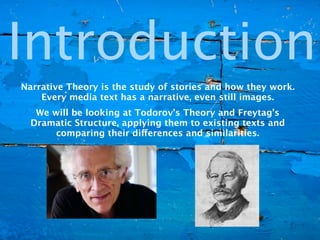
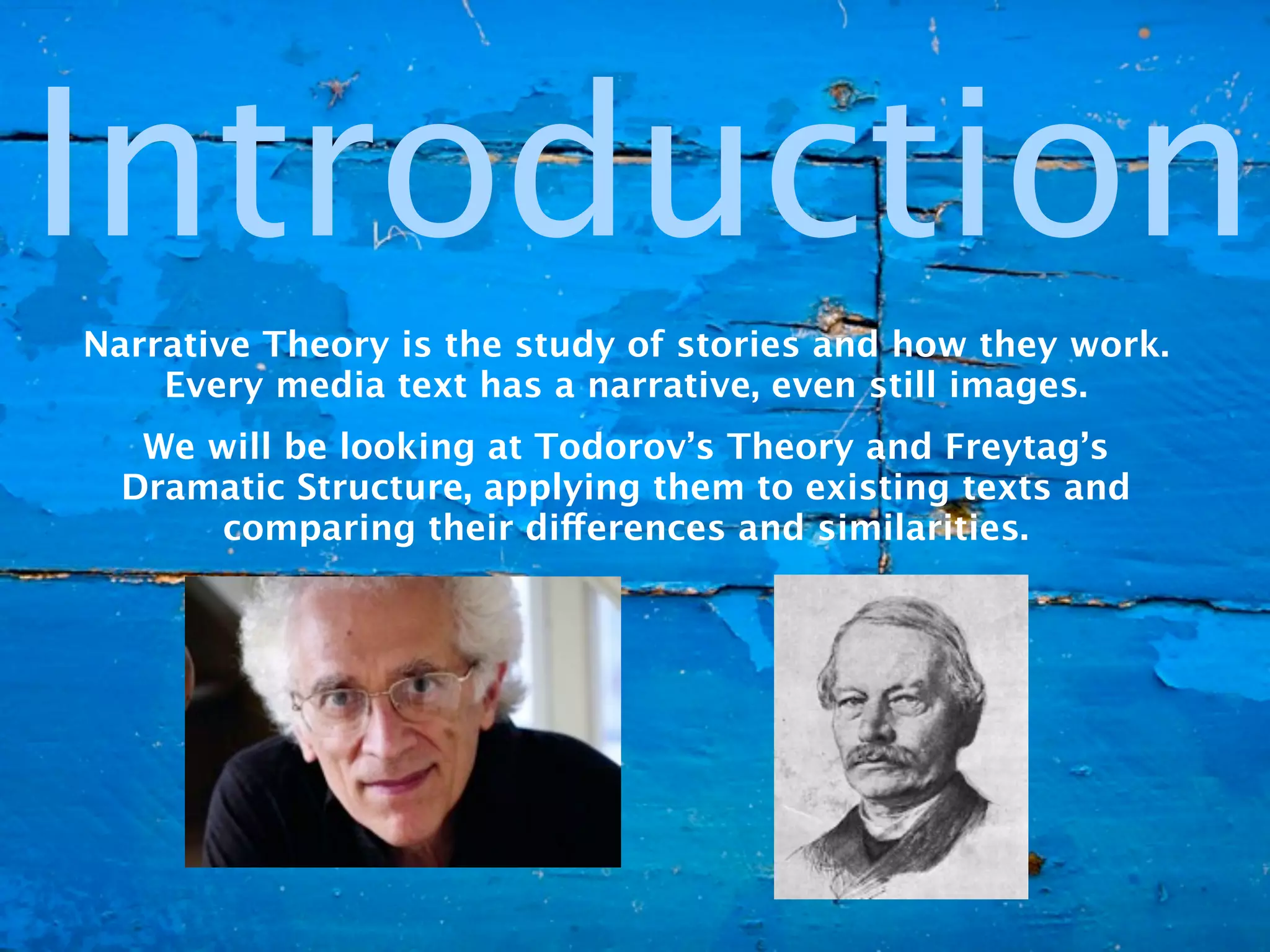
   We will be looking at Todorov’s Theory and Freytag’s
  Dramatic Structure, applying them to existing texts and
       comparing their differences and similarities.
Todorov’s Theory
Todorov’s narrative theory is the most simplest and is
often termed as the ‘classic’ narrative as it is so often
used in media products.
The theory consists of the basic narrative structure for
every story.
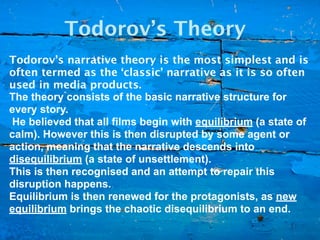
He believed that all films begin with equilibrium (a state of
calm). However this is then disrupted by some agent or
action, meaning that the narrative descends into
disequilibrium (a state of unsettlement).
This is then recognised and an attempt to repair this
disruption happens.
Equilibrium is then renewed for the protagonists, as new
equilibrium brings the chaotic disequilibrium to an end.
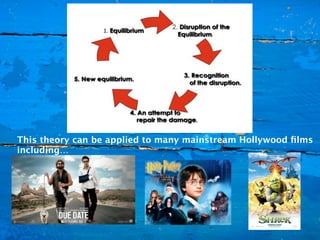
This theory can be applied to many mainstream Hollywood films
including…
Todorov’s Theory Criticism

• Todorov’s theory can be seen as too basic
• It perhaps ignores the more complex concepts
surrounding narrative such as Freytag who explores
narrative in more depth.
• Another big problem with his theory is that many
modern texts are far more complicated than this
simplistic concept which is duw to producers trying to
keep things fresh so audiences won’t get bored.
• Many postmodern texts will also mix up from this linear
narrative to look at a narrative in a different way.
Freytag's Theory


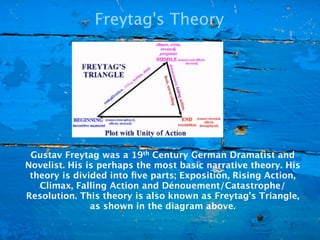
 Gustav Freytag was a 19th Century German Dramatist and
Novelist. His is perhaps the most basic narrative theory. His
 theory is divided into five parts; Exposition, Rising Action,
   Climax, Falling Action and Dénouement/Catastrophe/
Resolution. This theory is also known as Freytag’s Triangle,
               as shown in the diagram above.
Applying Freytag's Theory to
        Existing Texts
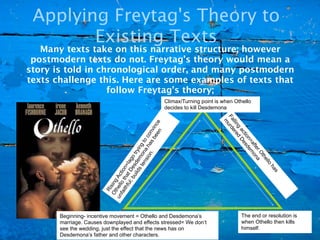
   Many texts take on this narrative structure; however
 postmodern texts do not. Freytag’s theory would mean a
story is told in chronological order, and many postmodern
texts challenge this. Here are some examples of texts that
                   follow Freytag’s theory;
                                                              Climax/Turning point is when Othello
                                                              decides to kill Desdemona


                                                                                      Fa urd
                                                                                        m
                                                                                        llin ere
                                                       en e
                                                     be inc


                                                                                            g dD
                                                n. as nv


                                                                                             ac
                                             sio h co


                                                                                                tio esd
                                                                                                   n= em
                                           en na to


                                                                                                     af o
                                        s t mo ng


                                                                                                       te na
                                     ild de ryi


                                                                                                         rO
                                   bu es o t


                                                                                                           th
                                ul; t D Iag


                                                                                                              el
                                                                                                             lo
                             thf ha n=


                                                                                                               ha
                          fai o t tio


                                                                                                                   s
                        un hell Ac
                          Ot sing
                            Ri


       Beginning- incentive movement = Othello and Desdemona’s                                  The end or resolution is
       marriage. Causes downplayed and effects stressed= We don’t                               when Othello then kills
       see the wedding, just the effect that the news has on                                    himself.
       Desdemona’s father and other characters.
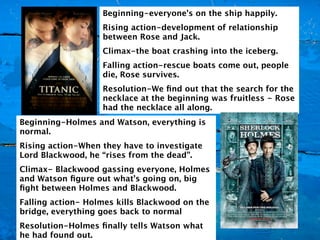
Beginning-everyone’s on the ship happily.
                   Rising action-development of relationship
                   between Rose and Jack.
                   Climax-the boat crashing into the iceberg.
                   Falling action-rescue boats come out, people
                   die, Rose survives.
                   Resolution-We find out that the search for the
                   necklace at the beginning was fruitless - Rose
                   had the necklace all along.
Beginning-Holmes and Watson, everything is
normal.
Rising action-When they have to investigate
Lord Blackwood, he “rises from the dead”.
Climax- Blackwood gassing everyone, Holmes
and Watson figure out what’s going on, big
fight between Holmes and Blackwood.
Falling action- Holmes kills Blackwood on the
bridge, everything goes back to normal
Resolution-Holmes finally tells Watson what
he had found out.
Criticisms of
   Freytag's Theory
     “Freytag, an empiricist, like Aristotle in a larger measure,
    undertook, at the close of an era in the moral and aesthetic
   history of mankind, to fit a dramatic theory to ideas that had
 already received their cues for their final exits.” Freytag's theory
of the drama, as well as his plays, were outdated by the end of the
                        nineteenth century.
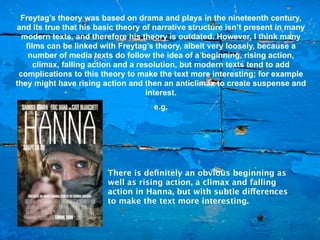
Freytag’s theory was based on drama and plays in the nineteenth century,
and its true that his basic theory of narrative structure isn’t present in many
  modern texts, and therefore his theory is outdated. However, I think many
   films can be linked with Freytag’s theory, albeit very loosely, because a
    number of media texts do follow the idea of a beginning, rising action,
      climax, falling action and a resolution, but modern texts tend to add
 complications to this theory to make the text more interesting; for example
they might have rising action and then an anticlimax to create suspense and
                                     interest.
                                     e.g.


                         There is definitely an obvious beginning as
                         well as rising action, a climax and falling
                         action in Hanna, but with subtle differences
                         to make the text more interesting.
Applying Todorov’s theory
    applied to our products…
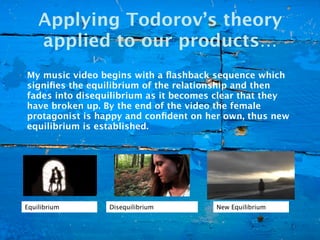
My music video begins with a flashback sequence which
signifies the equilibrium of the relationship and then
fades into disequilibrium as it becomes clear that they
have broken up. By the end of the video the female
protagonist is happy and confident on her own, thus new
equilibrium is established.


Equilibrium      Disequilibrium        New Equilibrium
Similarities and
          Differences
Both theories are quite basic, and they both rely on a linear, chronological
narrative. Todorov’s is more basic, but Freytag’s theory is much older and
 was applied to drama and plays as opposed to modern day films and TV.
Therefore, Todorov’s theory is much easier to apply to modern media texts.
 They are both quite similar, in that they explain that there is a beginning, a
  climax and a resolution. We found that it was easier to apply Todorov’s
    theory to films and TV shows than it was to apply Freytag’s because
Todorov’s theory is so basic that it can be applied to many genres and types
  of film, whereas Freytag’s is slightly more specific and doesn’t allow for
   possibilities like an anti-climax which is something a lot of films have.

Narrative Theory

  • 1.
    Introduction Narrative Theory isthe study of stories and how they work. Every media text has a narrative, even still images. We will be looking at Todorov’s Theory and Freytag’s Dramatic Structure, applying them to existing texts and comparing their differences and similarities.
  • 2.
    Todorov’s Theory Todorov’s narrativetheory is the most simplest and is often termed as the ‘classic’ narrative as it is so often used in media products. The theory consists of the basic narrative structure for every story. He believed that all films begin with equilibrium (a state of calm). However this is then disrupted by some agent or action, meaning that the narrative descends into disequilibrium (a state of unsettlement). This is then recognised and an attempt to repair this disruption happens. Equilibrium is then renewed for the protagonists, as new equilibrium brings the chaotic disequilibrium to an end.
  • 3.
    This theory canbe applied to many mainstream Hollywood films including…
  • 4.
    Todorov’s Theory Criticism •Todorov’s theory can be seen as too basic • It perhaps ignores the more complex concepts surrounding narrative such as Freytag who explores narrative in more depth. • Another big problem with his theory is that many modern texts are far more complicated than this simplistic concept which is duw to producers trying to keep things fresh so audiences won’t get bored. • Many postmodern texts will also mix up from this linear narrative to look at a narrative in a different way.
  • 5.
    Freytag's Theory GustavFreytag was a 19th Century German Dramatist and Novelist. His is perhaps the most basic narrative theory. His theory is divided into five parts; Exposition, Rising Action, Climax, Falling Action and Dénouement/Catastrophe/ Resolution. This theory is also known as Freytag’s Triangle, as shown in the diagram above.
  • 6.
    Applying Freytag's Theoryto Existing Texts Many texts take on this narrative structure; however postmodern texts do not. Freytag’s theory would mean a story is told in chronological order, and many postmodern texts challenge this. Here are some examples of texts that follow Freytag’s theory; Climax/Turning point is when Othello decides to kill Desdemona Fa urd m llin ere en e be inc g dD n. as nv ac sio h co tio esd n= em en na to af o s t mo ng te na ild de ryi rO bu es o t th ul; t D Iag el lo thf ha n= ha fai o t tio s un hell Ac Ot sing Ri Beginning- incentive movement = Othello and Desdemona’s The end or resolution is marriage. Causes downplayed and effects stressed= We don’t when Othello then kills see the wedding, just the effect that the news has on himself. Desdemona’s father and other characters.
  • 7.
    Beginning-everyone’s on theship happily. Rising action-development of relationship between Rose and Jack. Climax-the boat crashing into the iceberg. Falling action-rescue boats come out, people die, Rose survives. Resolution-We find out that the search for the necklace at the beginning was fruitless - Rose had the necklace all along. Beginning-Holmes and Watson, everything is normal. Rising action-When they have to investigate Lord Blackwood, he “rises from the dead”. Climax- Blackwood gassing everyone, Holmes and Watson figure out what’s going on, big fight between Holmes and Blackwood. Falling action- Holmes kills Blackwood on the bridge, everything goes back to normal Resolution-Holmes finally tells Watson what he had found out.
  • 8.
    Criticisms of Freytag's Theory “Freytag, an empiricist, like Aristotle in a larger measure, undertook, at the close of an era in the moral and aesthetic history of mankind, to fit a dramatic theory to ideas that had already received their cues for their final exits.” Freytag's theory of the drama, as well as his plays, were outdated by the end of the nineteenth century.
  • 9.
    Freytag’s theory wasbased on drama and plays in the nineteenth century, and its true that his basic theory of narrative structure isn’t present in many modern texts, and therefore his theory is outdated. However, I think many films can be linked with Freytag’s theory, albeit very loosely, because a number of media texts do follow the idea of a beginning, rising action, climax, falling action and a resolution, but modern texts tend to add complications to this theory to make the text more interesting; for example they might have rising action and then an anticlimax to create suspense and interest. e.g. There is definitely an obvious beginning as well as rising action, a climax and falling action in Hanna, but with subtle differences to make the text more interesting.
  • 10.
    Applying Todorov’s theory applied to our products… My music video begins with a flashback sequence which signifies the equilibrium of the relationship and then fades into disequilibrium as it becomes clear that they have broken up. By the end of the video the female protagonist is happy and confident on her own, thus new equilibrium is established. Equilibrium Disequilibrium New Equilibrium
  • 11.
    Similarities and Differences Both theories are quite basic, and they both rely on a linear, chronological narrative. Todorov’s is more basic, but Freytag’s theory is much older and was applied to drama and plays as opposed to modern day films and TV. Therefore, Todorov’s theory is much easier to apply to modern media texts. They are both quite similar, in that they explain that there is a beginning, a climax and a resolution. We found that it was easier to apply Todorov’s theory to films and TV shows than it was to apply Freytag’s because Todorov’s theory is so basic that it can be applied to many genres and types of film, whereas Freytag’s is slightly more specific and doesn’t allow for possibilities like an anti-climax which is something a lot of films have.

Editor's Notes