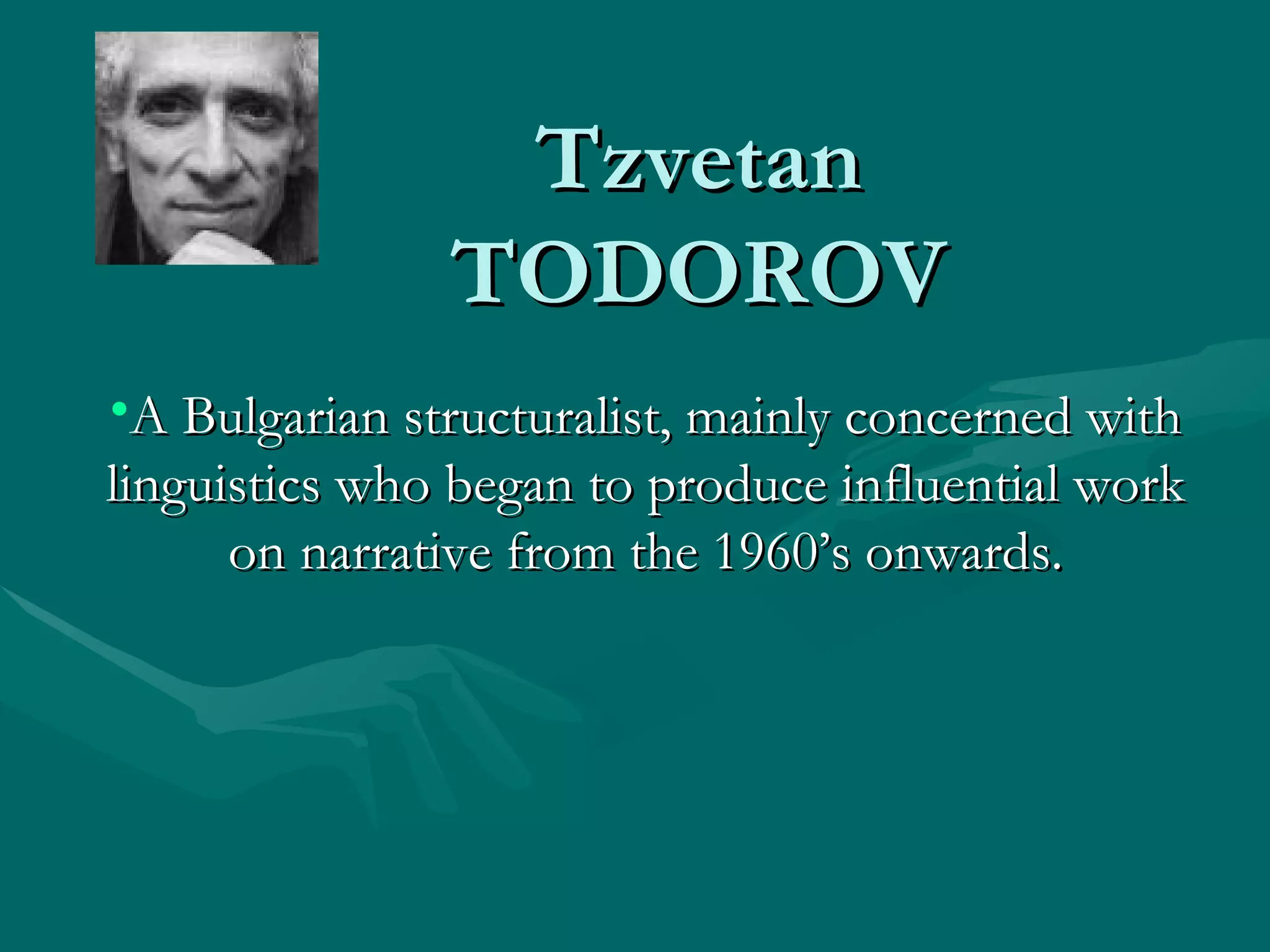
Tzvetan TODOROV A Bulgarian structuralist, mainly concerned with linguistics who began to produce influential work on narrative from the 1960’s onwards.
The Classical Narrative EQUILIBRIUM: The normal (norm) state at the beginning of the text. Any opposing forces are in balance. DIS-EQUILIBRIUM: An action or conflict introduced into the narrative. NEW-EQUILIBRIUM: The conflict is resolved and the narrative strands are tied together
Roland Barthes Barthes is famous in Media Studies for suggesting that narratives work with five codes.  The Action or Proairetic The Enigma or Hermeneutic The Semic  The symbolic The Cultural or referential The enigma code is the most famous as we use this to make guesses as to how the narrative will finish, therefore providing pleasure for the audience.
Claude Levi-Strauss Argued that meaning in narratives is based upon  binary oppositions. (conflict)  he was less interested in the arrangement (syntagmatic) of the narrative (or order) and more in the deeper meaning (paradigmatic) of themes.
Strauss applied to the Western Homesteaders Christian Domestic Weak (Need Cowboy hero) Garden Wilderness Civilised Native American Pagan Savage Strong Wilderness Outside Society Barbaric
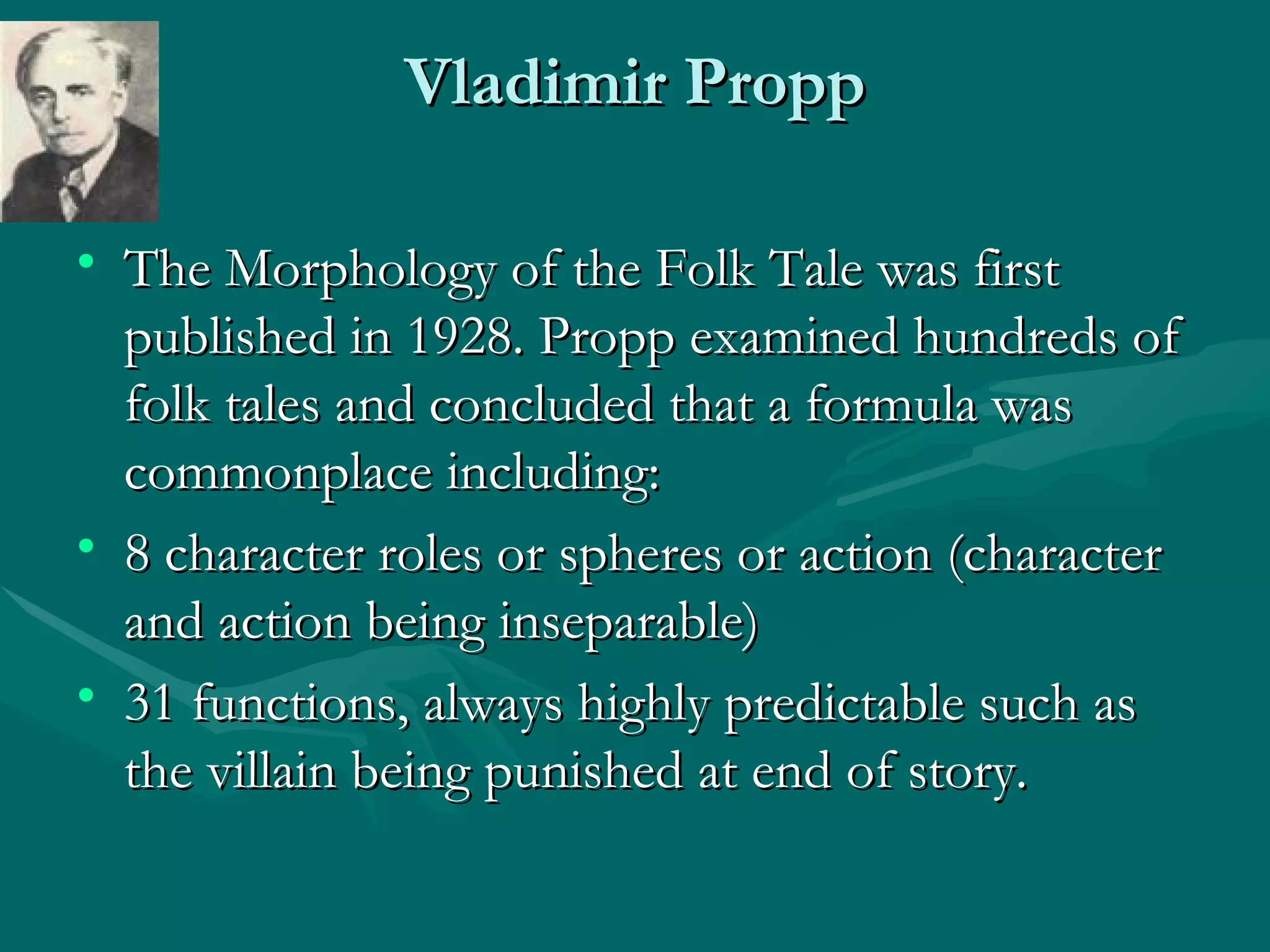
Vladimir Propp The Morphology of the Folk Tale was first published in 1928. Propp examined hundreds of folk tales and concluded that a formula was commonplace including: 8 character roles or spheres or action (character and action being inseparable) 31 functions, always highly predictable such as the villain being punished at end of story.
Propp: Spheres of Action  The villain The hero The donor The helper The Princess Her Father (the King who rewards hero) The dispatcher who sends hero on his way The false hero (usually good looking and a coward)

Todorov

  • 1.
    Tzvetan TODOROV ABulgarian structuralist, mainly concerned with linguistics who began to produce influential work on narrative from the 1960’s onwards.
  • 2.
    The Classical NarrativeEQUILIBRIUM: The normal (norm) state at the beginning of the text. Any opposing forces are in balance. DIS-EQUILIBRIUM: An action or conflict introduced into the narrative. NEW-EQUILIBRIUM: The conflict is resolved and the narrative strands are tied together
  • 3.
    Roland Barthes Barthesis famous in Media Studies for suggesting that narratives work with five codes. The Action or Proairetic The Enigma or Hermeneutic The Semic The symbolic The Cultural or referential The enigma code is the most famous as we use this to make guesses as to how the narrative will finish, therefore providing pleasure for the audience.
  • 4.
    Claude Levi-Strauss Arguedthat meaning in narratives is based upon binary oppositions. (conflict) he was less interested in the arrangement (syntagmatic) of the narrative (or order) and more in the deeper meaning (paradigmatic) of themes.
  • 5.
    Strauss applied tothe Western Homesteaders Christian Domestic Weak (Need Cowboy hero) Garden Wilderness Civilised Native American Pagan Savage Strong Wilderness Outside Society Barbaric
  • 6.
    Vladimir Propp TheMorphology of the Folk Tale was first published in 1928. Propp examined hundreds of folk tales and concluded that a formula was commonplace including: 8 character roles or spheres or action (character and action being inseparable) 31 functions, always highly predictable such as the villain being punished at end of story.
  • 7.
    Propp: Spheres ofAction The villain The hero The donor The helper The Princess Her Father (the King who rewards hero) The dispatcher who sends hero on his way The false hero (usually good looking and a coward)