Introduction to
Narrative Theory
Narrative Theory and Todorov
Learning Objective
• To become familiar with the ideas of Todorov
• To begin to apply narrative theories to film
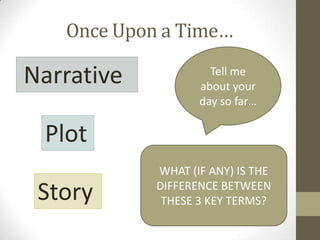
Once Upon a Time…
Tell me
about your
day so far…
Narrative
Plot
Story
WHAT (IF ANY) IS THE
DIFFERENCE BETWEEN
THESE 3 KEY TERMS?
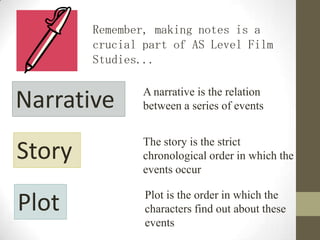
Narrative
Plot
Story
A narrative is the relation
between a series of events
Plot is the order in which the
characters find out about these
events
The story is the strict
chronological order in which the
events occur
Remember, making notes is a
crucial part of AS Level Film
Studies...
So, that means…
• "Story is the irreducible substance of a
story (A meets B, something happens,
order returns), while narrative is the way
the story is related (Once upon a time
there was a princess...)“
Key Concepts in Communication - Fiske et al (1983)
Narrative Structure
• There are three ways in which
narrative is structured.
1. Circular
2. Episodic
3. Linear
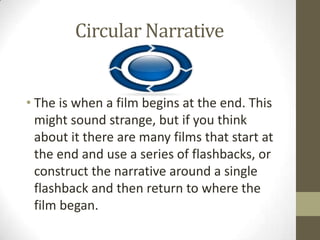
Circular Narrative
• The is when a film begins at the end. This
might sound strange, but if you think
about it there are many films that start at
the end and use a series of flashbacks, or
construct the narrative around a single
flashback and then return to where the
film began.
Episodic Narrative
• Not all films with flashbacks and voice-overs are
circular. For example ‘Forrest Gump’ has an
interesting narrative structure because although
events unfold more or less in chronological
order, rather than just seeing Forrest at the
beginning and end of the film, we keep returning
to him sitting on the bench telling his story. The
narrative is broken up into episodes or more
manageable narrative pieces.
Linear Narrative
• This is the most simple and commonly used narrative
structure; it refers to a story that is told in the order in
which events happen – from beginning to end. These are
sometimes referred to as ‘cause and effect’ narratives as
the consequences of one event have an effect on
something else and things move along in this linear
fashion. This doesn’t mean to say linear narratives are
boring – Sixth Sense and Pan’s Labyrinth follow linear
narratives but still create intrigue and mystery.
Remember – linear narratives are only simplistic in
reference to time and place, not in terms of plot!
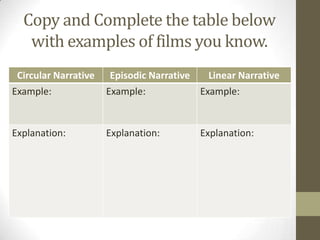
Copy and Complete the table below
with examples of films you know.
Circular Narrative Episodic Narrative Linear Narrative
Example: Example: Example:
Explanation: Explanation: Explanation:
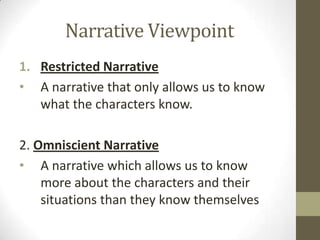
Narrative Viewpoint
1. Restricted Narrative
• A narrative that only allows us to know
what the characters know.
2. Omniscient Narrative
• A narrative which allows us to know
more about the characters and their
situations than they know themselves
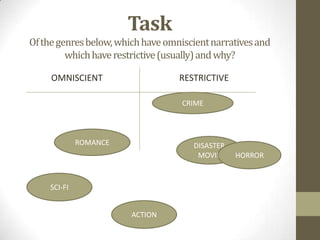
Task
Ofthegenresbelow,whichhaveomniscientnarrativesand
whichhaverestrictive(usually)andwhy?
CRIME
ACTION
DISASTER
MOVIE
SCI-FI
HORROR
ROMANCE
OMNISCIENT RESTRICTIVE
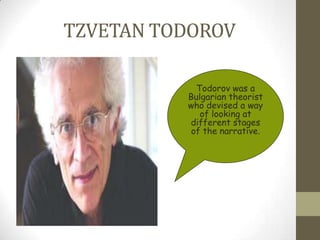
TZVETAN TODOROV
Todorov was a
Bulgarian theorist
who devised a way
of looking at
different stages
of the narrative.
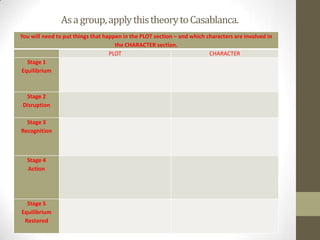
Asagroup,applythistheorytoCasablanca.
You will need to put things that happen in the PLOT section – and which characters are involved in
the CHARACTER section.
PLOT CHARACTER
Stage 1
Equilibrium
Stage 2
Disruption
Stage 3
Recognition
Stage 4
Action
Stage 5
Equilibrium
Restored
Relationship Between
Narrative and Genre
• A study of different genres in film and television
will suggest that the formula requires the
narrative to be closed in a different way for each
genre.
• “Both are means in which the world of human
experience can be reconstructed, rearranged
and reimagined.” - H.Newcomb (2004)
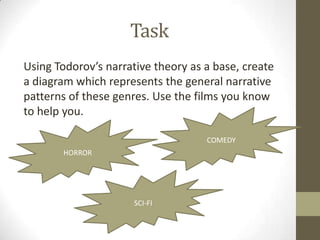
Task
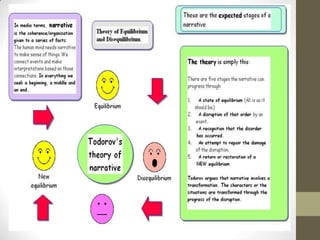
Using Todorov’s narrative theory as a base, create
a diagram which represents the general narrative
patterns of these genres. Use the films you know
to help you.
HORROR
COMEDY
SCI-FI

Introduction to narrative_theory

  • 1.
  • 2.
    Learning Objective • Tobecome familiar with the ideas of Todorov • To begin to apply narrative theories to film
  • 3.
    Once Upon aTime… Tell me about your day so far… Narrative Plot Story WHAT (IF ANY) IS THE DIFFERENCE BETWEEN THESE 3 KEY TERMS?
  • 4.
    Narrative Plot Story A narrative isthe relation between a series of events Plot is the order in which the characters find out about these events The story is the strict chronological order in which the events occur Remember, making notes is a crucial part of AS Level Film Studies...
  • 5.
    So, that means… •"Story is the irreducible substance of a story (A meets B, something happens, order returns), while narrative is the way the story is related (Once upon a time there was a princess...)“ Key Concepts in Communication - Fiske et al (1983)
  • 6.
    Narrative Structure • Thereare three ways in which narrative is structured. 1. Circular 2. Episodic 3. Linear
  • 7.
    Circular Narrative • Theis when a film begins at the end. This might sound strange, but if you think about it there are many films that start at the end and use a series of flashbacks, or construct the narrative around a single flashback and then return to where the film began.
  • 8.
    Episodic Narrative • Notall films with flashbacks and voice-overs are circular. For example ‘Forrest Gump’ has an interesting narrative structure because although events unfold more or less in chronological order, rather than just seeing Forrest at the beginning and end of the film, we keep returning to him sitting on the bench telling his story. The narrative is broken up into episodes or more manageable narrative pieces.
  • 9.
    Linear Narrative • Thisis the most simple and commonly used narrative structure; it refers to a story that is told in the order in which events happen – from beginning to end. These are sometimes referred to as ‘cause and effect’ narratives as the consequences of one event have an effect on something else and things move along in this linear fashion. This doesn’t mean to say linear narratives are boring – Sixth Sense and Pan’s Labyrinth follow linear narratives but still create intrigue and mystery. Remember – linear narratives are only simplistic in reference to time and place, not in terms of plot!
  • 10.
    Copy and Completethe table below with examples of films you know. Circular Narrative Episodic Narrative Linear Narrative Example: Example: Example: Explanation: Explanation: Explanation:
  • 11.
    Narrative Viewpoint 1. RestrictedNarrative • A narrative that only allows us to know what the characters know. 2. Omniscient Narrative • A narrative which allows us to know more about the characters and their situations than they know themselves
  • 12.
  • 13.
    TZVETAN TODOROV Todorov wasa Bulgarian theorist who devised a way of looking at different stages of the narrative.
  • 15.
    Asagroup,applythistheorytoCasablanca. You will needto put things that happen in the PLOT section – and which characters are involved in the CHARACTER section. PLOT CHARACTER Stage 1 Equilibrium Stage 2 Disruption Stage 3 Recognition Stage 4 Action Stage 5 Equilibrium Restored
  • 16.
    Relationship Between Narrative andGenre • A study of different genres in film and television will suggest that the formula requires the narrative to be closed in a different way for each genre. • “Both are means in which the world of human experience can be reconstructed, rearranged and reimagined.” - H.Newcomb (2004)
  • 17.
    Task Using Todorov’s narrativetheory as a base, create a diagram which represents the general narrative patterns of these genres. Use the films you know to help you. HORROR COMEDY SCI-FI