NARRATIVE RESEARCH
DESIGN
BY
NUR SYUHADA MOHD RASHID
2017932187
EDU702 RESEARCH METHODOLOGY
KEY CONCEPTS IN NARRATIVE RESEARCH
DESIGN
• What is it, when to use it and how did it develop?
• Types
• Key characteristics
• Steps in conducting
• Ethical issues
• Evaluation
WHAT IS NARRATIVE RESEARCH DESIGN?
• Derives from the verb ‘narrate’
- “to tell a story in detail”
• “researchers describe the lives of individuals, collect and tell
stories about people’s lives, and write narratives of individual
experiences,” (Connelly & Clandinin, 1990 )
• typically focuses on studying a single person, gathering data
through the collection of stories, reporting individual
experiences, and discussing the meaning of those experiences
for the individual.
WHEN TO USE NARRATIVE RESEARCH
DESIGN?
• when there are individuals/people willing to tell you
their stories and you, as a researcher, want to report
them
• when the stories you gathered follow a chronological
order
• when you want to collect practical, specific insights,
particularly in the education field
HOW DID NARRATIVE RESEARCH DESIGN
DEVELOP?
• Dr Jean Clandinin and Michael Connelly introduced the
research design into education field back in 1990
• Elaborated the process of collecting narrative
fieldnotes, writing and structure of a narrative study
• Some trends that helped spread the use of narrative
design include teacher’s reflection, teacher’s
knowledge, and teachers voicing their experiences
TYPES OF NARRATIVE RESEARCH DESIGN
• Biographies
• Autobiographies
• Personal accounts/documents
• Life writings
• Narrative interviews
• Ethnohistories
• Person-centered ethnographies
• Latin American testimonies
(more in Creswell pg. 504)
KEY CHARACTERISTICS OF NARRATIVE
RESEARCH DESIGN
• Individual experiences
• Chronology of the experiences
• Collecting individual stories
• Restorying
• Coding for themes
• Context or setting
• Collaborating with participants
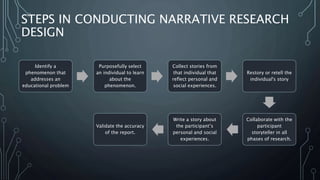
STEPS IN CONDUCTING NARRATIVE RESEARCH
DESIGN
Identify a
phenomenon that
addresses an
educational problem
Purposefully select
an individual to learn
about the
phenomenon.
Collect stories from
that individual that
reflect personal and
social experiences.
Restory or retell the
individual's story
Collaborate with the
participant
storyteller in all
phases of research.
Write a story about
the participant’s
personal and social
experiences.
Validate the accuracy
of the report.
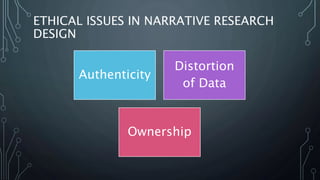
ETHICAL ISSUES IN NARRATIVE RESEARCH
DESIGN
Authenticity
Distortion
of Data
Ownership
EVALUATION OF NARRATIVE RESEARCH
DESIGN
• Keeps the focus on a single individual (or two)
• Reports the life experiences of individuals as told through their
stories
• Restories the individual’s stories and tells the story using a
chronology with a beginning, middle, and end
• Describes in some details the context of the story (i.e., the setting,
the place where it occurs, the people involved, and so forth)
• Reports themes (5 to 7) to emerge out of the story
• Closely collaborates with the participant providing the story
THANK YOU

Narrative research design

  • 1.
    NARRATIVE RESEARCH DESIGN BY NUR SYUHADAMOHD RASHID 2017932187 EDU702 RESEARCH METHODOLOGY
  • 2.
    KEY CONCEPTS INNARRATIVE RESEARCH DESIGN • What is it, when to use it and how did it develop? • Types • Key characteristics • Steps in conducting • Ethical issues • Evaluation
  • 3.
    WHAT IS NARRATIVERESEARCH DESIGN? • Derives from the verb ‘narrate’ - “to tell a story in detail” • “researchers describe the lives of individuals, collect and tell stories about people’s lives, and write narratives of individual experiences,” (Connelly & Clandinin, 1990 ) • typically focuses on studying a single person, gathering data through the collection of stories, reporting individual experiences, and discussing the meaning of those experiences for the individual.
  • 4.
    WHEN TO USENARRATIVE RESEARCH DESIGN? • when there are individuals/people willing to tell you their stories and you, as a researcher, want to report them • when the stories you gathered follow a chronological order • when you want to collect practical, specific insights, particularly in the education field
  • 5.
    HOW DID NARRATIVERESEARCH DESIGN DEVELOP? • Dr Jean Clandinin and Michael Connelly introduced the research design into education field back in 1990 • Elaborated the process of collecting narrative fieldnotes, writing and structure of a narrative study • Some trends that helped spread the use of narrative design include teacher’s reflection, teacher’s knowledge, and teachers voicing their experiences
  • 6.
    TYPES OF NARRATIVERESEARCH DESIGN • Biographies • Autobiographies • Personal accounts/documents • Life writings • Narrative interviews • Ethnohistories • Person-centered ethnographies • Latin American testimonies (more in Creswell pg. 504)
  • 7.
    KEY CHARACTERISTICS OFNARRATIVE RESEARCH DESIGN • Individual experiences • Chronology of the experiences • Collecting individual stories • Restorying • Coding for themes • Context or setting • Collaborating with participants
  • 8.
    STEPS IN CONDUCTINGNARRATIVE RESEARCH DESIGN Identify a phenomenon that addresses an educational problem Purposefully select an individual to learn about the phenomenon. Collect stories from that individual that reflect personal and social experiences. Restory or retell the individual's story Collaborate with the participant storyteller in all phases of research. Write a story about the participant’s personal and social experiences. Validate the accuracy of the report.
  • 9.
    ETHICAL ISSUES INNARRATIVE RESEARCH DESIGN Authenticity Distortion of Data Ownership
  • 10.
    EVALUATION OF NARRATIVERESEARCH DESIGN • Keeps the focus on a single individual (or two) • Reports the life experiences of individuals as told through their stories • Restories the individual’s stories and tells the story using a chronology with a beginning, middle, and end • Describes in some details the context of the story (i.e., the setting, the place where it occurs, the people involved, and so forth) • Reports themes (5 to 7) to emerge out of the story • Closely collaborates with the participant providing the story
  • 11.