Audience
QUESTION 1B – CHOOSE ONE PRODUCTION
AND APPLY MEDIA CONCEPTS
Audience
Why is it so important to understand our
audience?
Audience
Audience Research: Looks at producing
evidence of the relationship between audience
and the media
Audience Theory: considers the different ways of
thinking about audiences
Key Theories
Post Modern Media Audience – active, constructs their own
meaning, will engage with the text, will not always accept
the messages/ values/ meaning of the text
Reception Theory Stuart Hall - audiences will interpret
texts in very different ways and not always how the
producers intend (an aspect of POMO that we have
already cover….)
Hypodermic Needle Theory – works on the theory that the
audience just accept what the Media is telling them.
Audience are passive
Uses & Gratifications Theory – works on the theory that
people watch Media for a variety of reasons and take what
they want from it – they are an active audience
Reception Theory - Stuart
Hall
What do you remember?
Reception theory Stuart Hall
1980
Reception theory states that media texts are
encoded by the producer- they are loaded with
values and messages.
However, the text is then decoded by spectators.
However, different spectators will decode the text
in different ways, perhaps not in the way the
producer intended.
Reception theory Stuart
Hall
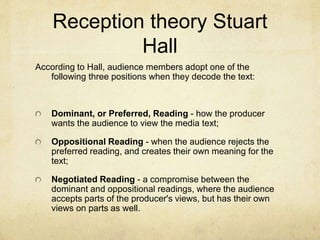
According to Hall, audience members adopt one of the
following three positions when they decode the text:
Dominant, or Preferred, Reading - how the producer
wants the audience to view the media text;
Oppositional Reading - when the audience rejects the
preferred reading, and creates their own meaning for the
text;
Negotiated Reading - a compromise between the
dominant and oppositional readings, where the audience
accepts parts of the producer's views, but has their own
views on parts as well.
Reception Theory
Lots of factors could affect whether we take the
dominant, oppositional or negotiated reading.
Life experience
Mood at the time of viewing
Age
Culture
Beliefs
Gender
Why might an audience
member…
… take the dominant position: clear messages in your video;
audience member is same age/ culture; your video is relevant to
modern society; your video has an easy to follow narrative; your
video deals with themes that are relevant to your audience;
audience member likes this style of music
… take an oppositional position: your video has difficult or
controversial themes; audience member disagrees with the
messages in your video; audience member dislikes this style of
music; your video has a complex narrative structure; your video
does not deal with themes in modern society; your video
references a previous era; audience member has different beliefs;
audience member is of a different age/ from a different culture.
… take a negotiated position: a combination of some of the above
e.g. audience member likes this style of music, is of the same age
as you and understands some of the messages, but the narrative is
complex and this inhibits full understanding
Hypodermic Needle Theory
It's an outdated theory of communication that suggests that
an audience is helpless to the effects and messages of a
medium, such as television. The theory says that an audience
will absorb all of the intended information; they will
unknowingly believe anything they see. This theory was very
popular in the 1930s, especially after H.G. Wells' "War of the
Worlds" broadcast in 1938, but has since been disproven by
more modern theories.
Due to the knowledge being very slim in the 1930’s compared
to now you can comply with the fact the information was
taken in so easily, however a weakness of the theory now is
that people have built opinions before they have been given
the information to take in, therefore this theory isn’t as strong
as it used to be.
The Theory
Uses & Gratifications
Personal Relationships – talk to others about the
programme (bonding/ shared experience), care about
the characters within the text.
Surveillance – seeing what other people/ events are
like
Personal Identity – reflects your interest lifestyle e.g.
a car enthusiast may watch Top Gear. Help you to
feel ‘normal’
Escapism – watching something to feel better either
because it makes you laugh, captivates you or shows
your if as being better than the person on the TV.
How could your work be
analysed according to these
theories
Post Modern Media Audience
Reception Theory Stuart Hall
Hypodermic Needle Theory
Uses & Gratifications Theory

Section A Audience

  • 1.
    Audience QUESTION 1B –CHOOSE ONE PRODUCTION AND APPLY MEDIA CONCEPTS
  • 2.
    Audience Why is itso important to understand our audience?
  • 3.
    Audience Audience Research: Looksat producing evidence of the relationship between audience and the media Audience Theory: considers the different ways of thinking about audiences
  • 4.
    Key Theories Post ModernMedia Audience – active, constructs their own meaning, will engage with the text, will not always accept the messages/ values/ meaning of the text Reception Theory Stuart Hall - audiences will interpret texts in very different ways and not always how the producers intend (an aspect of POMO that we have already cover….) Hypodermic Needle Theory – works on the theory that the audience just accept what the Media is telling them. Audience are passive Uses & Gratifications Theory – works on the theory that people watch Media for a variety of reasons and take what they want from it – they are an active audience
  • 5.
    Reception Theory -Stuart Hall What do you remember?
  • 6.
    Reception theory StuartHall 1980 Reception theory states that media texts are encoded by the producer- they are loaded with values and messages. However, the text is then decoded by spectators. However, different spectators will decode the text in different ways, perhaps not in the way the producer intended.
  • 7.
    Reception theory Stuart Hall Accordingto Hall, audience members adopt one of the following three positions when they decode the text: Dominant, or Preferred, Reading - how the producer wants the audience to view the media text; Oppositional Reading - when the audience rejects the preferred reading, and creates their own meaning for the text; Negotiated Reading - a compromise between the dominant and oppositional readings, where the audience accepts parts of the producer's views, but has their own views on parts as well.
  • 8.
    Reception Theory Lots offactors could affect whether we take the dominant, oppositional or negotiated reading. Life experience Mood at the time of viewing Age Culture Beliefs Gender
  • 9.
    Why might anaudience member… … take the dominant position: clear messages in your video; audience member is same age/ culture; your video is relevant to modern society; your video has an easy to follow narrative; your video deals with themes that are relevant to your audience; audience member likes this style of music … take an oppositional position: your video has difficult or controversial themes; audience member disagrees with the messages in your video; audience member dislikes this style of music; your video has a complex narrative structure; your video does not deal with themes in modern society; your video references a previous era; audience member has different beliefs; audience member is of a different age/ from a different culture. … take a negotiated position: a combination of some of the above e.g. audience member likes this style of music, is of the same age as you and understands some of the messages, but the narrative is complex and this inhibits full understanding
  • 10.
  • 11.
    It's an outdatedtheory of communication that suggests that an audience is helpless to the effects and messages of a medium, such as television. The theory says that an audience will absorb all of the intended information; they will unknowingly believe anything they see. This theory was very popular in the 1930s, especially after H.G. Wells' "War of the Worlds" broadcast in 1938, but has since been disproven by more modern theories. Due to the knowledge being very slim in the 1930’s compared to now you can comply with the fact the information was taken in so easily, however a weakness of the theory now is that people have built opinions before they have been given the information to take in, therefore this theory isn’t as strong as it used to be. The Theory
  • 12.
    Uses & Gratifications PersonalRelationships – talk to others about the programme (bonding/ shared experience), care about the characters within the text. Surveillance – seeing what other people/ events are like Personal Identity – reflects your interest lifestyle e.g. a car enthusiast may watch Top Gear. Help you to feel ‘normal’ Escapism – watching something to feel better either because it makes you laugh, captivates you or shows your if as being better than the person on the TV.
  • 13.
    How could yourwork be analysed according to these theories Post Modern Media Audience Reception Theory Stuart Hall Hypodermic Needle Theory Uses & Gratifications Theory