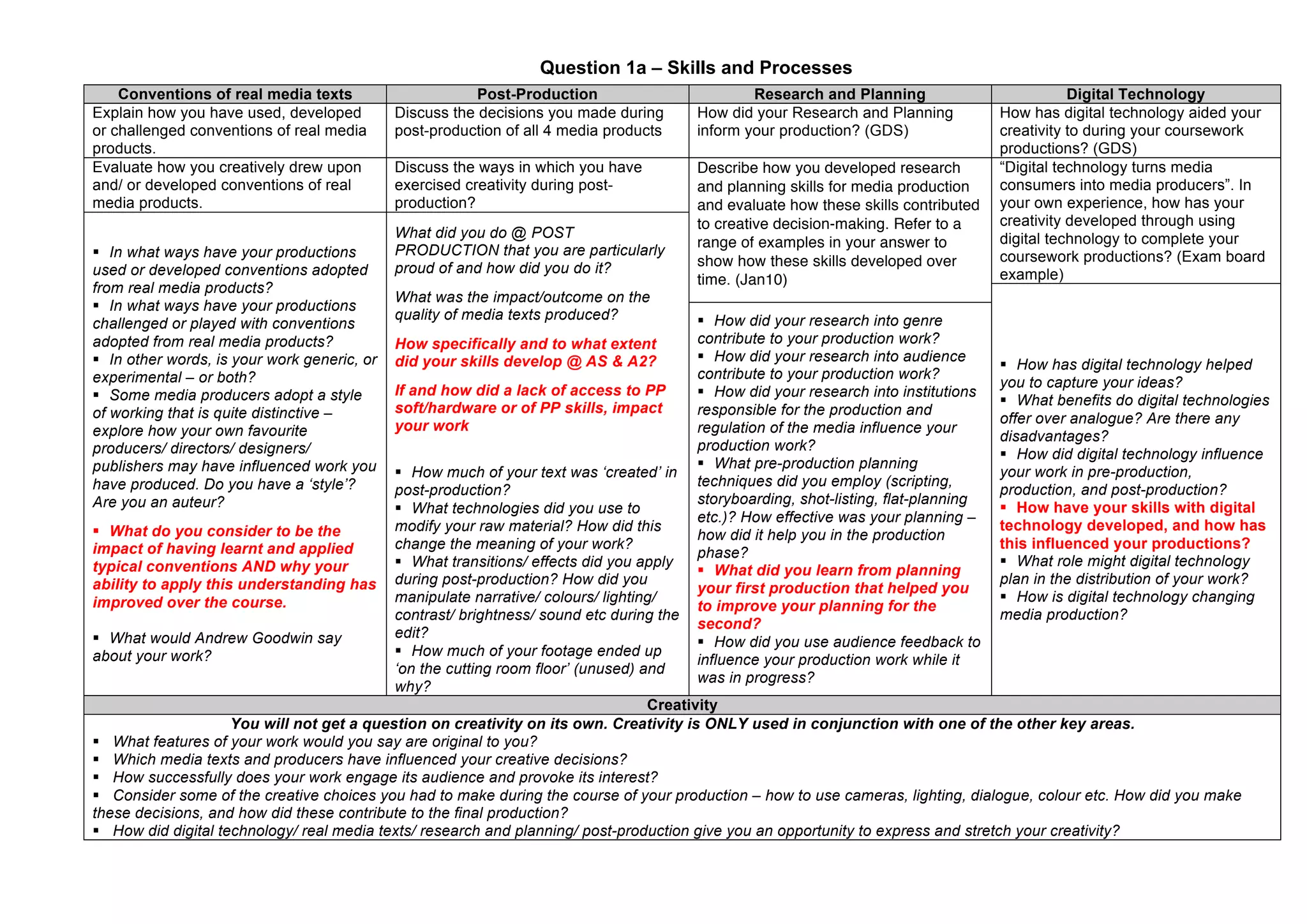

Question 1a – Skills and Processes
Conventions of real media texts Post-Production Research and Planning Digital Technology
Explain how you have used, developed
or challenged conventions of real media
products.
Discuss the decisions you made during
post-production of all 4 media products
How did your Research and Planning
inform your production? (GDS)
How has digital technology aided your
creativity to during your coursework
productions? (GDS)
Evaluate how you creatively drew upon
and/ or developed conventions of real
media products.
Discuss the ways in which you have
exercised creativity during post-
production?
Describe how you developed research
and planning skills for media production
and evaluate how these skills contributed
to creative decision-making. Refer to a
range of examples in your answer to
show how these skills developed over
time. (Jan10)
“Digital technology turns media
consumers into media producers”. In
your own experience, how has your
creativity developed through using
digital technology to complete your
coursework productions? (Exam board
example)
 In what ways have your productions
used or developed conventions adopted
from real media products?
 In what ways have your productions
challenged or played with conventions
adopted from real media products?
 In other words, is your work generic, or
experimental – or both?
 Some media producers adopt a style
of working that is quite distinctive –
explore how your own favourite
producers/ directors/ designers/
publishers may have influenced work you
have produced. Do you have a ‘style’?
Are you an auteur?
 What do you consider to be the
impact of having learnt and applied
typical conventions AND why your
ability to apply this understanding has
improved over the course.
 What would Andrew Goodwin say
about your work?
What did you do @ POST
PRODUCTION that you are particularly
proud of and how did you do it?
What was the impact/outcome on the
quality of media texts produced?
How specifically and to what extent
did your skills develop @ AS & A2?
If and how did a lack of access to PP
soft/hardware or of PP skills, impact
your work
 How much of your text was ‘created’ in
post-production?
 What technologies did you use to
modify your raw material? How did this
change the meaning of your work?
 What transitions/ effects did you apply
during post-production? How did you
manipulate narrative/ colours/ lighting/
contrast/ brightness/ sound etc during the
edit?
 How much of your footage ended up
‘on the cutting room floor’ (unused) and
why?
 How has digital technology helped
you to capture your ideas?
 What benefits do digital technologies
offer over analogue? Are there any
disadvantages?
 How did digital technology influence
your work in pre-production,
production, and post-production?
 How have your skills with digital
technology developed, and how has
this influenced your productions?
 What role might digital technology
plan in the distribution of your work?
 How is digital technology changing
media production?
 How did your research into genre
contribute to your production work?
 How did your research into audience
contribute to your production work?
 How did your research into institutions
responsible for the production and
regulation of the media influence your
production work?
 What pre-production planning
techniques did you employ (scripting,
storyboarding, shot-listing, flat-planning
etc.)? How effective was your planning –
how did it help you in the production
phase?
 What did you learn from planning
your first production that helped you
to improve your planning for the
second?
 How did you use audience feedback to
influence your production work while it
was in progress?
Creativity
You will not get a question on creativity on its own. Creativity is ONLY used in conjunction with one of the other key areas.
 What features of your work would you say are original to you?
 Which media texts and producers have influenced your creative decisions?
 How successfully does your work engage its audience and provoke its interest?
 Consider some of the creative choices you had to make during the course of your production – how to use cameras, lighting, dialogue, colour etc. How did you make
these decisions, and how did these contribute to the final production?
 How did digital technology/ real media texts/ research and planning/ post-production give you an opportunity to express and stretch your creativity?
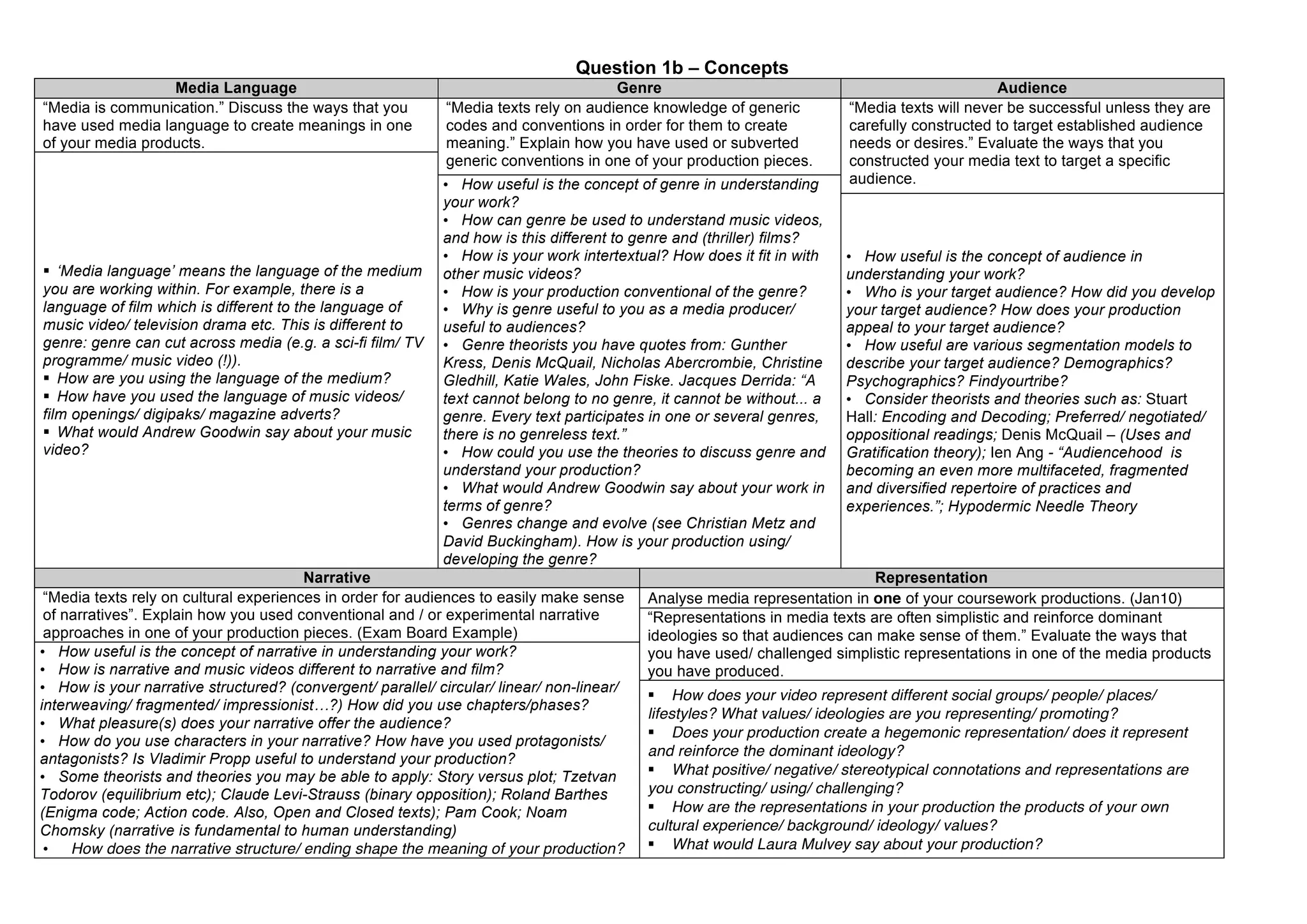
Question 1b – Concepts
Media Language Genre Audience
“Media is communication.” Discuss the ways that you
have used media language to create meanings in one
of your media products.
“Media texts rely on audience knowledge of generic
codes and conventions in order for them to create
meaning.” Explain how you have used or subverted
generic conventions in one of your production pieces.
“Media texts will never be successful unless they are
carefully constructed to target established audience
needs or desires.” Evaluate the ways that you
constructed your media text to target a specific
audience.
 ‘Media language’ means the language of the medium
you are working within. For example, there is a
language of film which is different to the language of
music video/ television drama etc. This is different to
genre: genre can cut across media (e.g. a sci-fi film/ TV
programme/ music video (!)).
 How are you using the language of the medium?
 How have you used the language of music videos/
film openings/ digipaks/ magazine adverts?
 What would Andrew Goodwin say about your music
video?
• How useful is the concept of genre in understanding
your work?
• How can genre be used to understand music videos,
and how is this different to genre and (thriller) films?
• How is your work intertextual? How does it fit in with
other music videos?
• How is your production conventional of the genre?
• Why is genre useful to you as a media producer/
useful to audiences?
• Genre theorists you have quotes from: Gunther
Kress, Denis McQuail, Nicholas Abercrombie, Christine
Gledhill, Katie Wales, John Fiske. Jacques Derrida: “A
text cannot belong to no genre, it cannot be without... a
genre. Every text participates in one or several genres,
there is no genreless text.”
• How could you use the theories to discuss genre and
understand your production?
• What would Andrew Goodwin say about your work in
terms of genre?
• Genres change and evolve (see Christian Metz and
David Buckingham). How is your production using/
developing the genre?
• How useful is the concept of audience in
understanding your work?
• Who is your target audience? How did you develop
your target audience? How does your production
appeal to your target audience?
• How useful are various segmentation models to
describe your target audience? Demographics?
Psychographics? Findyourtribe?
• Consider theorists and theories such as: Stuart
Hall: Encoding and Decoding; Preferred/ negotiated/
oppositional readings; Denis McQuail – (Uses and
Gratification theory); Ien Ang - “Audiencehood is
becoming an even more multifaceted, fragmented
and diversified repertoire of practices and
experiences.”; Hypodermic Needle Theory
Narrative Representation
“Media texts rely on cultural experiences in order for audiences to easily make sense
of narratives”. Explain how you used conventional and / or experimental narrative
approaches in one of your production pieces. (Exam Board Example)
Analyse media representation in one of your coursework productions. (Jan10)
“Representations in media texts are often simplistic and reinforce dominant
ideologies so that audiences can make sense of them.” Evaluate the ways that
you have used/ challenged simplistic representations in one of the media products
you have produced.
• How useful is the concept of narrative in understanding your work?
• How is narrative and music videos different to narrative and film?
• How is your narrative structured? (convergent/ parallel/ circular/ linear/ non-linear/
interweaving/ fragmented/ impressionist…?) How did you use chapters/phases?
• What pleasure(s) does your narrative offer the audience?
• How do you use characters in your narrative? How have you used protagonists/
antagonists? Is Vladimir Propp useful to understand your production?
• Some theorists and theories you may be able to apply: Story versus plot; Tzetvan
Todorov (equilibrium etc); Claude Levi-Strauss (binary opposition); Roland Barthes
(Enigma code; Action code. Also, Open and Closed texts); Pam Cook; Noam
Chomsky (narrative is fundamental to human understanding)
• How does the narrative structure/ ending shape the meaning of your production?
 How does your video represent different social groups/ people/ places/
lifestyles? What values/ ideologies are you representing/ promoting?
 Does your production create a hegemonic representation/ does it represent
and reinforce the dominant ideology?
 What positive/ negative/ stereotypical connotations and representations are
you constructing/ using/ challenging?
 How are the representations in your production the products of your own
cultural experience/ background/ ideology/ values?
 What would Laura Mulvey say about your production?
Question 1A & Q1B – Skills and Processes

Question 1A & Q1B – Skills and Processes

  • 1.
    Question 1a –Skills and Processes Conventions of real media texts Post-Production Research and Planning Digital Technology Explain how you have used, developed or challenged conventions of real media products. Discuss the decisions you made during post-production of all 4 media products How did your Research and Planning inform your production? (GDS) How has digital technology aided your creativity to during your coursework productions? (GDS) Evaluate how you creatively drew upon and/ or developed conventions of real media products. Discuss the ways in which you have exercised creativity during post- production? Describe how you developed research and planning skills for media production and evaluate how these skills contributed to creative decision-making. Refer to a range of examples in your answer to show how these skills developed over time. (Jan10) “Digital technology turns media consumers into media producers”. In your own experience, how has your creativity developed through using digital technology to complete your coursework productions? (Exam board example)  In what ways have your productions used or developed conventions adopted from real media products?  In what ways have your productions challenged or played with conventions adopted from real media products?  In other words, is your work generic, or experimental – or both?  Some media producers adopt a style of working that is quite distinctive – explore how your own favourite producers/ directors/ designers/ publishers may have influenced work you have produced. Do you have a ‘style’? Are you an auteur?  What do you consider to be the impact of having learnt and applied typical conventions AND why your ability to apply this understanding has improved over the course.  What would Andrew Goodwin say about your work? What did you do @ POST PRODUCTION that you are particularly proud of and how did you do it? What was the impact/outcome on the quality of media texts produced? How specifically and to what extent did your skills develop @ AS & A2? If and how did a lack of access to PP soft/hardware or of PP skills, impact your work  How much of your text was ‘created’ in post-production?  What technologies did you use to modify your raw material? How did this change the meaning of your work?  What transitions/ effects did you apply during post-production? How did you manipulate narrative/ colours/ lighting/ contrast/ brightness/ sound etc during the edit?  How much of your footage ended up ‘on the cutting room floor’ (unused) and why?  How has digital technology helped you to capture your ideas?  What benefits do digital technologies offer over analogue? Are there any disadvantages?  How did digital technology influence your work in pre-production, production, and post-production?  How have your skills with digital technology developed, and how has this influenced your productions?  What role might digital technology plan in the distribution of your work?  How is digital technology changing media production?  How did your research into genre contribute to your production work?  How did your research into audience contribute to your production work?  How did your research into institutions responsible for the production and regulation of the media influence your production work?  What pre-production planning techniques did you employ (scripting, storyboarding, shot-listing, flat-planning etc.)? How effective was your planning – how did it help you in the production phase?  What did you learn from planning your first production that helped you to improve your planning for the second?  How did you use audience feedback to influence your production work while it was in progress? Creativity You will not get a question on creativity on its own. Creativity is ONLY used in conjunction with one of the other key areas.  What features of your work would you say are original to you?  Which media texts and producers have influenced your creative decisions?  How successfully does your work engage its audience and provoke its interest?  Consider some of the creative choices you had to make during the course of your production – how to use cameras, lighting, dialogue, colour etc. How did you make these decisions, and how did these contribute to the final production?  How did digital technology/ real media texts/ research and planning/ post-production give you an opportunity to express and stretch your creativity?
  • 2.
    Question 1b –Concepts Media Language Genre Audience “Media is communication.” Discuss the ways that you have used media language to create meanings in one of your media products. “Media texts rely on audience knowledge of generic codes and conventions in order for them to create meaning.” Explain how you have used or subverted generic conventions in one of your production pieces. “Media texts will never be successful unless they are carefully constructed to target established audience needs or desires.” Evaluate the ways that you constructed your media text to target a specific audience.  ‘Media language’ means the language of the medium you are working within. For example, there is a language of film which is different to the language of music video/ television drama etc. This is different to genre: genre can cut across media (e.g. a sci-fi film/ TV programme/ music video (!)).  How are you using the language of the medium?  How have you used the language of music videos/ film openings/ digipaks/ magazine adverts?  What would Andrew Goodwin say about your music video? • How useful is the concept of genre in understanding your work? • How can genre be used to understand music videos, and how is this different to genre and (thriller) films? • How is your work intertextual? How does it fit in with other music videos? • How is your production conventional of the genre? • Why is genre useful to you as a media producer/ useful to audiences? • Genre theorists you have quotes from: Gunther Kress, Denis McQuail, Nicholas Abercrombie, Christine Gledhill, Katie Wales, John Fiske. Jacques Derrida: “A text cannot belong to no genre, it cannot be without... a genre. Every text participates in one or several genres, there is no genreless text.” • How could you use the theories to discuss genre and understand your production? • What would Andrew Goodwin say about your work in terms of genre? • Genres change and evolve (see Christian Metz and David Buckingham). How is your production using/ developing the genre? • How useful is the concept of audience in understanding your work? • Who is your target audience? How did you develop your target audience? How does your production appeal to your target audience? • How useful are various segmentation models to describe your target audience? Demographics? Psychographics? Findyourtribe? • Consider theorists and theories such as: Stuart Hall: Encoding and Decoding; Preferred/ negotiated/ oppositional readings; Denis McQuail – (Uses and Gratification theory); Ien Ang - “Audiencehood is becoming an even more multifaceted, fragmented and diversified repertoire of practices and experiences.”; Hypodermic Needle Theory Narrative Representation “Media texts rely on cultural experiences in order for audiences to easily make sense of narratives”. Explain how you used conventional and / or experimental narrative approaches in one of your production pieces. (Exam Board Example) Analyse media representation in one of your coursework productions. (Jan10) “Representations in media texts are often simplistic and reinforce dominant ideologies so that audiences can make sense of them.” Evaluate the ways that you have used/ challenged simplistic representations in one of the media products you have produced. • How useful is the concept of narrative in understanding your work? • How is narrative and music videos different to narrative and film? • How is your narrative structured? (convergent/ parallel/ circular/ linear/ non-linear/ interweaving/ fragmented/ impressionist…?) How did you use chapters/phases? • What pleasure(s) does your narrative offer the audience? • How do you use characters in your narrative? How have you used protagonists/ antagonists? Is Vladimir Propp useful to understand your production? • Some theorists and theories you may be able to apply: Story versus plot; Tzetvan Todorov (equilibrium etc); Claude Levi-Strauss (binary opposition); Roland Barthes (Enigma code; Action code. Also, Open and Closed texts); Pam Cook; Noam Chomsky (narrative is fundamental to human understanding) • How does the narrative structure/ ending shape the meaning of your production?  How does your video represent different social groups/ people/ places/ lifestyles? What values/ ideologies are you representing/ promoting?  Does your production create a hegemonic representation/ does it represent and reinforce the dominant ideology?  What positive/ negative/ stereotypical connotations and representations are you constructing/ using/ challenging?  How are the representations in your production the products of your own cultural experience/ background/ ideology/ values?  What would Laura Mulvey say about your production?