Media Language
The way in which a text is
constructed to create meaning for
a reader or viewer of the text
For the exam you need to be
able to:
Write a coherent analysis of the media language in your
teaser trailer including:
Reference to theory - Semiotics
Examples of the denotative and connotative levels of
meaning within your music video.
Appropriate use of key terms (e.g. denotation and
connotation, signifiers and signified, codes and
conventions).
Media messages are constructed using a
creative language with its own rules. Each
form of communication-- whether
newspapers, TV game shows or horror
movies-- has its own creative language:
scary music heightens fear, camera close-
ups convey intimacy, big headlines signal
significance.
KEY TERM: Semiotics
Definition: The study of SIGNS
(& the role of signs in social life)
Semiotics examines how signs construct meaning
(i.e. how the use of mise-en-scene, camerawork,
editing and sound construct meaning in your music
video, digipak or magazine advert).
Semiotics – The Study of Signs
Saussure (a founder of semiotics)
summarised it in the following equation:
The Sign = signifier + signified
the form which
the sign takes
the concept it
represents
So meaning is not fixed, the sign can be different
depending on the signified, i.e. the reader’s interpretation
of the signifier.
Terms you MUST use:
Denotation, Connotation
In semiotics, denotation and connotation
are terms describing the relationship
between the signifier and its signified.
As John Fiske (1982) puts it “denotation is
what is filmed, connotation is how it is
filmed”.
Aspects of Mise-en-Scene –
video and print style
1. Location - settings, set-design and
iconography
2. Character – Costume, Properties and
Make Up, Actors and Gesture
3. Cinematography - Lighting and
Colour
4. Layout and Page Design – colour,
juxtaposition of elements.
How to read the signs and
signifiers within a Media Text
All media texts have 2 layers of meaning:
DENOTATIVE LEVEL:
What we actually see/hear
CONNOTATIVE LEVEL:
What you associate with this image
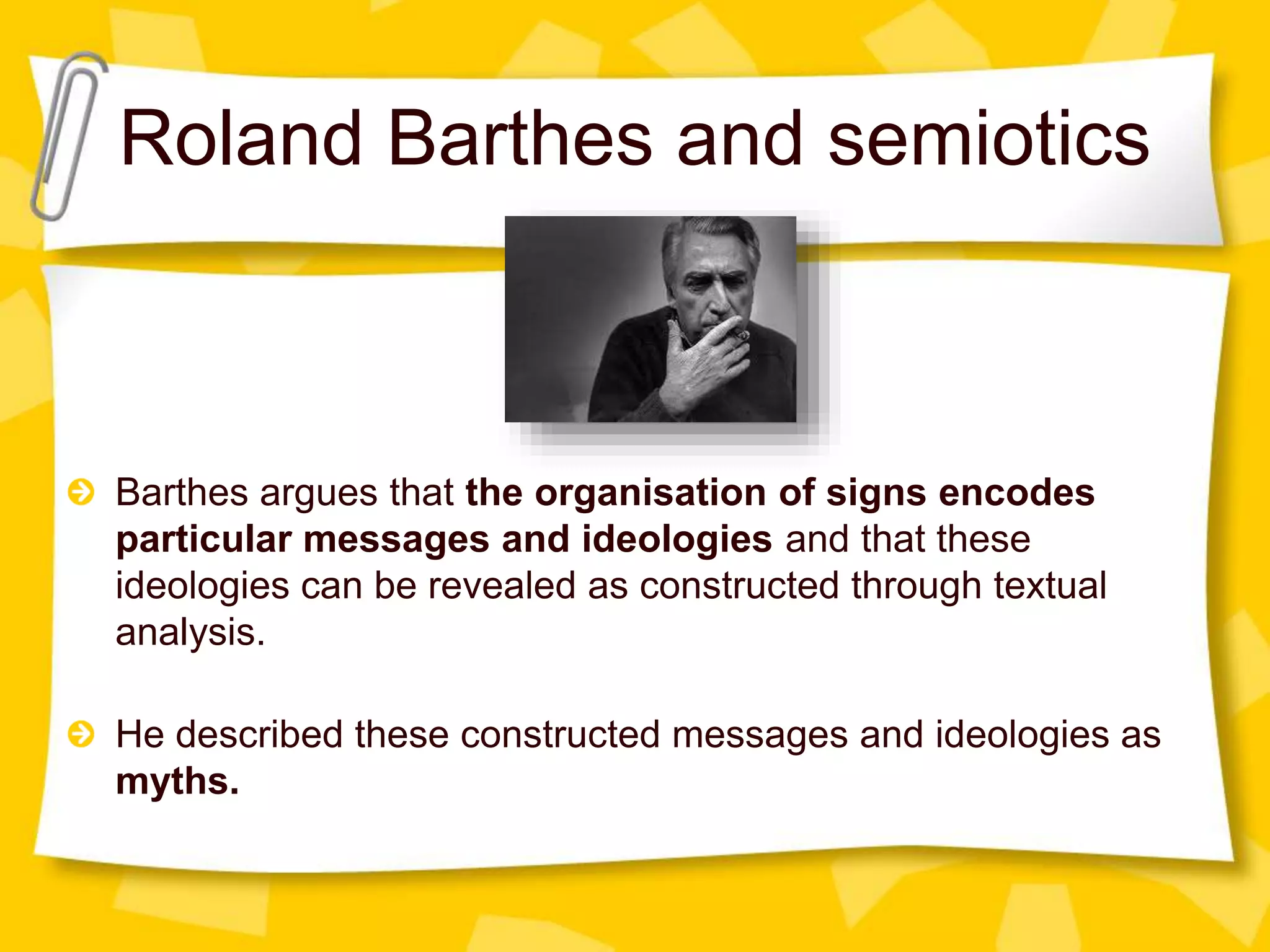
Roland Barthes and semiotics
Barthes was an influential theorist who
explored the way in which media texts make
meaning.
(Saussure was more interested in how meaning was created
in language, Barthes was more interested in the cultural
significance of Semiotics.)
He considered that all cultural forms, are essentially made up
of a system of signs that could be deconstructed to reveal
how cultural meanings are constructed.
He analysed the denotative and connotative level of signs
in a media text.
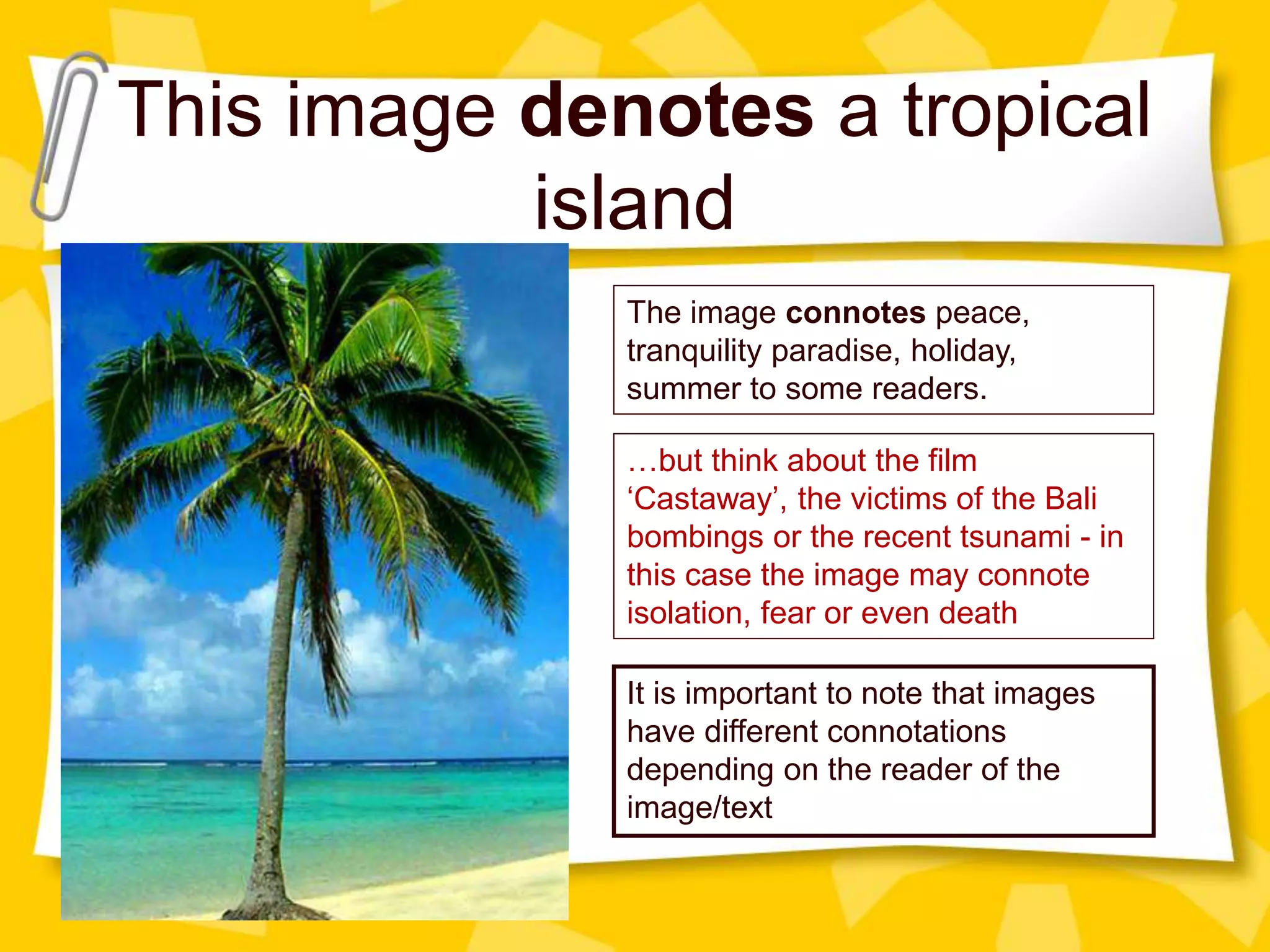
This image denotes a tropical
island
The image connotes peace,
tranquility paradise, holiday,
summer to some readers.
…but think about the film
‘Castaway’, the victims of the Bali
bombings or the recent tsunami - in
this case the image may connote
isolation, fear or even death
It is important to note that images
have different connotations
depending on the reader of the
image/text
Denotation & Connotation within a
Media Text – A Movie Poster
The Mission Impossible Poster
denotes a MATCH and a
GLOBE OF THE WORLD
What are the connotations of
a) The match?
b) The globe?
What are they communicating to
an audience? Why?
Semiotics – codes and
conventions
We interpret things as signs largely unconsciously by relating
them to familiar systems of codes and conventions (e.g.
genre conventions, cultural conventions, etc.).
e.g. low key lighting which casts dark shadows in a film scene can
symbolise mystery or sinister characters.
But it all depends on context!
What made the shadows mysterious or even
sinister in the last slide?
What different meanings are created in the
images on this slide?
Shadows as symbolic codes
Shadows are not mysterious in themselves.
I am tapping into cultural ideas that connect
darkness with the unknown or hidden.
Also, expectations based on our understanding
of thriller/horror film codes and conventions,
which associate low key lighting and dark
shadows in a scene with mystery or sinister
characters.
Semiotics
Signs can be polysemic (have many possible
meanings)
Why do viewers interpret certain meanings over
others?
– Context is important – how signs work in combination will
lead us towards particular readings over others.
– Dominant cultural ideas will lead us towards certain
interpretations over others.
– We understand the conventions of particular media forms.
Over to you
Analyse your own media product. Pick 5
elements from your Music Video and analyse
the connotations – 3 should be mise en
scene. 1 should be editing, 1 should be
camera angles
Use the key terms denotations and
connotations (or signifiers and signified)
In your connotations, try to link to genre,
narrative, audience and representation where
Roland Barthes and semiotics
Barthes argues that the organisation of signs encodes
particular messages and ideologies and that these
ideologies can be revealed as constructed through textual
analysis.
He described these constructed messages and ideologies as
myths.
Over to you
Go back to your analysis.
Summarise any overall messages it
connotes or cultural myths it reinforces.
For those of you who want to really
stretch your academic muscles…
‘Semiotics is important because it can help us not to take 'reality' for granted as
something having a purely objective existence which is independent of human
interpretation.
It teaches us that reality is a system of signs. Studying semiotics can assist us to
become more aware of reality as a construction and of the roles played by ourselves
and others in constructing it
…Meaning is not 'transmitted' to us - we actively create it according to a complex
interplay of codes or conventions of which we are normally unaware. Becoming aware of
such codes is both inherently fascinating and intellectually empowering…
In defining realities, signs serve ideological functions. Deconstructing and contesting
the realities of signs can reveal whose realities are privileged and whose are
suppressed.
The study of signs is the study of the construction and maintenance of reality. To
decline such a study is to leave to others the control of the world of meanings which we
inhabit.’
Daniel Chandler (2005)
“Media is communication”. Discuss the
ways that you have used media language to
create meanings in one of your media
products.
Question

Media language a2

  • 1.
    Media Language The wayin which a text is constructed to create meaning for a reader or viewer of the text
  • 2.
    For the examyou need to be able to: Write a coherent analysis of the media language in your teaser trailer including: Reference to theory - Semiotics Examples of the denotative and connotative levels of meaning within your music video. Appropriate use of key terms (e.g. denotation and connotation, signifiers and signified, codes and conventions).
  • 3.
    Media messages areconstructed using a creative language with its own rules. Each form of communication-- whether newspapers, TV game shows or horror movies-- has its own creative language: scary music heightens fear, camera close- ups convey intimacy, big headlines signal significance.
  • 4.
    KEY TERM: Semiotics Definition:The study of SIGNS (& the role of signs in social life) Semiotics examines how signs construct meaning (i.e. how the use of mise-en-scene, camerawork, editing and sound construct meaning in your music video, digipak or magazine advert).
  • 5.
    Semiotics – TheStudy of Signs Saussure (a founder of semiotics) summarised it in the following equation: The Sign = signifier + signified the form which the sign takes the concept it represents So meaning is not fixed, the sign can be different depending on the signified, i.e. the reader’s interpretation of the signifier.
  • 6.
    Terms you MUSTuse: Denotation, Connotation In semiotics, denotation and connotation are terms describing the relationship between the signifier and its signified. As John Fiske (1982) puts it “denotation is what is filmed, connotation is how it is filmed”.
  • 7.
    Aspects of Mise-en-Scene– video and print style 1. Location - settings, set-design and iconography 2. Character – Costume, Properties and Make Up, Actors and Gesture 3. Cinematography - Lighting and Colour 4. Layout and Page Design – colour, juxtaposition of elements.
  • 8.
    How to readthe signs and signifiers within a Media Text All media texts have 2 layers of meaning: DENOTATIVE LEVEL: What we actually see/hear CONNOTATIVE LEVEL: What you associate with this image
  • 9.
    Roland Barthes andsemiotics Barthes was an influential theorist who explored the way in which media texts make meaning. (Saussure was more interested in how meaning was created in language, Barthes was more interested in the cultural significance of Semiotics.) He considered that all cultural forms, are essentially made up of a system of signs that could be deconstructed to reveal how cultural meanings are constructed. He analysed the denotative and connotative level of signs in a media text.
  • 10.
    This image denotesa tropical island The image connotes peace, tranquility paradise, holiday, summer to some readers. …but think about the film ‘Castaway’, the victims of the Bali bombings or the recent tsunami - in this case the image may connote isolation, fear or even death It is important to note that images have different connotations depending on the reader of the image/text
  • 11.
    Denotation & Connotationwithin a Media Text – A Movie Poster The Mission Impossible Poster denotes a MATCH and a GLOBE OF THE WORLD What are the connotations of a) The match? b) The globe? What are they communicating to an audience? Why?
  • 12.
    Semiotics – codesand conventions We interpret things as signs largely unconsciously by relating them to familiar systems of codes and conventions (e.g. genre conventions, cultural conventions, etc.). e.g. low key lighting which casts dark shadows in a film scene can symbolise mystery or sinister characters.
  • 13.
    But it alldepends on context! What made the shadows mysterious or even sinister in the last slide? What different meanings are created in the images on this slide?
  • 14.
    Shadows as symboliccodes Shadows are not mysterious in themselves. I am tapping into cultural ideas that connect darkness with the unknown or hidden. Also, expectations based on our understanding of thriller/horror film codes and conventions, which associate low key lighting and dark shadows in a scene with mystery or sinister characters.
  • 15.
    Semiotics Signs can bepolysemic (have many possible meanings) Why do viewers interpret certain meanings over others? – Context is important – how signs work in combination will lead us towards particular readings over others. – Dominant cultural ideas will lead us towards certain interpretations over others. – We understand the conventions of particular media forms.
  • 16.
    Over to you Analyseyour own media product. Pick 5 elements from your Music Video and analyse the connotations – 3 should be mise en scene. 1 should be editing, 1 should be camera angles Use the key terms denotations and connotations (or signifiers and signified) In your connotations, try to link to genre, narrative, audience and representation where
  • 17.
    Roland Barthes andsemiotics Barthes argues that the organisation of signs encodes particular messages and ideologies and that these ideologies can be revealed as constructed through textual analysis. He described these constructed messages and ideologies as myths.
  • 18.
    Over to you Goback to your analysis. Summarise any overall messages it connotes or cultural myths it reinforces.
  • 19.
    For those ofyou who want to really stretch your academic muscles… ‘Semiotics is important because it can help us not to take 'reality' for granted as something having a purely objective existence which is independent of human interpretation. It teaches us that reality is a system of signs. Studying semiotics can assist us to become more aware of reality as a construction and of the roles played by ourselves and others in constructing it …Meaning is not 'transmitted' to us - we actively create it according to a complex interplay of codes or conventions of which we are normally unaware. Becoming aware of such codes is both inherently fascinating and intellectually empowering… In defining realities, signs serve ideological functions. Deconstructing and contesting the realities of signs can reveal whose realities are privileged and whose are suppressed. The study of signs is the study of the construction and maintenance of reality. To decline such a study is to leave to others the control of the world of meanings which we inhabit.’ Daniel Chandler (2005)
  • 20.
    “Media is communication”.Discuss the ways that you have used media language to create meanings in one of your media products. Question